Si Woo Kim Makes a Sunday Charge at the British Open, Delivering the Best Major Finish of His Career
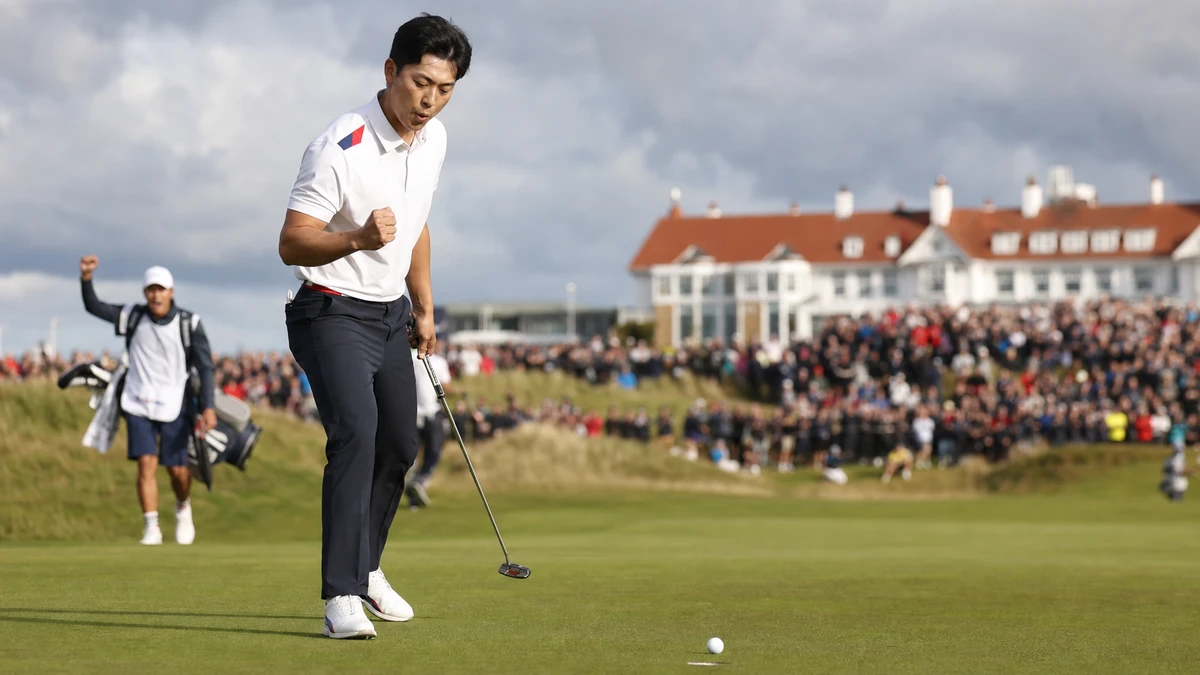
A Korean contender emerges on one of golf’s oldest stages
For much of Sunday at Royal Birkdale, Si Woo Kim was not simply having a nice week at a major championship. He was, for a meaningful stretch, at the top of the leaderboard at the British Open, golf’s oldest and most tradition-soaked tournament, the event formally known outside the United States as The Open Championship.
By day’s end, Kim did not leave England with the silver Claret Jug. Instead, he finished tied for sixth at 6-under 274, four shots behind champion Ryan Fox of New Zealand. Yet even without the trophy, the week marked a significant breakthrough. It was the best major-championship finish of Kim’s career, surpassing his previous high of a tie for eighth at the PGA Championship in 2025, and it offered something arguably more important than a number on the final leaderboard: evidence that one of South Korea’s most talented male golfers can put himself in genuine contention on the final day of the sport’s biggest events.
That distinction matters. Plenty of strong players post a top-10 finish by quietly climbing while others collapse. Kim’s week carried a different weight because he did not merely drift upward. He made a real run at the title, including a stretch in the final round when he stood alone in first place against one of the deepest fields in the game. For Korean golf fans, and for anyone tracking the growing global reach of the men’s game, that was the headline.
For American readers, it may help to think of it this way: Kim’s result was not just the golf equivalent of making the playoffs. It was closer to a player forcing his way into the center of a major Sunday, with the whole tournament suddenly feeling as though it could turn on his next few swings. In a sport where legitimacy is often measured by what happens under major pressure, Kim passed an important test, even if the final exam ended with a few mistakes coming home.
The result also arrives at a moment when South Korean golf continues to command attention beyond its better-known women’s success. While Korean women have been a dominant force for years on the LPGA Tour, the men’s side has long been searching for the kind of sustained major contention that turns occasional promise into a broader narrative. Kim’s performance at Royal Birkdale did not complete that story, but it added a compelling new chapter.
A front-nine surge that changed the tournament
Kim entered the final round already in strong position after posting scores of 68, 67 and 67 over the first three days. Those numbers reflected consistency, control and the kind of steady ball-striking needed to survive links golf, the traditional seaside style of golf played in Britain. Links courses, unlike many parkland courses Americans see on television during the PGA Tour season, are shaped by wind, firm turf and uneven bounces. They reward imagination as much as pure power, and they can expose even elite players in a matter of holes.
On Sunday, Kim did more than hold his ground. He attacked. He made two birdies on the front nine and surged into sole possession of first place, an eye-catching development given that he had not started the day as the leader. In other words, he did not inherit the position. He went out and took it.
That detail is crucial in understanding why this finish resonated so strongly. In major championships, especially at the British Open, the leaderboard can compress quickly. A single birdie can leapfrog several players, and a single bogey can erase an hour’s worth of momentum. Kim’s early move showed he was not intimidated by the moment or by the names surrounding him. He played his way into the center of the tournament, and for a time, it was his tournament to lose.
In South Korea, where sports fans often follow global events overnight or in the early morning because of the time difference, moments like that carry extra drama. Kim’s charge would have been the kind of sequence that keeps fans glued to live updates and television coverage, especially given how rare it is for a Korean male player to stand alone atop a major leaderboard late on Sunday. The excitement was about more than national pride. It was about seeing a familiar player prove he belonged in the most pressurized part of an elite competition.
For U.S. audiences less familiar with Kim, he has long been regarded as a gifted and sometimes unpredictable talent. He won The Players Championship in 2017, becoming the youngest winner in that tournament’s history at the time, and has built a reputation as a player capable of beating anyone when his game is sharp. But major championships are where golfers are ultimately measured, and until now, his record in those events had not quite matched his flashes of brilliance elsewhere.
At Royal Birkdale, at least for nine holes on Sunday, that gap began to close.
The back nine that got away
The cruel part of major championship golf is that momentum can evaporate almost instantly. Kim’s front-nine ascent gave way to a far more difficult inward half, where he made four bogeys over the final nine holes. By the time he signed for a 72, he had lost two shots on the day and slipped from solo leader to a tie for sixth.
The final score tells the story starkly. Kim had been 2 under on the front nine, only to play the back nine in 4 over. In a tournament where the top of the leaderboard was tightly packed, that swing changed everything. The difference between lifting the Claret Jug and finishing several spots down the board was measured not in a collapse over multiple days, but in a handful of late mistakes on a single afternoon.
That is the particular tension of the British Open. On a major Sunday, one loose tee shot, one missed up-and-down or one approach that catches the wrong contour can change the entire shape of a career-defining round. Kim experienced that reality in compressed form. The same leaderboard that elevated him so quickly when he made birdies also punished him swiftly when the bogeys arrived.
Still, it would be too simplistic to frame the week as a missed opportunity and nothing more. Yes, Kim came within reach of something larger and could not hold it. Yes, the back nine will linger because it turned a possible victory bid into a top-10 finish. But professional golf history is full of players whose first taste of real major contention ended not with a win, but with a painful education. The lesson is often part of the progress.
For Kim, the disappointing finish and the encouraging finish are the same story. He now knows, in a concrete and public way, that his game can carry him into the lead on a major Sunday. He also knows how exacting the closing stretch can be when every shot feels heavier than the last. That combination of validation and frustration is often what drives elite players toward their next leap.
American sports fans understand this pattern well. Think of the young quarterback who finally reaches a conference championship before learning how small the margin is at the highest level, or the tennis player who makes a first deep run at a Grand Slam before figuring out how to close. Kim’s Sunday at Royal Birkdale had a similar feel. The loss was real, but so was the arrival.
Why this result matters in Korean golf
To appreciate why Kim’s tie for sixth is generating so much attention, it helps to understand the place South Korea occupies in global golf. In women’s golf, South Korean players have been a powerhouse for decades, producing major champions, world No. 1 players and a pipeline of technically polished competitors who have reshaped the LPGA Tour. Names such as Inbee Park, Se Ri Pak and Jin Young Ko are familiar to golf audiences well beyond Korea.
On the men’s side, the picture has been more uneven. There have been important milestones, to be sure. Y.E. Yang’s victory over Tiger Woods at the 2009 PGA Championship remains one of the great upsets in modern golf and the first major title by a South Korean man. Players such as K.J. Choi, Sungjae Im, Tom Kim and Si Woo Kim have all helped keep South Korea relevant on the PGA Tour. But the men’s game has not produced the same depth of major-winning success that the women’s game has enjoyed.
That is one reason Kim’s performance stands out. A top-six finish at a major is not just a personal milestone; it becomes part of a larger conversation about whether South Korean men’s golf is building toward more sustained contention. Kim was not alone in putting Korea near the top of the board at Royal Birkdale. Sungjae Im finished tied for 14th at 4-under 276 after rounds of 66, 72, 69 and 69, giving South Korea two players in notable positions on the final leaderboard.
There is also a cultural layer to how such achievements are received at home. South Korean sports fans tend to follow overseas success closely, especially in global leagues and events where national representation carries symbolic weight. That dynamic is visible in everything from baseball players reaching Major League Baseball to soccer stars in Europe and golfers on the PGA and LPGA tours. When a Korean athlete is not merely participating but legitimately threatening to win on one of the sport’s biggest stages, the moment can resonate far beyond the fan base of that specific sport.
Kim’s week fits neatly into that pattern. The headline is not just that he earned prize money of $550,883. It is that he registered the best major result of his career and spent part of the final round staring directly at the possibility of becoming the champion golfer of the year, the title traditionally bestowed on the winner of the British Open. That image matters in a country that closely watches how its athletes perform on international stages.
There is another reason the result matters: Kim is 29, old enough to have experience but still young enough to imagine that his best major golf could be ahead of him. This was not a ceremonial late-career flourish. It looked more like a player discovering another gear in his competitive ceiling.
Ryan Fox wins, but the leaderboard tells a broader story
Kim’s breakthrough came in a tournament won by a player with an equally compelling storyline. Ryan Fox, a 39-year-old from New Zealand ranked No. 56 in the world, claimed his first major title at 10-under 270, one shot ahead of Cameron Young at 9-under. Sam Burns finished third at 8-under, while Scottie Scheffler and Tommy Fleetwood tied for fourth at 7-under. Kim shared sixth at 6-under with South Africa’s Casey Jarvis and Australia’s Lucas Herbert.
The spacing of those scores reveals just how tight the championship was. First place sat at 10 under, second at 9 under, third at 8 under, fourth at 7 under and sixth at 6 under. In other words, the upper reaches of the leaderboard were stacked one shot apart, a setup that magnified every birdie and every bogey. Kim’s four bogeys on the back nine were costly precisely because there was so little room for error.
Fox’s victory deserves its own spotlight. He closed with a 68 after opening the week with a 72, then finding his stride with rounds of 68, 62 and 68. That third-round 62 was the round that changed the tournament, giving him the platform to finish the job on Sunday. His win also carried national significance. Fox became just the third major champion from New Zealand, joining Bob Charles, who won the British Open in 1963, and Michael Campbell, who captured the U.S. Open in 2005.
For American readers, Fox may not have arrived with the household-name profile of a Scheffler or a Rory McIlroy. But golf majors have a habit of elevating players who seize the right week at the right time, and Fox did exactly that. His first major title at 39 is the kind of career-defining breakthrough that underscores how deep and unpredictable men’s golf has become.
And yet Kim’s presence on that same leaderboard is part of what made the week so interesting. He finished just four shots behind the winner, not 10 or 12. That matters when assessing whether his Sunday run was a fleeting burst or a sign of something more substantial. The final margin suggests the latter. He was close enough that the front-nine charge was not a mirage, and the back-nine fade, while disappointing, did not erase the quality of the golf that put him there.
At a major championship, context often matters as much as placement. A tie for sixth can mean very different things depending on how it happens. Kim’s version came with real contention attached, and that makes it a more meaningful result than the raw number alone might indicate.
What American readers should know about The Open and the weight of this stage
For many Americans, the British Open can feel both familiar and slightly mysterious. It is one of golf’s four majors, alongside the Masters, the PGA Championship and the U.S. Open. But unlike the more manicured visual language of Augusta National or many PGA Tour venues, the British Open is rooted in links golf, old clubs, coastal wind and a style of play that can look almost foreign to viewers used to target golf in the United States.
Royal Birkdale, in Southport, England, is one of the championship’s iconic settings. It has hosted many of the sport’s most memorable showdowns and carries a prestige similar to the way American sports fans view Wrigley Field, Fenway Park or Lambeau Field: not merely as venues, but as places where history hangs over every new chapter. Winning there is different from winning a routine tournament stop. Contending there, especially for a player from a country without a long tradition of men’s major success, can become a career marker.
The tournament’s trophy, the Claret Jug, is among the most recognizable prizes in sports, even to casual fans. In golf culture, it carries a mystique comparable to the Stanley Cup or the green jacket at Augusta, a symbol with both historical gravitas and storytelling power. That is why Kim’s Sunday mattered even without the final reward. He was, however briefly, in a position to contend for one of sports’ most iconic objects.
There is also a reason the Korean article emphasized that he was the solo leader during the final round rather than only highlighting the final placement. In many sports cultures, including South Korea’s, the sequence of how a result happened shapes its meaning. To lead outright in the last round of a major is proof of competitive legitimacy. It says the player was not a bystander to the event’s climax, but an active author of it.
That distinction is important for international audiences trying to gauge what comes next. Golf is a sport obsessed with evidence. Can a player handle a course setup? Can he sustain form over four days? Can he perform when the stakes rise? Kim’s week produced affirmative answers to those questions, even if it also revealed the difficulty of turning contention into victory.
From an American newsroom perspective, the most compelling angle is not simply that a Korean golfer finished tied for sixth. It is that he did so in a way that broadens the conversation about where elite men’s golf talent is coming from and who is ready to challenge on the biggest stages.
What comes next for Si Woo Kim
The temptation after a near miss is to focus only on what slipped away. Kim himself may replay the back nine for some time, as athletes do after the most consequential rounds of their careers. But the bigger takeaway is that his ceiling in majors now looks higher than it did a week ago.
His four-round total of 68, 67, 67 and 72 shows a player who built a strong foundation over three days and then carried enough confidence into Sunday to pressure the field. The final-round stumble does not erase that structure. If anything, it highlights how close he has come to crossing into another tier of major competitiveness.
In practical terms, this performance should strengthen belief, both internally and externally, that Kim can contend again. He has now shown that he can navigate a classic links test, maintain his position over multiple rounds and handle the glare that comes with a major Sunday. The remaining step is learning how to finish from that position, a challenge that has humbled countless players before him.
For South Korean golf, the week provided both validation and appetite. Validation, because Kim and Im placed Korean players firmly on the leaderboard of one of the sport’s signature events. Appetite, because Kim’s run made it possible to imagine something even larger next time. That is often how sporting expectations evolve: one performance changes what fans and competitors consider realistic.
There is an irony in the way golf measures progress. A player can leave without a trophy and still walk away with one of the most important weeks of his career. That appears to be the case for Kim. He did not win the British Open, and the back nine ensured that the story retained a note of regret. But he also accomplished something durable. He made the possibility of a Korean man winning another major feel less like a distant hope and more like an approaching event.
For American readers meeting this story from afar, that may be the most useful frame. This was not just a solid finish by a good international player. It was a meaningful breakthrough by a golfer from a country whose influence on the global game continues to expand. Kim left Royal Birkdale without the Claret Jug, but he left with something that can matter almost as much in the long run: proof that he belongs in the final-day fight at a major championship.
That is the sort of result that tends to age well. In golf, the first real run is often remembered later as the week before everything changed.
Comments
Post a Comment