South Korea and Chile Open U.N. Talks on Next Global Ocean Summit, Signaling Seoul’s Growing Diplomatic Ambitions
A procedural step with bigger diplomatic meaning
South Korea and Chile have opened formal negotiations at the United Nations on a resolution to prepare for the fourth U.N. Ocean Conference, a procedural move that may sound technical but carries real diplomatic weight.
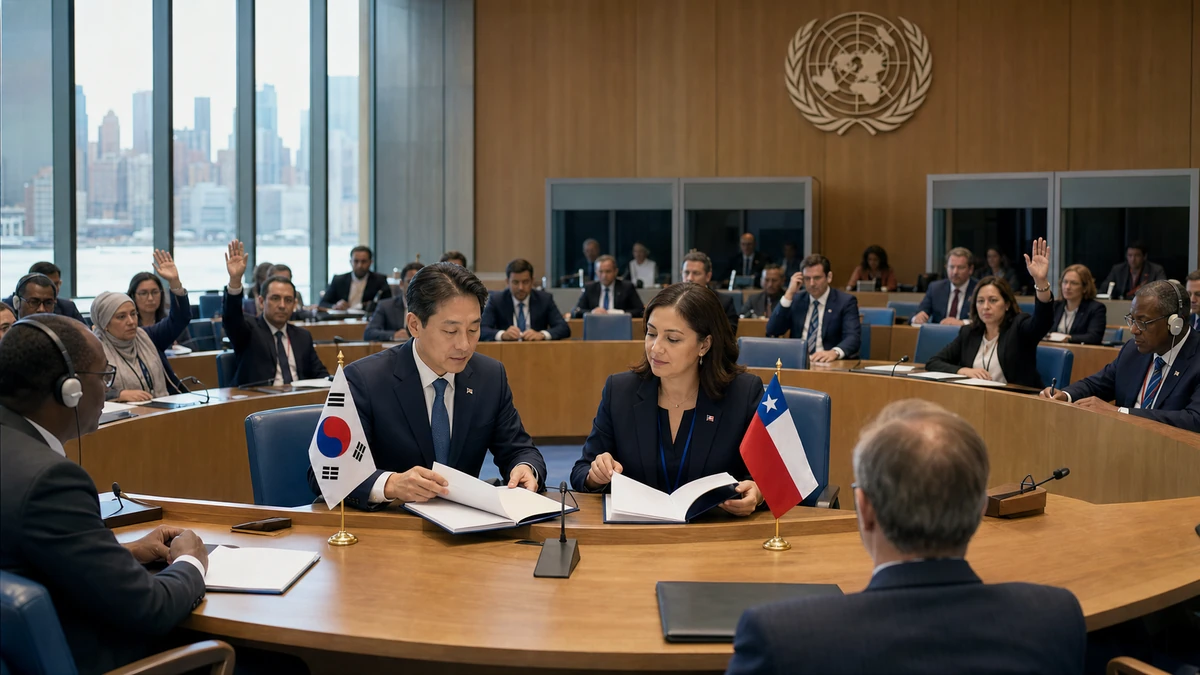
The talks began Wednesday at U.N. headquarters in New York, according to South Korea’s mission to the United Nations. The immediate goal is not to announce a new global ocean deal or unveil a final summit agenda. Instead, Seoul and Santiago are beginning the painstaking process of negotiating the text of a preparatory resolution with other U.N. member states, with the aim of having it adopted by the U.N. General Assembly in December.
In the world of multilateral diplomacy, that matters more than it may appear from the outside. International summits are often judged by their televised speeches and final declarations, but veteran diplomats know the real work usually starts much earlier, in conference rooms where governments debate wording, priorities and procedure line by line. Who gets to shape that process helps determine what the final meeting can realistically accomplish.
That is why this moment is notable for South Korea. Rather than simply showing up later to endorse a prewritten framework, the country is helping shape the terms of discussion from the beginning. For a middle power that has spent much of the past few decades building its profile as a technology leader, export powerhouse and cultural force, this is another sign of Seoul’s effort to translate its growing global visibility into influence over international rule-making.
The move also underscores how ocean issues, often treated as distant or niche, are becoming central to global debates about climate change, food security, economic development and national strategy. For Americans, it may help to think of the ocean agenda as a combination of climate policy, fisheries management, shipping regulation and resource politics, all rolled into one. The stakes range from plastic pollution and coral reef loss to maritime trade routes and the long-term sustainability of seafood supplies.
What began in New York this week, then, is not just event planning. It is the opening round in a broader effort to define how the international community talks about protecting the seas while still making use of the economic benefits they provide.
What the U.N. Ocean Conference is, and why it matters
The U.N. Ocean Conference is the United Nations’ highest-level gathering devoted specifically to the health of the world’s oceans and the sustainable use of marine resources. Held every three years, the conference is closely tied to the U.N. Sustainable Development Goals, especially Goal 14, which focuses on conserving and sustainably using oceans, seas and marine resources.
That U.N. language can sound abstract, but the underlying issues are concrete and increasingly urgent. The world’s oceans regulate the climate, absorb large amounts of carbon dioxide, support fisheries that feed billions of people, and serve as highways for global commerce. At the same time, they are under mounting stress from warming waters, acidification, overfishing, habitat destruction, plastic waste and coastal development.
For American readers, the challenge may resemble a familiar domestic debate: how to balance environmental protection with economic activity. In the United States, versions of that argument play out over offshore drilling, commercial fishing quotas, shipping emissions, coastal resilience spending and marine conservation zones. At the U.N., the same tensions exist, but on a much larger scale, involving countries with vastly different economies, geographies and priorities.
Some nations want strong language on conservation and ecosystem protection. Others are more focused on development, arguing that marine resources remain essential for jobs, energy, food and growth, especially in lower-income countries. Still others approach ocean governance through the lens of national sovereignty, wary of any language that could eventually constrain their choices.
The U.N. Ocean Conference is designed to hold those competing interests in a single diplomatic framework. It is not merely a forum for exchanging views. It is intended to encourage implementation of shared sustainability goals, push governments toward measurable commitments, and align ocean policy with the broader global agenda on climate and development.
That helps explain why the preparatory resolution matters so much. Before delegates gather for the conference itself, member states must agree on the broad purpose, structure and negotiating pathway for the meeting. The wording of a preparatory text can influence everything from the summit’s political tone to the kinds of commitments countries will be willing to make once leaders and ministers actually arrive.
In other words, the groundwork now underway in New York will help determine whether the conference becomes a serious venue for policy coordination or just another round of aspirational speeches.
Why South Korea is stepping forward now
South Korea’s decision to take a visible role in these early negotiations reflects more than an interest in marine affairs. It also fits a larger pattern in the country’s foreign policy: a push to be seen not only as a participant in the international system, but as a country capable of convening, mediating and shaping global agendas.
For years, South Korea has occupied a distinctive position in world affairs. It is a treaty ally of the United States, a major trading nation, a democracy with advanced industrial and technological capacity, and a country whose cultural exports, from K-pop to film and television, have given it unusual global soft power. Yet in hard diplomacy, Seoul has often been viewed through a narrower lens, with international attention dominated by North Korea, regional tensions with China and Japan, and security issues on the Korean Peninsula.
Moves like this one offer a different picture. They suggest South Korea wants to be taken seriously as a stakeholder in global governance beyond its immediate neighborhood. Ocean diplomacy is one venue where it has clear credibility. The country is deeply dependent on maritime trade, has major shipbuilding and logistics industries, and sits at the crossroads of Northeast Asian sea lanes. It also has a direct interest in sustainable fisheries, marine science and environmental management.
Just as important, taking part in the drafting and negotiation stage allows South Korea to exercise a kind of influence that is less visible but often more durable than headline-grabbing speeches. In multilateral settings, power is not only about forcing outcomes. It is also about writing acceptable language, bridging differences among blocs of countries and keeping a negotiating process moving when interests diverge.
That may sound bureaucratic, but it is a central diplomatic skill. A country that can persuade others to work from a common text, or keep talks from stalling, can shape the overall direction of the final agreement even if it never dominates the room. That is one reason diplomats often pay close attention to who chairs meetings, who circulates early drafts and who takes responsibility for assembling consensus.
South Korea’s U.N. mission said it plans to accelerate consultations with member states following this initial meeting, with December’s General Assembly target in mind. That signals a recognition that momentum matters. Once negotiations begin, delays can harden differences, while steady engagement can create pressure for compromise.
For Seoul, success here would not necessarily mean producing a dramatic breakthrough. It could simply mean demonstrating that South Korea can reliably manage a complicated multilateral file and help shepherd a broad group of states toward agreement.
Why Chile is a key partner
Chile’s role alongside South Korea is also significant. On the map, the two countries sit on opposite sides of the Pacific, but that geography is precisely part of the point. Ocean governance is inherently transnational, and pairing an East Asian state with a South American one reinforces the idea that marine sustainability is not a regional niche issue but a global concern.
Chile brings its own credentials to the partnership. With one of the world’s longest coastlines and a strong stake in fisheries, marine ecosystems and Pacific diplomacy, it has long viewed ocean policy as central to its national interest. It also has experience participating in international environmental and development negotiations, which can be invaluable in an effort like this, where process and coalition-building are often as important as policy ambition.
There is symbolism here as well. In U.N. diplomacy, co-facilitation by countries from different regions can help build trust and widen buy-in. If a proposal appears to belong too heavily to one geopolitical camp, it can prompt resistance from others. But when countries from different parts of the world jointly guide the process, the arrangement can signal inclusivity and reduce suspicion that the agenda is being driven by a narrow group.
That matters in negotiations over oceans because the membership is so diverse. Small island developing states often prioritize sea-level rise, resilience and the protection of marine ecosystems that are existential to their economies. Major industrial powers may emphasize technology, shipping and resource management. Coastal developing countries may focus on equitable access to financing and marine economic growth. Countries with distant-water fishing fleets may have yet another set of concerns.
South Korea and Chile will have to navigate those differences if they want to keep the process on track. Their challenge is not to erase disagreement, which is impossible, but to create a framework that allows countries with competing priorities to remain invested in the talks. That can mean careful drafting, strategic sequencing and sometimes the use of deliberately broad language that preserves room for later bargaining.
In practical terms, their partnership is best understood as a coordinating structure. They are not unilaterally deciding the outcome. They are trying to organize the conversation, gather views, identify common ground and move member states toward a resolution that enough governments can accept.
That is often how diplomacy works at the U.N.: not as a clean battle between winners and losers, but as a long exercise in narrowing differences until a text becomes politically survivable for a large number of countries.
The central dilemma: Protecting oceans while still using them
At the heart of the upcoming negotiations is a tension that every ocean policy debate eventually runs into: how to protect marine environments while still allowing people and economies to depend on them.
The phrase “sustainable use” can sound like a compromise slogan, but it points to a real dilemma. Oceans are not museums. Countries fish them, ship goods across them, extract energy from them and build industries around them. For many communities, especially in coastal and island states, marine resources are not optional; they are the basis of daily life and national income.
At the same time, decades of overexploitation and pollution have made clear that treating the ocean as an unlimited resource is no longer viable. Fish stocks can collapse. Coastal ecosystems can be destroyed. Plastic waste can accumulate in food chains. Warming and acidification can transform entire marine habitats. Once damage reaches a certain point, the economic consequences can be just as severe as the ecological ones.
That is why negotiations like this can be difficult. Strong conservation language may appeal to environmentally ambitious states and advocacy groups, but overly rigid formulations can alienate countries worried about growth, development or policy flexibility. On the other hand, language that is too weak risks turning the conference into a rhetorical exercise disconnected from the scale of the problem.
For American readers, the balancing act is not unlike debates at home over how much regulation industries should face in the interest of long-term environmental security. The difference is that the U.N. setting adds dozens of legal systems, development levels and political interests to the mix. Every phrase can carry implications for future funding, reporting obligations, national discretion or diplomatic precedent.
That is why analysts often say the most effective multilateral texts are neither the most sweeping nor the most timid, but the ones that set credible common direction while keeping enough governments at the table to sustain implementation.
If South Korea and Chile are successful, the result will likely be a resolution that reflects this balance: clear enough to show seriousness about marine protection, but flexible enough to earn broad support from a highly varied U.N. membership. Reaching that point will require not just political will, but disciplined drafting and continuous follow-up.
What happens between now and December
The next milestone is the U.N. General Assembly in December, where South Korea and Chile hope the preparatory resolution can be adopted. But adoption is not automatic, and the months ahead are likely to involve detailed consultations with member states, revisions to draft language and efforts to smooth over disputes before they become public obstacles.
This is the phase in diplomacy where progress is often incremental and mostly invisible to outside audiences. Delegations will test wording, propose additions, object to certain formulations and seek assurances that their priorities are reflected. Some governments may want stronger references to conservation commitments. Others may push for language emphasizing national circumstances, technology transfer, financing or development needs.
The outcome will depend not just on the substance of the resolution but on whether the co-facilitators can maintain trust in the process. If member states believe their concerns are being heard, they are more likely to stay engaged. If they feel boxed in or ignored, they can slow the process, demand reopening of text or withhold support until late in the game.
South Korea’s mission has stressed the importance of carrying out the follow-up procedures steadily, which is a realistic description of what success would require. International negotiations often falter not because the overall idea is unpopular, but because the process loses continuity. Momentum fades, competing priorities intrude and unresolved wording disputes pile up.
That is one reason the launch of negotiations itself is meaningful. It marks the point at which a general intention becomes an organized diplomatic effort. It is also the moment when responsibility becomes real. Once a country helps lead a process, it is judged on whether it can keep that process moving.
The South Korean mission said Ambassador Choi Ji-hoon presided over the preparatory meeting at U.N. headquarters, underscoring that Seoul is directly involved on the ground. Still, the significance lies less in any one meeting or individual appearance than in whether the negotiating track remains stable over time. In U.N. diplomacy, endurance is often a better predictor of success than a dramatic opening.
Why this matters beyond the ocean agenda
For global audiences, and especially for Americans who often encounter Korea-related news through the lenses of North Korea, semiconductors or pop culture, this story offers a different way of understanding South Korea’s place in the world.
It shows a country increasingly willing to operate not just as an interested party but as an agenda-setter within the international system. That does not mean South Korea suddenly commands the diplomatic weight of the United States or China. It does mean, however, that Seoul is trying to exercise the kind of middle-power leadership that can matter in issue areas where consensus-building is more important than raw leverage.
There is also a broader lesson about how international influence works today. In an era when many people associate power with military might, sanctions or summit theatrics, the quieter architecture of global governance can be easy to miss. But rules, frameworks and negotiated texts shape how countries cooperate on problems that do not stop at national borders, from climate and pandemics to cyberspace and the oceans.
South Korea’s role in launching these negotiations with Chile is a reminder that diplomacy is often about building that architecture long before a final headline appears. The event in New York was not the culmination of a process. It was the starting point.
It is also a useful caution against overstatement. No final resolution has been adopted yet, and no summit outcome has been secured. There is still a long way to go before December, and even farther before the eventual conference can be judged on substance. The significance of this week’s move lies precisely in its modesty: it opens a negotiation rather than concluding one.
But that starting point is still worth watching. The world’s oceans are under growing pressure, and the need for durable international cooperation is not going away. If South Korea can help organize that cooperation at an early stage, it would mark a meaningful step in its evolution from a country that mainly responds to global agendas to one that helps write them.
For now, the test is simple but demanding. Can South Korea and Chile turn a procedural opening into a workable, broadly supported U.N. resolution by December? The answer will say something not only about the future of the next ocean summit, but about the kind of diplomatic role Seoul is prepared to play in the years ahead.
Comments
Post a Comment