
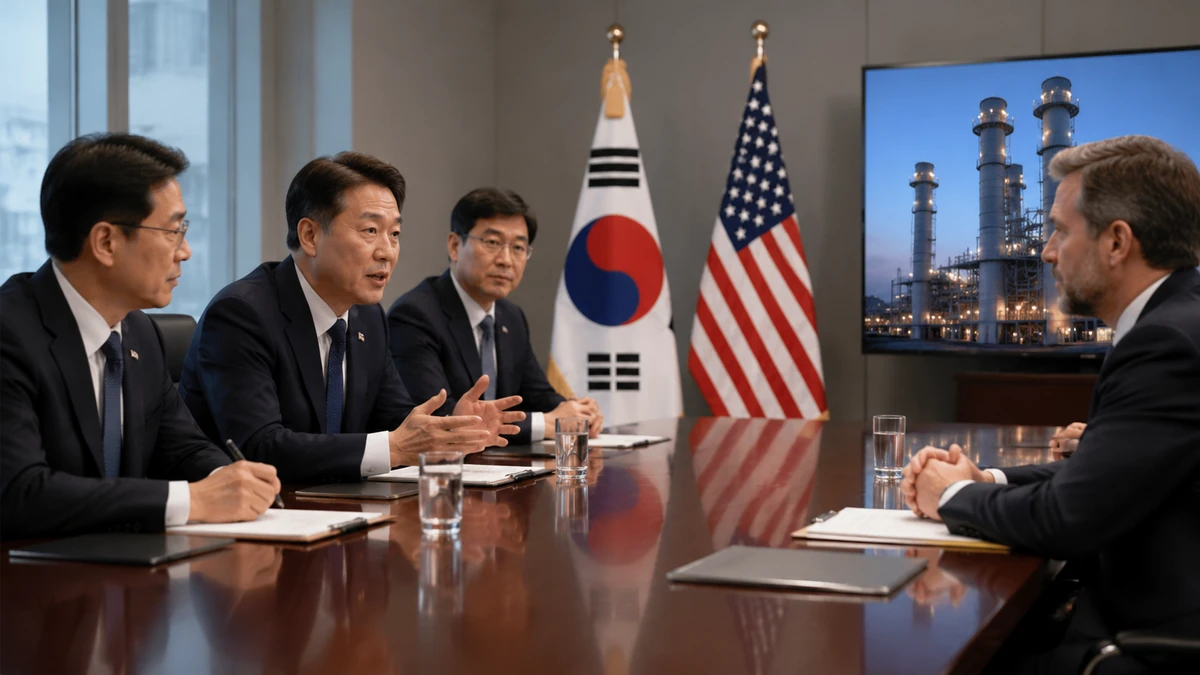
A diplomatic promise begins to take shape
South Korea and the United States appear to be moving from headline-grabbing investment promises to something far more concrete: a power plant.
South Korean officials are in the final stages of talks with the U.S. Department of Commerce over what would become the first project under a broader plan for Korean investment in the United States, according to South Korean reports citing government and industry officials. The project under discussion is the construction of a gas-fired combined-cycle power plant in the U.S., a choice that says as much about the priorities of both governments as it does about the economics of energy.
The development matters beyond the plant itself. Last year, after a summit between the leaders of the two countries, Seoul and Washington laid out a framework for as much as $200 billion in South Korean investment in the U.S. over time, with an annual ceiling of $20 billion. That kind of arrangement is not a single giant check written all at once. It is better understood as a pipeline: one project after another, reviewed, negotiated and carried out over years. In that sense, the first deal is often the most revealing. It becomes a template for how future projects are chosen, who gets a say, what political hurdles arise and how the benefits are divided.
For American readers, the easiest comparison may be to the way a major federal infrastructure law is implemented. Congress may approve hundreds of billions of dollars in broad terms, but the real story emerges through specific bridges, factories, semiconductor plants, transmission lines and energy projects. That is what now seems to be happening in the U.S.-South Korea economic relationship. The joint statements and summit communiques are giving way to site selection, financing structures, regulatory reviews and industrial policy.
The South Korean ministry leading the effort is the Ministry of Trade, Industry and Energy, often abbreviated in English as MOTIE. It is one of Seoul’s most powerful economic ministries, responsible for industrial policy, energy strategy and trade issues. In Washington, any such project would naturally involve multiple players, including agencies with responsibility for commerce, energy and, depending on the location and ownership structure, environmental permitting and state-level regulation.
Many details remain unknown, including the project’s size, location, participating companies and construction timeline. But the fact that a gas-fired power plant has emerged as the likely first move is telling. It suggests both governments want an early project that is tangible, economically legible and politically defensible: not an abstract portfolio investment, but a piece of real infrastructure that can be built, operated and pointed to as evidence that the alliance is producing jobs and industrial capacity.
Why a gas-fired plant, and why now?
The choice of a combined-cycle gas plant may surprise some readers who associate Korea’s overseas industrial push primarily with semiconductors, electric vehicle batteries or consumer brands like Samsung, Hyundai and LG. Those sectors have dominated American attention because they are highly visible and tied to the Biden administration’s industrial policy, as well as to the Trump-era and post-Trump concern with supply chains, China competition and advanced manufacturing. But energy infrastructure occupies a different, and increasingly important, lane in the alliance.
A combined-cycle gas plant uses both a gas turbine and a steam turbine to generate electricity, making it more efficient than older conventional gas plants. In plain English, it squeezes more power out of the same fuel. Utilities and developers often view such plants as a practical way to add generation relatively quickly, especially in regions facing rising power demand from data centers, factories and population growth. In the U.S., that demand has become more urgent as artificial intelligence facilities consume enormous amounts of electricity, manufacturers build more domestic capacity and electrification shifts more activity onto the grid.
For South Korea, the appeal is also strategic. Korean firms have extensive experience in engineering, construction, power equipment, heavy industry and project execution. A U.S. power plant is not just a passive investment; it is the kind of project where Korean industrial strengths can be put to work across design, procurement, construction and potentially operations or maintenance. That makes it a more substantial industrial collaboration than buying Treasury bonds or taking a minority financial stake in an existing asset.
For the U.S., natural gas remains politically and economically important even as the country expands renewable energy. That can create tension with climate goals, but it also reflects realities on the ground. Solar and wind are growing fast, yet many utilities still rely on gas to provide steady, dispatchable power when the sun is not shining or the wind is not blowing. Battery storage is advancing, but not everywhere and not always at the scale needed to replace gas in the near term. A new combined-cycle plant, then, can be pitched as a bridge project: cleaner than coal, reliable for the grid and supportive of industrial expansion.
That does not mean the decision will be free of controversy. In the U.S., any new fossil fuel-related infrastructure can draw scrutiny from environmental groups, local communities and climate advocates who argue that long-lived gas assets risk locking in emissions for decades. Those criticisms are likely to intensify if the plant is framed as part of a broader strategic partnership rather than merely a market-driven utility project. Still, from the standpoint of governments seeking an achievable first deal, gas has advantages: the technology is familiar, financing models are well established and American energy markets already know how to absorb this kind of project.
In that sense, the first project appears carefully chosen. It is large enough to matter, practical enough to execute and symbolic enough to show that the U.S.-Korea investment partnership is moving beyond diplomatic ceremony.
The bigger meaning of the $200 billion framework
The headline number attached to the broader agreement — $200 billion — is the sort of figure that can sound either transformative or vague, depending on how it is used. In Washington and Seoul alike, governments often publicize large aggregate investment commitments because they signal ambition, alignment and political momentum. But aggregate figures can obscure as much as they reveal. The real significance lies in the structure.
According to the framework described by South Korean media, Korean participation in U.S. investment projects is capped at $20 billion per year. That annual limit matters. It means the initiative is designed not as a one-off splash, but as a multi-year sequence in which each project must be prioritized against others. In practical terms, the first project may shape the approval process for those that follow. If the power plant is executed smoothly, it could establish a working model for how Seoul coordinates with Washington, how Korean companies partner with American counterparts and what kinds of sectors are likely to rise to the top.
That matters because South Korean investment in the U.S. has already grown sharply in recent years, especially in batteries, autos and advanced manufacturing. Korean companies have become some of the most aggressive foreign investors in America’s industrial revival. Hyundai’s electric vehicle and battery investments in Georgia, Samsung’s semiconductor plans in Texas and battery supply chain projects tied to automakers have helped turn South Korea into one of the most consequential U.S. economic partners in Asia.
Yet those projects, while often discussed together, have usually been company-led and sector-specific. What makes the current framework different is the stronger role of governments in shaping the direction, pace and symbolism of the investment agenda. This is industrial policy with an alliance dimension. It is not just about profit; it is about strategic reassurance, supply chain resilience, energy security and the visible tightening of the U.S.-South Korea partnership at a time of geopolitical tension.
For American audiences, it may help to think of this through the lens of “friend-shoring,” the idea that the U.S. should deepen economic ties with trusted allies and move more production, capital and strategic capacity into friendly jurisdictions. South Korea has become central to that story. It is a treaty ally, a technology powerhouse and a country that sits geographically close to China while remaining firmly aligned with the U.S. security system. That makes Korean capital especially attractive in sectors Washington sees as strategic.
The gas plant project also broadens the image of Korean investment in America. It suggests the next phase may not be limited to flashy manufacturing campuses or high-tech clean-energy supply chains. It may also include the more old-fashioned but essential underpinnings of economic life: power generation, industrial infrastructure and energy systems that keep factories, data centers and communities running.
Energy is becoming a central pillar of the alliance
The timing of the reported talks is notable. South Korea’s industry minister, Kim Jung-kwan, recently met in Washington with U.S. Energy Secretary Chris Wright, according to South Korean reports. That alone would not guarantee a project announcement, but it underscores how energy cooperation is becoming an increasingly visible part of the alliance.
For decades, the U.S.-South Korea relationship was framed primarily through security: North Korea’s nuclear program, U.S. troop deployments on the Korean Peninsula and the broader architecture of deterrence in East Asia. Economic ties were always important, but they often came second in public discussion. That has changed. In recent years, semiconductors, batteries, shipbuilding, critical minerals and energy have all become part of the alliance conversation. The result is a partnership that looks less like a traditional military pact and more like an all-of-government strategic relationship.
That evolution reflects broader global shifts. Russia’s war in Ukraine elevated energy security for American allies around the world. Tensions with China sharpened concerns about supply chains and technological dependence. And the energy transition itself — the long, uneven shift toward lower-carbon systems — has made infrastructure investment a strategic matter rather than merely a commercial one.
South Korea sits at the center of several of those trends. It is a major industrial economy with world-class manufacturers but limited domestic natural resources. It is deeply dependent on trade and on imported energy. That has made Korean policymakers acutely sensitive to the risks of geopolitical disruption. Investing in U.S. energy infrastructure can therefore serve multiple aims at once: strengthening political ties with Washington, deepening access to the American market and embedding Korean firms in projects tied to long-term U.S. growth.
There is also a domestic Korean angle that American readers might otherwise miss. In South Korea, overseas investment by large companies and the government can be politically sensitive. Critics sometimes worry about jobs or capital moving abroad. Supporters argue that foreign investment, especially in the U.S., can secure market access, diversify risks and create indirect gains for Korean industry through engineering contracts, component exports and global brand positioning. A first project that is visible and manageable could help Seoul make the case that such investment is not simply money leaving Korea, but part of a larger national economic strategy.
In Washington, meanwhile, Korean investment is generally welcomed, especially when it aligns with U.S. goals like grid reliability, domestic industrial expansion and alliance-building. But that welcome is not unconditional. Projects can face local permitting fights, labor questions, community concerns and political debates over foreign ownership or subsidies. The true test of the alliance is not whether leaders can announce big numbers, but whether bureaucracies, companies and communities can make individual projects work.
What Americans should watch next
Because so few specifics are public, the most important next step is not rhetorical but factual. Where will the plant be built? Which Korean and American companies will participate? Will the project involve equity investment, engineering contracts, long-term operations agreements or some combination of all three? How large will the plant be, and what demand is it meant to serve? Is it aimed at a regulated utility market, a merchant power market or a large industrial off-taker such as a data center operator?
Those questions matter because they will determine whether the first project is mostly symbolic or genuinely precedent-setting. If the arrangement is simple and narrow, it may function as a pilot. If it is large and structurally complex, it could become a model for future alliance-backed infrastructure deals. The involvement of multiple U.S. agencies would also hint at how deeply Washington intends to institutionalize this investment framework.
Americans should also watch the balance between climate policy and energy security. A gas-fired plant can be defended as a practical response to rising electricity demand and as an improvement over more carbon-intensive options. But it also raises the question of how the U.S. and its allies define “strategic” energy investment in an era when decarbonization remains a stated priority. If the first flagship project in a major alliance investment plan is a gas plant rather than a battery factory, hydrogen facility or transmission project, that tells us something about what policymakers believe is most urgent right now.
Another important point is how the annual cap on Korean investment shapes competition among projects. If the total allowed each year is limited, then every early project carries opportunity costs. A dollar devoted to gas infrastructure is a dollar not immediately going to semiconductors, EV supply chains, shipbuilding capacity or other strategic sectors. That does not make the choice wrong, but it does make it revealing. Governments are signaling that energy reliability and infrastructure are near the top of the list.
There is also the broader economic question of whether this model can scale. It is one thing to negotiate a flagship project under close government attention. It is another to replicate that process repeatedly across years without running into political turnover, changing market conditions or commercial disputes. In democracies, especially, summit-era promises often outlive the leaders who made them. The durability of the U.S.-Korea investment agenda will depend on whether the pipeline can survive changes in administrations, interest rates, fuel prices and public opinion.
From summit language to steel in the ground
The most important takeaway is simple: the U.S.-South Korea economic alliance is entering a more practical phase. For years, the relationship has been described in lofty strategic terms. Increasingly, it is being measured in factories, supply contracts, ship orders, battery lines and now, potentially, in megawatts of electricity generation.
That shift may sound dry, but it is where alliances become real. Voters in both countries do not experience foreign policy through communiques. They experience it through jobs, utility bills, construction sites, export orders and the sense that international partnerships produce visible benefits at home. A combined-cycle gas plant in the U.S., backed by Korean participation, would fit that mold. It is concrete enough for politicians to celebrate, substantial enough for companies to rally around and strategic enough for both capitals to treat as a proof of concept.
At the same time, caution is warranted. Many essential facts have yet to be disclosed, and the project is still reportedly in final coordination rather than formally launched. It would be premature to read too much into an initiative whose size, location and ownership remain undisclosed. Large cross-border infrastructure deals can evolve quickly or stall unexpectedly. Markets shift, permitting drags and political winds change.
Still, first moves matter. If this plant is confirmed as the first project under the larger investment framework, it will send a clear signal about the direction of U.S.-South Korea cooperation. It will suggest that the alliance’s next chapter is being built not only around cutting-edge technology and defense coordination, but also around the workhorse systems of industrial modernity: energy, infrastructure and long-term capital deployment.
For Americans, that may be the most useful way to understand the story. This is not just about a foreign government investing in a power station. It is about how one of America’s closest Asian allies is choosing to anchor itself more deeply in the U.S. economy at a time when Washington wants trusted partners to help build the physical backbone of growth. If the first project succeeds, it may become the opening act in a much larger story about how alliances are increasingly built through balance sheets, concrete and steel as much as through treaties and troop deployments.
And if it does, the power plant now under discussion may be remembered less for the electricity it produces than for what it represents: the moment when a big diplomatic number began turning into an actual American project.


0 Comments