South Korea and the U.S. Open a Shipbuilding Cooperation Center in Washington, Betting Industrial Policy Can Reinforce the Alliance
A new outpost for an old industry
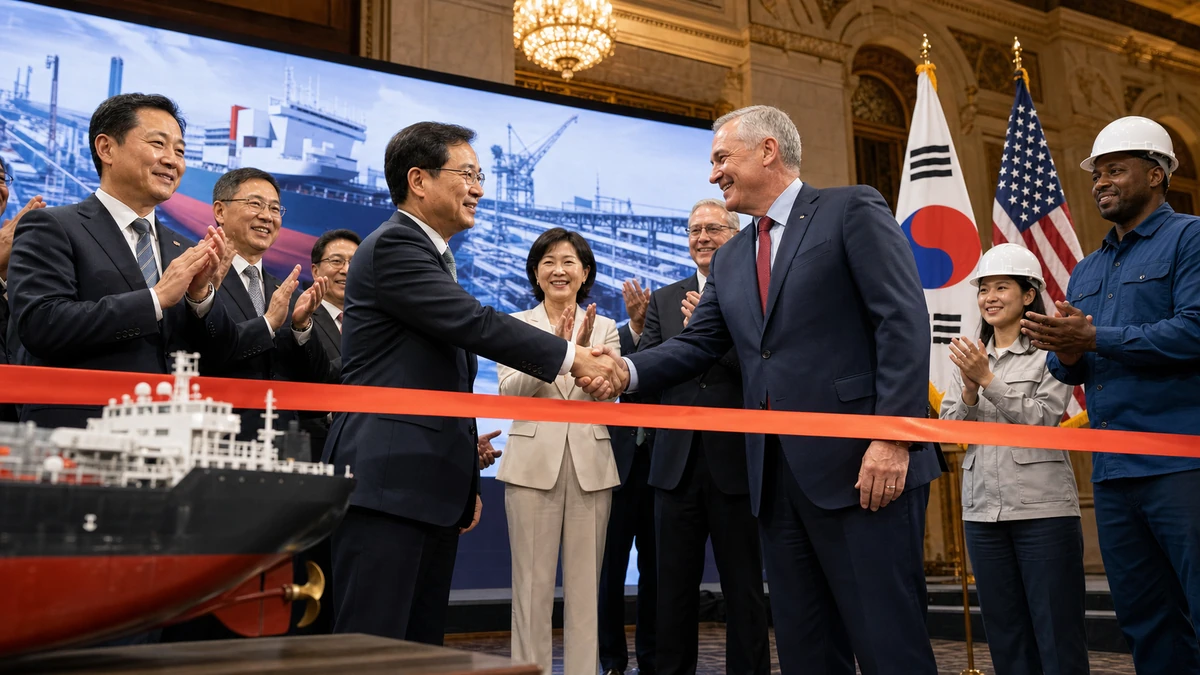
Washington is getting a new kind of bilateral institution — not a security dialogue, not a trade tribunal and not another think tank conference series, but a practical hub focused on shipbuilding. South Korea’s Ministry of Trade, Industry and Energy and the U.S. Commerce Department formally opened a Korea-U.S. Shipbuilding Cooperation Center on July 23 at the Mayflower Hotel in Washington, according to South Korea’s Yonhap News Agency. The new center is being described by the South Korean side as a forward base for a broader bilateral shipbuilding initiative and, more importantly, as a permanent contact point meant to turn government-level promises into factory-floor programs and business deals.
That distinction matters. In diplomacy, grand declarations are common. In industry, results tend to depend on much less glamorous work: consulting on production processes, training workers, matching companies with potential partners, coordinating research and development, facilitating technology exchanges and helping investments move from concept to execution. The new center is supposed to do all of that, or at least help create the conditions for it.
For American readers, it may help to think of this not as a ribbon-cutting for a ceremonial office, but as something closer to an industrial bridgehead. South Korea is one of the world’s dominant shipbuilding nations, home to major builders that have long competed at the top end of the global market. The United States, by contrast, remains a major naval power and a large economy but has struggled for decades with the commercial shipbuilding capacity and workforce depth that once defined coastal industrial America. In that context, a Washington-based cooperation center is an attempt to connect Korean industrial know-how with U.S. needs in a sector that has become strategically important again.
The center’s opening also reflects a broader shift in how Washington and Seoul increasingly talk about the alliance. For much of the postwar era, the U.S.-South Korea relationship was defined primarily by security: deterrence against North Korea, military exercises, basing issues and regional diplomacy. Those topics remain central. But in recent years, semiconductors, batteries, critical minerals, supply chains and advanced manufacturing have moved closer to the heart of the alliance. Shipbuilding now appears to be joining that list.
The symbolism of placing the center in Washington is hard to miss. It puts the effort near policymakers, regulators, lobbyists, industry representatives and diplomats — the ecosystem where industrial strategy, alliance management and corporate decision-making increasingly overlap. But symbolism alone will not make ships faster, yards more productive or workforce shortages disappear. The real test will be whether the center can help connect policy ambition to measurable industrial outcomes.
Why shipbuilding matters again in the United States
For many Americans, shipbuilding can sound like a legacy industry — something associated with World War II posters, Navy yards, rust-belt documentaries or the decline of blue-collar manufacturing. But around the world, it is anything but obsolete. Shipbuilding sits at the crossroads of trade, defense, logistics, energy and industrial employment. A modern shipyard is not just a place where steel is welded together; it is a complex manufacturing system involving design software, supply-chain coordination, advanced materials, specialized labor and long production timelines.
That helps explain why productivity consulting is one of the first missions assigned to the new center. South Korean officials say the center will support U.S. shipyards by offering productivity-focused consulting and workforce training backed by South Korean government funding. In plain terms, that means the center is expected to help American shipyards examine how they organize work, deploy labor, sequence production, share technical knowledge and potentially adopt practices honed in one of the most competitive shipbuilding environments in the world.
Americans have heard similar arguments in other industries. For decades, U.S. manufacturers looked to foreign partners or competitors — especially in Japan, Germany and later South Korea — for lessons in quality control, lean production, supplier coordination and skills development. The auto sector offers one familiar comparison: factory-floor methods once treated as niche or foreign eventually became standard language in American discussions about productivity and competitiveness. Shipbuilding may be poised for a similar conversation, though in a more specialized and strategically sensitive setting.
There is also a geopolitical dimension. The U.S. and its allies have spent the past several years confronting a hard truth: industrial capacity is not just an economic issue, it is a national security issue. Whether the topic is chips, batteries, munitions or maritime logistics, policymakers increasingly worry about what happens when production is too concentrated, too slow or too thinly staffed. Shipbuilding fits squarely into that concern. Commercial yards, defense needs, maintenance capacity and maritime logistics all exist in the same wider ecosystem, even if they are financed and managed differently.
That does not mean the center will solve every structural problem in U.S. shipbuilding, or even most of them. Productivity problems are often rooted in issues much larger than one office can fix: aging infrastructure, regulatory complexity, inconsistent demand, labor shortages and fragmented supplier bases. Still, creating an institution specifically designed to move from government agreement to yard-level cooperation signals that both countries see an opening — and perhaps a necessity — for more serious collaboration.
What the center is supposed to do
According to the Korean summary of the initiative, the center’s role goes well beyond hosting meetings or helping Korean firms navigate the U.S. market. It is being tasked with operating programs for U.S. shipyards, encouraging collaboration between Korean and American companies and serving as a connector for research and development, technical exchanges and direct investment. That makes it something like a hybrid between an industry liaison office, a project incubator and a policy implementation platform.
That breadth is notable. Too often, international cooperation in manufacturing stops at memorandums of understanding or one-off forums heavy on speeches and light on follow-through. By contrast, this center is being presented as a standing mechanism — in other words, an ongoing institution rather than a temporary initiative. Its value, if it succeeds, would come from continuity. Businesses considering investment or technical cooperation usually do not want to start from scratch each time they speak with a foreign ministry or a company in another country. A permanent center can, at least in theory, lower those transaction costs.
Productivity consulting is likely to be the most immediate and tangible area. In industrial settings, productivity is not just about asking workers to do more. It often means diagnosing bottlenecks in workflow, layout, scheduling, procurement and coordination between subcontractors. Shipyards are especially vulnerable to inefficiencies because of the scale and complexity of their projects. If a Korean-backed center can help identify problems and align American yards with firms or experts that offer workable solutions, that could produce early wins.
Workforce development is the second major pillar, and it may prove just as important. Shipbuilding requires skilled trades that many U.S. employers have struggled to fill, including welders, electricians, pipefitters, naval architects, planners and project managers. In the Korean summary, workforce development is presented not as an afterthought but as a core part of the long-term cooperation model. That reflects a basic industrial reality: improved processes do not matter much if there are not enough trained people to execute them.
The center is also expected to facilitate R&D, technology exchange and direct investment. Those phrases can sound abstract, but together they outline a ladder of cooperation. Research collaboration can identify new methods or shared technical challenges. Technology exchange can move knowledge closer to application. Investment can then give that collaboration a commercial or industrial home. If the center works as intended, it could help reduce the gaps between those stages, making it easier for an idea raised in a bilateral meeting to become a real project with money, people and timelines attached.
Still, the announcement leaves important questions unanswered. Which U.S. shipyards will participate first? What form will consulting take? Will training programs be built with community colleges, unions, private employers or state governments? What kinds of Korean firms will engage, and under what commercial terms? Those details will determine whether the center becomes a meaningful industrial node or merely another well-intentioned diplomatic structure.
South Korea’s industrial model meets America’s workforce challenge
To understand why Seoul believes it has something to offer here, it helps to know a bit about South Korea’s industrial history. The country’s modern economic rise was driven in part by heavy industry, export manufacturing and close coordination — sometimes contentious, sometimes effective — between government planners and large private conglomerates. In Korea, those family-controlled conglomerates are known as chaebol, a term Americans may recognize from coverage of companies such as Samsung, Hyundai and SK. Shipbuilding grew within that broader development model and became one of the sectors in which South Korea built world-class scale and expertise.
That historical experience does not transfer neatly to the United States. American industry is larger, more decentralized and shaped by different labor, legal and political institutions. But Korean experience in scaling shipyard operations, training specialized workers and integrating suppliers is clearly part of the appeal. The center’s mission suggests Seoul believes its expertise is exportable not only in the form of ships or contracts, but in management practices, technical knowledge and workforce systems.
For the United States, the labor piece may be especially attractive. Workforce shortages are now a common theme in American industry, from semiconductors and construction to aviation maintenance and advanced manufacturing. Shipbuilding faces the same pressure, made worse by the physical demands of the work and the long time it takes to train skilled personnel. The Korean summary emphasizes that training and productivity should be understood together. That is a sensible framework. A shipyard can identify operational improvements through consulting, but those changes rarely stick unless the workforce is trained to implement and sustain them.
There is also a time-horizon issue. Corporate partnerships can come and go with budgets, contracts or political winds. Training systems, if they are built well, can outlast individual projects. That may be one reason the center is emphasizing workforce development as part of the cooperation structure rather than treating it as a side benefit. If Korean and American partners can help establish durable training pipelines, the relationship could deepen beyond any single yard or investment announcement.
American readers may also find it useful to see this as part of a familiar debate over whether the U.S. still knows how to make things at scale. In recent years, presidents from both parties have talked about rebuilding domestic industry, supporting strategic manufacturing and bringing supply chains closer to home or to allied countries. Shipbuilding offers a particularly vivid test case because it combines economics, labor, infrastructure and national strategy. The center’s launch suggests that at least some policymakers in Seoul and Washington believe allies can help each other rebuild industrial strength without reducing the effort to a zero-sum contest.
More than economics: alliance management through industry
The center’s opening comes at a time when the U.S.-South Korea relationship is operating on multiple tracks at once. Security coordination remains the alliance’s backbone, especially given North Korea’s weapons programs and wider tensions in the Indo-Pacific. But the Korean summary notes that even as some security-related follow-up talks between the two governments have moved more slowly than expected, industrial cooperation is moving forward through a permanent shipbuilding platform in Washington.
That does not mean industrial cooperation is replacing security dialogue. The two are different in purpose, tempo and political sensitivity. It does mean, however, that the alliance is becoming more layered. Where earlier generations of Americans may have thought of South Korea mainly through the prism of the Korean War, North Korea or K-pop, policymakers increasingly engage Seoul as a high-capacity industrial partner in sectors the U.S. now considers strategic.
That broader framing is important. Alliances are often judged by summit statements, defense budgets and troop deployments. But they are also sustained by less visible forms of interdependence: company partnerships, training programs, investment flows, technical standards and professional networks. A shipbuilding center may sound niche compared with missile defense or diplomatic summits, yet these practical institutions can strengthen an alliance in quieter, more durable ways.
There is also a message here about how modern diplomacy works. Industrial policy is no longer confined to domestic debates over subsidies and factory incentives. It increasingly overlaps with foreign policy. Governments are not merely cheering from the sidelines while firms do business; they are creating frameworks, funding platforms and shaping where allied cooperation happens. The new center is a clear example of that blend. Public money from South Korea is helping create an institution meant to support American industrial performance while deepening bilateral commercial ties.
For Washington, that may look like a welcome example of burden-sharing in a form Americans do not always discuss. Much of the alliance conversation centers on troop levels or defense cost-sharing. Here, Seoul is effectively putting resources into a cooperative industrial effort on U.S. soil. That does not erase the competitive realities of global shipbuilding, but it does show how allied governments are experimenting with new ways to define practical partnership.
The real measure will be projects, not press releases
For all the strategic logic behind the opening, it is worth keeping expectations grounded. The center exists now. Its mission has been defined. But the evidence of success will come later, and it will be concrete. Which yards seek help? Which training programs launch? What Korean and American companies sign onto joint projects? Does research collaboration produce usable technology? Do investment discussions turn into deals that create jobs, improve capacity or speed up production?
Those questions are especially important because public funding is involved. The Korean side is backing the center with government budget support, which means there will be pressure to show that the money does more than finance staffing and events. Publicly supported industrial cooperation carries an implicit promise of accountability. In the American context, that often means measurable outcomes: workers trained, projects completed, productivity improved, investment catalyzed.
There are reasons to be cautious. International industrial partnerships can stall when commercial interests diverge, when regulatory hurdles pile up or when political enthusiasm outruns operational readiness. A consulting report does not automatically translate into a more efficient yard. A workforce initiative can fall flat if it is not matched to employer demand. Technology exchange can produce headlines without producing implementation. Direct investment can be slowed by local politics, financing concerns or long permitting timelines.
Even so, the center’s creation matters because it addresses one of the most common weaknesses in bilateral economic diplomacy: the lack of a standing mechanism to move from broad agreement to specific execution. In that sense, the center is not the end of a story but the start of a test. Can two allies known for deep security ties build a similarly practical framework for industrial cooperation in a sector that has become strategically urgent?
That may be the most significant takeaway for American readers. This is not simply a Korea story, and it is not merely a niche maritime story. It is a story about how allied countries are trying to rebuild productive capacity, train workers, share technology and make diplomacy more tangible. In the years ahead, the center’s value will not be judged by the fanfare at a Washington hotel, but by whether welders are trained, workflows improve, partnerships deepen and actual projects take shape. If that happens, the new office could become a modest but meaningful example of how 21st-century alliances are built — not just in war rooms and summit halls, but in shipyards, classrooms and investment plans.
Comments
Post a Comment