South Korea and the U.S. open a shipbuilding hub in Washington, signaling a new phase in industrial cooperation
From memorandum to machinery
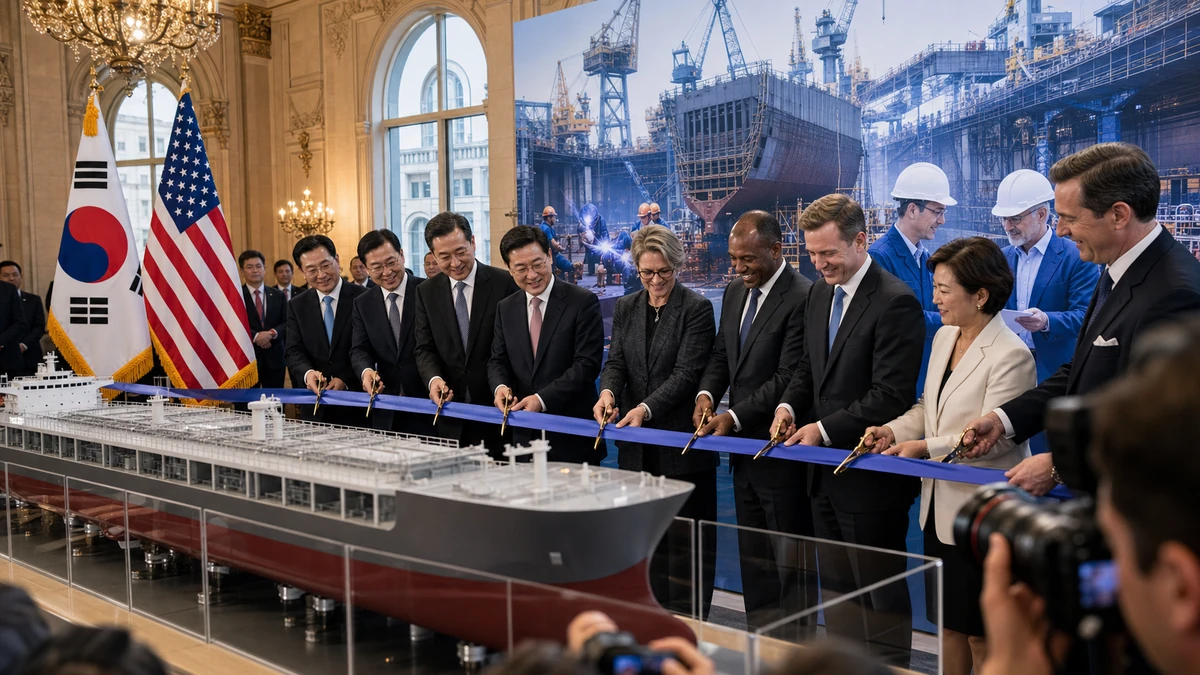
South Korea and the United States have opened a new shipbuilding cooperation center in Washington, marking a shift from diplomatic promises to the harder work of turning policy into factory-floor results.
The center, launched Wednesday at the Mayflower Hotel in downtown Washington, is designed to serve as the operational base for a bilateral shipbuilding project known as “MASGA,” according to South Korea’s Ministry of Trade, Industry and Energy and the U.S. Department of Commerce. Its mission is practical rather than ceremonial: help connect American shipyards with Korean expertise in productivity, workforce training, research and development, technology exchange and investment.
That may sound like bureaucratic language, but the significance is clearer in American terms. Think of it less as another government dialogue and more as a hybrid of an industry accelerator, a training office and a cross-border business matchmaking hub. The idea is not simply to have officials talk about cooperation. It is to create a standing institution that can help companies identify projects, move engineers and trainers into place, and turn political goodwill into contracts, pilot programs and, eventually, measurable output.
The timing matters. The center opened about two months after Seoul and Washington signed a memorandum of understanding on a “Korea-U.S. Shipbuilding Cooperation Partnership Initiative” on May 8 in Washington. In diplomatic life, memorandums of understanding often amount to a declaration of intent. They can be important, but they do not always lead to concrete follow-through. The relatively quick creation of a dedicated center suggests both governments want to show momentum in an area that is increasingly tied to economic security, supply chains and strategic competition.
It also reflects a broader reality in U.S. industrial policy. In sectors from semiconductors to batteries, Washington has spent the past several years looking for ways to rebuild domestic capacity while working more closely with allies. Shipbuilding is now entering that same conversation. South Korea, home to some of the world’s most competitive shipbuilders, is positioning itself not just as a seller of ships but as a provider of industrial know-how.
That is a notable evolution. For decades, Americans encountering South Korea’s shipbuilding industry mostly did so indirectly, through the global flow of tankers, LNG carriers and container ships built by Korean firms. The new center suggests Seoul wants to export something more complex than finished vessels: a system for training workers, improving yards and linking engineering expertise to capital investment.
Why shipbuilding is back on Washington’s agenda
For many Americans, shipbuilding can sound like a legacy industry associated with wartime mobilization, old industrial ports or naval procurement battles on Capitol Hill. But in Washington today, it is increasingly discussed as part of a bigger national challenge: whether the United States can maintain enough industrial depth to support both economic resilience and defense needs.
Commercial shipbuilding in the United States has long lagged behind major Asian producers, especially South Korea, China and Japan. American shipyards remain critical in naval construction, repairs and specialized vessels, but they have not dominated global commercial ship orders for generations. That has led to recurring concerns among lawmakers, military planners and labor groups that the U.S. lacks the workforce scale, production efficiency and supplier network needed for a stronger maritime industrial base.
The new Korea-U.S. center is aimed at that gap. According to the Korean side, it will offer productivity consulting for American shipyards and run workforce development programs tailored to the industry’s needs. In plain English, that means experts will work with yards to identify inefficiencies, improve processes and help train the workers needed to sustain those gains.
Those are not small issues. Anyone familiar with U.S. manufacturing debates will recognize the pattern. A factory or shipyard can buy equipment, but productivity depends on workflow, management systems, training pipelines and the availability of skilled labor. In many sectors, the bottleneck is not just technology. It is whether enough people know how to use that technology consistently and efficiently.
That is where South Korea brings credibility. Korean shipbuilders have spent decades refining production systems in one of the most demanding industrial businesses in the world. Building a ship is less like assembling consumer electronics and more like orchestrating a floating city: steelwork, engines, digital systems, safety requirements, logistics and thousands of workers all have to move in sequence. Korean companies earned their standing in the global market by learning how to manage that complexity at scale.
For Washington, partnering with an ally that already has that experience offers a way to speed up learning. For Seoul, it opens a deeper foothold in the American market at a time when industrial alliances are becoming more valuable than simple export relationships.
South Korea’s export playbook is evolving
To understand why this center matters to South Korea, it helps to understand how the country has long approached global industry. South Korea’s economic rise was built in large part on manufacturing: first labor-intensive goods, then higher-value industries such as automobiles, semiconductors, batteries and shipbuilding. In each case, Korean firms moved from making products to mastering systems — the training, engineering, quality control and management practices that make large-scale production competitive.
The new shipbuilding center reflects that next-stage strategy. Instead of treating industrial strength as something embodied only in a finished product, South Korea is increasingly packaging expertise itself as an export. That can include consulting, technology collaboration, research partnerships and direct investment. In American business language, it is the difference between selling the hardware and helping design the operating model.
That matters because it changes the nature of bilateral cooperation. A one-off ship order is a transaction. A center that helps identify projects, train workers, connect investors and facilitate R&D is infrastructure for an ongoing relationship. It creates a pipeline through which multiple projects can develop over time, even if no single announcement grabs headlines right away.
There is also a political logic to this approach. South Korea has spent years deepening economic ties with the United States, particularly in strategically sensitive sectors. Korean automakers and battery makers have invested heavily in the U.S., in part because American industrial policy now rewards local production and trusted supply chains. Shipbuilding appears to be the latest field where Seoul sees an opening to align its industrial strengths with Washington’s policy priorities.
For Korean policymakers, that alignment is valuable beyond economics. South Korea’s alliance with the United States has traditionally centered on security, especially deterring North Korea. But in recent years, the relationship has expanded into technology, energy and supply-chain cooperation. A shipbuilding center in Washington fits neatly into that broader alliance story: not just troops and treaties, but shared industrial capacity.
In that sense, the center’s location is symbolic as well as practical. Washington is where policy gets made, budgets get debated and corporate strategies increasingly intersect with national security thinking. Opening the center there sends a message that shipbuilding cooperation is no longer a niche industry matter. It is part of the capital’s wider conversation about how America works with allies to rebuild strategic sectors.
What the new center is actually supposed to do
The most important thing about the new center may be that its mandate is not limited to exchanging information. Its stated purpose is to function as a hands-on platform linking production sites, workers, technology and capital. That is a more ambitious role than many bilateral offices ever attempt.
On one track, the center will support American shipyards directly through productivity consulting and workforce training. Consulting in this context likely means examining how work is organized on the ground: where delays occur, how fabrication and assembly schedules are managed, how digital tools are integrated and how labor skills match production needs. If this works as intended, the center could help U.S. yards adopt methods that improve efficiency without reducing the emphasis on quality or safety.
On another track, the center will promote collaboration among Korean and American companies in research and development, technology exchange and direct investment. That combination matters because these elements often operate separately. Engineers may discuss technical cooperation without a clear path to commercialization. Investors may study opportunities without a strong grasp of operational realities. Governments may encourage partnerships without providing a reliable venue to connect the right people.
The center is meant to close those gaps. In theory, it could help an American shipyard identify a productivity problem, connect with Korean experts who have solved similar issues, explore whether a technology partnership makes sense and then help facilitate the investment needed to implement the solution. That is why Korean officials are presenting it as an “execution base,” not simply a policy office.
Still, it is worth keeping expectations realistic. Opening a center does not automatically produce successful projects. Outcomes will depend on which companies participate, how programs are funded and managed, and whether the consulting and training offered can be adapted to the very specific conditions of American shipyards. Industrial cooperation is rarely plug-and-play. Methods that worked in Ulsan or Geoje, two South Korean shipbuilding hubs, may need substantial adjustment for yards in the United States with different labor structures, regulations and supply chains.
That said, the existence of a permanent platform can make a real difference. One of the recurring problems in international industrial cooperation is continuity. Projects start with enthusiasm, then stall because there is no institution tasked with keeping them moving. A center in Washington, backed by the Korean government and linked to the U.S. Commerce Department, gives both sides a place to return to when trying to move from concept to execution.
What this means for American industry and workers
For U.S. readers, the most immediate question is likely whether this center could materially help American shipbuilding or whether it is mainly diplomatic theater. The honest answer is that it could be either, depending on what follows. But the design suggests it is aiming at real industrial pain points rather than abstract partnership language.
American shipyards, like many manufacturers, face a workforce challenge. Skilled trades take time to develop, and the national conversation about reviving industrial capacity often runs into the same practical obstacle: there are not enough trained workers entering the pipeline fast enough. A workforce development program tied to an experienced shipbuilding partner could help address that problem, especially if it includes structured training systems rather than one-off seminars.
There is also the issue of productivity. In American politics, productivity is sometimes treated as a cold economic metric. In industry, it is more tangible. Higher productivity can mean less rework, fewer delays, better coordination and more predictable schedules. For shipyards, where projects are large, expensive and technically complex, even incremental efficiency gains can matter. If Korean consulting helps yards improve throughput or reduce bottlenecks, the effects could extend to cost competitiveness and delivery reliability.
For workers, of course, international cooperation can raise understandable questions. Will this lead to stronger American yards and better training, or will it create pressure to adopt practices that do not fit local conditions? Will new investment generate jobs, or will it mostly benefit firms already positioned to profit from government-backed partnerships? Those questions are not unique to shipbuilding. They echo broader debates Americans have had over foreign investment in auto manufacturing, battery plants and steel.
The answer will likely come down to implementation. If the center’s programs are built around local workforce needs, long-term training and durable business relationships, it could help strengthen domestic capacity. If it remains top-heavy and disconnected from actual yards, it may struggle to show results. In that sense, this is not unlike federal efforts to support semiconductor manufacturing or clean-energy supply chains: the headline announcement is easy, but the real test comes years later in hiring, output and competitiveness.
There is also an alliance dimension that American audiences may find familiar. Washington has increasingly framed economic cooperation with allies as a way to reduce vulnerabilities without retreating into isolationism. In other words, the U.S. is not trying to make every strategic industry entirely alone; it is trying to build trusted networks with partners. South Korea has become one of the clearest examples of that approach. The shipbuilding center is another case study in how alliance management is now happening through factories, labs and training programs as much as through summit meetings.
Why Washington, and why now?
The choice to launch the center in Washington is more than a matter of convenience. In Korea, geographic symbolism in policy often carries weight, and that is true here as well. When Korean officials note that both the May memorandum and the July launch took place in Washington, they are signaling that this project sits close to the center of bilateral policymaking, not on the margins of it.
For American readers, the equivalent would be the difference between a promising industry discussion at a trade conference and a standing initiative with visibility in the nation’s capital. Washington is where government agencies can coordinate, where business lobbies pay attention and where strategic industries increasingly receive policy support. A center based there can more easily connect interagency priorities, corporate interests and international diplomacy.
The speed of the rollout also sends a message. Roughly two months elapsed between the signing of the memorandum and the opening of the center. That is relatively fast by the standards of international economic bureaucracy. It suggests both sides wanted to capitalize on political momentum and avoid the fate that often befalls cross-border initiatives: a burst of headlines followed by institutional drift.
That urgency likely reflects the changing strategic environment. The United States has been reassessing the health of its industrial base, while allies such as South Korea are looking for ways to deepen ties with the world’s largest economy beyond traditional trade. Maritime capacity has become more salient as supply-chain disruptions, naval competition and industrial resilience all gain prominence in policy debates. In that context, shipbuilding is no longer a sleepy sector. It is part of the strategic map.
There is another reason timing matters. South Korea’s shipbuilders are globally competitive now, but industrial leadership is never permanent. By moving quickly to institutionalize cooperation, Seoul can lock in partnerships while its expertise is in strong demand. For Washington, moving now may help ensure that any future rebuilding of maritime capacity is done with allied input rather than starting from scratch.
The big test: Can a diplomatic idea become an industrial result?
The center’s launch is an important marker, but it is still the beginning of the story, not the end. The real measure of success will not be the ribbon-cutting in Washington. It will be whether the center produces visible, repeatable outcomes.
Several benchmarks will matter. First, do the productivity consulting programs lead to concrete improvements inside U.S. shipyards? Second, do workforce training efforts create a sustainable pipeline of skilled workers rather than a short-term burst of activity? Third, can research and development partnerships move beyond memorandums and workshops into actual projects with commercial or operational value? And fourth, does the center catalyze direct investment that ties both countries more deeply into long-term cooperation?
Those are demanding standards, but they are appropriate for an initiative that aims to be more than symbolic. A permanent platform only proves its worth if it keeps generating opportunities after the opening ceremony fades from memory.
There is reason for cautious optimism. The structure described by both governments addresses real industrial needs. It combines workforce issues, operational performance, technology exchange and capital formation — the very elements that often determine whether manufacturing partnerships succeed. It also fits a broader trend in U.S.-South Korea relations, where economic cooperation is becoming more operational and less theoretical.
But there are also reasons for caution. Cross-border industrial projects can be slowed by regulation, mismatched business expectations, labor concerns, cost pressures and shifting political priorities in both countries. Even the best-designed center cannot guarantee that companies will commit capital or that local conditions will support rapid change. In that sense, the Washington launch should be seen as the creation of a mechanism, not proof of an outcome.
Still, in a period when industrial policy is back in fashion and alliances are increasingly judged by what they can build together, the new Korea-U.S. shipbuilding cooperation center stands out as more than a diplomatic footnote. It is an attempt to create a practical bridge between one country that wants to strengthen maritime capacity and another that has spent decades mastering it.
For Americans, the development offers a glimpse of how alliance economics is evolving. Cooperation is no longer just about lowering tariffs or issuing joint statements. It is about transferring know-how, training workers, aligning investment and making strategic industries more capable over time. In that respect, a shipbuilding center opening in a Washington hotel may sound modest. But if it succeeds, its impact could reach far beyond the ballroom where it was launched.
Comments
Post a Comment