South Korea Approves First Dual-Listing Exceptions for Subsidiaries, Testing a New Playbook for Investor Protection
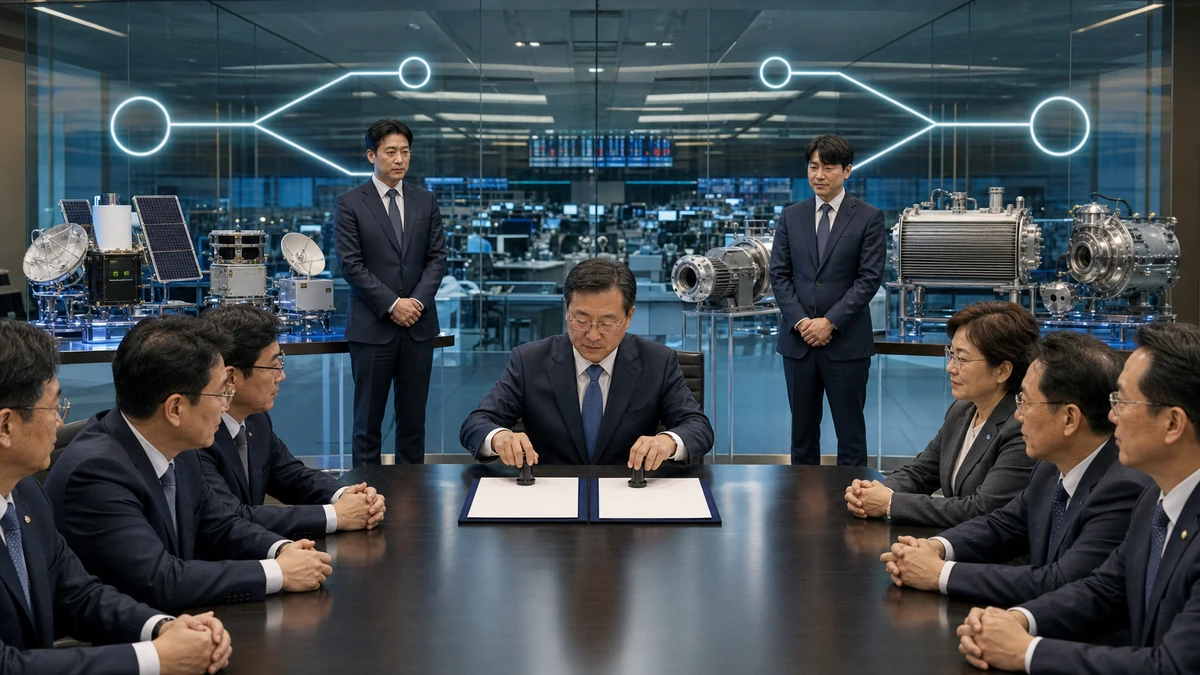
A new test for South Korea’s stock market
South Korea’s exchange has approved preliminary listing reviews for two corporate subsidiaries in what amounts to a closely watched test of the country’s new rules on so-called dual listings — a corporate structure that can raise money for fast-growing businesses but also stir concerns about whether existing shareholders are getting a fair deal.
The Korea Exchange’s KOSDAQ Listing Committee on Friday approved the preliminary listing applications of Ducksan Nepcores, a defense and aerospace parts developer owned by listed parent Ducksan Hi-Metal, and DTS, a machinery manufacturer owned by listed parent Dasan Networks, according to the South Korean financial news flow summarized from Yonhap, the country’s best-known wire service.
That may sound technical, but in South Korea’s capital markets, the decision carries significance beyond the two companies themselves. Regulators and the exchange recently laid out standards for when a subsidiary of an already listed company can be allowed to seek its own separate public listing. This week’s approvals are being treated as the first cases in which those exceptions have been granted under that framework.
For American readers, the closest parallel is a debate Wall Street has seen many times in different forms: When a parent company spins off, partially sells, or separately lists a business unit, who really benefits? Does the move unlock value and give a promising business room to grow? Or does it shift assets, attention and value away from the parent company’s ordinary shareholders?
In South Korea, those questions carry extra weight because the country’s corporate landscape has long been shaped by sprawling family-controlled conglomerates known as chaebol — business groups whose complex ownership structures have often drawn scrutiny from minority investors, governance advocates and foreign funds. While the two companies in this case are not household-name conglomerates on the scale of Samsung or Hyundai, the principle at stake touches a much broader issue in Korean corporate life: how to balance growth financing and corporate flexibility with investor trust and shareholder rights.
The Korea Exchange’s decision does not mean the two companies have completed an initial public offering or begun trading. A preliminary listing review approval is a major procedural hurdle, not the finish line. But because these are the first cases approved under the new exception standard, the outcome is being read as an early signal of how South Korea intends to police one of the most sensitive areas in its IPO market.
Why dual listings are controversial
A dual listing, in this context, refers to a situation in which a parent company is already publicly traded and a subsidiary under its control also seeks its own listing. On paper, the idea can make sense. A subsidiary with a specialized business may want direct access to capital, a market valuation tied more closely to its own industry, and a clearer identity for investors who might otherwise view it as just one piece of a larger group.
That logic is familiar in U.S. markets. A company might carve out a unit so investors can better value a high-growth software arm separately from a slower industrial business, or so management can pursue a strategy tailored to a particular sector. Supporters often argue that such moves create transparency and unlock value.
But critics point out that the parent company’s shareholders already had an indirect claim on that subsidiary. If the subsidiary gets separately listed on terms that benefit insiders or controlling shareholders more than ordinary investors, the parent’s minority shareholders can feel like part of the family silver is being taken out of the house and repriced without adequate protection.
That concern has been especially resonant in South Korea, where retail investors — often called “ants” in local market slang, a nod to their collective power despite small individual stakes — have become more vocal about governance, fair treatment and the so-called Korea discount, the persistent tendency for Korean stocks to trade at lower valuations than some global peers. Policymakers have increasingly framed better governance and clearer shareholder protections as necessary if South Korea wants deeper, more trusted capital markets.
Against that backdrop, regulators and the exchange did not want to send the message that subsidiary listings would simply be waved through. Instead, the market has been looking for evidence that any exception to the basic skepticism around dual listings would be tied to clear criteria. This week’s decisions matter because they suggest the exchange is trying to build a rule-based approach rather than a discretionary one.
The core standard: independence in business and management
The central question in these cases was not merely whether the subsidiaries were promising companies. It was whether they were independent enough — operationally and managerially — to justify standing before public investors as companies in their own right.
South Korean reporting on the case highlights two concepts: business independence and management independence. Those phrases may sound dry, but they go to the heart of the issue.
Business independence asks whether the subsidiary has a distinct line of business, one capable of generating its own corporate value rather than simply functioning as an internal arm of the parent. In plain English, can investors look at this company and say it does something identifiable, in a market of its own, with commercial prospects that are meaningfully separate from its parent?
Management independence asks a related but different question: Does the subsidiary have decision-making structures that allow it to be judged like an independent listed company? In other words, is it run in a way that supports accountability to its own shareholders, not just subordination to the strategic needs of the parent?
Those are the standards that appear to have separated these cases from the many situations in which investors worry that a listed subsidiary is independent in name only. If a business cannot show that it has its own management logic and commercial identity, a separate stock listing can start to look less like a clean capital-raising exercise and more like financial engineering.
Ducksan Hi-Metal disclosed that its board met on May 13 to review how a proposed listing of Ducksan Nepcores would affect the parent company’s shareholders. The board concluded that the subsidiary satisfied both the business-independence and management-independence requirements under the dual-listing review criteria, according to the Korean summary. The board also said it did not believe the listing would have a negative effect on the rights of the parent company’s general shareholders or on investor protection more broadly.
That last point is especially important. The exchange and regulators appear to be signaling that a parent company cannot simply say, “Our subsidiary is growing and needs capital.” It also has to address the more uncomfortable question: What happens to the people who already own the parent?
Two companies, two industries, one message
The fact that the first approved cases involve two very different industries is part of why market watchers are paying attention.
Ducksan Nepcores develops components used in defense and aerospace, sectors that in both the United States and South Korea tend to command strategic attention far beyond their size because they sit at the intersection of advanced manufacturing, national security and long-term industrial policy. In the Korean context, an aerospace and defense supplier can attract interest not only as a growth company but also as a bellwether for the country’s ambitions in high-value technology manufacturing.
DTS, by contrast, is described in the Korean summary as a maker of general-purpose machinery, a category that sounds less glamorous but remains foundational in an export-driven manufacturing economy. Machinery companies often occupy a vital middle layer in industrial ecosystems, supplying the tools and equipment that allow more visible sectors to function.
The pairing matters because it suggests the new standard is not designed only for cutting-edge or politically favored sectors. If the first exceptions had gone solely to a flashy defense or aerospace affiliate, skeptics might have dismissed the process as a one-off accommodation for a strategic industry. By also approving a machinery manufacturer, the exchange appears to be emphasizing that the key test is not the buzz level of the industry but the specific evidence of independence and shareholder safeguards.
That may help the exchange present this as a principles-based system. In effect, the message is that a defense parts developer and a machinery maker can both qualify — but not because of their sectors alone. They qualify, at least at the preliminary review stage, because they were deemed sufficiently independent and because the parent-shareholder impact was considered as part of the process.
For overseas investors, this distinction matters. South Korea has been trying to show global markets that it is serious about improving corporate governance and narrowing the gap between how Korean companies are valued at home and how international investors think they should be valued. A review process that looks consistent across industries is more credible than one that appears arbitrary or politically driven.
What investor protection means in practice
Investor protection can be an abstract phrase, but in this case it points to a concrete tension. A listed parent company’s shareholders may have bought the parent in part because they valued the subsidiary inside it. If that subsidiary then goes public on its own, some of that embedded value can be separated out, potentially changing how the parent is valued.
In the United States, such concerns often show up in debates over spin-offs, tracking stocks, related-party transactions or controlled-company structures. Investors want to know whether the transaction allocates value fairly, whether governance is robust, and whether insiders are using complexity to their advantage.
South Korea’s new approach seems to demand that these questions be addressed upfront. According to the Korean summary, Ducksan Hi-Metal’s board did not only weigh the subsidiary’s business case; it also reviewed the potential effect on the parent’s ordinary shareholders and formally expressed the view that their rights would not be harmed. That matters because it moves the conversation beyond corporate ambition into fiduciary responsibility.
It also suggests a more formal role for boards in justifying these transactions. In governance systems where controlling shareholders or founding families have historically exercised strong influence, requiring documented board-level consideration can serve as at least one check, even if it is not a perfect one. For minority investors, the value lies partly in forcing companies to articulate why a separate listing is justified and how shareholder interests are being protected.
Whether that protection proves meaningful will depend on what happens next. Preliminary approval is one thing; the eventual offering structure, valuation, governance terms and post-listing relationship between parent and subsidiary are another. Investors will likely want to see how much of each subsidiary is sold, what rights outside shareholders receive, how related-party dealings are handled and whether independent directors play a substantive role.
Still, as a procedural milestone, the approvals show that South Korea is trying to define what “good” dual listing behavior looks like. The standard being articulated is not that such listings are automatically bad or automatically good. It is that they are acceptable only when independence is real and when the parent company’s shareholders are not treated as an afterthought.
Why this matters for Korea’s broader reform effort
These cases arrive at a time when South Korea is under pressure to make its stock market more attractive, especially to long-term investors who want stronger governance and more predictable rules. Efforts to tackle the Korea discount have included debate over dividend practices, corporate governance, capital efficiency and shareholder returns. The treatment of subsidiary listings fits squarely into that larger campaign.
One reason the issue is so symbolic is that it goes to trust. Investors can accept risk. What they struggle with is uncertainty over whether the rules will be applied consistently and whether insiders and ordinary shareholders are truly playing on the same field.
If South Korea wants more companies to command premium valuations, it has to persuade investors that corporate restructurings and capital-raising exercises will not dilute protections for minority holders. That is as true for domestic retail investors as it is for foreign institutions.
In that sense, the approvals of Ducksan Nepcores and DTS are less about two isolated IPO candidates and more about a regulatory philosophy. The exchange appears to be saying that specialized subsidiaries can seek their own market identities, but they must do so under scrutiny that ties corporate strategy to governance discipline.
There is also a practical industrial dimension. South Korean companies often incubate specialized businesses inside larger groups before seeking outside capital to scale them. If regulators make subsidiary listings impossible, some companies may argue that capital formation and industrial specialization suffer. If regulators make them too easy, investor confidence can erode. The new framework appears to be an attempt to split the difference: allow the pathway, but only with guardrails.
That balancing act is familiar to U.S. readers even if the Korean terms are different. American markets have long wrestled with how to encourage innovation, spinouts and value creation without opening the door to abusive complexity. South Korea is now confronting a version of the same challenge, filtered through its own corporate history.
What comes next
For now, the immediate fact pattern remains limited. The Korea Exchange’s KOSDAQ Listing Committee approved preliminary listing reviews for the two subsidiaries. That is the confirmed development. It does not, by itself, answer every question about pricing, timing, final listing mechanics or longer-term governance.
Even so, the symbolic value is substantial. Because these are being treated as the first approved exceptions under the new dual-listing review standard, they are likely to become reference cases for future applicants. Lawyers, bankers, boards and investors will study the logic used here as they assess which subsidiary listings may be viable going forward.
If additional companies with similar structures seek approval, the market will watch for consistency. Are the same standards applied across sectors? Do regulators ask tough enough questions about parent-subsidiary overlap? Are boards genuinely examining shareholder impact, or merely checking a formal box? The answers will shape whether the first two approvals are remembered as the start of a credible governance framework or simply the beginning of a new gray area.
For Ducksan Nepcores, the spotlight may be especially bright because defense and aerospace are sectors where technological specialization can make the case for independent corporate value easier to understand. For DTS, the interest may center on whether a more traditional machinery business can also persuade investors that a separate listing reflects genuine corporate independence rather than a balance-sheet maneuver.
Either way, the exchange has now moved the debate from theory into practice. South Korea’s capital markets have spent years discussing how to reconcile corporate flexibility with investor protection. With these approvals, that conversation is no longer hypothetical.
For American observers, the broader lesson is that South Korea’s market reforms are increasingly happening not just through sweeping policy slogans, but through case-by-case decisions that test whether governance principles can survive contact with real companies and real incentives. That may not make for flashy headlines in the way a blockbuster IPO does. But in the long run, these quieter procedural decisions often do more to determine whether investors trust a market enough to commit their money.
And that, more than the fate of any single listing, is why two little-known subsidiaries on Korea’s KOSDAQ pipeline have suddenly become a meaningful story in the evolution of one of Asia’s most watched stock markets.
Comments
Post a Comment