From flashy algorithms to real-world medicine
South Korea is putting new emphasis on a question that has become increasingly urgent in health care systems around the world: Can artificial intelligence actually improve patient care once it leaves the lab and enters a busy hospital?
That question is at the center of a newly selected government-backed project involving a consortium led in part by physicians at Chilgok Kyungpook National University Hospital, a major academic medical center in the southeastern city of Daegu. According to South Korea’s Ministry of Health and Welfare, the consortium has been chosen for the 2026 medical AI test-bed support program, an initiative designed not simply to help build AI tools, but to verify whether already-developed products are accurate, safe, practical and cost-effective when used in real clinical settings.
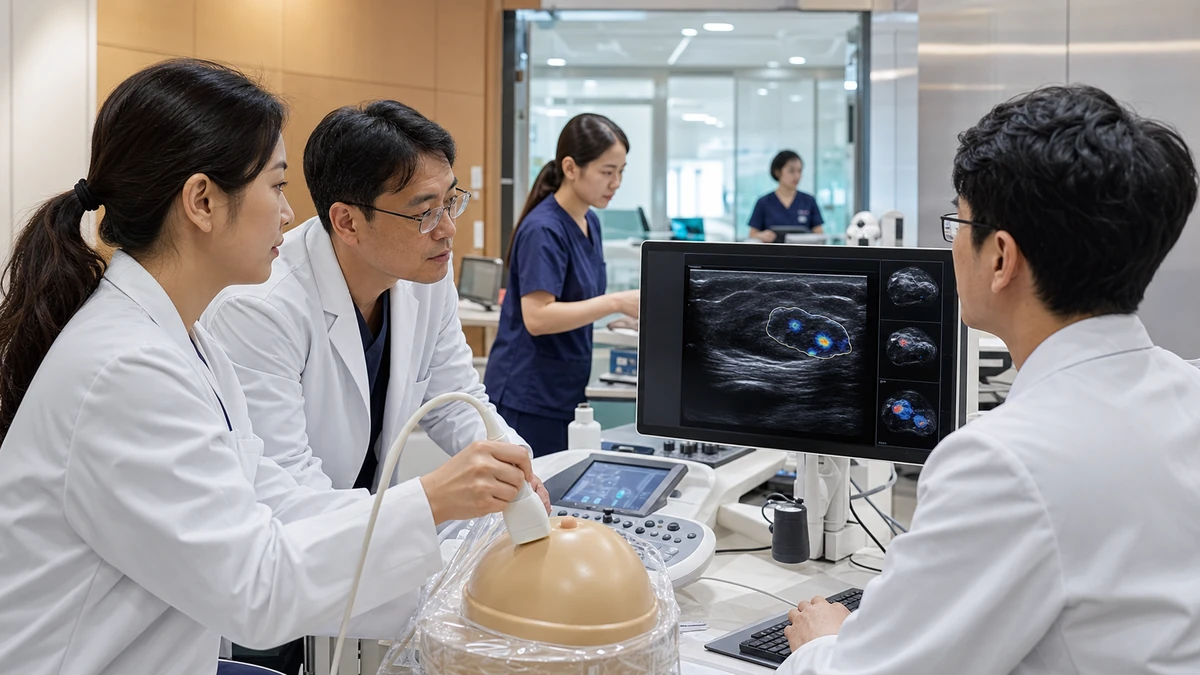
The project’s focus is breast ultrasound, an area where radiologists and breast specialists often must review large volumes of imaging and make judgment calls that can carry high stakes for patients. The Korean team plans to build an AI-based automatic screening test bed for breast ultrasound and develop a clinical demonstration platform to assess how well those tools perform with hospital data and in ordinary medical workflows.
For American readers, the distinction matters. In the United States, medical AI often generates headlines when a startup announces a promising model or when a hospital system pilots a software product. But the harder and more consequential phase usually comes afterward: proving that the technology works consistently across patient populations, fits into doctors’ daily routines, saves time without missing disease, and justifies its cost. South Korea’s new project is aimed squarely at that middle ground between invention and adoption.
In other words, this is not a story about whether AI can detect patterns in medical images in theory. It is about whether hospitals can trust those systems enough to use them, whether doctors will find them useful rather than cumbersome, and whether health systems can make a practical case for buying them.
That marks a shift in how South Korea is positioning itself in the global race over health care AI. The country is still investing in algorithms, but it is now signaling that clinical proof, not just technical promise, is where the next battle will be fought.
Why breast ultrasound matters in South Korea and beyond
The selected research project centers on AI-assisted breast ultrasound screening. That may sound specialized, but it touches on a much broader issue in women’s health: how to improve the early detection and evaluation of abnormalities while reducing the burden on specialists and patients alike.
Breast imaging is already familiar terrain in the United States, where mammograms remain the standard screening tool for many women. Ultrasound often enters the picture as a supplemental exam, especially for patients with dense breast tissue or for closer evaluation of an area that needs a second look. In South Korea, as in other parts of Asia, ultrasound also plays an important role in breast care, and clinicians have shown strong interest in tools that can help analyze those images more efficiently.
Unlike a simple blood test, ultrasound interpretation is highly dependent on workflow, operator technique and clinical judgment. A software system might look impressive in a controlled setting, but hospitals need to know whether it can perform reliably when different clinicians use different machines on different patients under real time pressure. That is why the Korean government’s framing of the project is significant. The goal is not to replace doctors with automation, but to test whether AI can support image review, shorten reading time, improve diagnostic efficiency and potentially raise the quality of care.
The research team also plans to explore whether AI might help with earlier detection of complications related to breast implants. That detail broadens the scope of the effort. It suggests the system may be evaluated not only for classifying routine imaging findings but also for flagging issues that require close clinical attention. For U.S. audiences, it may be helpful to think of this less as a futuristic robot doctor and more as a digital second set of eyes — one that still must prove it can be trusted.
The distinction is especially important in breast care, where false reassurance and false alarms both come with real costs. If AI misses a suspicious lesion, the consequences can be serious. If it overcalls benign findings, patients may face unnecessary anxiety, extra imaging or biopsies. A clinically useful system therefore has to strike a difficult balance: it must be accurate enough to help physicians without creating new problems.
That is one reason the Korean project stands out. Its stated goals go beyond technical accuracy alone and explicitly include stability and usability, two qualities that often determine whether promising software survives contact with everyday medical practice.
A government test bed aimed at the messy realities of hospital care
In policy terms, the project reflects a growing realization that AI adoption in medicine is not just a software problem. It is a systems problem.
South Korea’s Health and Welfare Ministry describes the broader program as a demonstration effort intended to move medical AI beyond the development stage and into the harder work of validating clinical effectiveness and cost-effectiveness. It is also meant to support market entry for AI products that pass those tests. That is a notable policy choice. Governments often subsidize research and development, but this program recognizes a more specific bottleneck: many medical AI tools stall after development because they lack persuasive evidence from real clinical environments.
The word “test bed” can sound bureaucratic, but it points to something concrete. In technology policy, a test bed is essentially a controlled environment for real-world trials — a place where products can be evaluated under realistic conditions before broader deployment. In health care, that means measuring not only whether a model reaches a certain accuracy score, but whether it behaves consistently, integrates with hospital data systems, works within the routines of clinicians and produces outcomes that matter to patients and providers.
American hospitals face similar questions. A medical AI vendor may promise faster image analysis or earlier disease detection, but hospital leaders still have to ask: Does it fit into our electronic records system? Does it slow down staff training? Does it reduce physician burnout or add another layer of clicks? Does it work equally well for varied patient populations? Will insurers or administrators see enough value to support its use?
The Korean initiative appears designed to answer comparable questions in a structured way. According to the publicly described research plan, the consortium will use institutional data to verify the accuracy, safety and usability of breast ultrasound AI analysis solutions. It will also evaluate whether these tools can improve physicians’ diagnostic efficiency and support better service quality.
That focus on the clinical environment is arguably the most important development here. Too often, AI in medicine is discussed as though performance exists independently of context. But hospitals are not software demos. They are noisy, crowded, complex workplaces shaped by staffing limits, insurance pressures, regulatory requirements, privacy concerns and the human realities of medical decision-making. A product that performs well in a polished presentation may fail in a radiology reading room at the end of a long shift.
South Korea, by emphasizing demonstration in working hospitals, is effectively acknowledging that medical AI must prove itself where medicine actually happens.
Why accuracy alone is not enough
One of the most revealing aspects of the project is the way it defines success. The Korean summary makes clear that the consortium will assess three pillars together: accuracy, stability and usability.
That may sound obvious, but it represents a mature way of evaluating medical AI. In public discussions, accuracy tends to dominate because it is intuitive and easy to headline. If a model identifies disease with high sensitivity or strong overall performance metrics, the story writes itself. Yet clinicians know that an accurate tool can still be unhelpful if it is unreliable, awkward to use or poorly matched to the flow of patient care.
Stability matters because health care providers need consistency. A system that performs well one day but unpredictably across different cases, machines or operators the next day is difficult to trust. In medicine, trust is not a branding exercise; it is part of the infrastructure of safe care. Doctors may use software as an aid, but they must be confident that it behaves in a dependable way across many circumstances.
Usability matters for a different reason: doctors and technicians are already overwhelmed. In the U.S., clinician burnout has become a major issue, with electronic records systems frequently blamed for adding administrative friction. South Korean hospitals, while different in structure, also operate under pressures of efficiency and patient volume. If an AI tool requires too many extra steps, complicates image review or disrupts clinical workflow, it may be ignored no matter how sophisticated the algorithm is.
That is why the project’s mention of reducing reading time is so important. In imaging, time savings can be meaningful if they are achieved without compromising diagnostic quality. A useful AI product might help triage studies, highlight areas of concern, standardize measurements or speed routine review. But if the system generates too many false alerts or forces clinicians to spend time double-checking confusing outputs, it can cancel out the very efficiency gains it promises.
The Korean government’s framing also includes cost-effectiveness, another concept familiar to American health policy experts. Even if a tool improves care in some narrow technical sense, hospitals still must decide whether the benefits justify the investment. That includes licensing fees, integration costs, staff training and maintenance, as well as the opportunity cost of adopting one digital system instead of another.
Seen in that light, the test-bed project is doing more than evaluating a single medical imaging application. It is helping define what counts as meaningful evidence for AI in medicine. Not just: Does the algorithm work? But: Does it work reliably, smoothly and at a cost that makes sense in an actual health system?
The hospital at the center of the project
Chilgok Kyungpook National University Hospital is not a household name in the United States, but in South Korea it is a significant academic medical institution tied to Kyungpook National University, one of the country’s major public universities. Located in Daegu, the hospital serves as both a treatment center and a research site, which makes it a natural setting for a project that sits at the intersection of clinical care and technology validation.
The consortium includes professors Lee Ji-yeon, Kang Byung-joo and Moon Joon-seok of the hospital’s breast surgery division, according to the Korean summary. Their role is central because any serious attempt to validate medical AI requires more than engineering expertise. It requires clinicians who understand how diagnosis actually unfolds, what information doctors need at each step, and where tools can help or hinder decision-making.
The project’s design underscores that point. Hospital data are expected to serve as the basis for evaluating the breast ultrasound AI analysis solution. That matters because performance tested in a development environment does not automatically translate to real patients in real clinics. Local patient populations, imaging practices and institutional workflows can all affect results.
Professor Kang said he has continued researching the use of AI in breast imaging diagnosis and that the team would work to prove the clinical value of the technology while also suggesting directions for future development. That kind of statement can easily sound routine, but it hints at a broader ambition. The team is not only trying to score the current generation of products; it is also trying to show how medical AI should evolve if it is to become genuinely useful in practice.
That is an important distinction for English-speaking readers used to Silicon Valley language about “disruption.” In health care, the more durable innovations are often the ones that solve ordinary but difficult operational problems. Can a doctor review images faster? Can concerning findings be surfaced earlier? Can variation in interpretation be reduced? Can patients move through the system with fewer delays? Those are less glamorous questions than whether AI can outperform humans in a benchmark test, but they are often the ones that determine whether technology makes a lasting difference.
By placing clinicians at the heart of the validation effort, the Korean consortium is signaling that practical medical value, not just computational achievement, is the standard it wants to meet.
What this says about South Korea’s broader AI strategy
The project also offers a window into South Korea’s larger ambitions in the AI economy. The country has spent years building a reputation as a high-tech power, from semiconductors and consumer electronics to digital platforms and advanced manufacturing. More recently, it has pushed to become a serious player in health technology, including diagnostics, digital therapeutics and medical AI.
In that sense, the breast ultrasound test bed is not an isolated research grant. It is part of a larger national effort to move up the value chain from making advanced tools to proving those tools can be deployed responsibly and competitively. For South Korea, success in medical AI will depend not only on coding talent, but on regulatory agility, clinical partnerships and an evidence base that can persuade hospitals and investors at home and abroad.
This matters internationally because medical AI is becoming crowded. The basic ability to build image-analysis algorithms is no longer rare. What differentiates products increasingly is whether they can clear regulatory hurdles, demonstrate reproducible value, and fit into health care systems that are often conservative for good reason. In that environment, a country that builds strong demonstration platforms may gain an edge by helping its domestic companies generate better evidence faster.
The Korean summary explicitly notes that this case is being viewed as an example of the country’s medical AI competitiveness expanding beyond algorithm development into clinical application and the construction of demonstration systems. That is a sophisticated shift. It suggests policymakers understand that in medicine, commercialization depends on trust, and trust depends on evidence gathered in settings that resemble actual care.
There is also a cultural dimension worth explaining for American audiences. South Korea often moves quickly when the government, hospitals, universities and industry align around a strategic sector. That coordination can accelerate pilot programs and infrastructure building in ways that are sometimes harder in the more fragmented U.S. system, where hospital networks, insurers, regulators and technology vendors operate with different incentives. At the same time, faster coordination does not eliminate the need for careful validation. If anything, it raises the stakes for getting the evidence right.
The emphasis on building a platform, rather than running a one-off experiment, may turn out to be especially important. If the consortium can create a repeatable process for assessing medical AI with hospital data — measuring accuracy, stability, usability and cost-related value in a standardized way — South Korea could be laying groundwork for future evaluations beyond breast ultrasound.
The global lesson: AI’s future in health care depends on proof
For all the hype surrounding artificial intelligence, the long-term winners in health care may not be the loudest companies or the flashiest demos. They may be the hospitals, researchers and regulators willing to do the slower, less glamorous work of proving what technology can actually deliver.
That is the larger significance of South Korea’s new medical AI test-bed selection. The project involving Chilgok Kyungpook National University Hospital is focused on a specific clinical area, but it addresses a universal problem: how to turn a promising digital tool into something a doctor can use confidently at the bedside or in the reading room.
If the consortium succeeds, it could show that AI-assisted breast ultrasound screening improves efficiency without sacrificing quality, and perhaps even expands the range of clinically useful information available to physicians. It could also provide evidence on whether the technology is stable enough for routine use and practical enough to fit into hospital workflows. Just as importantly, it may help clarify whether the economics of adoption make sense.
If it falls short, that result would be meaningful, too. One of the problems in the AI era is that failed or underwhelming deployments often receive less attention than early-stage breakthroughs. But medicine benefits when weak claims are tested rigorously before they spread widely.
For American readers, there is a familiar lesson here. The U.S. has seen this pattern before with electronic medical records, telehealth, robotic surgery and other innovations that looked transformative on paper but produced mixed results depending on implementation. Technology alone rarely changes medicine. Systems, incentives, training and trust do.
South Korea appears to be acting on that reality. Rather than treating medical AI as a solved engineering challenge, it is asking whether hospitals can incorporate these tools in ways that are clinically valid, financially sensible and operationally sustainable. That is a harder question than whether a model can be built. It is also the one that matters more.
In the coming years, the global conversation about health care AI is likely to shift from possibility to proof. South Korea’s new breast ultrasound initiative suggests the country wants to be part of that next phase — and perhaps help define its rules. For patients, doctors and health systems alike, that may be the most consequential development of all.
Comments
Post a Comment