South Korea’s latest resource push reaches South America
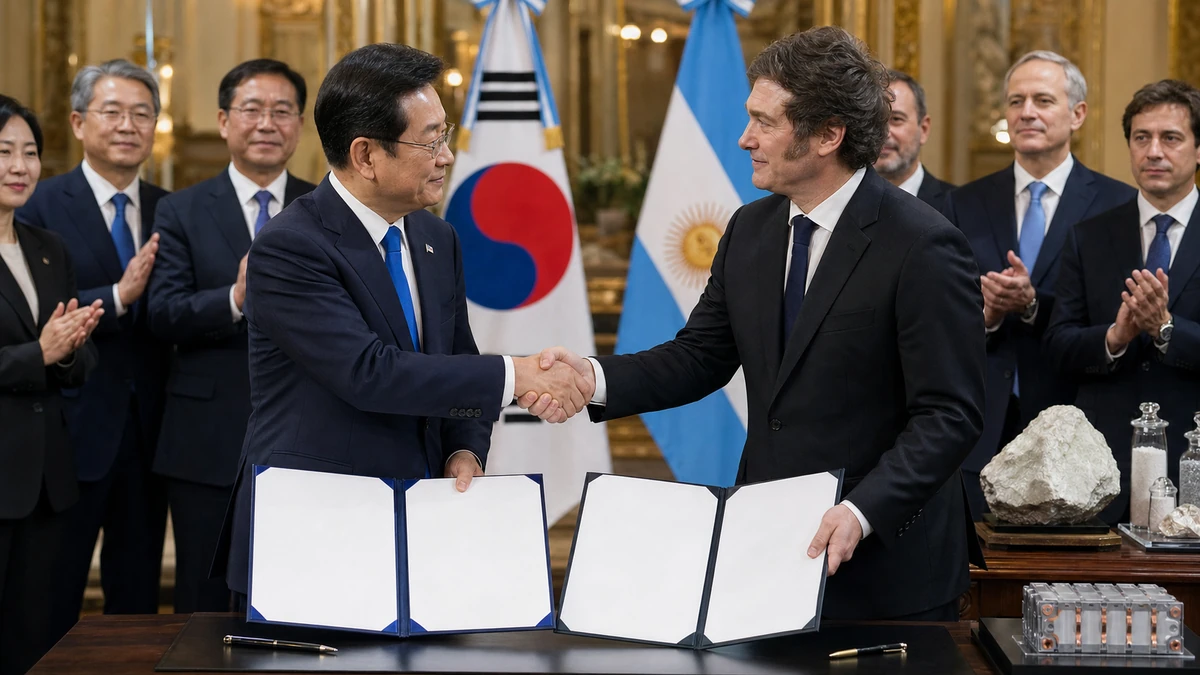
South Korean President Lee Jae-myung said his government plans to sign a memorandum of understanding with Argentina on cooperation across the critical minerals supply chain, a move that highlights how deeply competition over battery materials and industrial security now shapes global diplomacy.
The announcement came during Lee’s official visit to Argentina ahead of a summit with Argentine President Javier Milei on July 31, local time. In written remarks to the Spanish-language news agency EFE, Lee described the coming agreement as more than a narrow trade arrangement. The goal, he suggested, is to build cooperation across the full chain of activity tied to strategic minerals, not just the buying and selling of raw materials.
For American readers, it helps to think of this as part of the same global race that has pushed Washington to rethink everything from semiconductor manufacturing to electric vehicle batteries. Countries that once treated commodity imports as a back-office business are now elevating them to presidential diplomacy. In that sense, Lee’s visit to Argentina reflects a broader reality: The minerals needed for batteries, advanced manufacturing and energy technology are no longer just commercial inputs. They are geopolitical assets.
South Korea, home to some of the world’s most sophisticated battery and manufacturing companies, has strong reasons to diversify where it gets the materials that feed those industries. Argentina, meanwhile, is a major energy and mineral producer with ambitions not only to export raw resources but also to capture more of the industrial value tied to them. The proposed MOU appears designed to meet those interests in the middle.
That matters because the old model of resource diplomacy often ran one way. A resource-rich country shipped out raw materials; an industrial power imported them, refined them, manufactured high-value products and captured most of the profits. The language coming from Seoul suggests it wants to frame its approach differently, presenting South Korea as a partner that can help add value rather than simply extract supply.
Whether that message translates into concrete projects remains to be seen. But the political signal is clear: South Korea is moving supply chain policy out of trade ministries and into the center of summit diplomacy.
Why critical minerals matter far beyond mining
The phrase “critical minerals” can sound bureaucratic, but it sits at the heart of many industries Americans encounter every day. These are materials essential to products such as electric vehicle batteries, consumer electronics, grid storage systems and a range of advanced industrial technologies. When policymakers talk about critical minerals, they are usually talking about resilience, economic security and technological competitiveness all at once.
In the United States, concerns over dependence on overseas supply chains intensified during the pandemic, then deepened as tensions with China sharpened. That has led to major federal efforts to strengthen domestic manufacturing and secure access to strategic inputs. South Korea faces similar pressures, even if its position in the supply chain is somewhat different. It is not a major producer of many raw minerals, but it is a leading processor and manufacturer in sectors that depend on them.
That makes South Korea especially vulnerable to supply disruptions. Its globally competitive battery sector, for example, depends on reliable access to a steady stream of raw materials that originate elsewhere. A disruption in mining, shipping, refining or export policy in one part of the world can ripple quickly into manufacturing schedules and investment decisions in another.
Lee’s remarks suggest Seoul is thinking about these risks in a comprehensive way. Rather than focusing only on securing shipments of raw ore or concentrates, South Korea appears to be pursuing cooperation that spans extraction, processing, utilization and broader industrial value creation. That is an important distinction. In modern supply chains, control over value often depends less on who digs a resource out of the ground than on who refines it, integrates it into manufacturing and builds a stable commercial ecosystem around it.
For Argentina, that broader framing is also attractive. Resource-rich countries increasingly resist being seen merely as exporters of unprocessed materials. Across Latin America, Africa and elsewhere, governments have sought a larger share of the benefits from the energy transition, not just the role of suppliers at the lowest end of the chain. If Seoul is indeed offering cooperation that acknowledges that political and economic reality, it may give South Korea a more durable basis for partnership than a simple buyer-seller arrangement would.
That broader context is one reason this visit stands out. Even in an era of constant talk about “friend-shoring” and strategic autonomy, not every country has found a convincing diplomatic language for balancing supply security with the development goals of resource producers. South Korea is trying to do that here.
What South Korea brings to the table
South Korea’s pitch to Argentina rests on a familiar national strength: turning imported inputs into high-value manufactured products. Few countries have built a modern economic model around that capability more successfully than South Korea. Over the past several decades, it transformed itself from a war-scarred, aid-dependent country into a technology and manufacturing power whose companies are central to global supply chains in cars, ships, electronics, batteries and industrial machinery.
For Americans, South Korea is often most visible through brands such as Samsung, Hyundai and LG. But those consumer-facing names are only part of the story. Underneath them sits a sophisticated industrial base with deep expertise in engineering, precision manufacturing and supply chain management. In batteries especially, South Korean firms have become key global players, serving automakers and energy companies around the world.
That manufacturing expertise is the core of Lee’s message. According to the Korean account of his remarks, he emphasized that South Korea’s advanced capabilities in sectors such as batteries make it an ideal partner for a country like Argentina, which wants to increase the value generated from its mineral resources. In other words, Seoul is not only offering to buy what Argentina has. It is offering industrial know-how, long-term cooperation and a route toward higher-value activity.
That kind of argument reflects a broader shift in how middle powers like South Korea conduct economic diplomacy. Instead of relying purely on market access or aid, they increasingly present themselves as problem-solving industrial partners. That is especially useful in places where local governments want outside investment but are wary of models that leave them stuck in the role of commodity exporter.
There is also a strategic logic for Seoul. South Korea needs reliable inputs, but it does not necessarily want to depend too heavily on a single source or region. A diversified mineral strategy can reduce vulnerability and strengthen the bargaining power of Korean firms. If cooperation with Argentina eventually includes processing, technology exchange or downstream manufacturing discussions, that could give Seoul a more resilient foothold in a crucial part of the supply chain.
At this stage, however, the agreement described is a memorandum of understanding, not a final investment package or a detailed industrial blueprint. In diplomatic practice, an MOU often sets the framework and political intent for future negotiations rather than locking in binding commercial obligations. That means the symbolism is significant, but the real test will come later, in the form of projects, financing structures, regulatory cooperation and timelines.
Why Argentina is more than a raw-material source
Argentina occupies an increasingly important place in global conversations about energy and minerals. It is known not only for agricultural exports and recurring financial turmoil, but also for its substantial resource potential, including energy and key mineral assets. Lee’s remarks also pointed to Argentina as an energy exporter, including shale gas, underscoring that Seoul’s interest extends beyond a single commodity.
That wider lens matters. Countries with abundant natural resources often seek partners who will help them move up the value chain rather than simply ship resources abroad in raw form. In practical terms, that can mean developing local processing capacity, attracting manufacturing investment, building infrastructure, training workers or creating industrial clusters tied to extraction.
Argentina has clear incentives to pursue that path. Commodity exports bring in foreign currency, but exporting processed materials or attracting manufacturing linked to those materials can create more jobs, more domestic investment and greater insulation from swings in raw commodity prices. That aspiration is hardly unique to Argentina. It is a familiar goal across developing and middle-income economies that do not want the clean energy transition to reproduce older patterns of dependency.
From Seoul’s standpoint, recognizing that aspiration is not just good diplomacy; it may also be good business. A relationship built around shared value creation can be more politically stable than one seen as extractive or one-sided. It can also make it easier for companies to build long-term operations if they are viewed as contributing to local development rather than merely sourcing inputs.
That said, Argentina is not an easy place for foreign economic partners. It has long struggled with inflation, debt pressures, policy reversals and political swings that can complicate large-scale investment. President Milei has sought to recast the country’s economic image through a dramatic free-market agenda, but questions remain about implementation, stability and how quickly investors will respond. Any future Korean-Argentine mineral cooperation would have to navigate those realities.
Still, Argentina’s appeal is obvious. In a world where industrial powers are scrambling to secure strategic inputs and reduce concentration risk, resource-rich democracies hold growing importance. For South Korea, which relies heavily on trade and imported inputs, it makes sense to court countries that can help stabilize future supply while opening room for industrial partnerships.
A new style of economic diplomacy from Seoul
One of the most notable aspects of Lee’s visit is not only what he said, but the level at which he said it. Supply chain cooperation is no longer being left to corporate procurement teams or lower-level bureaucrats. It is being discussed at the top of government, alongside broader bilateral ties. That shift says a great deal about how strategic economic policy now works.
In Washington, Americans have watched something similar unfold over the past several years. Presidents and cabinet officials now routinely speak about microchips, battery plants and mineral supply with the same seriousness once reserved for oil shocks or military alliances. The idea is straightforward: If a country cannot secure the materials and components required for modern industry, its economic strength and national security are both at risk.
South Korea has embraced a version of that logic suited to its own position. It is a manufacturing power without an oversized domestic resource base, which means its prosperity depends on smooth international flows of inputs, technology and finished goods. That helps explain why Lee’s comments appear to frame Argentina not only as a minerals supplier but as a broader partner in energy, resources and industrial capability.
The language also suggests a diplomatic effort to avoid a transactional tone. Rather than saying South Korea simply needs more minerals, Lee emphasized complementarity between the two countries. Argentina has the resource base and the desire to create more industrial value. South Korea has advanced capabilities in batteries and manufacturing. Put together, the argument goes, both sides gain.
This may seem like standard summit rhetoric, and in part it is. Leaders often describe bilateral talks in mutually beneficial terms. But in this case, the emphasis on the “entire supply chain” is particularly revealing. It implies that Seoul understands the politics of resource nationalism and development strategy well enough to know that a 21st-century minerals partnership cannot be sold as a one-way pipeline of raw materials.
That framing could prove useful not only in Argentina but across the Global South, where governments increasingly want foreign partners that will support domestic industrial ambitions. For South Korea, which lacks the scale of the United States or China but has a respected industrial base, this partnership model could become a valuable diplomatic niche.
What the memorandum does — and does not — guarantee
For all the significance attached to the planned memorandum, it is important not to overstate what has been announced so far. Based on the available summary, the key confirmed point is the intention to sign an MOU on cooperation in the critical minerals supply chain. The broad objectives have been laid out, but the exact project scope, execution mechanisms and commercial details have not been made public.
That distinction matters. In international economic diplomacy, MOUs are often best understood as political frameworks. They signal commitment, help align bureaucracies and give private-sector players a reason to explore opportunities. But they do not automatically create mines, refineries, battery plants or shipping corridors. Those outcomes depend on financing, regulation, market conditions, technical feasibility and political follow-through.
In this case, the next phase will likely be more difficult than the initial announcement. If Seoul and Buenos Aires want to turn the agreement into lasting cooperation, they will need to define roles clearly. Which minerals are the priority? Will cooperation focus on supply contracts, joint studies, industrial development, technology exchange or investment promotion? What incentives will each side provide? How will regulatory and environmental concerns be handled? Those are the questions that determine whether a diplomatic idea becomes economic reality.
There is also the issue of time. Supply chain cooperation in strategic sectors rarely moves quickly. Even when political leaders are aligned, projects involving extraction, processing and manufacturing can take years to plan and implement. Investors want predictability. Governments want local benefits. Communities want safeguards. Global markets can shift in the meantime.
Still, formalizing intent has value of its own. It can shape expectations, attract interest from companies and place an issue higher on the agenda of both governments. At a minimum, the planned MOU shows that South Korea wants to be part of the next phase of resource diplomacy in South America and that Argentina sees enough potential in the relationship to elevate it at the presidential level.
For observers in the United States and Europe, that should be a reminder that the competition for strategic minerals is not only a superpower story. Middle powers are also carving out roles, building partnerships and trying to position themselves in a world where economic security increasingly begins underground.
Why this matters beyond Seoul and Buenos Aires
The deeper significance of Lee’s Argentina trip lies in what it says about the future of globalization. For decades, the dominant assumption was that markets would allocate resources efficiently and that supply chains would stretch across borders with relatively little political interference. That world has not disappeared, but it has changed. Strategic vulnerabilities are now front-page issues, and governments are more openly shaping the terms of cross-border commerce.
The South Korea-Argentina initiative fits squarely into that new era. It reflects a search for a more resilient model of interdependence, one in which resource-rich countries and manufacturing powers try to share value rather than remain locked in an older hierarchy. Whether they can actually do that is another question, but the effort itself is telling.
It is also relevant to Americans because the same tensions run through U.S. industrial policy. Washington wants secure supplies of critical inputs, but many partner countries want more than extraction deals. They want processing, jobs and industrial upgrading. That negotiation — between supply security for consumers and value creation for producers — may become one of the defining economic questions of the clean energy era.
South Korea’s approach in Argentina suggests one possible answer: Build partnerships that acknowledge both needs from the start. That does not eliminate the frictions. There will still be disputes over pricing, investment terms, environmental standards and political risk. But it offers a more sustainable narrative than simply treating resource producers as warehouses for richer industrial economies.
For now, Lee’s announcement is best seen as an opening move, not a final outcome. The real measure of success will be whether the broad language of supply chain cooperation produces tangible projects and whether those projects genuinely distribute benefits in a way both sides can defend at home.
Even so, the symbolism should not be overlooked. South Korea is signaling that its economic future depends not only on exporting finished products, but also on building durable international partnerships around the materials that make those products possible. Argentina, for its part, is being courted not just as a source of raw resources, but as a country with industrial ambitions of its own.
In a global economy increasingly organized around strategic technologies, that may be the most important takeaway of all: The contest over critical minerals is no longer only about who owns the ground. It is about who shapes the chain of value that rises from it.
Comments
Post a Comment