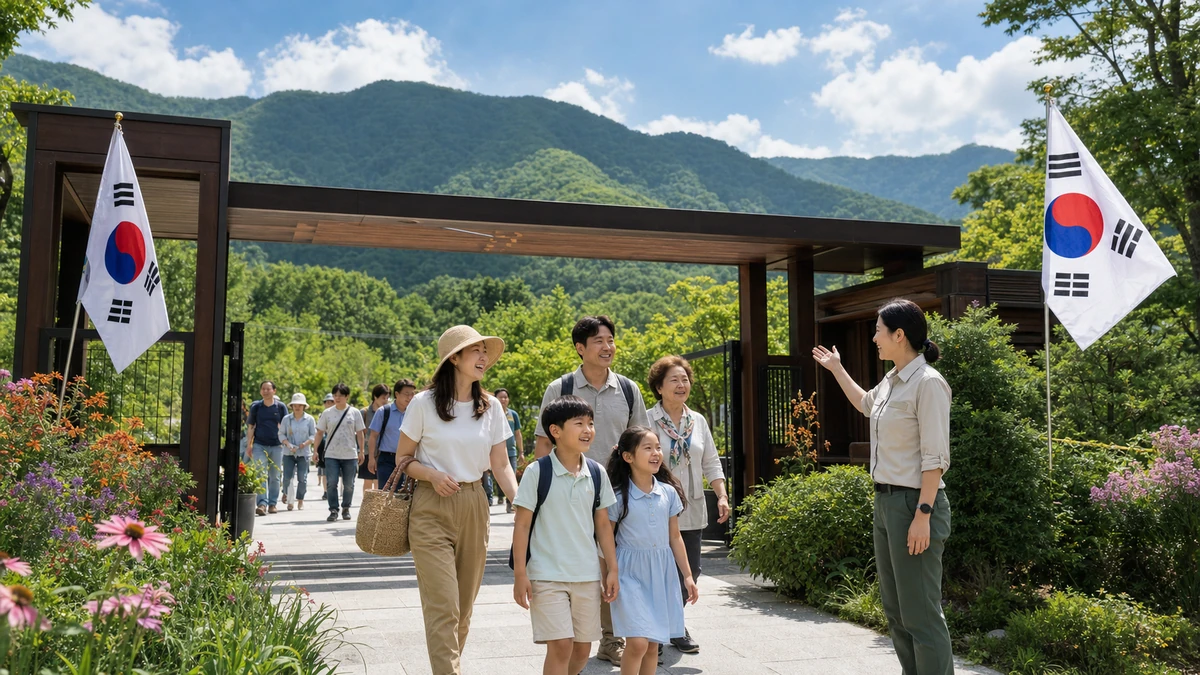
A civic holiday takes root in the outdoors
In the United States, patriotic observances often come with fireworks, parades or speeches on the courthouse steps. In South Korea this summer, one public institution is tying a national milestone to something quieter: a walk among trees.
The National Baekdudaegan Arboretum, a government-run botanical and forest site in Bonghwa, a rural county in North Gyeongsang Province, said it will offer free admission from July 17 through July 19 to mark the 78th anniversary of Constitution Day, one of South Korea’s major national commemorations. During the same three-day period, items sold at the arboretum’s garden shop will be discounted by 10%.
On its face, the promotion is simple: no admission fee for three days, plus a modest retail discount. But the event also says something about how South Korea increasingly presents public memory to ordinary citizens — not only through official ceremonies or textbook reminders, but through everyday cultural spaces where families, couples and tourists actually spend time.
Constitution Day in South Korea, known in Korean as Jeheonjeol, marks the promulgation of the country’s constitution in 1948, laying the foundation for the modern Republic of Korea. It is a date with clear historical weight, tied to the creation of the state after Japanese colonial rule and the upheaval that followed World War II. Yet unlike Independence Day in the United States, it is not primarily associated with fireworks or mass outdoor celebration. In recent years, it has often carried a more reflective, civics-oriented tone.
That is part of what makes the arboretum’s approach notable. Rather than treating the anniversary as a purely solemn occasion, organizers are inviting visitors to experience the meaning of the day through leisure, nature and culture. The message is subtle but clear: civic identity does not have to be confined to formal ritual. It can also be folded into the rhythms of summer travel, family outings and public recreation.
What Constitution Day means in South Korea
For readers more familiar with the American civic calendar than the Korean one, Constitution Day in South Korea occupies a somewhat unusual place. It commemorates the establishment of the nation’s constitutional order, a foundational step in the birth of the republic. In that sense, it carries echoes of the U.S. Constitution’s revered place in American political culture, though it is observed differently in public life.
South Korea’s Constitution Day falls on July 17, the anniversary of the 1948 proclamation of the constitution. The date reflects a broader national effort after liberation from Japanese rule in 1945 to build the institutions of a sovereign state. It is one of several official observances that help explain how South Korea narrates its modern history: colonial occupation, liberation, state-building, war, authoritarian rule, democratization and economic transformation.
To many Americans, civic holidays can feel abstract unless they are tied to a visible ritual or a day off from work. South Korea is not so different. The ideals embedded in a constitution — representation, rights, the rule of law, state legitimacy — are important but can feel distant from daily life. Public institutions have increasingly looked for ways to bridge that gap, translating national meaning into something more accessible and lived.
The arboretum’s free-admission plan is a case study in that approach. Rather than asking citizens to engage the anniversary only through speeches, flags or institutional messaging, it lowers the threshold to participation. Visitors come because it is free, because it is summer, because they want to get out of the house, because children need something to do, or because a trip to the mountains sounds appealing. Once there, the public meaning of the date becomes part of the experience.
That may sound modest, but it reflects a broader shift in how democratic societies often keep civic traditions alive. In the U.S., national parks, Smithsonian museums and presidential libraries do something similar when they tie public programming to historical milestones. The point is not to turn a serious commemoration into a shopping event or a picnic. It is to recognize that citizens often encounter national identity most meaningfully in shared public spaces, not just in classrooms or government buildings.
Why an arboretum matters in Korea
The setting matters here. The National Baekdudaegan Arboretum is not just a pretty garden. It sits in Bonghwa, in a region associated with the Baekdudaegan, the mountain spine that runs down the Korean Peninsula and holds deep ecological and cultural significance in Korea. For many Koreans, mountains are not merely scenic backdrops. They are central to national geography, local identity and everyday recreation.
If Americans think of the Blue Ridge Mountains, the Appalachian Trail or the national park system as places where landscape and identity meet, the Korean comparison would not be exact but it would be useful. Hiking is one of South Korea’s most popular leisure activities, and mountain landscapes carry a symbolic weight that goes beyond tourism. They represent continuity, heritage and a relationship between people and place that remains unusually strong in a highly urbanized country.
An arboretum in this context functions as more than a plant collection. It is a public cultural space, an educational institution, a conservation site and a leisure destination rolled into one. Families visit for fresh air. Students learn about biodiversity. Travelers see a side of Korea beyond Seoul’s high-rises and neon corridors. Public agencies use such spaces to connect policy, education and civic life.
That helps explain why the institution is framing this promotion not simply as a fee waiver but as an opportunity to rest in nature and enjoy culture while reflecting on the significance of the constitution. The language may sound broad, but it fits the way many Korean public venues present themselves: as spaces where education and recreation are not opposites, but complementary parts of a meaningful visit.
There is also an economic and practical dimension. Free admission reduces one of the small but real barriers that can keep people from making a trip, especially families traveling during a holiday window. Even when entrance fees are modest, removing them can change the psychology of a visit. It shifts the outing from something to weigh carefully against other expenses to something easier to say yes to.
By extending the offer over three days — July 17, 18 and 19 — the arboretum also spreads out traffic and gives visitors flexibility. Not everyone has the same schedule, and not everyone wants to travel on the actual commemorative date. In that sense, the event is designed less like a one-day civic ceremony and more like a public invitation.
Turning remembrance into an everyday experience
One of the most interesting aspects of the event is its underlying philosophy. The arboretum is effectively arguing that remembrance does not have to be heavy to be sincere. A constitutional anniversary can be recognized in a way that is calm, family-friendly and woven into ordinary life.
That matters in South Korea, where debates about history, identity and democracy are often intense. The country’s modern story includes war, division, military dictatorship, mass protest and a hard-won democratic transition. Civic values are not abstract in the Korean context; they have been contested, defended and redefined over decades. Yet institutions still face the practical challenge of how to keep those values meaningful for people who encounter them mostly as background noise in daily life.
The answer in this case is not a grand ideological campaign. It is a trip to a public nature site. Free entry encourages people to show up. Once there, the date itself becomes part of the frame through which the visit is understood. The benefit is tangible, but so is the symbolic connection: this leisure opportunity exists because the institution wants the public to engage, however lightly, with a foundational national anniversary.
That may strike some readers as a softer approach than Americans are used to. But public memory often works best when it is not forced. The event does not require visitors to take part in a ceremony, listen to a lecture or purchase anything. Instead, it offers choices. People can simply walk the grounds. They can browse the garden shop. They can come with children, with parents or with friends. The commemorative meaning is present, but it does not dominate the visit.
In a media environment where civic discourse is often polarized or performative, that kind of low-pressure public programming can be revealing. It shows a state institution trying to make a national day feel open rather than obligatory. It treats the public not as an audience to be instructed, but as participants whose own rhythms and preferences matter.
There is a democratic logic in that. A constitution, after all, is supposed to structure the relationship between citizens and the state. Marking its anniversary by opening a public space more widely to the public carries a quiet symbolism: access itself becomes part of the commemoration.
The details: free admission now, tiger-themed discounts later
The core offer tied to Constitution Day is straightforward. From July 17 to July 19, visitors to the National Baekdudaegan Arboretum will be admitted free of charge. During the same period, goods sold at the garden shop will be available at a 10% discount.
That discount is separate from another promotion the arboretum plans later in the month. From July 24 to July 29, it will hold a different sale tied to International Tiger Day, with tiger-related merchandise discounted by 15% to 20%.
The distinction matters because the two events reflect different aspects of the institution’s role. The Constitution Day program links a civic anniversary with public access to nature and culture. The later tiger-themed promotion points to the arboretum’s environmental and educational identity. The Baekdudaegan Arboretum is known not only for plants and gardens but also for broader ecological programming, including themes tied to wildlife and conservation.
To overseas readers, the mention of a tiger-themed event might seem random. It is not. Tigers carry strong symbolic weight in Korean culture and folklore, appearing in art, storytelling and national imagery. The Korean Peninsula’s tiger, especially the Siberian or Amur tiger, has long held an outsized place in the Korean imagination even as the animal disappeared from the South in the modern era. For institutions working at the intersection of nature, education and national symbolism, tiger programming is an intelligible fit.
Still, the Constitution Day offer is the more revealing of the two because it illustrates how public institutions in Korea package meaning. The benefits are concrete, but the presentation is also conceptual. This is not just “come shop” or “come save money.” It is “come reflect, rest and experience culture in nature” — a familiar formulation in Korean public messaging that aims to combine civic purpose with practical appeal.
Americans who have seen museums or parks in the U.S. use Veterans Day, Juneteenth or National Park Week for free-entry programming will recognize the strategy. The details differ, but the logic is shared: lower financial barriers, increase public participation and let the institution itself become the venue where history is encountered.
A window into Korean summer life beyond Seoul
For international readers, especially those whose impressions of South Korea come mostly from K-pop, K-dramas or the hyper-modern skyline of Seoul, stories like this offer a different view of the country. They show how Korean public life is also rooted in regional institutions, domestic travel and seasonal habits that unfold far from the capital’s celebrity districts and tech corridors.
Bonghwa is not a global tourist hub. That is part of the point. The arboretum event reflects a kind of Korean summer normalcy: traveling within the country, seeking out mountain air, visiting family-friendly public spaces and taking advantage of limited-time promotions tied to the civic calendar. It is the sort of story that may not go viral internationally, but it reveals how a country understands itself at the level of everyday life.
It also underscores the role of government-run cultural and environmental institutions in South Korea. Such venues are often expected to do many things at once: conserve resources, educate the public, support tourism, promote regional development and serve as accessible community spaces. A three-day free-admission event may seem small, but it fits squarely within that broader mission.
There is a lesson here for readers interested in the Korean Wave as more than entertainment. The global appeal of Korean culture did not emerge in a vacuum. It exists alongside a dense domestic ecosystem of public institutions, commemorative traditions and place-based cultural habits. When a national arboretum uses Constitution Day to invite citizens into a mountain landscape, it reflects a society where state institutions still see themselves as active shapers of public culture — and where the public often expects that role.
That expectation can look unfamiliar from an American vantage point, where cultural funding and public space are often more fragmented. But it helps explain why a Korean arboretum would confidently present itself as a place not just for plants, but for rest, learning and civic reflection.
For travelers or observers abroad, the story is also a reminder that Korean identity is not only urban and digital. It is agricultural, mountainous, historical and seasonal. It is found in roadside rest stops, temple trails, provincial festivals and public gardens as much as in music charts and streaming platforms.
More than a promotion
In the end, the National Baekdudaegan Arboretum’s Constitution Day program is easy to describe but worth reading closely. Yes, it is a free-entry event. Yes, it includes a 10% garden shop discount. But it is also a small example of how South Korea is trying to bring civic meaning into daily experience without making it feel obligatory or remote.
The institution’s framing is telling. It is not presenting the anniversary as a burden of remembrance or a test of patriotism. Instead, it is offering an open door: come spend time in nature, enjoy a cultural space and, in doing so, reconnect with the idea that the republic’s constitutional foundation belongs to the public.
There is something quietly modern about that. Around the world, democratic societies are struggling with how to make civic life feel real to citizens who are overwhelmed by politics, distracted by digital life or skeptical of official messaging. One answer is to create more places where public values can be encountered indirectly but meaningfully — through museums, parks, memorials, libraries and, in this case, an arboretum.
Whether visitors arrive thinking deeply about constitutional history or simply hoping for a pleasant summer outing, the event is designed to meet them where they are. That may be its smartest feature. Public institutions are often most effective not when they demand reverence, but when they invite participation.
For American readers, the scene may feel both foreign and familiar: a national anniversary, a public landscape, a government invitation to gather, reflect and enjoy a shared space. The particulars are Korean. The broader impulse is not. In any democracy, the challenge is the same — finding ways to make the abstract promises of public life visible, usable and close at hand.
For three days in July, in a mountain arboretum in southeastern South Korea, that challenge will be answered with free admission, discounted souvenirs and the simple proposition that civic memory can live comfortably among forests, families and a summer walk.
Comments
Post a Comment