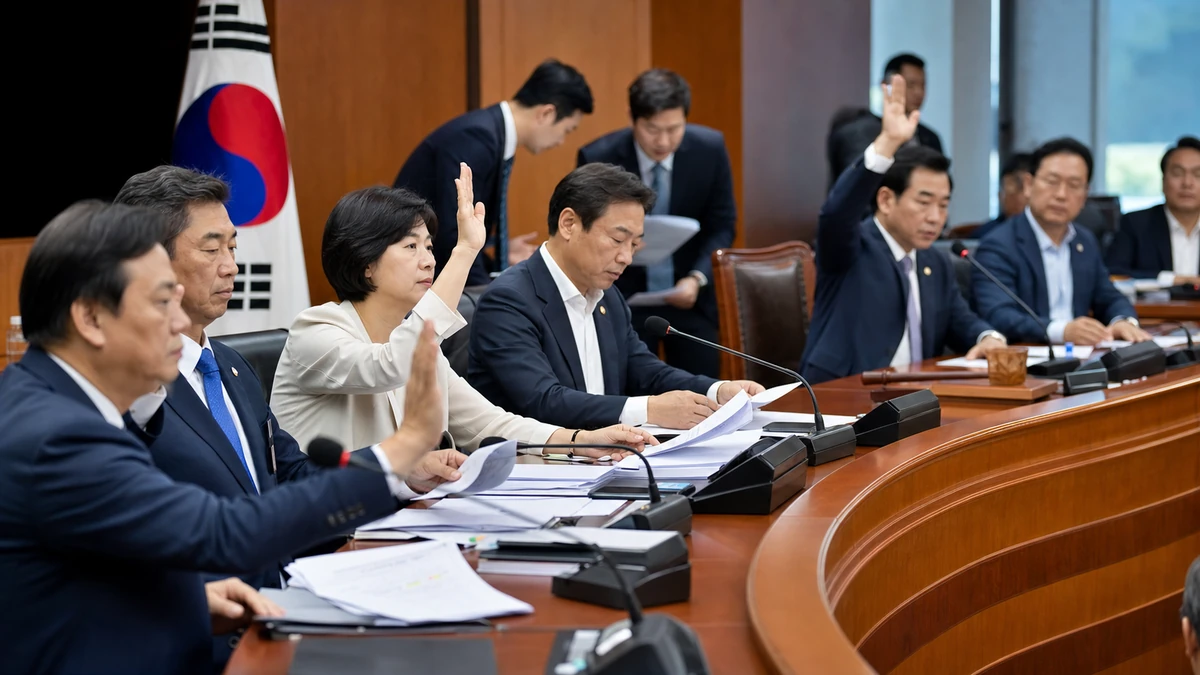
South Korea takes a procedural step with long-term consequences
South Korea’s National Assembly has taken an important, if easily misunderstood, step toward writing a longer-term climate strategy into law. On July 22, a subcommittee under the Assembly’s special committee on the climate crisis approved an amendment to the country’s framework law on carbon neutrality and green growth, setting out ranges for future greenhouse gas reduction targets through 2045.
The proposal does not set one final national target for each milestone year. Instead, it creates legal guardrails. Using 2018 emissions as the baseline, the amendment would require South Korea to set reduction goals within the following ranges: 53% to 61% by 2035, 69% to 80% by 2040, and 84% to 90% by 2045.
That distinction matters. In American political terms, this is less like Congress passing a final emissions cap and more like lawmakers establishing the boundaries within which the executive branch must later make a more specific policy choice. The Korean subcommittee did not declare that the country will cut emissions by exactly 69% in 2040, or exactly 90% in 2045. It approved a legal structure that says future administrations must choose targets within those ranges.
Just as important, this is not the final step in the legislative process. The measure cleared a subcommittee, not the full National Assembly. That may sound procedural, but in climate policy, procedure often determines what is durable and what is merely aspirational. The significance of the vote lies in the attempt to embed a long-term emissions pathway into law rather than rely only on broad pledges, policy papers or the priorities of any one administration.
For American readers, it helps to think of this as part roadmap, part guardrail and part political signal. South Korea is trying to show that climate policy should not be defined only by a single end date or a single headline number. Instead, the country’s lawmakers are testing a framework that lays out a progression over time, with milestones spaced in five-year increments and a baseline year fixed in law.
Why these ranges matter more than one eye-catching number
Climate targets often become a contest of shorthand. A country says it will cut emissions by a certain percentage by a certain year, and that headline figure becomes the story. But the Korean amendment points to something more technical and, arguably, more consequential: the architecture of target-setting itself.
Under the proposal, lawmakers would write the upper and lower bounds of medium- and long-term emissions reductions into statute for the period from 2031 to 2049. The more detailed numbers within those bands would then be set by presidential decree. That is a meaningful division of labor. The legislature defines the floor and the ceiling; the executive chooses the precise point in between.
There are political advantages to that design. A statutory minimum can keep a future government from watering down climate ambition below a legally defined threshold. At the same time, a range allows policymakers to adjust for economic shifts, technological change, energy security concerns and the realities of implementation. South Korea, like many advanced economies, is balancing multiple pressures at once: industrial competitiveness, electricity demand, trade exposure, manufacturing jobs and a public that may support climate action in principle but feel differently about higher costs in practice.
For readers in the United States, where climate policy often swings sharply depending on which party controls the White House or Congress, the Korean model may look familiar in spirit even if different in form. American debates regularly turn on whether durable climate action should be enacted through legislation, regulation or executive action. South Korea appears to be grappling with a similar question: How do you create a climate framework that is both binding enough to matter and flexible enough to survive political turnover?
The answer suggested by this amendment is that ranges can be a feature, not a weakness. Critics may see a spread like 69% to 80% for 2040 as imprecise. Supporters will argue that the range itself is the point. It establishes an enforceable zone of ambition. The exact number may come later, but the country would no longer be free to drift below the legal minimum without changing the law.
What the baseline year tells us
All three milestones in the proposal are measured against 2018 emissions. That may sound like a technical detail, but it is central to understanding the policy. Climate targets can be misleading if the baseline year is unclear, because the same percentage cut can look much more or less ambitious depending on the starting point.
By fixing 2018 as the reference year for 2035, 2040 and 2045 alike, South Korea gives the public and international observers a common measuring stick. That makes it easier to compare the three goals as part of a single trajectory. The proposal essentially says: start from one known point, then keep increasing the reduction level over time.
That rising slope is the most striking feature of the plan. The proposed 2035 range is lower than the 2040 range, which is lower than the 2045 range. In plain English, South Korea is not treating decarbonization as one big promise in the distant future. It is sketching out a step-by-step tightening path across the mid-2030s and mid-2040s.
For Americans used to hearing about net-zero pledges for 2050, that should sound familiar. What is less common in public discussion is the idea that long-term goals need intermediate checkpoints sturdy enough to shape investment decisions now. Utilities, automakers, chipmakers, steel producers, builders and local governments do not plan on election cycles alone. They plan on timelines measured in decades. The practical value of a legally signaled pathway is that it helps those sectors anticipate where regulation, public investment and market expectations may be heading.
South Korea’s economy makes that especially important. The country is a major manufacturing power, heavily integrated into global supply chains and deeply exposed to energy and trade dynamics. It is home to globally recognized brands in semiconductors, batteries, autos, shipbuilding and heavy industry. Those sectors all stand to be affected, directly or indirectly, by how aggressively the country cuts emissions over time.
None of that means the amendment answers every question. It does not, based on the information currently available, specify which industries would shoulder what burden or which regions would see the biggest changes. It does not lay out a sector-by-sector map of winners and losers. But it does send a clear long-range signal: the country is considering a legal framework in which emissions reductions become progressively deeper as the 2030s give way to the 2040s.
Understanding the Korean political context
To make sense of this development, it helps to understand a bit about how South Korea’s political system handles major policy questions. The National Assembly is the country’s legislature, and like Congress in the United States, it often uses committees and subcommittees to shape legislation before it reaches a broader vote. A special committee, or one created for a focused issue such as the climate crisis, can function as a venue for detailed policy negotiations that would be difficult to conduct on the Assembly floor.
That is why the phrase “subcommittee approval” should not be overstated, but also should not be dismissed. In Washington terms, it is not the same as final passage. But it can still mark an important threshold, especially when lawmakers are trying to define the framework for a politically and economically sensitive issue.
The Korean law at issue here is often referred to in English as the Carbon Neutrality Framework Act, part of a broader legal structure for responding to climate change and promoting what policymakers call green growth. “Green growth” is a phrase that has long had particular resonance in South Korea. It reflects an effort to frame climate action not only as environmental protection but as industrial strategy, technological modernization and future competitiveness. Americans may hear echoes of the way U.S. leaders talk about clean energy jobs, advanced manufacturing or the race to dominate battery and electric vehicle supply chains.
Another cultural and political point worth noting is how South Korea often approaches long-horizon national challenges. The country’s modern history includes periods of state-led economic planning, rapid industrial transformation and intense public-private coordination. That does not mean every long-term plan succeeds. It does mean that when Korean lawmakers try to establish a multidecade policy timetable, they are operating within a political culture that is relatively comfortable with national development strategies and milestone-driven agendas.
Climate policy, of course, is more complicated than building highways or expanding broadband. It cuts across daily life, consumer prices, labor markets, geopolitics and international trade. Even so, the effort to legislate a long-term timeline fits a broader Korean habit of treating big structural problems as matters for institutional design, not just rhetorical commitment.
What this could mean for Korean society and the global economy
The immediate news is legislative and procedural. The broader implications are social and economic. When a country begins to define a legal emissions pathway through 2045, it is not merely talking about atmospheric chemistry. It is signaling future expectations for power generation, transportation, construction, industrial processes and consumer behavior.
For Korean households, that could eventually shape everything from electricity sourcing to housing standards to the types of vehicles encouraged or discouraged by policy. For businesses, it may affect capital spending, technology choices and export strategy. South Korea’s largest companies do not operate only in the domestic market. They sell into North America, Europe and beyond, where carbon rules, supply chain disclosures and green industrial policy are becoming increasingly important.
That is one reason the story matters outside Korea. The country is one of the world’s most important trading nations and a major player in sectors central to the energy transition. If South Korea hardens its long-term climate framework, companies in the United States and elsewhere may take notice, particularly those tied to batteries, semiconductors, autos, shipping and clean technology.
There is also a geopolitical dimension. Asian economies are under growing pressure to show credible climate pathways while maintaining industrial competitiveness against rivals in the United States, China and Europe. South Korea’s effort to codify a multi-stage emissions trajectory can be read as part of that larger competition. Climate policy is no longer just about environmental credibility. It is also about who captures future industries, who avoids trade friction and who adapts fastest to a world where carbon intensity increasingly affects market access.
At the same time, no climate pathway exists in a vacuum. South Korea remains heavily dependent on energy imports and must weigh decarbonization against energy security, especially in a volatile global environment. That tension should sound familiar to American readers, who have watched similar debates play out around natural gas, oil production, grid reliability and the pace of renewable deployment. The Korean amendment does not resolve those tensions. It simply tries to create a legal time horizon within which those debates will unfold.
Why the process matters as much as the policy
The easiest way to misread this story would be to treat the proposed numbers as final, settled national targets. They are not. What has happened so far is narrower and, in some ways, more interesting. A legislative subcommittee has endorsed a bill that would define the allowable range of future climate targets, leaving the exact figures to be determined later through presidential decree.
That process may sound bureaucratic, but climate governance is full of these seemingly technical design choices. Who chooses the number? How much discretion does the executive branch have? What happens if a future government wants to backtrack? Is there a legal minimum? Is there a maximum? Those questions can matter as much as the target itself because they determine whether climate commitments survive changing political winds.
There is a lesson here for international readers and reporters alike. Climate stories often compress multiple stages of policymaking into one dramatic headline. A pledge, a bill, a decree, a committee vote and a final law can blur together in public understanding. But accuracy requires separating them. In this case, the clearest verified facts are these: a Korean National Assembly subcommittee approved an amendment; the amendment includes emissions-reduction ranges for 2035, 2040 and 2045 based on 2018 levels; and it envisions detailed targets being chosen within those ranges by presidential decree if the broader legislative process is completed.
That may seem less dramatic than a final national climate commitment. Yet it reveals something consequential about how South Korea is thinking. Rather than anchor the conversation to a single distant finish line, lawmakers are experimenting with a legal framework that turns decarbonization into a sequence of linked milestones. It is a way of saying that climate policy should not depend on one administration’s slogan or one summit’s announcement. It should have a timetable.
A signal of long-term intent, with plenty left to decide
Even at this early stage, the Korean proposal offers a window into how a close U.S. ally is trying to structure the politics of climate action. The most important takeaway is not that South Korea has definitively chosen one set of emissions targets through 2045. It has not. The deeper story is that Korean lawmakers are trying to define the rules of the game for how those targets get set over the long haul.
That approach reflects both ambition and caution. Ambition, because the ranges point toward steep emissions cuts over time. Caution, because the law would preserve room to decide the exact level later, within legislatively fixed boundaries. In a field where rigid promises can prove politically fragile and vague promises can prove meaningless, South Korea appears to be searching for a middle path.
For American readers, this may be one of the most relatable aspects of the story. The United States has long wrestled with how to build climate policy that is durable, credible and adaptive. South Korea’s subcommittee vote suggests it is wrestling with the same challenge from a different institutional angle.
What happens next will determine whether this becomes a lasting part of Korean law or remains a notable but incomplete step. For now, the news is best understood not as the final word on South Korea’s climate future, but as a sign that the country wants to write that future in a more structured way. In climate policy, where governments are often better at setting aspirational endpoints than mapping the road between them, that alone is worth watching.
Comments
Post a Comment