South Korea Moves to Shape the Next Era of Trade, Joining New Partnership Focused on Supply Chains, Digital Rules and Green Growth
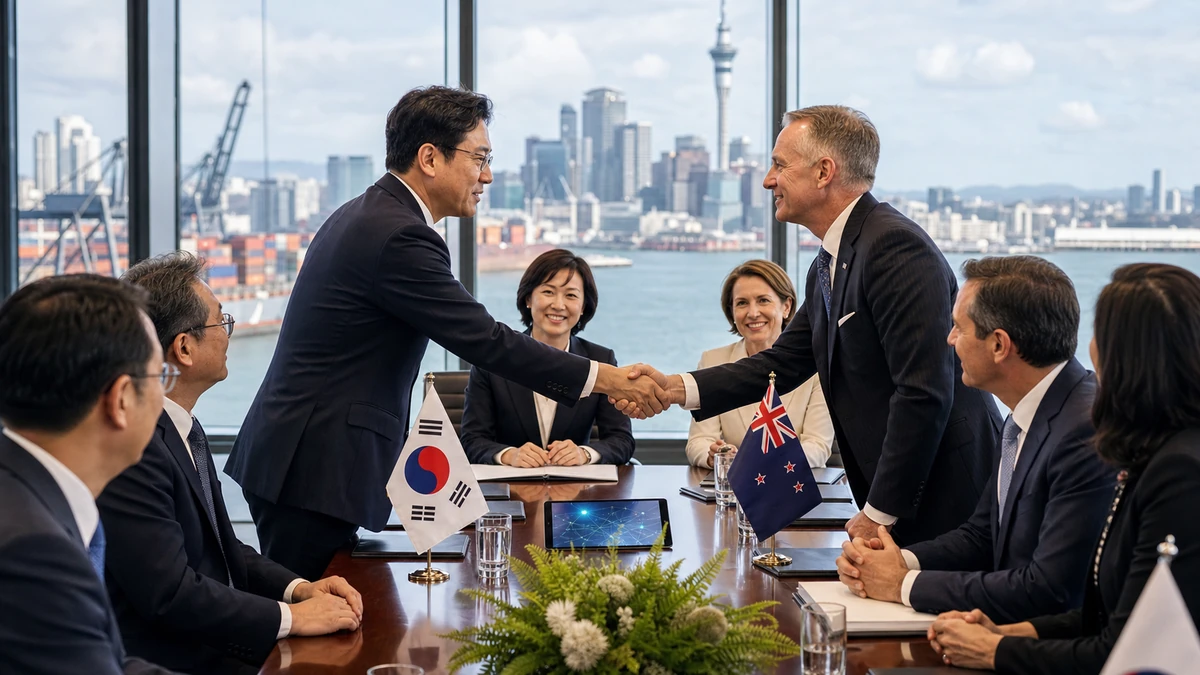
South Korea steps into a different kind of trade club
South Korea has formally joined a new international trade initiative aimed less at lowering tariffs on goods and more at writing the rules for how countries will handle some of the biggest economic challenges of the next decade: supply chain disruptions, the digital economy, environmental standards and access to critical minerals. The move, announced at a ministerial meeting in Auckland, New Zealand, signals that Seoul wants a seat at the table not just when trade deals are signed, but when the ground rules are still being written.
According to the South Korean government, Trade Minister Yeo Han-koo attended the second ministerial meeting of the Future Investment Trade Partnership, or FIT-P, where South Korea’s participation was officially declared. For American readers, the significance of the move is similar to a country deciding it does not want to merely comply with the next generation of global economic rules, but to help draft them from the outset.
That distinction matters. For decades, trade policy was often understood in familiar terms: tariffs, quotas, market access and the movement of manufactured goods across borders. But recent years have exposed how incomplete that framework has become. The coronavirus pandemic, semiconductor shortages, shipping bottlenecks, geopolitical tensions and the race for clean-energy materials have all underscored that modern trade policy now reaches into logistics networks, data governance, climate policy and industrial strategy.
South Korea, one of the world’s most export-dependent advanced economies, has more at stake than many countries in how those rules develop. Home to global manufacturing heavyweights in chips, autos, batteries, consumer electronics and shipbuilding, the country depends on stable access to inputs and open overseas markets. A disruption in lithium supplies, stricter digital regulations or changing carbon-related trade standards can affect South Korean companies almost as directly as a tariff hike once did.
That is the broader context behind Seoul’s FIT-P decision. South Korea is not simply joining another multinational forum for symbolic diplomatic value. It is aligning itself with a growing view among trade policymakers that the future of commerce will be shaped as much by data flows, environmental benchmarks and resilience planning as by customs duties at the port.
Why this matters beyond traditional free trade
At its core, South Korea’s entry into FIT-P reflects a strategic shift in how governments think about trade. In older free trade agreements, the main goal was usually straightforward: reduce barriers so goods and services could move more easily. FIT-P appears to be part of a newer generation of trade arrangements focused on what officials in Seoul describe as “new trade norms” — rules for emerging areas that cut across multiple sectors at once.
Those areas are deeply connected. A supply chain is not only about where a factory gets parts; it is also about whether companies can monitor shipments digitally, whether customs systems can exchange data securely and whether producers can adapt to tougher environmental rules in export markets. In practical terms, a battery maker in South Korea might need steady mineral imports from Latin America, cloud-based data tools to manage production, and compliance systems to satisfy climate-related regulations in Europe or North America. FIT-P is designed to address those kinds of overlapping realities.
For Americans, there is a useful parallel in the way Washington has increasingly talked about “friendshoring,” semiconductor resilience and clean-energy supply chains. The Biden administration, like many U.S. allies, has pushed the idea that trade can no longer be separated from national security, digital governance or climate policy. South Korea’s latest move fits squarely into that trend. It suggests Seoul sees the next era of trade as a contest over standards, trusted networks and strategic coordination, not just market opening.
There is also an important institutional point. South Korea’s trade ministry made clear that one purpose of joining FIT-P is to participate proactively in discussions that will shape new rules, rather than simply adapt after those rules are settled. For a country whose economy is heavily integrated into global manufacturing networks, early participation matters. If standards on digital commerce, supply chain transparency or green industrial cooperation are designed without South Korean input, Korean companies could later face compliance burdens or commercial disadvantages they had little role in shaping.
That is why Seoul’s entry into FIT-P is likely being viewed in government and industry circles as a defensive and offensive move at the same time. Defensively, it helps protect South Korea’s interests in evolving trade governance. Offensively, it gives the country a platform to expand practical cooperation with a range of partners on issues that are likely to define industrial competitiveness for years to come.
New Zealand, Singapore and the diplomacy of practical cooperation
One of the more notable aspects of South Korea’s announcement is that it was paired with discussions of concrete bilateral cooperation, rather than left as a broad diplomatic statement. With New Zealand, South Korea said it would strengthen cooperation in three areas: supply chains, digital issues and the environment. The talks involved New Zealand Trade and Investment Minister Todd McClay.
That combination is revealing. New Zealand is not one of South Korea’s largest trading partners in the way China, the United States or Japan are. But that may be part of the point. The FIT-P framework appears to be as much about building trusted policy networks and rules-based coordination as it is about headline-grabbing commercial volume. By naming supply chains, digital cooperation and environmental coordination together, Seoul is showing that it wants to build issue-specific partnerships across a wide set of countries, not only with its biggest traditional markets.
At the same time, the announcement came with limits. South Korea did not disclose specific projects, targeted products, participating companies, investment amounts or implementation timelines in connection with New Zealand. That means the present significance is political and strategic rather than transactional. It would be premature to interpret the talks as a finalized business deal or an immediate realignment of industrial flows. The real test will come later, when officials spell out whether cooperation means data-sharing arrangements, joint initiatives on sustainable trade practices, resilience dialogues on key imports, or something more sector-specific.
South Korea took a similarly forward-looking approach in its talks with Singapore. Yeo met with Singapore Deputy Prime Minister Gan Kim Yong, who also oversees trade and industry, and the two sides discussed expanding cooperation through an upgraded bilateral free trade agreement. Here again, the emphasis was not merely on existing trade volumes but on linking a preexisting trade framework to newer priorities such as supply chain cooperation and the green economy.
That matters because Singapore, like South Korea, is a highly globalized economy that often punches above its size in trade diplomacy, logistics and regulatory innovation. In Asia, Singapore is frequently treated as a laboratory for advanced trade rules, especially around digital commerce and business-friendly regulation. If Seoul can use an updated agreement with Singapore to deepen cooperation in supply chain resilience and green growth, it would provide a template for how conventional trade deals can be modernized to address 21st-century concerns.
For American readers used to trade debates framed around giant bilateral deficits or factory jobs, this style of diplomacy may sound more technocratic. But it is increasingly where the action is. Much of the real competition in global trade now happens through standard-setting, regulatory compatibility, technological trust and control over strategic inputs. South Korea is making clear that it intends to compete in that arena.
Critical minerals bring Latin America into the picture
If the New Zealand and Singapore talks showed the policy architecture of South Korea’s new trade strategy, Seoul’s conversations with Chile highlighted the hard industrial logic beneath it. On the sidelines of the Auckland meeting, South Korean officials discussed cooperation with Chile in critical minerals, specifically lithium and copper.
Those two materials sit near the center of the global clean-energy transition. Lithium is essential for many rechargeable batteries used in electric vehicles, energy storage systems and consumer electronics. Copper is a foundational material for power grids, electric motors, renewable energy infrastructure and an enormous range of industrial applications. Any country serious about batteries, electric vehicles or advanced manufacturing has a growing interest in securing reliable access to both.
South Korea has every reason to care. The country is home to major battery makers and manufacturers deeply connected to the electric vehicle supply chain. For those companies, the question is not abstract. Access to critical minerals can affect production planning, pricing, investment strategy and long-term competitiveness. In Washington, Brussels, Tokyo and Seoul alike, officials increasingly see critical minerals not just as commodities, but as strategic assets.
Chile, meanwhile, is one of the world’s most important producers of both lithium and copper. So even though the South Korean government did not announce a contract, supply agreement or financing package, the very fact that these minerals were singled out is significant. It shows how Seoul is using multilateral trade gatherings to advance highly practical, country-specific economic conversations. FIT-P, in other words, is serving not only as a forum for new-rule discussions, but also as a networking platform for targeted economic diplomacy.
Still, caution is warranted. The South Korean summary indicates only that the two sides discussed possible cooperation. It did not provide figures, company names, pricing terms, procurement volumes or a timeline. That means there is no basis yet to conclude that Korea has locked in new supplies or altered its import strategy in a concrete way. But it does suggest that critical minerals are firmly embedded in Seoul’s broader trade thinking — and that supply chain policy, in Korea’s view, now stretches from rule-making to raw materials access.
That approach mirrors trends in the United States and Europe, where governments are trying to reduce dependence on concentrated mineral supply chains without abandoning global trade altogether. South Korea appears to be pursuing a similar middle course: diversify relationships, widen strategic options and stay active in the international conversations that determine how those supply chains will function.
Uruguay and the wider push into South America
South Korea also used the Auckland meeting to widen its trade diplomacy with South America beyond mineral discussions. Officials said Seoul and Uruguay agreed to consult on restarting negotiations for a trade agreement between South Korea and Mercosur, the South American customs bloc that includes Brazil, Argentina, Paraguay and Uruguay.
That may sound like a niche diplomatic footnote, but it points to a broader geographic strategy. South Korea is not treating its FIT-P participation as limited to one set of member-state conversations or one thematic agenda. Instead, it appears to be leveraging the gathering to revive or expand multiple trade channels at once — across Oceania, Southeast Asia and Latin America.
Mercosur has long represented both promise and frustration for outside economies seeking deeper access to South American markets. The bloc is economically significant, especially because of Brazil and Argentina, but negotiations can move slowly and are often shaped by domestic political sensitivities over agriculture, manufacturing and industrial policy. For South Korea, reopening the conversation through Uruguay suggests an effort to rebuild momentum where previous trade ambitions have stalled or become politically complicated.
Again, the announcement stops short of saying negotiations have formally restarted. The more precise point is that the two sides will consult on how to resume them. That distinction matters in trade reporting, where diplomatic language can easily be overstated. But even at this preliminary stage, the move demonstrates how Seoul is trying to connect multilateral engagement with bilateral and regional openings elsewhere.
There is a larger lesson here about how middle powers like South Korea operate in a fragmented global economy. Rather than betting everything on one giant trade deal or one strategic partner, they often build layered networks: a multilateral forum here, a bilateral upgrade there, a supply chain conversation with one country, a mineral dialogue with another. The result is a denser web of economic relationships that can provide flexibility when geopolitics or markets become more volatile.
For South Korea, that flexibility is especially important. Its export model has delivered remarkable prosperity, transforming a war-ravaged country into one of the world’s leading industrial economies in a matter of generations. But that same openness leaves it vulnerable to external shocks. Expanding connections with countries like Uruguay and Chile, while deepening policy coordination with partners like Singapore and New Zealand, is part of an effort to make that openness more resilient.
What this means for Korean companies and the global economy
For businesses, the real value of new trade initiatives often lies not in the press release but in the eventual rules, procedures and relationships that follow. South Korea’s FIT-P entry does not automatically guarantee export gains, new contracts or investment wins for Korean firms. Yet it could shape the environment in which those companies operate in meaningful ways.
If FIT-P helps establish common approaches to supply chain resilience, Korean manufacturers may gain more predictable access to information, partner networks or coordination mechanisms during future disruptions. If digital trade rules become more interoperable, companies that rely on cross-border data, e-commerce systems or digitally managed production chains could face fewer barriers. If environmental cooperation produces clearer standards or coordinated green-economy strategies, Korean exporters may find it easier to adapt to a world of tougher climate-related expectations.
That is especially important for South Korean firms because many of them sit near the center of global industries undergoing rapid change. Think about semiconductors, electric vehicles, battery manufacturing, advanced displays, clean-energy technology and high-end consumer electronics. These industries no longer compete solely on cost or product quality. They also compete on access to strategic materials, exposure to geopolitical risk, regulatory compliance and the ability to navigate shifting digital and climate-related rules.
In that sense, what may sound like an abstract trade initiative is actually closely tied to corporate strategy. A battery maker cares whether lithium sources are stable. A chip or electronics producer cares whether logistics networks are resilient. An exporter selling into climate-conscious markets cares how environmental standards are evolving. A company with multinational operations cares whether digital systems can function across borders without excessive friction. FIT-P sits at the intersection of all of those concerns.
There is also a political economy dimension. South Korea is often discussed abroad through the lens of the Korean Wave — K-pop, K-dramas, film, food and fashion — or through the security tensions of the Korean Peninsula. Those are important parts of the story, but they can obscure just how central trade strategy is to the country’s identity and economic survival. South Korea is one of the clearest examples in the world of a nation whose prosperity depends on remaining deeply plugged into global commerce while constantly adapting to new conditions.
For U.S. readers, that may make South Korea a particularly useful case study in how advanced economies are rethinking trade. The debate is no longer a simple choice between free trade and protectionism. Increasingly, governments are trying to design systems that preserve openness while managing vulnerability — not decoupling entirely from the world, but reducing exposure to the kinds of shocks that can cripple industries or hand leverage to rivals.
The next test is implementation, not ceremony
The official declaration in Auckland marks a starting point, not a finished achievement. South Korea has made clear that it wants to participate in shaping new trade norms and broaden practical cooperation with a range of partners. The harder question is what that ambition will produce over time.
With New Zealand, the key issue will be whether the broad areas of supply chains, digital cooperation and environmental coordination turn into measurable projects or policy mechanisms. With Singapore, attention will focus on whether an upgraded free trade agreement can meaningfully incorporate new priorities such as supply chain resilience and green-economy cooperation. With Chile, observers will be watching to see whether mineral discussions mature into concrete arrangements involving companies, investment structures or long-term procurement strategies. And with Uruguay, the question is whether consultations can actually revive momentum toward broader engagement with Mercosur.
There is also the wider challenge of converting rule-making participation into economic advantage. Joining a forum is one thing; shaping its agenda is another. South Korea will need to show that it can translate its industrial strengths and trade experience into influence over how emerging standards are framed. That will require diplomatic skill, sustained bureaucratic follow-through and likely close coordination with the private sector.
Still, the strategic logic is hard to miss. South Korea is signaling that it does not want to be a passive taker of the next generation of trade rules. It wants to help define them, while simultaneously building country-by-country relationships that can support its industries in a more uncertain world.
That may prove to be the most important takeaway from Auckland. The future of trade is no longer just about shipping more goods at lower tariff rates. It is about who writes the standards for resilient supply chains, trusted digital commerce, green industrial cooperation and access to the materials that power the modern economy. South Korea has now formally joined that contest — and for a country whose economic fortunes have long been tied to the global marketplace, that could be one of the most consequential trade decisions it makes this year.
Comments
Post a Comment