South Korea Turns Its Ports Into Offshore Wind Hubs, Betting Harbor Infrastructure Will Shape the Clean Energy Race
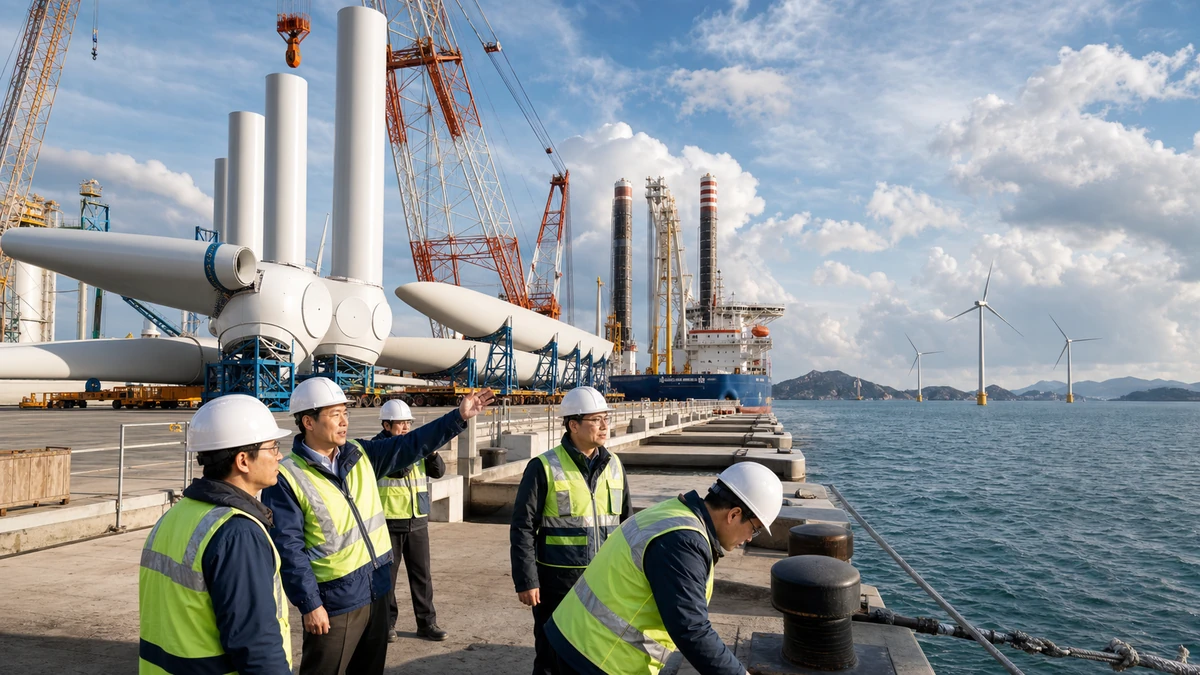
South Korea is rethinking what a port is for
South Korea is moving to expand port infrastructure in five cities to support the offshore wind industry, a sign that one of Asia’s most export-driven economies increasingly sees harbors not just as gateways for cargo ships, but as industrial platforms for the energy transition.
The country’s Ministry of Oceans and Fisheries said it plans to formally revise its national port development blueprint to add offshore wind support facilities at five ports: Mokpo, Gunsan, Incheon, Ulsan and Taean. The updated plan, scheduled to be announced this week, calls for expanding a total of eight berths tied to the offshore wind supply chain.
For American readers, a berth is essentially a docking space where a vessel can tie up to load, unload or stage operations. That might sound technical, but it matters. Offshore wind projects require enormous blades, towers, foundations, cables and specialized installation vessels. Those components do not move through an ordinary logistics system as easily as containers filled with consumer goods. They need heavy-lift space, assembly areas, storage yards and a shoreline industrial network that can handle outsized cargo safely and efficiently.
That is what makes South Korea’s latest move noteworthy. The government is not simply adding more waterfront real estate. It is signaling that port planning itself must adapt to new industries, especially those tied to decarbonization and advanced manufacturing. In the United States, similar conversations have played out around ports from New Bedford, Massachusetts, to New Jersey and Virginia, where state and federal officials have pushed to build staging areas for offshore wind farms along the Atlantic coast. South Korea appears to be making a comparable calculation: Whoever wants to compete in offshore wind needs more than turbines at sea. It needs the industrial choreography on land to make those projects possible.
The announcement also reflects a broader change in how governments think about infrastructure. Ports were once viewed primarily through the lens of shipping and trade volume. Increasingly, they are being treated as strategic assets in supply chains for semiconductors, batteries, hydrogen and renewable energy. South Korea, which has spent decades building a global reputation in shipbuilding, steel, autos and electronics, is now trying to connect those industrial strengths to the next phase of clean energy development.
At the center of the new plan is a straightforward but important idea: Offshore wind is not just an electricity story. It is also a logistics story, a manufacturing story and a regional development story.
Why offshore wind needs specialized ports
Offshore wind farms can look deceptively simple from afar: rows of turbines standing in the ocean, turning wind into electricity. But building them is an unusually land-intensive industrial process. Before a single turbine is installed offshore, massive components must be manufactured, transported, assembled and loaded onto vessels capable of carrying extraordinary weight and size.
A modern offshore wind blade can stretch longer than a football field. Foundations can weigh hundreds or even thousands of tons. Tower sections are too large for many conventional transport routes and often require careful handling at every step. Ports become the places where those pieces come together. They are the hinge between factory production on land and energy generation at sea.
That helps explain why South Korea’s government is emphasizing support berths rather than discussing offshore wind solely in terms of generation targets. Without the right marine infrastructure, even ambitious renewable energy plans can stall. Delays can come from bottlenecks in loading capacity, insufficient storage space, weak transport links or the lack of a port configured for repeated movement of oversized components.
In that sense, a port built for general cargo is not necessarily ready for offshore wind. The operational needs are different. Heavy components may need reinforced quays. Installation vessels need adequate water depth and maneuvering space. The cargo flow is less like container shipping and more like a carefully timed industrial sequence, where delays in one component can disrupt an entire project schedule offshore.
For U.S. readers, the comparison to the American East Coast is useful. One reason offshore wind development there has required substantial public and private investment onshore is because the marine side of the business is inseparable from the land side. States have spent years upgrading terminals and dredging channels because turbines cannot simply be trucked to a random dock and loaded onto any ship. South Korea’s decision suggests officials there are taking the same lesson seriously.
It also reflects the economics of competition. Offshore wind developers want predictable, efficient logistics. Manufacturers want ports that can support long-term production and shipment. Regional governments want jobs, industrial clustering and supply-chain investment. When a national government designates multiple ports to support one industry, it is doing more than planning transportation infrastructure. It is trying to shape where economic activity will gather.
A five-port network instead of a single mega-hub
One of the most important parts of South Korea’s plan is geographic. Rather than concentrate offshore wind support in a single flagship port, the revised blueprint spreads the effort across five ports in different parts of the country: Mokpo in the southwest, Gunsan on the west coast, Incheon near the Seoul metropolitan area, Ulsan in the southeast and Taean on the west coast.
That matters because offshore wind is inherently regional. Projects are built in different waters under different seabed, wind and grid conditions. Manufacturing clusters may emerge in one place, vessel operations in another and component storage in a third. A multi-port strategy can offer flexibility, reduce congestion and better align port roles with nearby industrial and energy demand.
It also fits South Korea’s geography. The country’s coastlines open onto several economically significant marine zones, and its industrial base is not concentrated in a single region. Incheon connects to the capital area, where a large share of South Korea’s population and corporate activity is based. Ulsan is already synonymous with heavy industry, shipbuilding and petrochemicals. Gunsan and Taean sit closer to the country’s western seaboard, an area often discussed in energy and industrial planning. Mokpo, meanwhile, is positioned in the southwest, where policymakers have long seen potential for offshore wind development.
By linking several ports instead of elevating only one, Seoul is effectively building a network model. That does not mean every port will do the same thing. In fact, the strategy appears to depend on differentiation. Some ports may be better suited to storage and staging, others to manufacturing support, others to vessel servicing or distribution. The current announcement does not spell out every operational detail for every berth, but the overall direction is clear: South Korea wants a distributed support system, not a single chokepoint.
That is a familiar lesson in industrial policy. In the United States, federal and state governments often talk about “supply chain resilience,” a phrase that gained prominence after pandemic-era disruptions and geopolitical tensions exposed the risks of overconcentration. South Korea’s port plan, while tailored to offshore wind, reflects a similar instinct. If an industry is going to become strategic, its supporting infrastructure cannot be overly fragile or geographically narrow.
There is also a political dimension. Spreading infrastructure across multiple ports can help distribute economic opportunity and align national policy with regional development agendas. Ports are fixed assets; they cannot be relocated like an office tower or software team. That means every major port investment carries local implications for jobs, land use and business attraction. When the central government includes several regions in one plan, it is also making a statement about how the benefits of a growth industry should be shared.
Mokpo’s role shows how targeted the strategy is becoming
The clearest signal in the revised plan concerns Mokpo, where some berths are expected to be assigned a dedicated role for handling offshore wind equipment. That may sound like a narrow administrative detail, but it is arguably the most concrete part of the government’s announcement.
In practical terms, designating berths for offshore wind equipment means the port is being asked to specialize. Instead of functioning only as a general-purpose facility where many kinds of cargo compete for space and scheduling, part of Mokpo would take on a more defined role in a clean energy supply chain. That can improve efficiency because operators, planners and nearby businesses know what the port is meant to handle and can invest accordingly.
It also highlights the importance of South Korea’s southwest region, often referred to domestically as the southwestern zone or the southwest corridor. For readers unfamiliar with Korean regional terminology, that language is similar to the way U.S. policymakers might talk about the Gulf Coast, the Midwest manufacturing belt or the Northeast corridor. It refers not just to geography, but to a cluster of economic ambitions and infrastructure connections. In this case, the government is tying Mokpo’s port function directly to the development of the southwest’s offshore wind industry.
That linkage matters because offshore wind supply chains tend to reward proximity. The closer a port is to project sites and associated manufacturers, the easier it is to move giant components and maintain scheduling discipline. A dedicated equipment-handling function can also make it easier for companies to justify investing nearby, whether in fabrication, storage, vessel services or engineering support.
South Korea has not announced, at least in the summary of the plan, the full list of private-sector contracts, capital commitments or construction timelines that would turn that strategy into visible commercial activity. But the inclusion of specialized port functions in the national plan is significant in its own right. It tells the market that the state is reserving physical and policy space for offshore wind, rather than treating it as an ad hoc or temporary use.
For international observers, Mokpo may become a case study in how a mid-sized regional port can be repositioned for the energy transition. The story is not unlike what some former industrial waterfronts in Europe and North America have tried to do: convert legacy maritime infrastructure into a launchpad for new energy industries. The difference is that South Korea is attempting to do so through a centralized national planning framework, rather than through a patchwork of local redevelopment initiatives alone.
What this says about Korean industrial policy
South Korea is often described abroad through its most recognizable exports: Hyundai cars, Samsung electronics, K-pop, Oscar-winning films and globally popular Korean dramas. But underneath that cultural and consumer visibility is a state with a long history of industrial planning and infrastructure coordination. The offshore wind port expansion fits squarely into that tradition.
The measure comes through a revision to the country’s fourth national port master plan, which covers 2021 through 2030. Under South Korean law, such plans are set on a 10-year basis and reviewed every five years for possible revision. For Americans, this kind of framework can sound unusually centralized. U.S. infrastructure planning is often fragmented across federal, state, local and private actors, with changes shaped by appropriations fights, permitting battles and elections. South Korea’s approach allows it to embed industrial priorities into long-range infrastructure documents with comparatively direct administrative force.
That does not guarantee success. Long-term plans can still run into financing issues, local opposition, market changes or technology shifts. But it does create a clearer institutional pathway for aligning port development with industrial policy. In this case, the government is not announcing a one-off pilot project detached from the main planning system. It is modifying the official framework that governs how ports evolve over time.
That distinction matters. It suggests offshore wind support is no longer being treated as peripheral to port policy. It is becoming part of the core mission. The revised plan broadens the concept of a port from a transit node for ships and cargo to an industrial base that can support manufacturing, logistics and energy deployment.
This is consistent with how many governments now think about strategic sectors. Whether the focus is semiconductors in the United States, battery production in Europe or green shipping in East Asia, the common theme is that competitiveness depends on ecosystems. A successful industry is rarely built on one factory or one technology alone. It requires supporting infrastructure, trained labor, logistics capacity, financing and regulatory predictability. South Korea’s latest move is best understood as an attempt to strengthen one of those ecosystem pieces.
There is also an international dimension. Offshore wind is a global business with supply chains that cross borders, and countries are increasingly competing to attract manufacturers, vessel operators and project developers. Ports can influence where that business goes. If South Korea can offer a more coherent network of wind-ready ports, it may become more attractive not only for domestic projects but also for export-oriented manufacturing tied to broader Asian markets.
The timing reflects both opportunity and caution
The South Korean government’s announcement is meaningful, but it is also measured. Officials are laying out infrastructure direction, not declaring that every surrounding business decision has already been made. The available summary does not include detailed construction schedules, exact investment totals or named commercial partners for each site. That restraint is important.
Too often in the global clean energy conversation, governments announce headline-grabbing targets while the harder questions of logistics, permitting and industrial execution remain unresolved. South Korea’s port revision is more modest in tone, but in some ways more concrete in substance. It focuses on the enabling infrastructure without which many future promises would remain theoretical.
At the same time, the absence of detailed corporate commitments means the real impact will depend on what follows. Will component makers cluster near these ports? Will grid and project development timelines line up with port readiness? Will local governments and businesses move quickly enough to turn designated berths into functioning industrial assets? Those are the questions that will determine whether the revised plan becomes a genuine turning point or simply a procedural adjustment.
There are also broader headwinds facing offshore wind globally. Rising interest rates, supply-chain costs, vessel shortages and project delays have challenged developers in the United States and Europe. South Korea is not insulated from those pressures. Building better ports can reduce some friction, but it cannot solve every commercial problem in the sector.
Still, infrastructure preparedness can make a difference when markets recover or accelerate. Countries that have the right port capacity in place are often better positioned to capture investment when developers and manufacturers decide where to expand next. From that perspective, South Korea’s move looks less like a short-term gamble and more like a readiness strategy.
It is also a reminder that energy transitions are built in ordinary-looking bureaucratic steps as much as in dramatic technology breakthroughs. A revised port plan may not generate the same excitement as a giant turbine unveiling or a splashy clean energy summit. But these are the kinds of decisions that determine whether projects can actually be built at scale.
Why the rest of the world should pay attention
For global audiences, especially in the United States, the significance of South Korea’s decision lies in what it reveals about the next phase of clean energy competition. The race is no longer just about inventing better technology or setting bigger emissions targets. It is increasingly about organizing the industrial backbone needed to deploy that technology quickly and reliably.
South Korea’s five-port strategy suggests officials understand that offshore wind depends on a chain of physical capabilities stretching from factory floor to dockside to open water. By formally incorporating support berths into the national port master plan, the government is acknowledging that clean energy industries must be designed into infrastructure systems, not merely layered on top of them.
That is a lesson with broad relevance. The United States is having its own debate over how to build domestic supply chains for renewable energy, electric vehicles and advanced manufacturing. Europe is wrestling with similar questions while trying to stay competitive against both American subsidies and Asian industrial capacity. South Korea’s approach offers one example of how a government can use long-term infrastructure planning to reinforce a strategic sector without necessarily promising immediate blockbuster outcomes.
The emphasis on Mokpo is especially instructive. It shows how national policy can be translated into local specialization, turning a port into a clearer piece of an industrial map. In that respect, the plan is about more than wind power. It is about how states assign roles to regions, how logistics shapes economic geography and how legacy maritime infrastructure can be repurposed for the low-carbon economy.
If the strategy succeeds, South Korea will not just have more berths. It will have a more integrated support network for offshore wind, one that connects regional ambitions to national planning and energy goals to physical infrastructure. If it falls short, the reasons will likely have less to do with the concept than with the execution that follows: investment timing, commercial uptake, construction delivery and industrial coordination.
Either way, the announcement is a useful marker of where the clean energy conversation is heading. Harbors, once seen mainly as places where goods passed through, are being recast as places where future industries are built. South Korea’s latest port revision makes that shift explicit. In the emerging offshore wind economy, the shoreline may be just as important as the sea.
Comments
Post a Comment