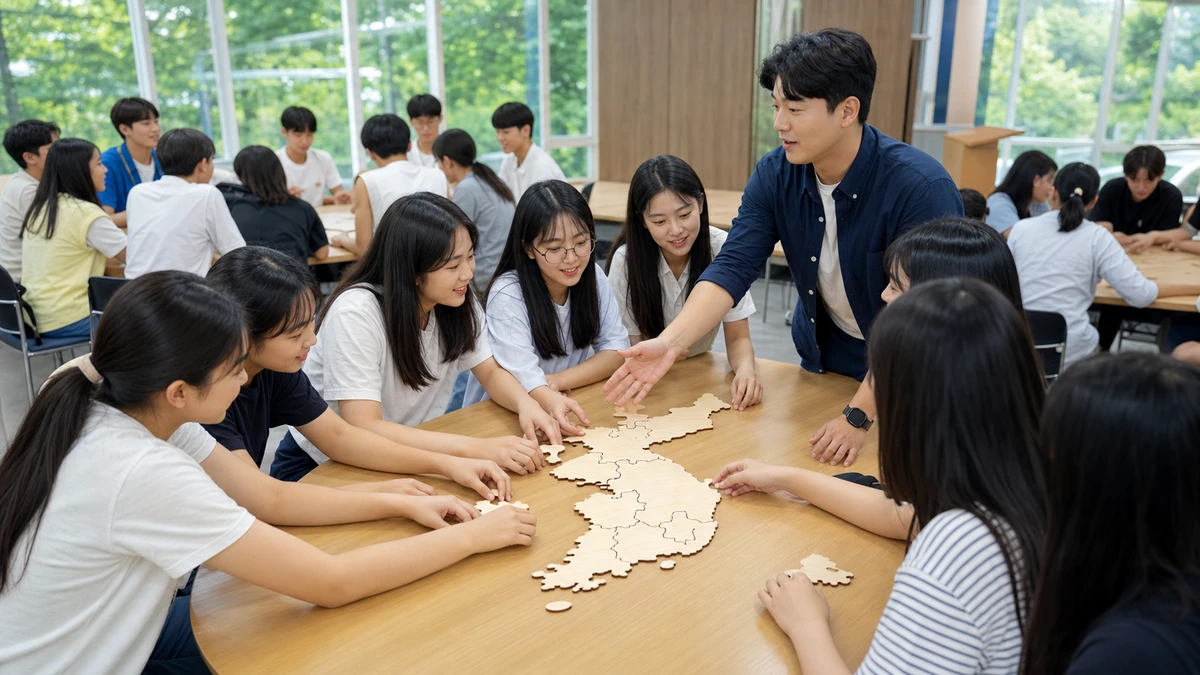
A youth camp with a national message
South Korea’s Ministry of Unification is spending three summer days on a project that may sound modest at first glance: bringing teenagers from different parts of the country together at a YMCA youth center in Goyang, just northwest of Seoul, to talk about peace, coexistence and the future of the Korean Peninsula. But in a country still technically at war with North Korea, and still marked by its own internal regional divides, the symbolism is much bigger than a typical student leadership retreat.
The program, held from July 20 to 22, is the fifth session in this year’s Youth Peace and Unification Leadership Camp series, according to South Korean officials and local media reports. The Ministry of Unification, the government agency responsible for inter-Korean affairs and policies related to peace and possible reunification, has scheduled 10 of these camps this year. This one stands out because it is the only joint session bringing together students from two broad regions with distinct identities: the Honam area in the southwest, including Gwangju and South Jeolla Province, and the Yeongnam area in the southeast, represented here by students from North Gyeongsang Province.
To American readers, that may sound like a routine effort at geographic diversity, something akin to gathering teenagers from the Deep South and New England, or from rural Appalachia and coastal California, and asking them to live, learn and debate together. But in South Korea, regional identity has long carried political, cultural and historical weight. By designing this camp around students from those different backgrounds, the government is sending a clear message: peace is not only about military deterrence or summit diplomacy with Pyongyang. It is also about how people inside South Korea learn to live with difference, disagreement and competing life experiences.
That is what makes this event worth attention beyond Korea. In Washington, foreign policy discussions about the Korean Peninsula often focus on missiles, sanctions, nuclear negotiations and the latest provocations from North Korean leader Kim Jong Un. Those issues matter, and they shape everyday security calculations in Seoul. But South Korea’s latest youth initiative highlights a quieter truth often overlooked abroad: lasting peace requires more than agreements between governments. It also requires a civic culture that teaches young people how to listen, argue and imagine a shared future.
That broader goal appears to be at the heart of the camp. Rather than treat unification as an abstract patriotic slogan or a far-off diplomatic dream, organizers are framing peace as something tangible: safe daily life, democratic participation and the ability to make long-term plans for one’s future. In that sense, the camp is as much about citizenship education as it is about North-South relations.
Why regional differences matter in South Korea
For readers unfamiliar with Korea’s internal map, the terms Yeongnam and Honam refer to two of the country’s most prominent regional blocs. Yeongnam generally refers to the southeast, including cities and provinces historically associated with conservative political strength and export-driven industrial growth. Honam points to the southwest, including Gwangju and the Jeolla provinces, areas often associated with progressive politics, agricultural communities and a powerful legacy of democratic resistance.
These identities are not merely labels on a map. They have shaped elections, social attitudes and narratives of political favoritism for decades. Regional rivalry in South Korea is not identical to the red-state-blue-state divide in the United States, but there are echoes Americans would recognize: resentments over uneven development, accusations that one region gets more political attention than another, and a tendency to turn geography into shorthand for worldview.
Gwangju, in particular, carries deep historical significance. For many Koreans, the city symbolizes democratic struggle because of the 1980 Gwangju Uprising, when citizens rose against military rule and were violently suppressed. That memory still shapes the political identity of the region. North Gyeongsang Province, by contrast, has often been associated with political conservatism and with leaders from earlier eras of rapid industrialization. None of this means teenagers from those regions arrive at camp as ideological opposites. But it does mean they come from places that can carry different historical narratives and political instincts.
That is what makes the camp’s structure notable. The Ministry of Unification is not limiting peace education to the idea of managing differences between North and South Korea. It is also acknowledging that understanding begins within South Korean society itself. Before a young person can meaningfully imagine coexistence across the Demilitarized Zone, the argument goes, that person may first need to experience coexistence with peers whose regional backgrounds, assumptions and social environments are not the same.
There is a practical dimension here as well. South Korean youth, like their counterparts in the United States, are growing up in a polarized media environment. Their views are shaped not only by school and family, but by algorithm-driven news feeds, online communities and increasingly sharp political rhetoric. A government-sponsored camp cannot solve polarization. But it can create rare face-to-face space where disagreement is humanized rather than caricatured.
In that sense, the choice to make this year’s fifth camp the only cross-regional joint session appears deliberate. It signals that regional difference is not an obstacle to be erased, but a teaching resource. By putting students in shared activities, organizers are turning difference into a starting point for dialogue rather than a trigger for suspicion.
What the Ministry of Unification is trying to teach
The Ministry of Unification occupies a somewhat unusual place in South Korean government. For Americans, it may be easiest to think of it as part foreign-policy institution, part domestic policy body and part long-range planning office for a national question that remains unresolved more than 70 years after the Korean War armistice. Its mission involves not only managing relations with North Korea, but also shaping public understanding of unification and peace.
That educational role matters because younger South Koreans do not necessarily view unification the way their grandparents did. The generation that directly experienced war, family separation and postwar poverty is aging. Many teenagers and young adults today have no living memory of a Korea that was not divided. For them, North Korea may feel less like a lost half of the nation and more like a dangerous, heavily armed neighbor whose instability could upend their lives. Some South Korean youth support engagement; others are skeptical of pouring resources into a future reunification process that could be expensive and politically fraught.
The camp’s title reflects that changing environment. It is not simply a “unification camp.” It is a “peace and unification leadership camp.” The inclusion of “leadership” suggests that the ministry wants students to see themselves not as passive recipients of national doctrine, but as participants in shaping a civic culture around peace. That is an important rhetorical shift. It places less emphasis on memorizing the correct answer and more on learning how to discuss hard questions together.
According to the ministry’s stated message, peace should not be understood only as the absence of war. It should also be understood as the basis for safe daily life and the foundation of democracy. That phrasing, reportedly emphasized in remarks prepared by Unification Minister Chung Dong-young and read at the opening ceremony by the head of the National Institute for Unification Education, broadens the conversation beyond geopolitics. It suggests that peace is what allows students to go to school without fear, express opinions openly and imagine careers, families and futures without the constant threat of crisis.
That is a sophisticated framing for a youth audience. It connects the macro and the micro, the state and the individual. In American terms, it is the difference between telling students that national security matters in the abstract and showing them how stability affects their neighborhood, their freedom and their chance to build a life. It translates diplomacy into lived experience.
Just as importantly, it links peace to democracy. That connection is especially resonant in South Korea, a country that transformed itself within a generation from military authoritarianism into a vibrant, if fiercely contentious, democracy. To say that peace undergirds democracy is to imply that social trust, civil debate and institutional stability are not luxuries. They are part of national resilience.
From slogans to lived experience
One of the most striking features of the camp, based on the official description available so far, is its effort to move peace education out of the realm of slogans and into the realm of experience. Students are not simply being lectured about coexistence; they are being asked to practice it. The details of the programming, participation numbers and student feedback have not been fully disclosed, so there are limits to what can be said about its immediate impact. Still, the structure itself reveals the educational philosophy.
Bringing together students from different regions and housing them in a neutral site outside their everyday routines matters. Goyang, in Gyeonggi Province, serves here as a common ground rather than a home turf for either side. That kind of setting can change the dynamic. Teenagers are removed from familiar school hierarchies and local expectations, and placed in a temporary community where they must negotiate shared space, group activities and conversation.
Educators often describe this as experiential learning: the idea that values are absorbed more deeply when they are enacted rather than merely explained. A student may hear in class that peace means respecting difference. That lesson can remain abstract. But if that same student spends several days working through discussions, meals and team activities with peers from a region they know mainly through stereotypes, the concept becomes concrete. Peace stops being a diplomatic noun and starts becoming a social practice.
That distinction is critical on the Korean Peninsula. For decades, public talk about unification has often swung between idealism and fatigue. Older narratives emphasized ethnic unity, historical destiny and the moral imperative of ending national division. Younger generations, facing housing pressure, intense academic competition and an uncertain job market, sometimes view those grand narratives with distance. If peace education is to resonate with them, it must speak in a language connected to everyday anxieties and aspirations.
The ministry’s messaging appears designed to do exactly that. By defining peace as the condition for “safe daily life” and a society where young people can pursue “bigger dreams,” officials are framing the issue in terms of security, opportunity and quality of life. American audiences can understand that easily. In the United States, civic educators frequently argue that democratic institutions are not self-sustaining; they require habits of participation, compromise and mutual recognition. South Korea’s camp is making a comparable point through the lens of inter-Korean tension and domestic regional difference.
There is also an understated but important lesson embedded here: coexistence does not require sameness. Peace is not being presented as the elimination of all difference, whether regional, political or historical. Instead, it is being framed as the ability to recognize difference and still build a shared civic space. That may be one of the most exportable aspects of the program.
The long shadow of division
No discussion of peace education in South Korea can be separated from the unresolved conflict with North Korea. The Korean War ended in 1953 with an armistice, not a peace treaty. The peninsula remains divided by one of the most fortified borders in the world. Families remain separated. Military crises can flare with little warning. Even in relatively calm periods, the possibility of escalation shapes public consciousness.
Yet the politics of unification have changed dramatically over the decades. For many South Koreans, especially younger ones, reunification is no longer an assumed endpoint just over the horizon. It is a complex, uncertain prospect that raises practical questions: What would it cost? How would the two systems be integrated? What social tensions might follow? Is peaceful coexistence without formal reunification a more realistic goal in the near term?
That is why the term “peace” may now carry as much weight as “unification” in educational settings. Peace can be discussed as a present-tense civic necessity, even when reunification remains distant or ambiguous. The camp’s focus suggests that officials understand this shift. They are not abandoning the language of eventual national unity, but they are broadening the educational frame to include coexistence, democratic values and shared responsibility among the next generation.
This approach also reflects a wider global pattern. In societies touched by long-term conflict, formal negotiations are only one part of the equation. Equally important is whether younger citizens develop the emotional and civic tools to sustain a less hostile future. Northern Ireland, for example, has shown how peace agreements can change institutions while social attitudes evolve more slowly. In the Balkans, post-conflict education has often had to wrestle with competing narratives of history and identity. South Korea’s situation is different in many ways, but the underlying question is similar: How do you prepare young people for a future that requires both memory and flexibility?
The answer emerging from this camp is not ideological uniformity. It is dialogue, exposure and the cultivation of what some educators would call democratic habits. If that sounds less dramatic than high-level diplomacy, that is precisely the point. Governments can sign agreements. Citizens have to live with one another afterward.
What American readers should take from it
For U.S. readers, the significance of this story lies partly in what it reveals about South Korea beyond the familiar headlines. American coverage of Korea often narrows the country to two dominant frames: North Korea’s nuclear threat and the global success of Korean pop culture, from K-pop to Oscar-winning films and hit streaming dramas. Those are real and important dimensions of Korean influence. But they can obscure another part of the story: South Korea as a democracy continuously debating how to educate its citizens for coexistence under extraordinary geopolitical pressure.
This camp is a reminder that the Korean Wave does not exist in a vacuum. The same country exporting music, film, fashion and technology is also wrestling with deeply civic questions about identity, division and democratic culture. The youth attending this program are the generation that will inherit not only the creative and economic dynamism that Americans know from brands like Samsung, BTS or “Squid Game,” but also the unresolved burden of a divided peninsula.
There is something strikingly universal in that. Many Americans worry about polarization, civic mistrust and the ability of younger generations to talk across lines of difference. South Korea’s regional tensions are not the same as America’s political divides, and the stakes of living next to a nuclear-armed authoritarian state are certainly different. But the educational challenge has familiar contours: how to teach young people that democracy depends on listening as much as winning, and that peace is not an abstraction reserved for diplomats.
There is no guarantee that a three-day camp will transform how teenagers think about one another, much less how a nation approaches unification. The available information does not provide participation numbers, a detailed curriculum or measurable outcomes. Any honest assessment must acknowledge those limits. Yet it would be a mistake to dismiss the effort as symbolic theater. Symbols matter in public education, especially when they are embodied in concrete experiences.
By making this the only joint regional session among 10 camps this year, South Korea’s Ministry of Unification is elevating an idea that deserves attention: a society cannot prepare for peace on the peninsula if it does not also prepare its young citizens to navigate differences at home. That is a lesson with relevance far beyond Korea. It suggests that peace begins not only at the negotiating table or at the border, but in classrooms, dorm rooms and conversations between teenagers who may discover that the “other side” is less distant than they imagined.
In an age when international news is often driven by crisis and spectacle, this is the kind of quieter development that can be easy to miss. But it may ultimately say more about South Korea’s long-term resilience than any missile test or summit photo. A country still living with the legacy of war is trying to teach its future adults that peace is the groundwork for ordinary life, democratic confidence and the freedom to dream. That is not a small lesson. It may be the most important one on the peninsula.
Comments
Post a Comment