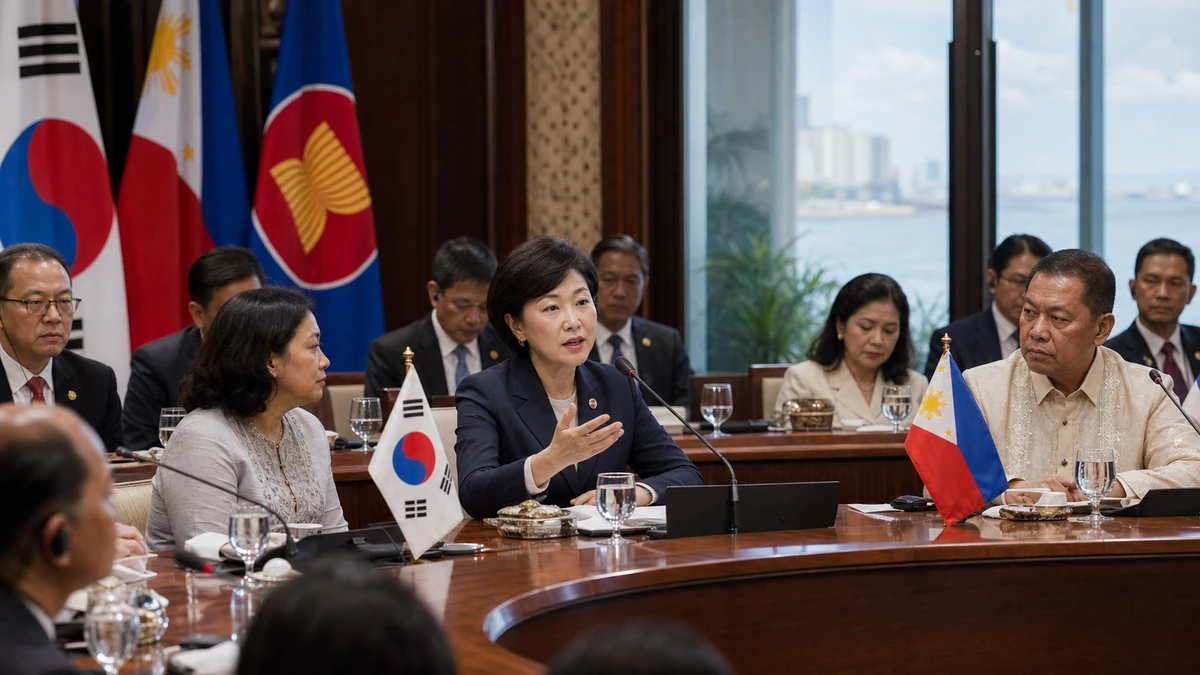
South Korea delivers a familiar message in a tense maritime arena
At a high-level regional meeting in Manila, South Korea made a point that has become increasingly important in Asia’s crowded and contested waters: the rules should apply everywhere, and they should apply to everyone. Speaking at a senior officials’ meeting of states party to Southeast Asia’s Treaty of Amity and Cooperation, or TAC, South Korean Deputy Foreign Minister for Political Affairs Chung Eui-hye said international law, including the U.N. Convention on the Law of the Sea, must be faithfully observed in all maritime areas, including the South China Sea.
That may sound like standard diplomatic language. In fact, that is precisely the point. Seoul did not call out any one country by name, did not endorse a specific outcome in any territorial dispute, and did not try to turn the gathering into a public confrontation. Instead, it leaned on the kind of principles countries can endorse in public even when they disagree in private: respect for sovereignty and territorial integrity, peaceful settlement of disputes, and renunciation of the threat or use of force.
Those principles are at the heart of the Treaty of Amity and Cooperation, a foundational diplomatic pact in Southeast Asia. They were reaffirmed at the Manila meeting and echoed again at a dinner hosted by Philippine President Ferdinand Marcos Jr. South Korea’s message was that these ideas should not stop at land borders or in ceremonial communiques. They should extend to the sea as well.
For American readers, a comparison may help. Think of it as the international equivalent of insisting that traffic laws still matter in the busiest, most stressful intersection in town. The South China Sea is one of those intersections. It carries a huge share of global trade, sits astride strategic shipping lanes, and is claimed in part by multiple governments. The waters are also a regular stage for confrontations involving coast guards, fishing boats, naval vessels and competing legal claims. By framing its position around rules rather than rivals, South Korea signaled that it wants to be seen less as a partisan in a dispute and more as a consistent defender of a predictable regional order.
That careful approach matters because South Korea is not a distant observer. It is both a treaty party and a maritime nation whose economy depends heavily on secure sea lanes. It also has its own delicate balancing act to manage: close security ties with the United States, deep economic exposure to China, and growing diplomatic interests across Southeast Asia.
Why the South China Sea matters far beyond Southeast Asia
For many Americans, the South China Sea can sound like an abstract foreign-policy phrase, the kind of place mentioned in Pentagon briefings and not much else. In reality, what happens there affects everything from global shipping costs to the strategic balance in the Indo-Pacific. It is one of the world’s most important maritime corridors, linking Northeast Asia with Southeast Asia, the Indian Ocean and beyond. Energy supplies, raw materials, manufactured goods and food all move through these waters.
That means the stakes are not limited to the governments that border the sea. South Korea, Japan, the United States and European trading powers all have an interest in open, stable and law-governed maritime routes. So do consumers. When supply chains tighten, insurance rates climb, or military tension spooks markets, the ripple effects can show up far from Manila or Beijing. Americans learned during the pandemic and subsequent shipping disruptions that global trade chokepoints are not remote geopolitical trivia. They can affect prices on store shelves and production schedules in factories.
The South China Sea is also a test case for a broader question: whether mid-sized and major powers alike will operate under shared rules, or whether the strongest actors can reshape facts on the ground, or in this case on the water, through pressure and persistence. That is why diplomatic statements that sound technical often carry real strategic weight. When Seoul says the law of the sea should govern all maritime spaces, it is not making a legalistic aside. It is declaring that the same standards should hold whether the waters are calm, disputed or strategically sensitive.
The Philippines, which hosted the meeting, has been at the center of some of the region’s most visible maritime confrontations in recent years. Clashes between Philippine and Chinese vessels have drawn international attention, especially around contested features and resupply missions. Other Southeast Asian states have their own disputes, calculations and red lines. In that environment, even seemingly modest affirmations of principle become part of a larger contest over whose vision of order will prevail.
South Korea’s intervention was therefore notable not because it broke new ground, but because it reinforced a pattern. Seoul is increasingly trying to present itself as a country that supports an open and stable Indo-Pacific without always adopting the sharpest rhetoric used by Washington or some of China’s most vocal critics. That is a diplomatic style, not an accident.
What Seoul actually said, and what it avoided saying
According to the Korean summary of the meeting, Chung stressed that international law, including the U.N. Convention on the Law of the Sea, should be observed in the South China Sea and all other maritime domains. He also underscored two related ideas: that South Korea is a maritime state, and that it consistently supports ASEAN-centered regional cooperation.
Those details are important. By referring to “all maritime areas,” Seoul avoided treating the South China Sea as a one-off exception or as a purely political battleground. Instead, it placed the issue in the broader category of universal maritime governance. In other words, the law is not supposed to become optional in the world’s most contested waters. If anything, places marked by overlapping claims and rising tension are where common rules matter most.
At the same time, South Korea avoided the language of direct accusation. It did not name China. It did not single out any incident. It did not publicly weigh in on which party was right in a given encounter at sea. That omission should not be mistaken for indifference. In Asian diplomacy, especially when multiple relationships are at stake, what is not said can be as revealing as what is.
Seoul’s choice reflects a familiar diplomatic method: uphold the standard without escalating the fight. It allows South Korea to align itself with international law and peaceful dispute resolution while limiting the risk of turning a regional forum into a public anti-China platform. For a country that shares the United States’ interest in a stable maritime order but must also account for its economic links with China, that kind of calibrated language is often the preferred instrument.
There is also a domestic and strategic logic. South Korea wants to be taken seriously as a larger regional actor, not just as a country whose diplomacy revolves around North Korea. Speaking about maritime order in Southeast Asia helps broaden that profile. It suggests Seoul sees itself not only as a peninsular state preoccupied with its northern border, but as a trading and maritime power with a stake in the wider Indo-Pacific.
Understanding ASEAN and the treaty at the center of the meeting
To understand why this forum mattered, it helps to understand ASEAN, the Association of Southeast Asian Nations. ASEAN is often described as a regional bloc, but that can be misleading to American readers if it conjures images of the European Union. ASEAN is looser, more consensus-driven and often slower moving. Its strength lies less in binding supranational power than in convening, habit-building and creating diplomatic space where states with very different systems and interests can still talk.
The Treaty of Amity and Cooperation is one of the key instruments in that diplomatic architecture. First established in 1976, it lays out basic principles for interstate conduct in Southeast Asia, including mutual respect for sovereignty, noninterference, peaceful dispute settlement and renunciation of force. Over time, countries outside Southeast Asia, including South Korea, have joined the treaty as a sign of commitment to those norms.
That background matters because Chung was not speaking as an outsider dropping in with unsolicited advice. South Korea is itself a party to the treaty. When Seoul invokes the TAC’s core spirit, it is pointing to obligations and expectations shared by the group rather than inventing a new rulebook. That gives its remarks added diplomatic legitimacy, especially in a region sensitive to outside powers appearing to dictate terms.
ASEAN’s “centrality,” another phrase diplomats love to use, also deserves translation into plain English. It means Southeast Asian countries want regional problems to be discussed through institutions where they have a leading role, rather than being reduced to a tug-of-war between larger powers such as the United States and China. When South Korea says it supports ASEAN centrality, it is signaling respect for that preference. It is essentially saying: regional states should not be sidelined in discussions about their own neighborhood.
For Washington audiences, this can sound procedural. But in Asia, procedure is substance more often than Americans assume. The choice of forum, the order of speakers, and the specific formula used in a communique can all reflect hard-fought political understandings. By emphasizing both ASEAN-centered cooperation and international law, South Korea tried to marry two ideas that are not always easy to combine: local ownership of regional diplomacy and universal legal standards.
A maritime nation with global ambitions
One of the more revealing parts of Seoul’s message was its insistence that South Korea is a maritime nation. That is not just geography talking. It is a statement about identity and interest. South Korea is one of the world’s major trading economies, heavily dependent on shipping for exports, energy imports and industrial supply chains. Stability at sea is not an abstract value for Seoul. It is tied to economic security and national strategy.
Americans may know South Korea best through brands like Samsung, Hyundai and LG, or through its cultural exports, from K-pop to Oscar-winning films. But beneath that soft power lies a deeply trade-dependent economy whose prosperity relies on the uninterrupted movement of goods across oceans. In that sense, South Korea’s maritime diplomacy belongs in the same conversation as its manufacturing prowess and technological reach. The sea is what connects the Korean Peninsula to the markets and materials that sustain its economy.
That helps explain why Seoul would speak up in Manila even without unveiling a new policy or initiative. The significance of this week’s meeting was not the launch of a grand plan. It was the reaffirmation of a worldview: that a rules-based maritime order benefits countries like South Korea, and that middle powers have an interest in defending it before crises intensify rather than after they spiral.
There is another dimension as well. South Korea has been trying in recent years to expand its diplomatic footprint in Southeast Asia through trade, investment, security cooperation and political engagement. That effort has continued across administrations, even as branding and priorities have shifted. By participating in high-level ASEAN-related meetings, Seoul is reinforcing the idea that Southeast Asia is not a peripheral theater but a core part of its foreign policy map.
In that sense, the Manila appearance was also a statement about South Korea’s global role. It suggested that Seoul wants to be seen as a country that contributes to regional stability by supporting institutions, norms and steady diplomacy, not just by reacting to immediate crises closer to home.
The diplomatic strategy: principles over provocation
The most striking feature of South Korea’s message was its restraint. In an era when governments often speak in sharper, more public terms about geopolitical rivals, Seoul chose a rules-first vocabulary. That approach carries risks. Critics can dismiss it as too cautious, too vague or too unwilling to confront coercive behavior directly. But it also has advantages, especially in multilateral settings where consensus is fragile and relationships overlap.
By grounding its position in the law of the sea and the TAC’s basic principles, South Korea framed the issue in a way that does not require public finger-pointing to be understood. The implication is clear enough: no state should use threats or force to settle maritime disagreements, and all parties should respect shared legal norms. Saying it that way makes the message harder to reject outright, even if governments differ privately over how it should apply.
This is a classic middle-power strategy. Countries that are influential but not dominant often try to shape behavior through norms, institutions and coalition-building rather than through direct coercion. Canada, Australia and several European states have used versions of this playbook in other contexts. South Korea is adapting it to a maritime dispute environment where overt alignment can carry economic and political costs.
It also reflects the realities of Korean diplomacy. Seoul cannot afford to ignore the concerns of the United States, its treaty ally, which has strongly backed freedom of navigation and a rules-based order in the South China Sea. But neither can it casually antagonize China, one of its largest economic partners and a major player in regional stability, including issues involving North Korea. The result is often a carefully balanced posture: firm on principle, measured in tone.
That does not make the message empty. Quite the opposite. Diplomacy is often about establishing the baseline from which later actions are judged. If tensions worsen in the South China Sea, or if maritime incidents become more frequent, positions like the one South Korea articulated in Manila help clarify where it stands: in favor of peaceful settlement, against coercion, and for the consistent application of international law.
Why global readers should pay attention
The broader significance of the Manila meeting lies in what it says about the evolving shape of Asian diplomacy. This was not a summit dominated by headline-grabbing announcements, sanctions or security pacts. It was a quieter exercise in norm-setting. Yet those quieter exercises are often where the rules of tomorrow’s order are contested and reinforced.
For global readers, including Americans, the takeaway is straightforward. The argument over the South China Sea is not only about who controls which reef, shoal or stretch of water. It is also about whether disputes in one of the world’s most strategically important regions will be managed through law and negotiation or through pressure and faits accomplis. When South Korea, a major U.S. ally and one of Asia’s leading economies, publicly backs the former approach, that is worth noting.
It is also worth noting what Seoul did not do. It did not propose a new institution, announce a new security initiative or change the diplomatic landscape overnight. Instead, it reinforced existing norms and the ASEAN-centered framework through which many Southeast Asian states prefer to address regional tensions. That may sound incremental, but incrementalism is often how Asian regional order is built and preserved.
In American political culture, there is sometimes impatience with this style of diplomacy. It can seem too cautious, too indirect or too wrapped in formulas. But in a region where history, hierarchy and national sensitivity matter enormously, bluntness is not always strength. Sometimes the more durable move is to keep widening agreement around shared principles until deviation from them carries a clearer diplomatic cost.
That, in effect, is what South Korea attempted in Manila. It used the language of international law and regional cooperation to remind its neighbors and partners that maritime order should not depend on power alone. Whether those principles hold under pressure is another question, and one no single meeting can answer. But as tensions continue to simmer in the South China Sea, the countries that keep restating the rules are helping define the standard against which future behavior will be measured.
For South Korea, the message was also about self-definition. It presented itself as a maritime state, a treaty party, a supporter of ASEAN-led diplomacy and a country with a stake in rules that extend beyond any single dispute. In a region where every word is weighed, that is a meaningful signal. Seoul is saying that its role in Asia is not limited to the Korean Peninsula. It also sees itself as a stakeholder in the legal and diplomatic order of the wider Indo-Pacific.
That is the part of this story that should resonate outside Asia as well. The struggle over international rules is rarely confined to courtrooms or communiques. It plays out in shipping lanes, diplomatic forums and the carefully chosen language of allied governments. In Manila, South Korea chose to make one thing clear: the principles of sovereignty, peaceful settlement and restraint should govern the seas no less than they govern the land. In today’s Indo-Pacific, that is both a modest statement and a consequential one.
Comments
Post a Comment