A trade deal from another era faces a rewrite
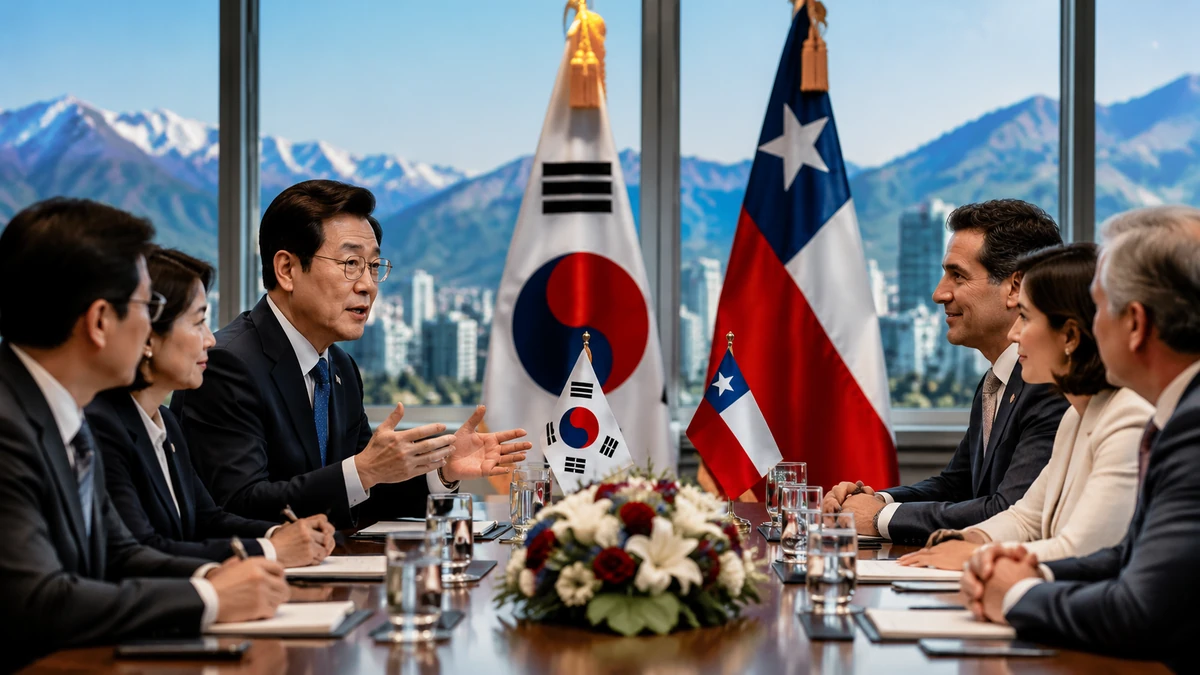
South Korean President Lee Jae Myung is signaling that one of Seoul’s oldest trade agreements in Latin America may be due for a 21st-century overhaul. Ahead of a visit to Chile during his South American trip, Lee said the free trade agreement between South Korea and Chile should “evolve” to reflect a sharply changed global economy, according to remarks released in a written interview.
That might sound like dry trade-policy language, but it points to something much bigger than tariff schedules or customs paperwork. Lee is arguing that the original Korea-Chile free trade agreement — once seen mainly as a tool to lower barriers for goods moving across borders — now needs to function more like a platform for deeper industrial cooperation. In his telling, the next phase should cover digital trade, artificial intelligence, clean technology, more resilient supply chains and the transition to carbon neutrality.
For American readers, the easiest comparison may be the way Washington has increasingly discussed trade not just in terms of exports and imports, but in terms of semiconductors, batteries, critical minerals, clean energy and the strategic risk of overreliance on any single country. Around the world, governments are asking a similar question: What should a trade agreement do when the most important economic issues are no longer limited to automobiles, fruit or steel, but include cloud services, rare minerals, data rules and the security of global production networks?
Lee’s answer appears to be that South Korea and Chile should update their relationship before the old framework becomes obsolete. He called for the two countries to restart their joint free trade committee and begin formal discussions on modernizing the agreement. He also emphasized stronger cooperation on supply chains, including in sectors tied to future industries.
The message is notable not only because Chile was South Korea’s first free trade partner in Latin America, but also because it shows how Seoul is trying to position itself in a global economy increasingly shaped by technology competition, green industrial policy and geopolitical uncertainty. In practical terms, South Korea is looking beyond the traditional logic of market opening and toward a model in which trade agreements help businesses manage risk, secure inputs and build cross-border technology partnerships.
Why Chile matters to South Korea
At first glance, Chile may not seem like one of South Korea’s most obvious economic priorities. It is geographically distant, its population is far smaller than that of Brazil or Mexico, and it does not dominate the headlines in the United States the way China, Japan or the European Union do. But for Seoul, Chile has long held outsized importance as a stable democratic partner, a gateway into Latin America and a country with resources that matter in the energy transition.
Chile is one of the world’s leading producers of copper and a major player in lithium, both of which are central to clean-energy technologies. Copper is essential for power grids, electric vehicles and industrial equipment. Lithium is a key ingredient in many rechargeable batteries, including those used in EVs and energy storage systems. As countries race to build cleaner energy systems and expand advanced manufacturing, access to these materials has become a strategic issue, not just a commercial one.
That helps explain why Lee’s call for closer supply-chain cooperation carries weight. For South Korea — home to globally competitive battery makers, electronics companies, automakers and heavy industries — reliable access to critical materials is crucial. A disruption in one part of the supply chain can ripple through entire industries. American companies have learned the same lesson in recent years, whether from pandemic-era bottlenecks, shipping disruptions, semiconductor shortages or geopolitical tensions involving China.
Chile also offers something businesses value just as much as raw materials: predictability. In trade and investment, stable rules can matter nearly as much as low tariffs. That is especially true for long-term projects in mining, energy infrastructure and industrial technology, where companies need confidence that regulatory systems will remain legible over time. Lee’s push to revive bilateral trade mechanisms suggests South Korea wants not just more trade with Chile, but a more structured and resilient relationship.
There is also a political dimension. South Korea has spent years trying to diversify its economic ties beyond its immediate neighborhood and major-power relationships. Latin America is part of that strategy. Deepening ties with Chile allows Seoul to strengthen its presence in the region while aligning trade policy with newer industrial goals, particularly in green technology and high-value manufacturing.
From tariffs to technology: what “modernization” really means
When officials say a trade agreement should be “modernized,” they often mean much more than routine maintenance. In this case, Lee is pointing to a broad rethinking of what bilateral economic cooperation should look like. The original free trade model was built around opening markets to goods and services, reducing duties and making commercial rules more predictable. That still matters. But it is no longer sufficient in an economy where software, data, automated systems and clean-energy requirements increasingly shape who wins and loses.
Lee’s remarks tied together five areas: digital trade, artificial intelligence, clean technology, resilient supply chains and carbon-neutral transition. These are not isolated topics. They overlap in ways that reflect how modern industries actually work. A battery plant, for example, is not just a manufacturing site. It depends on mined materials from multiple countries, logistics systems that can survive disruption, AI tools that improve efficiency, digital infrastructure that supports design and sales, and regulatory systems that increasingly account for carbon emissions.
That is why the proposed evolution of the Korea-Chile trade pact matters. If the two governments can integrate these newer issues into formal economic cooperation, the relationship could move beyond a buyer-seller model and toward something closer to a shared industrial ecosystem. For South Korean firms, that could mean better coordination with Chilean partners on materials, energy, technology deployment and standards. For Chile, it could mean deeper integration into higher-value supply chains rather than remaining primarily an exporter of raw commodities.
For American audiences, a useful parallel is the shift in U.S. policy discussions from “free trade” in the classic 1990s sense toward what might be called strategic trade and industrial resilience. The language may differ from country to country, but the underlying concern is familiar: how do nations write economic rules for a world where data flows, climate targets and supply security are just as important as border taxes?
Modernization can also mean adjusting old agreements to account for the way services are now delivered across borders. Digital trade includes questions about e-commerce, digital platforms, data governance, electronic contracts and the rules that let businesses provide services online without unnecessary friction. AI raises a different but related set of issues, from productivity gains to governance questions to the need for trusted cross-border tech partnerships. If those subjects are built into trade discussions, the agreement becomes less about yesterday’s commerce and more about tomorrow’s competitive landscape.
The supply-chain lesson of the post-pandemic economy
If there is one phrase that captures the economic mood of the early 2020s, it may be “supply-chain resilience.” Before the pandemic, those words were used mostly by logistics specialists and corporate planners. Since then, they have become part of mainstream political vocabulary from Washington to Brussels to Seoul. Shortages of chips, shipping delays, factory shutdowns and geopolitical shocks have all underscored the same reality: a low-cost supply chain is not always a secure one.
Lee’s emphasis on resilient supply chains reflects that new consensus. In a globally fragmented production system, a problem in one country can stop production in another. A shortage of a mineral, a port disruption, a trade dispute or political instability can echo across industries. For South Korea, whose economy is deeply integrated into global manufacturing, the stakes are especially high. Its major companies depend on reliable flows of materials, components and export routes. Building resilience is not optional; it is a core economic priority.
Chile fits into this picture because of its role in mineral supply and its potential as a long-term partner in sectors related to clean energy and advanced manufacturing. A stronger bilateral framework could help reduce uncertainty, improve coordination and create channels for addressing emerging bottlenecks before they become crises. Restarting a bilateral free trade committee may sound bureaucratic, but institutions like that often determine whether political slogans produce real commercial results.
For U.S. readers, the argument is likely familiar from debates over semiconductors, pharmaceuticals and clean-energy supply chains. American policymakers have spent years worrying about concentrated dependencies, especially in sectors seen as economically or strategically sensitive. South Korea is approaching many of the same issues from its own vantage point. The difference is that Seoul, as a major exporter with limited natural resources of its own, has even greater incentive to secure trusted external partnerships.
What Lee appears to be saying is that trade agreements should no longer be treated as static documents signed once and left alone. They need to be living mechanisms that can help governments and companies respond to new vulnerabilities. If the Korea-Chile pact becomes a venue for dealing with supply-chain risk, it would represent a broader evolution in how middle powers use trade architecture in a volatile global economy.
Clean tech, carbon neutrality and the politics of the energy transition
Another notable feature of Lee’s comments is how explicitly they connect trade policy to climate-era industrial policy. He did not frame clean technology and carbon neutrality as side issues or public-relations add-ons. Instead, he placed them near the center of the modernization agenda. That matters because countries are increasingly treating decarbonization not only as an environmental necessity, but also as a source of future economic advantage.
South Korea has strong incentives to compete in this space. It has globally recognized companies in batteries, electronics, automobiles, shipbuilding and advanced materials — industries that are all being reshaped by the push to cut emissions. Chile, meanwhile, offers potential advantages in minerals, renewable energy and clean-industry cooperation. Put together, that creates a logic for expanding bilateral ties beyond conventional trade into areas tied directly to the green transition.
In American terms, think of the way the Inflation Reduction Act helped turn climate policy into industrial policy by linking tax incentives, manufacturing goals and supply-chain strategy. South Korea and Chile are not reproducing that model exactly, but they are operating in the same global context. Countries are competing to attract investment in cleaner technologies, secure inputs for electrification and ensure that their industries remain viable as carbon rules tighten around the world.
That is where a modernized trade agreement could matter. It could create a more coherent framework for joint work on clean technology, lower barriers to related investment and help coordinate standards or commercial rules in emerging sectors. It could also give businesses clearer signals that both governments see green industrial cooperation as a priority. That type of policy clarity can influence where companies place factories, sign procurement deals or build long-term partnerships.
There is also an important symbolic shift here. The old politics of free trade often revolved around whether opening markets would undermine domestic industries or jobs. The newer politics increasingly asks whether countries can use trade relationships to accelerate strategic sectors at home while still participating in global markets. Lee’s remarks suggest South Korea wants to do exactly that: use international economic partnerships not merely to sell more goods, but to shape the industrial structure of the next decade.
What Lee’s Chile message says about South Korea’s broader strategy
Although Lee’s comments focused on Chile, they also offer a window into South Korea’s broader worldview. Seoul is trying to navigate a period in which the rules of globalization are being rewritten but not abandoned. The era of pure market-opening optimism has faded. In its place is a more guarded system in which governments still support trade, but increasingly attach it to national resilience, strategic technology, climate goals and geopolitical hedging.
For South Korea, this balancing act is especially delicate. Its economy depends heavily on exports and deep integration with global markets. At the same time, it operates in a region shaped by intensifying U.S.-China rivalry, technological competition and growing concern over supply-chain concentration. That forces Seoul to diversify its partnerships while remaining nimble enough to work with a wide range of countries across regions.
Chile is a useful test case because it allows South Korea to pursue multiple goals at once: strengthen ties with Latin America, secure access to strategically important materials, promote cooperation in clean and digital industries, and demonstrate that older trade frameworks can be upgraded rather than discarded. In that sense, the Chile conversation is not peripheral to Seoul’s trade policy. It is an example of how South Korea may approach similar relationships elsewhere.
There is also a domestic political angle worth noting for American readers less familiar with South Korean political communication. Korean presidents often frame overseas economic diplomacy as directly tied to growth, industrial competitiveness and national resilience at home. In other words, foreign trade strategy is not presented as an elite diplomatic exercise detached from everyday life. It is sold as a way to protect jobs, support national champions, stabilize supply lines and secure future industries. Lee’s comments fit squarely within that tradition, even as they update it for a world centered on AI, climate and supply risk.
His emphasis on practical mechanisms — restarting the free trade committee, discussing modernization, broadening cooperation sectors — also suggests a technocratic rather than purely rhetorical approach. The underlying message is that economic diplomacy should produce actionable channels for problem-solving, not just summit-level declarations.
What happens next, and why global readers should pay attention
For now, the key development is Lee’s public commitment to pursue three related goals with Chile: restart the bilateral free trade committee, begin modernization discussions and deepen supply-chain cooperation. The details remain to be negotiated, and trade upgrades are rarely quick. They involve technical talks, political trade-offs and the challenge of translating broad ambitions into legal language both sides can accept.
Still, the direction of travel is clear. South Korea is treating the future of trade as inseparable from digital systems, strategic materials and the green transition. Chile, with its mix of institutional stability and resource importance, is a logical place to test that model. If the two countries can move from general statements to concrete cooperation, the result could offer a template for how middle-sized powers adapt older trade agreements to new economic realities.
That is worth watching well beyond Seoul and Santiago. Around the world, many bilateral trade deals were negotiated before AI became a boardroom obsession, before carbon-neutral deadlines became part of national planning and before supply-chain fragility became obvious to ordinary consumers. Governments are now under pressure to update those frameworks without blowing them up entirely. The Korea-Chile case may show one path forward: keep the market-opening foundation, but layer onto it new rules and institutions for resilience, technology and clean growth.
For American readers, the broader lesson is that the future of trade policy is increasingly being shaped outside the traditional Washington-Brussels-Beijing triangle. Countries like South Korea and Chile are not just reacting to great-power competition; they are building their own frameworks to navigate it. That matters because the next generation of trade rules may emerge not from one grand global accord, but from a web of targeted, modernized partnerships linking technology, resources and climate strategy.
Lee’s remarks, then, are about more than one bilateral pact. They reflect a wider shift in how countries understand economic security and growth in an era of disruption. The old free trade agreement was built for a world focused on opening markets. The new version, if it takes shape, would be designed for a world focused on securing the future.
Comments
Post a Comment