U.S., South Korea and Japan Reaffirm North Korea Strategy in Manila, Expanding Cooperation Beyond the Nuclear Threat
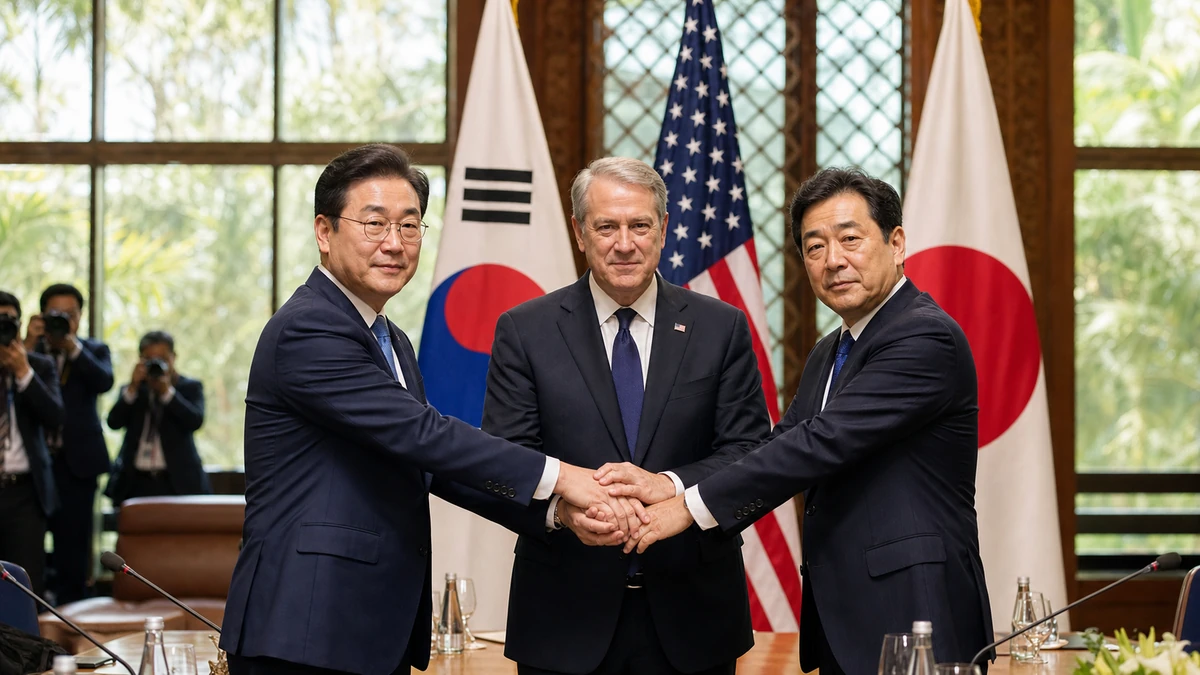
A familiar alliance message, delivered from a wider regional stage
Meeting on the sidelines of a major diplomatic gathering in Manila, the top diplomats of the United States, South Korea and Japan used a familiar message on North Korea to signal something broader: Their three-way partnership is no longer focused only on Pyongyang’s weapons program. It is increasingly being framed as a regional strategy for security, technology, energy and the rules that govern one of the world’s most contested waterways.
According to the South Korean and U.S. readouts of the meeting, South Korean Foreign Minister Cho Hyun, Secretary of State Marco Rubio and Japanese Foreign Minister Toshimitsu Motegi reaffirmed their commitment to the complete denuclearization of the Korean Peninsula and agreed to maintain close coordination on North Korea policy. They also discussed defense cooperation, maritime security, energy security, cyber threats and the broader goal of preserving peace and stability across the Indo-Pacific, including Southeast Asia.
The meeting took place at the Philippine International Convention Center during a round of Association of Southeast Asian Nations-related foreign ministers meetings, a setting that matters. ASEAN gatherings often serve as neutral diplomatic ground where countries with overlapping concerns but different priorities can test language, display unity and signal where the region may be headed. By convening there, the three countries tied the Korean Peninsula question to a bigger map — one that stretches from Northeast Asia through the South China Sea and into the wider Indo-Pacific security order.
For American readers, this may sound like another routine statement of alliance solidarity. But the Manila meeting reflects a more important shift. Washington, Seoul and Tokyo are increasingly treating North Korea not as an isolated problem but as part of a linked security environment where missile threats, cybercrime, energy resilience, sea lane access and international law all intersect. In other words, what might once have been seen as separate policy silos are now being bundled into one strategic conversation.
The timing also stood out. The three ministers had met just two weeks earlier, underscoring the frequency with which the United States, South Korea and Japan are now coordinating at senior levels. That tempo sends its own message: Whatever differences may exist in tone or diplomatic style, the three governments want adversaries and partners alike to see a standing framework, not a one-off show of unity.
North Korea remains the core issue, but not the only one
At the center of the talks was the issue that has defined much of trilateral diplomacy in Northeast Asia for years: North Korea’s nuclear ambitions. The three ministers reaffirmed the principle of complete denuclearization of the Korean Peninsula, language that has long appeared in U.S., South Korean and Japanese statements, even as the practical path to that goal remains uncertain.
That phrase — complete denuclearization — can sound abstract to people outside East Asia, especially after years of stalled diplomacy and repeated weapons tests. In practice, it signals that the three governments are not prepared to accept North Korea as a permanently recognized nuclear weapons state, even if the world has grown accustomed to Pyongyang’s advances. It is both a policy objective and a political statement about what should count as legitimate under international norms.
At the same time, the readouts from Manila made clear that the three countries do not want deterrence to be their only vocabulary. They also emphasized dialogue and diplomacy as tools for maintaining peace and stability on the Korean Peninsula. That matters, particularly for South Korea, which lives with the immediate consequences of any military escalation. Seoul’s position has often required a difficult balancing act: staying firm on sanctions, deterrence and alliance cooperation while keeping open at least the theoretical possibility of negotiations.
U.S. officials said the ministers reaffirmed the importance of a unified approach to North Korea. In diplomatic language, “unified” does not necessarily mean identical. It means the three governments want to avoid visible splits on core principles, especially when dealing with a regime that has historically tried to exploit disagreements among outside powers. The basic signal from Manila was that Washington, Seoul and Tokyo remain aligned on the fundamentals even if each capital emphasizes somewhat different concerns.
The U.S. side also highlighted continued joint responses to North Korean cyber threats and illicit activities, along with a shared commitment to resolving the abductee issue. The abductee issue has special political and emotional weight in Japan, where the kidnapping of Japanese citizens by North Korean agents in past decades remains a major public concern. For Americans unfamiliar with that history, it is somewhat analogous to a foreign policy issue that never fully leaves domestic politics because it symbolizes both national vulnerability and unanswered injustice.
By including cyber threats, illicit activity and humanitarian concerns alongside denuclearization, the three governments are presenting North Korea as a multidimensional challenge. This is not just about warheads and missiles. It is also about hacking, sanctions evasion, illicit finance, regional coercion and the long-term question of how to manage an unpredictable state that uses both military and nonmilitary tools.
Why the wording matters: One meeting, three diplomatic languages
One of the more revealing aspects of the Manila talks is that South Korea, the United States and Japan all described the same meeting in slightly different ways. That may seem minor, but in diplomacy, wording is policy’s public face. What governments choose to name directly, what they imply and what they leave unsaid can reveal just as much as a formal agreement.
South Korea’s Foreign Ministry placed notable emphasis on principles such as international law, maritime security, freedom of navigation and freedom of overflight. It referred to concerns about regional conditions and opposition to unilateral attempts to change the status quo, but it did so without directly naming a specific country in the language summarized publicly. That kind of phrasing is not accidental. It allows Seoul to align with its allies on strategic concerns while preserving diplomatic room to maneuver in a region where economic ties, especially with China, remain significant.
For American audiences, this may resemble the difference between making a direct accusation and stating a general legal standard that everyone understands is being violated. The second approach can be less confrontational while still communicating the point. It also leaves more space for future diplomacy with other regional players that may be wary of being forced into overt bloc politics.
The U.S. statement, by contrast, was more explicit about North Korea-specific concerns, including cyber threats and illicit activity. That tracks with Washington’s tendency to define the problem in operational terms — what needs to be deterred, disrupted or sanctioned. The Japanese position, meanwhile, has historically placed particular emphasis on North Korea’s missile threat and the abductee issue, reflecting domestic political priorities and longstanding public sentiment.
These differences do not necessarily signal division. In fact, they may show a mature form of coordination. The three governments appear to agree on the destination while allowing some variation in the route each takes rhetorically. That flexibility may be essential to keeping the trilateral framework durable. Alliances are rarely strengthened by forcing identical language on governments with different electorates, geographies and economic relationships. They are strengthened when those governments can maintain shared objectives without denying their own realities.
South Korea’s messaging is especially noteworthy because it foregrounds norms rather than threats alone. By stressing lawful maritime use, international law and dialogue, Seoul is effectively saying that regional order should be defended not only through military strength but through agreed rules. For a middle power like South Korea — militarily capable, economically significant and geographically exposed — that is both a principle and a strategic necessity.
Manila and ASEAN: Why Southeast Asia is now central to the conversation
The location of the meeting was not just a logistical detail. Holding the talks in Manila during ASEAN-related meetings reinforced the idea that the Korean Peninsula is no longer being discussed strictly as a Northeast Asia issue. It is increasingly bound up with the wider Indo-Pacific, a term that has become central to U.S. strategy and increasingly common in Asian diplomacy.
The Indo-Pacific concept can sound like bureaucratic shorthand, but it points to a simple reality: The waters linking the Pacific and Indian oceans carry enormous volumes of global trade, energy shipments and strategic competition. If the Atlantic once defined the geopolitical imagination of the post-World War II West, the Indo-Pacific increasingly occupies that role in the 21st century. For Americans, a useful comparison might be thinking of the region as a combined theater where economic lifelines and military flashpoints overlap.
Southeast Asia sits at the center of that map. Sea lanes running through or near the region are vital not only to Asian economies but to global supply chains. Questions about freedom of navigation, air transit and maritime law are not theoretical. They affect shipping, insurance costs, military planning and the broader credibility of international rules. That is why language about lawful maritime use and adherence to the U.N. Convention on the Law of the Sea carries real significance, even when specific new measures are not announced.
South Korea’s decision to explicitly mention Southeast Asia in connection with peace and stability across the Indo-Pacific also reflects a broader evolution in its foreign policy. Seoul has traditionally had to devote much of its diplomatic attention to the immediate challenge posed by North Korea. But it increasingly wants to present itself as a country with a regional role beyond the peninsula — a democracy, technology powerhouse and trading nation with a stake in the broader order.
That matters because South Korea is no longer simply a security consumer sheltered under the U.S. alliance. It is also a major exporter, shipbuilder, chip producer and cultural force whose interests span far beyond its immediate neighborhood. Its diplomacy now has to connect peninsula concerns with shipping routes, supply chains and the strategic anxieties of Southeast Asian states that do not want open conflict but also do not want rules rewritten by force.
ASEAN, for its part, remains an important convening platform precisely because many countries in the region prefer inclusive diplomacy and careful language over overt alignment. That can frustrate Washington at times, but it also makes ASEAN-centered meetings useful for coalition-building. By showing up in Manila and linking their agenda to regional stability, the United States, South Korea and Japan were addressing not only one another but the broader audience of Southeast Asian governments watching how major powers behave.
Security is no longer just military: Energy, cyber and the new regional agenda
Another striking feature of the Manila meeting was the way traditional and nontraditional security concerns were grouped together. Defense cooperation appeared alongside energy security and cyber threats, reflecting how governments now define resilience in a world where conflict does not begin and end with troops or missiles.
Cybersecurity has become especially relevant in the North Korea context. U.S. and allied officials have long accused Pyongyang-linked actors of carrying out hacking operations, cryptocurrency theft and other cyber-enabled activities that help fund the regime and create disruption abroad. For policymakers in Washington, Seoul and Tokyo, these activities blur the old distinction between peacetime nuisance and national security threat. A cyber intrusion that steals money, compromises infrastructure or undermines public trust can have strategic effects even without a shot being fired.
Energy security also belongs in this conversation, though the Manila statements did not announce a specific new initiative. The inclusion of energy on the agenda shows how the region’s security planners now think in systems rather than compartments. Access to reliable fuel and power affects industrial production, defense readiness, economic stability and political confidence. The war in Ukraine drove home for many governments, including U.S. allies, that energy dependence can create strategic vulnerability far from the battlefield.
In East Asia, where import dependence and shipping security matter enormously, energy discussions naturally overlap with maritime strategy. If sea lanes become unstable, if prices spike or if coercion disrupts supply, the effects ripple through everything from manufacturing to domestic politics. That is one reason trilateral cooperation has expanded beyond purely military coordination.
Defense cooperation remains the backbone of the U.S.-South Korea-Japan triangle, but the Manila meeting suggests a more comprehensive framework is taking shape. Instead of treating military, economic and technological threats as separate categories, the three governments are increasingly approaching them as interconnected forms of strategic pressure. That reflects a world in which competition may play out through naval patrols, semiconductor restrictions, ransomware attacks and disinformation campaigns all at once.
For American readers, a useful analogy may be the post-9/11 expansion of the idea of homeland security, when policymakers began to think more broadly about infrastructure, finance, digital systems and border controls as pieces of one security puzzle. In the Indo-Pacific today, something similar is happening at the regional level. The questions are not just who has the strongest military, but who can keep trade flowing, protect networks, secure energy and maintain alliances under stress.
South Korea’s balancing act: Firm on principles, careful in tone
South Korea’s public messaging after the meeting offered a window into its increasingly delicate diplomatic posture. Seoul clearly wanted to underscore solidarity with Washington and Tokyo, especially on denuclearization and policy coordination toward North Korea. But it also chose language that emphasized dialogue, diplomacy, international law and general regional principles rather than direct confrontation.
That is a classic balancing move for South Korean diplomacy. As the country most directly exposed to North Korean escalation, South Korea has strong incentives to keep deterrence credible. But it also has reasons to avoid language that would unnecessarily narrow its diplomatic options or inflame tensions with other regional actors. This is not weakness so much as geography translated into policy.
American observers sometimes interpret softer wording as hesitation. In the Korean context, it can just as easily reflect the constraints of living next door to an armed adversary while maintaining extensive economic relationships across Asia. Seoul’s challenge is to show that alliance coordination is solid without appearing to close off the possibility of talks or force itself into a more rigid posture than it wants.
The emphasis on international norms is also a way for South Korea to make its case in universal rather than bloc-based terms. Freedom of navigation, freedom of overflight and lawful maritime use are principles that resonate well beyond the U.S.-China rivalry or Korean Peninsula tensions. By grounding its position in rules, South Korea can support a regional order without making every issue look like a direct confrontation between named states.
This approach may also be intended for Southeast Asian ears. Many countries in the region are wary of choosing sides outright, even as they worry about coercion and instability. A rules-based message is often more politically sustainable there than overtly ideological or confrontational language. If Seoul wants to be seen as a constructive regional actor, its diplomatic tone matters almost as much as its policy alignment.
At the same time, there is no mistaking the underlying substance. South Korea joined the United States and Japan in reaffirming denuclearization, strengthening coordination on North Korea and broadening trilateral cooperation across multiple security domains. The nuance lies in how that commitment is articulated, not whether it exists.
What unity means — and what to watch next
The Manila meeting did not produce a dramatic new breakthrough or unveil a sweeping new policy package. What it offered instead was a reaffirmation of principles and a demonstration of continuity. In diplomacy, especially on hard problems like North Korea, that can matter more than headlines suggest.
The most important takeaway is that trilateral coordination among the United States, South Korea and Japan appears to be deepening in scope and becoming more routine in practice. The agenda now extends far beyond the Korean Peninsula alone. It includes maritime order, cyber defense, energy resilience and regional stability across the Indo-Pacific. That suggests the three countries increasingly view their partnership not just as a reaction to crises, but as part of the architecture of the region.
There are still limits. Public statements can only reveal so much, and the Manila readouts did not include detailed new timelines, mechanisms or operational steps in several of the issue areas discussed. It is one thing to affirm broad cooperation; it is another to turn that into sustained action across bureaucracies and political cycles. Domestic politics in all three countries will continue to shape how far and how fast this cooperation can go.
Still, the repeated meetings themselves are a signal worth noting. In international politics, frequency often indicates priority. By meeting again so soon and issuing aligned messages, the three foreign ministers conveyed that their coordination is active, not symbolic. In a region where adversaries test for daylight between allies and where smaller states closely study the behavior of larger ones, consistency has strategic value.
What to watch next will be whether the trilateral framework can translate broad alignment into measurable follow-through — particularly on cyber cooperation, maritime coordination and the difficult long game of managing North Korea. Another key question is whether Seoul, Washington and Tokyo can maintain unity while preserving the flexible diplomatic language each government needs for its own domestic and regional audiences.
For now, the Manila message is clear enough. The United States, South Korea and Japan want to show that their cooperation is steady, multidimensional and rooted in both deterrence and diplomacy. They are speaking not only to Pyongyang, but to the wider Indo-Pacific region, where the contest over security, rules and influence is increasingly interconnected. In that sense, this was not just a Korea story. It was a story about how three allies are trying to define order in Asia at a time when the old boundaries between military threat, economic vulnerability and diplomatic signaling have largely disappeared.
Comments
Post a Comment