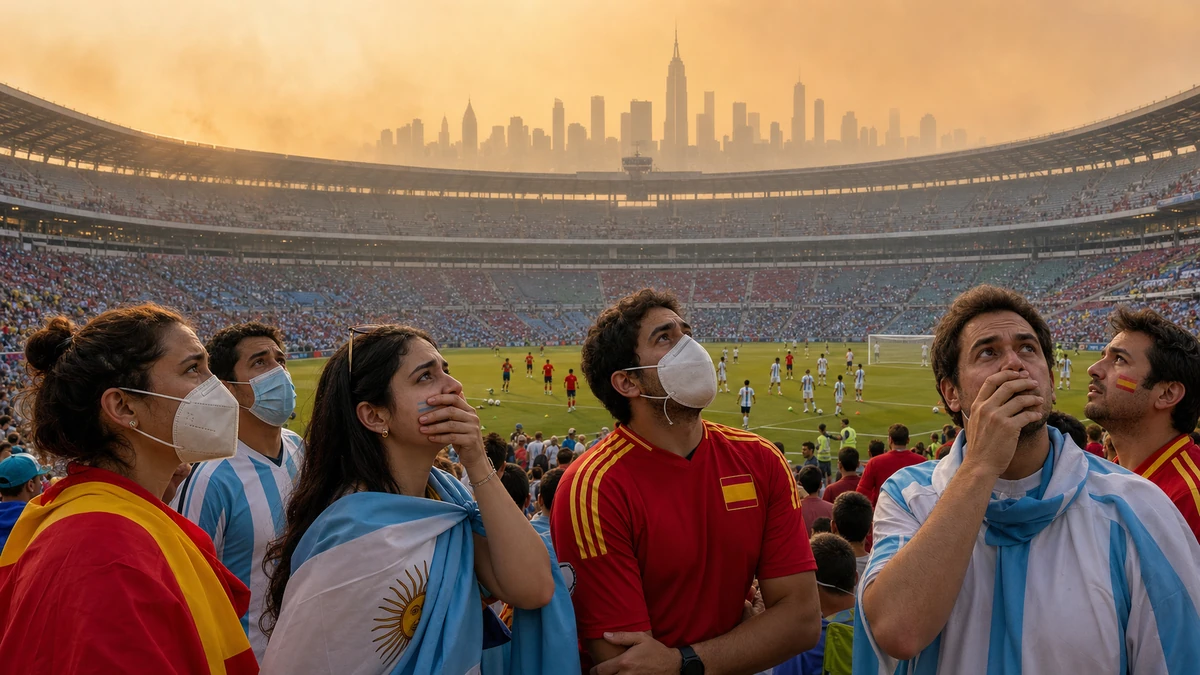
A global showpiece meets a cross-border environmental threat
Just days before one of the biggest events in world sports, organizers of the 2026 FIFA World Cup final are confronting a problem no coach can game-plan away: air pollution drifting south from Canadian wildfires.
The championship match, scheduled for July 19 at New York New Jersey Stadium in East Rutherford, New Jersey, is still expected to go forward as planned. But officials say they are closely monitoring deteriorating air quality in the region after smoke from wildfires in Canada pushed pollution levels high enough to trigger public warnings around the New York-New Jersey area.
The final, featuring Spain and Argentina, is supposed to be the triumphant climax of a monthlong tournament spread across North America. Instead, in the final days before kickoff, attention has shifted beyond lineups, tactics and celebrity halftime plans to a more basic question: What happens when the air itself becomes a health concern?
That question will sound familiar to many Americans. In recent years, wildfire smoke has become a recurring fact of life far beyond the forests where the fires begin. From hazy skies over New York in 2023 to dangerous conditions across parts of the Midwest and West during past fire seasons, Americans have seen how climate-linked disasters do not stay neatly within state or national borders. This time, the issue has landed at the doorstep of an event designed to project spectacle, unity and global celebration.
Organizers have not announced any schedule change, and there is no indication that a postponement is imminent. But the very fact that officials are publicly emphasizing air-quality monitoring underscores how much major sporting events now depend on forces outside the stadium gates. In the 21st century, the biggest game on earth can still be at the mercy of wind patterns hundreds of miles away.
Why this venue makes air quality especially important
The stakes are higher because the final is being held in an open-air stadium. Unlike a domed arena, where indoor climate systems can at least partially buffer outside conditions, the New York-area venue leaves players, staff and more than 80,000 spectators exposed to the same ambient air.
That matters for obvious reasons and some less obvious ones. Fans attending a World Cup final are not just dropping in for a two-hour event. They often spend hours traveling, standing in lines, sitting in the stands and taking part in pregame and postgame festivities. Add a halftime show, security procedures and the sheer scale of a global mega-event, and people could be breathing compromised air for a prolonged stretch.
For elite athletes, the issue is even more delicate. Soccer players cover miles during a match, often at high intensity, while breathing heavily. Even modest declines in air quality can become more consequential during sustained exertion. Respiratory irritation, reduced oxygen efficiency and general discomfort may not affect every player the same way, but they are the sort of variables no tournament organizer wants hovering over a final between two top national teams.
The open design of the stadium is usually part of the attraction. It creates a sense of atmosphere Americans might compare to a Super Bowl held without a roof, where weather, crowd noise and the natural environment heighten the drama. But what makes a venue feel grand and alive can also make it vulnerable. In this case, the same openness that promises a vivid World Cup spectacle also means wildfire smoke cannot simply be shut out.
That tension is central to what is happening now. The final was built to be a celebration on a massive scale, with all the theatrical elements modern sports fans expect. Yet the infrastructure of even a world-class venue has limits when the threat is not a broken light bank or a traffic jam, but a broad regional air mass carrying smoke from another country.
The numbers behind the concern
According to AirNow, the U.S. Environmental Protection Agency's public air-quality tracking site, the air quality index, or AQI, in East Rutherford measured 101 on July 15 and then climbed to 157 on July 16.
For Americans who do not follow AQI readings closely, those numbers are not abstract. An AQI of 101 enters the category considered unhealthy for sensitive groups, meaning children, older adults and people with asthma, heart disease or other respiratory conditions may face increased risk. At 157, the level moves into the broader unhealthy range, where the concern extends beyond the especially vulnerable and can affect the general public as well.
That distinction matters because a World Cup final is precisely the kind of event that draws a diverse cross-section of people: young fans, older tourists, families with children, workers staffing concessions and security, and international visitors who may not be acclimated to local advisories or even fully understand the severity of the warning. What might be an inconvenience during an ordinary day can become a larger public-health question when tens of thousands of people gather outdoors at once.
At the same time, AQI readings are not fixed in place. Air quality can shift meaningfully from one day to the next, or even within hours, depending on weather systems and the movement of smoke. That is one reason organizers are not treating the earlier readings as an automatic predictor of conditions at game time. An elevated number two days before the final is a warning sign, not a final verdict.
Still, the jump from 101 to 157 in a single day is a reminder of how quickly the situation can change. It also explains why officials are talking publicly about vigilance rather than offering blanket reassurance. There is a difference between saying the final remains on schedule and saying there is nothing to worry about. Right now, organizers appear to be drawing that line carefully.
How organizers and government officials are responding
Officials tied to World Cup planning say they are monitoring the situation closely rather than moving immediately toward postponement or relocation. That approach reflects both practical realities and the nature of the threat itself. Wildfire smoke can be severe, but it is also dynamic. The most useful response in the short term is often constant observation, consultation with experts and flexibility if conditions worsen.
At a White House World Cup task force briefing on July 17, Andrew Giuliani said discussions had taken place among relevant agencies regarding deteriorating air quality linked to the Canadian fires. He said organizers were watching developments carefully.
According to reporting cited from AFP, personnel from the National Weather Service are also involved in the response, with specialized staff stationed at FIFA headquarters to help assess changing conditions. That detail may sound bureaucratic, but it is significant. It suggests the issue is being handled not merely as an inconvenience for event operations, but as an evolving weather and environmental challenge requiring professional, real-time analysis.
For American readers, it may help to think of this as the kind of coordination that would accompany a major hurricane threat before a Super Bowl, a severe heat emergency at a marathon, or lightning concerns at a large outdoor concert. The difference here is that smoke is less visually dramatic than a storm but can still have serious health consequences. It is an invisible infrastructure problem, one that demands data, expertise and contingency planning.
So far, that planning has not produced any announced changes to the final. But the posture of the organizers matters. They are not brushing off the issue, nor are they signaling panic. Instead, they appear to be keeping open the possibility of action if updated forecasts or on-the-ground readings justify it. In crisis management terms, it is a hold-and-watch stance.
A reminder that climate and sports increasingly collide
This is not just a sports story. It is also a climate and public-safety story, and one increasingly familiar across North America.
Wildfire smoke used to feel, for many Americans, like a regional problem primarily associated with Western states. That perception has changed. Massive fires in Canada in recent years have sent smoke into major U.S. population centers, tinting skylines orange, prompting school cancellations and pushing millions of people indoors. The sight of Manhattan skyscrapers disappearing into a gray haze helped cement a new understanding: Environmental disasters can travel, and they can disrupt daily life far from the ignition point.
The World Cup final illustrates that reality in unusually vivid fashion. Here is one of the most choreographed events in global entertainment, with years of planning, multinational sponsorships, security coordination and broadcast arrangements. Yet none of that can fully insulate the event from a fire burning in another country if weather conditions carry the smoke south.
That does not mean the final is doomed or even likely to be delayed. It means modern event planning now has to account for a category of risk that once might have been considered peripheral. Heat waves, poor air quality, flooding and extreme storms are no longer hypothetical background concerns. They are operational issues.
For FIFA and future host cities, the lesson may extend beyond this single match. Air-quality protocols, thresholds for player safety, communication strategies for fans and backup plans for major outdoor events may all become more central in an era of increasingly volatile environmental conditions. The sports world, like the rest of society, is being forced to adapt to a climate reality that does not respect borders or schedules.
Spain, Argentina and the challenge of preparing through uncertainty
For the teams themselves, the timing is especially awkward. The World Cup final is a singular event, the sort of match players prepare for over a lifetime. Spain and Argentina are expected to meet in a heavyweight showdown worthy of the tournament's final stage, and the conversation under normal circumstances would center on strategy, star power and national expectations.
Instead, both teams must also account for an environmental factor beyond their control. Coaches can tweak formations. Trainers can monitor hydration and conditioning. Medical staffs can prepare for heat, fatigue and muscle strain. But no one can coach around a shifting air mass.
That uncertainty can have subtle effects even if the game goes ahead without incident. Teams may alter training loads. Players with asthma or respiratory sensitivity may require closer monitoring. Recovery, warmups and substitution patterns could all be influenced by the quality of the air on match day. None of that guarantees a visible impact on the game, but at this level, tiny variables matter.
There is also the fan experience. For many supporters, attending a World Cup final is a bucket-list journey akin to going to the Olympics or the Super Bowl. International fans may have spent thousands of dollars and crossed oceans to be there. If the air remains poor, the festive atmosphere could be complicated by health advisories, masks, reduced outdoor celebration and concern from families traveling with children or elderly relatives.
That said, one of the striking features of this moment is that excitement around the final has not disappeared. It has simply been joined by a parallel conversation about safety. The event remains, at its core, a sporting and cultural spectacle. What has changed is that organizers now have to preserve not just the pageantry, but the basic conditions that allow people to enjoy it without undue risk.
What to watch before kickoff
As of now, the clearest facts are these: The final is still scheduled for July 19 in East Rutherford. Officials have acknowledged the air-quality issue. Monitoring is ongoing. Expert personnel are involved. No formal postponement or venue change has been announced.
In practical terms, the next 24 to 48 hours matter. Updated AQI readings, smoke forecasts and local weather patterns will help determine whether conditions improve, worsen or remain unstable. Organizers are likely to focus less on a single headline number and more on trend lines, timing and expected conditions during the full event window, including fan arrivals and departure.
For spectators, especially those with asthma or other respiratory issues, local public-health guidance may become just as important as ticket information. In the United States, that often means checking official air-quality tools such as AirNow, following venue updates and taking common-sense precautions such as limiting unnecessary outdoor exposure before the event. For international visitors unfamiliar with AQI warnings, organizers may need to communicate clearly and repeatedly in ways that are easy to understand.
The broader significance of this episode may endure even if the smoke lifts and the final unfolds smoothly. It is a reminder that today's global sports spectacles do not exist in a bubble. They are shaped not only by TV contracts, security plans and athletic talent, but also by environmental systems that no host city can fully control.
For now, the world's attention remains fixed on a title match between Spain and Argentina. But just outside the frame of that sporting drama is another story, one that says as much about this era as any final score will: Even the grandest games on earth are increasingly being played under skies altered by a warming, burning world.
Comments
Post a Comment