
Image to help understand the article
From Korean breakout hit to Japanese prime-time remake
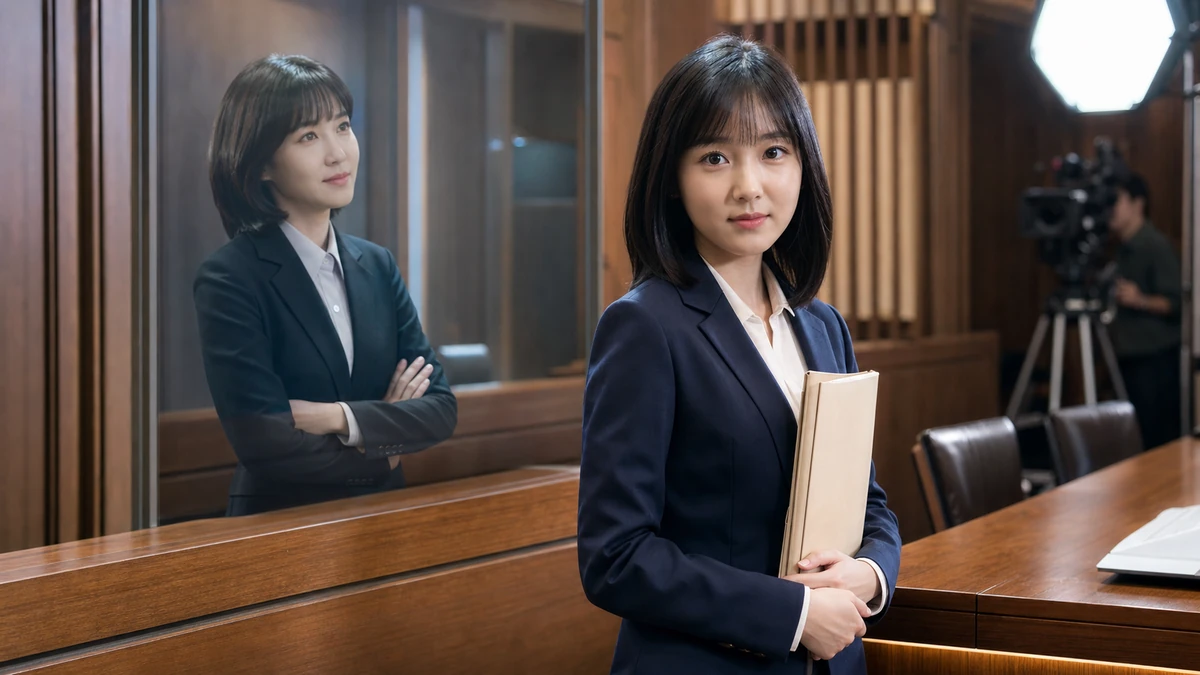
A South Korean television drama that became one of the most talked-about international series of 2022 is now entering a new phase of global life: not just traveling overseas, but being rebuilt for another country’s mainstream audience. “Extraordinary Attorney Woo,” the Korean legal drama led by actor Park Eun-bin, is being remade in Japan under the title “Extraordinary Attorney Minami,” with Japanese actor Mana Ashida in the lead role. According to the announcement cited by Kansai TV, the remake is scheduled to premiere Oct. 19, 2026, at 10 p.m.
That may sound like a routine adaptation in an era when popular shows regularly cross borders. But in the context of the Korean Wave, or Hallyu — the global spread of South Korean entertainment and culture — this is more significant than a simple remake announcement. For years, the dominant model of Korean TV’s international success was export: a Korean show is made in Korea, subtitled or dubbed, then watched abroad through television licensing deals or global streaming platforms. “Extraordinary Attorney Woo” followed that path and succeeded on a very large scale. Now the story is moving into a different category, one familiar to Americans from shows like “The Office” or “Ugly Betty”: a local industry taking a proven format and reinterpreting it with its own stars, rhythms and cultural references.
That shift matters because it suggests Korean drama is no longer just an imported product in overseas markets. In some cases, it is becoming source material — intellectual property sturdy enough to be remade, localized and tested within another country’s own broadcast system. Japan’s version will not simply borrow the title recognition of the Korean original. It will compete as a domestic drama in Japanese prime time, with a well-known Japanese lead and a presentation calibrated for viewers there.
The original Korean series aired on ENA in 2022 and became a breakout sensation. It posted a 17.5% rating, the highest in the channel’s history, according to the source material provided here. It also spent seven consecutive weeks at No. 1 in Netflix’s non-English TV category, a measure of how strongly it traveled beyond Korea. Those two metrics are not the same thing — one reflects domestic television audience concentration, the other reflects global streaming attention — but together they help explain why a broadcaster in Japan would see the property as worth adapting.
In other words, this is not just a case of one successful show getting another life. It is evidence of a broader industry transition: K-dramas are increasingly valuable not only as finished programs to watch, but as stories that can be redeveloped for local audiences elsewhere.
Why this story resonated in the first place
To understand why a remake carries so much weight, it helps to remember what made “Extraordinary Attorney Woo” stand out. The series centered on a brilliant young lawyer navigating the legal profession and social expectations while bringing an unconventional perspective to the cases around her. It became widely discussed not only because of courtroom plotting, but because it blended procedural structure with emotional storytelling, character-driven humor and a carefully built lead performance from Park Eun-bin.
For American audiences, the easiest comparison is to think about what happens when a legal drama becomes something more than a legal drama. In the United States, courtroom series often find staying power when they deliver both weekly cases and a deeply personal point of view — whether that is the high-gloss professional churn of “The Good Wife,” the moral ambiguity of “Better Call Saul,” or the network-TV accessibility of older broadcast staples. Korean dramas often work differently in format, usually built for a single-season narrative arc rather than an open-ended run, but the same principle applies: viewers stay for the cases, then become invested in the character’s inner life.
The original series also benefited from timing. By 2022, American and global audiences were already much more comfortable with subtitled Korean content than they had been a decade earlier. The success of “Parasite,” the worldwide reach of Netflix’s “Squid Game,” the continued expansion of K-pop and the broader normalization of streaming international TV all helped create a market in which a Korean legal drama could become part of everyday entertainment conversation outside Korea. A show did not need to be remade in English first in order to travel. It could arrive in its original language and still become a hit.
That is what makes the Japanese remake notable. It is not stepping in to solve a distribution problem. The original was already widely available and already globally visible. Instead, the remake reflects a different calculation: some stories are strong enough that another market believes they can work again, freshly performed and culturally recalibrated, for viewers who may want something more local in accent, acting style and emotional register.
The source summary emphasizes exactly that point. The Japanese version is not being introduced as a mere foreign import. It is being positioned as a fully independent domestic drama, airing at a set prime-time slot and built around Mana Ashida, an actor with deep name recognition in Japan. That kind of casting is not incidental. It lowers the barrier for viewers who may not know the Korean original while also inviting fans of the Korean version to compare performances, tone and interpretation.
What changes when a Korean hit is remade in Japan
The most visible change is right there in the title. Woo Young-woo becomes Minamida Minami. That renaming is more than a branding choice; it is a signal of localization. In cross-border television adaptation, names matter because they immediately tell the audience whether they are being asked to visit another culture or inhabit their own. A remake generally succeeds not by preserving every visible surface detail from the original, but by deciding which core elements are essential and which should be translated into local emotional language.
That is especially important in East Asia, where audiences in Korea and Japan may share some overlapping genre expectations yet still respond differently to dialogue cadence, family dynamics, workplace behavior and television pacing. Even before any episode airs, the announced structure suggests the Japanese version will be judged less on fidelity than on credibility: Does this character feel fully Japanese within a Japanese broadcast drama world? Does the emotional logic land for local viewers? Can the series stand on its own for people who never saw Park Eun-bin’s performance?
Mana Ashida’s casting is central to that effort. The source material notes her long familiarity to Japanese audiences and references major screen credits, including Japanese dramas such as “Mother” and “Marumo no Okite,” as well as Guillermo del Toro’s Hollywood film “Pacific Rim.” In Japan, she has at times carried the image of a nationally beloved younger star — the kind of shorthand celebrity recognition that can instantly make a project more approachable for a broad audience. For a remake, that is useful. A familiar actor in an unfamiliar setup can make adaptation feel less risky.
American viewers have seen this strategy many times. When Hollywood remakes a foreign film or when a U.S. network adapts a British format, star casting often acts as a bridge. The audience may not know the original source, but it knows the face on the poster. The same logic appears to be at work here. The Japanese production is not simply betting on the residual fame of a Korean streaming success. It is anchoring the material in local celebrity capital.
That also means the real creative question is not whether Ashida can reproduce what Park did. It is whether she can create a version of the role that makes sense in a different performance tradition. This is where cross-border remakes live or die. The worst ones feel like cover songs performed too closely to the original. The best ones preserve the spine of the story while letting a new actor, language and production culture discover distinct notes.
The source summary rightly points out that original fans and new viewers do not have to be in conflict. Remakes can expand audience pathways rather than split them. Someone who starts with the Japanese version may decide to go back to the 2022 Korean original. Someone who loved the Korean series may watch the Japanese adaptation to see how its emotional beats shift in another national context. In the streaming era, adaptation no longer erases the original. It usually sits beside it.
What this means in the United States
For the United States, the remake is a useful signal about the maturity of Korean entertainment as a global business. American audiences tend to notice K-dramas most visibly when they explode on Netflix rankings, generate fan conversation on TikTok or inspire niche devotion among streaming subscribers. But the bigger industry story is not just about viewership. It is about ownership, adaptation rights and the long-term value of story intellectual property.
Hollywood understands that value better than almost anyone. The American entertainment business has long turned books, foreign films, magazine articles and older TV series into new properties for domestic audiences. What is changing is that Korean drama is increasingly entering that pipeline not as a curiosity, but as premium source material. A Japanese remake of a Korean hit does not directly involve the United States, but it still matters to American studios, streamers and agencies because it reinforces an idea the U.S. industry is already watching closely: Korean storytelling can generate durable franchises and repeatable formats, not just one-off international sensations.
That has implications for American companies in several ways. Streamers operating in the United States are in a constant fight for recognizable global titles that can travel across markets. If a Korean series can work first as a domestic hit, then as a global streaming success, then as the basis for a remake in another major Asian market, it becomes more attractive as an asset class. Rights holders, production companies and distributors all notice that. So do American executives who increasingly look to Asia not only for licensing deals but for development pipelines.
There is also a fan dimension. The U.S. audience for Korean drama is no longer small or especially niche, even if it remains fragmented across platforms and age groups. Korean series have found viewers among Asian American households, younger streaming audiences, K-pop fans, and increasingly mainstream viewers who have become comfortable reading subtitles. Those viewers are sophisticated enough to understand the difference between an original and an adaptation. They are also used to following a property across versions, just as anime fans may compare live-action remakes or British-TV devotees may track American reinterpretations.
For American media consumers, then, the Japanese remake is less likely to replace “Extraordinary Attorney Woo” than to deepen conversation around it. It may encourage more U.S.-based viewers to revisit the Korean original or to think more critically about how stories change when they move between cultures. That, in turn, helps normalize the idea that international television is not a side category. It is simply television — global, iterative and increasingly interconnected.
One more U.S. angle matters here: America’s relationship with both Korea and Japan as cultural exporters. For decades, many Americans consumed Japanese pop culture through anime, games and film while viewing Korean entertainment as more specialized. That hierarchy has changed dramatically. Today, Korea is one of the central global drivers of pop culture conversation. A Japanese remake of a Korean hit subtly reflects that shift in regional influence. For Americans used to seeing entertainment flow mainly from Hollywood outward, this is another reminder that the creative map has changed.
Beyond export: K-drama as adaptable intellectual property
The most important industry takeaway from this announcement is that K-drama is moving beyond the export model. Export means a series leaves Korea largely intact: same script, same cast, same production, different subtitles. Adaptable IP means the story itself becomes portable. That is a bigger leap because it extends the life of a show beyond its original run and opens multiple revenue and influence channels at once.
In practical terms, a successful Korean drama can now generate value in at least three ways. First, it can succeed in Korea, where ratings and public buzz establish domestic legitimacy. Second, it can travel globally through streaming, where platform rankings and social media conversation broaden its footprint. Third, it can be remade locally in another country, where the narrative gets reintroduced to a new audience under different production conditions. The source summary on “Extraordinary Attorney Woo” points to all three stages, with the Korean ratings record, the seven-week Netflix run at No. 1 in the non-English TV category, and now the Japanese adaptation.
For the Korean content business, that matters because it reduces dependence on a single release window. A show’s value no longer ends when its original finale airs. If the premise is strong, the emotional engine durable and the format flexible enough, the series can continue to generate relevance through adaptation. That is the same economic logic that has long driven American television development, where format ownership and remake rights often matter as much as initial ratings.
There is a cautionary side, too. A hit record in one market does not guarantee a repeat in another. The source material is careful on that point, and rightly so. A 17.5% audience share on a Korean channel and seven weeks atop a global Netflix category demonstrate proven appeal, but they do not predetermine how a Japanese prime-time audience will respond. Remakes are often purchased because they seem safer than originals; they are never truly safe. Local viewers still demand emotional truth, tonal consistency and performances that feel native rather than imported.
That is why the upcoming Japanese version is best understood not as a victory lap for the Korean original, but as a test of how far Korean television IP can stretch without losing coherence. If it succeeds, it will support the case that more Korean dramas can be repositioned this way. If it struggles, that will not erase the original’s accomplishments, but it may remind broadcasters that streaming virality and local broadcast success are different muscles.
What to watch next
Between now and the 2026 premiere, the most revealing details will likely be the ones that show how aggressively the Japanese production localizes the material. Will it preserve the Korean original’s narrative architecture closely, or will it adapt more freely to Japanese legal-drama conventions and broadcasting style? How will it shape the lead character’s emotional expression, relationships and social environment? And how heavily will marketing lean on the fame of the Korean original versus the star power of Mana Ashida?
Those choices will say a lot about where Asian television adaptation is heading. In the past, cross-border remakes sometimes carried a defensive undertone, as if a local audience needed its own version because the original felt too foreign. In today’s streaming environment, that logic is weaker. Viewers can often access the original with a few clicks. That means modern remakes have to justify themselves creatively, not just logistically.
There is also a broader geopolitical and cultural backdrop. South Korea and Japan have a complicated history, and culture has often served as both bridge and battleground between them. A Japanese adaptation of a contemporary Korean hit does not erase those realities, but it does highlight how deeply entertainment industries in the region are entangled. For American readers, the parallel may be the way the U.S. and Britain constantly reinterpret each other’s television formats while still maintaining distinct cultural identities. Creative exchange does not mean sameness; it means sustained influence.
For the U.S. market, the next thing to watch is whether more Korean properties are treated not just as importable series but as development blueprints. American companies do not need Japan’s remake to validate Korean storytelling, but each successful adaptation elsewhere strengthens the business case for more ambitious partnerships, co-productions and rights deals. It also trains audiences to expect that a major story may exist in multiple national versions at once.
Ultimately, the significance of “Extraordinary Attorney Minami” is larger than one remake. It marks another step in the evolution of Korean drama from globally circulated content into globally reusable storytelling infrastructure. The original “Extraordinary Attorney Woo” became a ratings phenomenon at home and a streaming phenomenon abroad. The Japanese version will now test whether that success can be transformed into something harder to achieve and more revealing: a convincing second life in another country’s own language, star system and prime-time television culture.
That is why this announcement deserves attention beyond Korea and Japan. It is a snapshot of where television is going. In the old model, a hit crossed borders. In the new one, a hit crosses borders and changes shape — and if the industry is right about where audience habits are headed, that second stage may become just as important as the first.


0 Comments