A Korean Band Wants to Expand the Meaning of Pop. With ‘One,’ SEODO Band Bets on Tradition, Emotion and a New Sound Called ‘Joseon Pop’
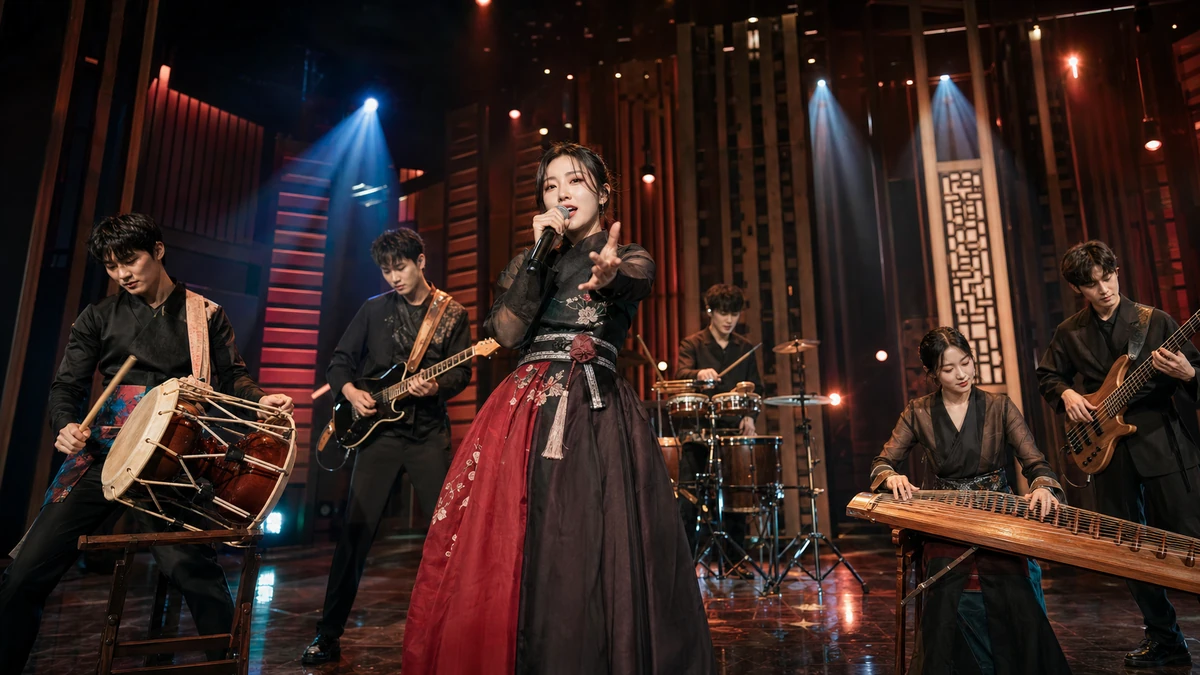
Image to help understand the article
A New Kind of Korean Pop Steps Forward
As K-pop has become a global force — filling arenas in Los Angeles, topping Billboard charts and reshaping the music business far beyond South Korea — the term itself has started to mean very different things to different listeners. For some Americans, K-pop still evokes highly polished idol groups, synchronized choreography and glossy dance tracks engineered for global appeal. But inside South Korea’s music scene, the category is much broader, and artists continue to test how much of Korea’s own history, language and emotional vocabulary can fit inside a modern pop framework.
That is where SEODO Band comes in. The Korean group released its first full-length album, One, on Monday, presenting not just a new record but a declaration of identity. The band describes its music as “Joseon pop,” a term it uses to signal a deliberate fusion of Korean traditional music and contemporary pop structures. The goal, the group has said, is not simply to decorate pop songs with a few recognizable traditional sounds. It is to build a distinctly Korean musical language that feels familiar to Korean listeners while sounding fresh and compelling to audiences abroad.
For American readers unfamiliar with the term, “Joseon” refers to Korea’s Joseon Dynasty, which ruled from the late 14th century to the late 19th century and still looms large in Korean cultural memory. In modern popular culture, the word often suggests something historically Korean, rooted in older customs, aesthetics and ways of expression. By pairing “Joseon” with “pop,” SEODO Band is effectively announcing its mission in the name itself: music grounded in Korean tradition, delivered through the accessible architecture of present-day popular music.
The release of One matters because full-length albums still carry symbolic weight, even in a streaming era dominated by singles and quick-turnaround digital releases. A debut album can function as a thesis statement, a chance for an artist to present a complete worldview rather than a one-off experiment. For SEODO Band, that makes One more than a playlist of songs. It is the band’s most complete attempt yet to define what Joseon pop sounds like, what it means and why it deserves to stand as more than a novelty inside the larger K-pop ecosystem.
That ambition also places the group in a different lane from many export-oriented Korean acts. Rather than softening the Korean elements in its music to make them easier for outsiders to digest, SEODO Band appears to be making the opposite argument: that the more specifically Korean the emotional and lyrical core becomes, the more distinctive and competitive the music can be in a crowded global market.
What ‘Joseon Pop’ Means — and Why the Name Matters
Genre labels can be clumsy, but they are also useful. “Latin pop,” “Afrobeats,” “country rap” and “Americana” all do more than describe sound; they tell listeners something about origin, lineage and intention. SEODO Band’s use of “Joseon pop” works in a similar way. It is a branding tool, certainly, but it is also an argument about where Korean pop can go next.
In South Korea, traditional music is generally referred to as gugak, a broad term that includes court music, folk music, ritual music and a range of vocal and instrumental traditions. In the United States, comparisons are imperfect, but one way to think about it is as a category that combines elements of folk heritage, classical preservation and regional memory — the kinds of sounds that carry a nation’s historical identity. When artists borrow from that tradition, they face a familiar challenge: use too little, and the heritage becomes superficial window dressing; lean too heavily into preservation, and the work may struggle to connect with younger mainstream audiences.
SEODO Band’s pitch is that Joseon pop can solve that tension. The Korean lyrics and emotional sensibility hold onto the music’s identity, while the pop production offers a point of entry for listeners who may not know anything about Korean history or traditional performance styles. That balancing act is central to the band’s project. It is not only about mixing instruments or vocal techniques. It is about translating cultural feeling without flattening it.
The band has also taken on the unusual task of publicly identifying itself as the originator of the term. That comes with risk. Coining a genre name can sound presumptuous, especially in a music industry where labels are often created by journalists, marketers or fans after the fact. But it also reflects the group’s sense that what it is doing is distinct enough to require its own frame. If “K-pop” has become, in global shorthand, associated mainly with one set of aesthetics, then “Joseon pop” signals a refusal to be absorbed into that expectation.
That matters in a U.S. context as well. American listeners have grown more comfortable with non-English music, but international artists are still often sorted into broad, flattening categories. Korean music, in particular, is frequently treated overseas as if it were synonymous with idol pop. SEODO Band’s self-definition challenges that assumption by insisting that Korean popular music can emerge from older cultural roots and still speak in a modern voice.
The Emotional Core: Explaining ‘Han’ to a Global Audience
The band says one of the key things separating its music from other forms of K-pop is han, a Korean concept often described as a deep, layered feeling of sorrow, grievance, endurance and emotional residue carried over time. It is one of those cultural terms that resists simple translation. No single English word — not grief, resentment, melancholy or longing — fully captures it. Han can include pain, but also persistence. It suggests a wound that does not disappear, yet does not stop life from moving forward.
For Americans, a rough comparison might be the emotional depth often associated with the blues, Appalachian ballads or certain strains of gospel and country music — forms born not just from sadness, but from historical memory, hardship and survival. Still, even those analogies only go so far. Han is rooted in specifically Korean experiences and storytelling traditions, and it occupies a powerful place in Korean literature, cinema and music. To invoke it is to signal not simply sadness, but a shared emotional inheritance.
That makes SEODO Band’s emphasis notable. Much of globally successful pop music is built around instantly legible emotional cues: romance, heartbreak, confidence, desire, freedom, rebellion. Those themes travel easily. Han, by contrast, asks listeners to enter a more culturally specific emotional world. Rather than treating that specificity as a commercial obstacle, SEODO Band appears to view it as the center of its artistic strength.
This is a sophisticated approach to cultural export. In many international music markets, artists are often encouraged to smooth out what is most local in order to maximize accessibility. But some of the most resonant global music succeeds for the opposite reason. Audiences do not always need every lyric or reference fully explained to feel an emotional truth. A Portuguese listener may not speak Spanish and still feel the ache in flamenco. An American may know little about West African musical structures and still respond viscerally to rhythm and voice. SEODO Band seems to be betting that han can work the same way: first as sensation, then as understanding.
That may be especially important at a time when international audiences are looking for more than just polished spectacle from Korea. The global appetite for Korean culture has matured. Viewers who first arrived through blockbuster K-dramas or chart-dominating idol groups are increasingly curious about what lies underneath: language, history, food, fashion, folklore and older artistic traditions. A band foregrounding han is effectively inviting listeners deeper into that world.
Familiar at Home, New Abroad
SEODO Band has described its creative goal in simple terms: to offer familiarity to Koreans and novelty to foreigners. It is a strikingly clear summary of how cultural hybridity works in practice. The same song can carry one meaning for a domestic audience and another for international ears, depending on what each group recognizes when it listens.
For Korean listeners, the familiarity may come through turns of phrase, melodic contours, vocal style or emotional texture tied to traditional music and language. Certain cadences or tonalities may register not as exotic but as intimate, even ancestral. For a listener raised with those sounds somewhere in the cultural background, the effect may be less about surprise than about recognition.
For overseas listeners, the path in is different. Pop structure becomes the bridge. A familiar rhythm section, modern arrangement or song form can make a listener comfortable enough to stay with a track long enough to hear what is unusual about it. In that sense, pop is not replacing the traditional core; it is acting as a guide rail. The band’s strategy is less “fusion” in the superficial world-music sense and more “double address”: one song, two entry points.
That approach may sound abstract, but it mirrors how many Americans already engage with foreign-language music. A listener might first click on a song because the production feels contemporary or the hook feels immediate, then become intrigued by the timbre of the vocal, the lyrical flow or the cultural references they do not yet understand. That is how audiences learn to love music across borders: not by mastering a culture before listening, but by listening first and then following curiosity.
In that way, SEODO Band’s project aligns with a broader shift in global music consumption. Streaming platforms have made genre and geography more porous, but they have also intensified competition for attention. Distinctiveness matters. Artists who can offer something recognizable and something unrepeatable at the same time often break through more effectively than those who simply mimic whatever is already popular. By centering Korean language and traditional emotional cues while maintaining accessible pop scaffolding, SEODO Band is trying to occupy precisely that space.
There is also a subtle cultural confidence in the band’s framing. The message is not that Korean identity must be diluted for foreign listeners. It is that Korean identity, clearly expressed, can be the very thing that draws people in. That is a meaningful shift from older eras of Asian crossover strategy, when artists were often pressured to conform to Anglo-American expectations in language, styling or sound.
A Wider Korean Wave, Beyond the Idol System
To understand why One could matter beyond one band’s career, it helps to place it within the broader Korean Wave, known in Korean as hallyu. Over the past two decades, South Korea has become one of the world’s most influential cultural exporters, with impact extending from pop music and television to beauty products, film, gaming and cuisine. Americans who may not have known Korean artists a decade ago now likely recognize names such as BTS, BLACKPINK or NewJeans, or at least have seen the commercial footprint of Korean entertainment in streaming menus, festival lineups and social media feeds.
But the success of K-pop abroad has sometimes narrowed outside perceptions of Korean music rather than expanding them. The idol system — with its rigorous training, visual branding and international marketing machine — is only one part of the country’s musical landscape. Indie rock, hip-hop, R&B, folk revivalists, singer-songwriters and experimental musicians all exist alongside the better-known pop giants. What groups like SEODO Band represent is another layer still: artists trying to widen the international definition of Korean pop by reconnecting it to older Korean forms.
American audiences have seen similar debates in their own music history. Country artists have long argued over the boundary between tradition and crossover pop. Jazz musicians have wrestled with commercialization versus preservation. Folk revivals have repeatedly asked whether authenticity lies in maintaining the old form or reinterpreting it for the present. SEODO Band is entering a Korean version of that conversation. The difference is that it is doing so during a moment when Korean culture already has unprecedented global visibility.
That timing gives the band an opening. There is now a larger international audience ready to hear Korean music that does not fit the usual idol template. The challenge, of course, is whether that audience will stay long enough to absorb music built around concepts, linguistic textures and emotional traditions they do not immediately understand. The band’s confidence suggests it believes they will — provided the songs themselves are strong enough to carry the unfamiliar material.
And that may be the most important point. Novelty alone rarely sustains a genre label. A new category survives only if the music convinces people before the concept does. “Joseon pop” is catchy as a descriptor, but it will endure only if listeners feel something real when they hear it. SEODO Band appears aware of that burden. The group has framed the label not as a marketing gimmick but as a responsibility, implying that naming a genre means proving, through the work, that the distinction is meaningful.
Why ‘One’ Could Mark a Turning Point
The title One carries an obvious symbolic charge for a first studio album. It suggests origin, unity and a starting point. In SEODO Band’s case, it also reads as a statement that the group now sees its musical identity as coherent enough to present in full. Singles can test an idea; an album asks whether the idea can sustain a whole world.
That is what makes this release worth watching for anyone following the future of Korean pop beyond its biggest commercial exports. If One succeeds, it could help normalize a richer vocabulary for talking about Korean music internationally. It could encourage journalists, critics, festival programmers and casual listeners to think of Korean pop not as a single polished format but as a field with multiple histories and trajectories.
It may also sharpen an ongoing question inside global pop itself: What do audiences really want from international music now? For years, the dominant industry answer was accessibility — English hooks, familiar structures, collaborations with Western stars, sleek genre neutrality. That model still works. But there is growing evidence that audiences also crave specificity. They want music that comes from somewhere, that sounds tied to a place, a language or a worldview. The worldwide success of regional Mexican music, Afrobeats, flamenco-pop hybrids and multilingual rap scenes suggests that local identity is not a liability in the streaming age. It can be a competitive advantage.
SEODO Band’s argument with One is that Korean identity should not be limited to visual motifs or costume-coded nods to tradition. It can live in lyrical phrasing, emotional structure, vocal inflection and musical tension. That is a more demanding proposition because it asks the listener to engage at a deeper level. But it is also a more durable one. A decorative use of tradition may impress at first glance; an emotionally coherent musical language can last.
For English-speaking listeners discovering the album, the appeal may come precisely from that layered experience. There is the immediate pleasure of hearing something sonically fresh. Then there is the curiosity sparked by terms such as gugak, Joseon and han. And finally there is the broader realization that the Korean Wave is still evolving, not by repeating a single winning formula, but by generating new forms from within Korea’s own cultural archive.
In that sense, One is more than a debut album. It is part of a larger conversation about what global pop can be when artists refuse to separate modernity from memory. SEODO Band is not asking the world to look at Korean tradition from a distance, like a museum piece. It is asking listeners to hear that tradition alive inside contemporary music, carrying an emotional logic that may be unfamiliar at first but no less human for being hard to translate.
Whether “Joseon pop” becomes a lasting category or remains closely associated with one pioneering act, the release of One underscores something increasingly clear about Korean music in the 2020s: its international future may belong not only to the most streamlined and export-ready sounds, but also to artists bold enough to make the local, the historical and the untranslatable central to the pop experience.
Comments
Post a Comment