Image to help understand the article
Korea’s pharmaceutical industry claims a milestone beyond K-pop and semiconductors
South Korea has spent years building a global reputation on exports that Americans instantly recognize: Samsung smartphones, Hyundai cars, Oscar-winning films, streaming dramas and K-pop groups that can sell out stadiums from Los Angeles to London. Now one Korean company is trying to make a different kind of international statement — not in entertainment or electronics, but in prescription medicine.
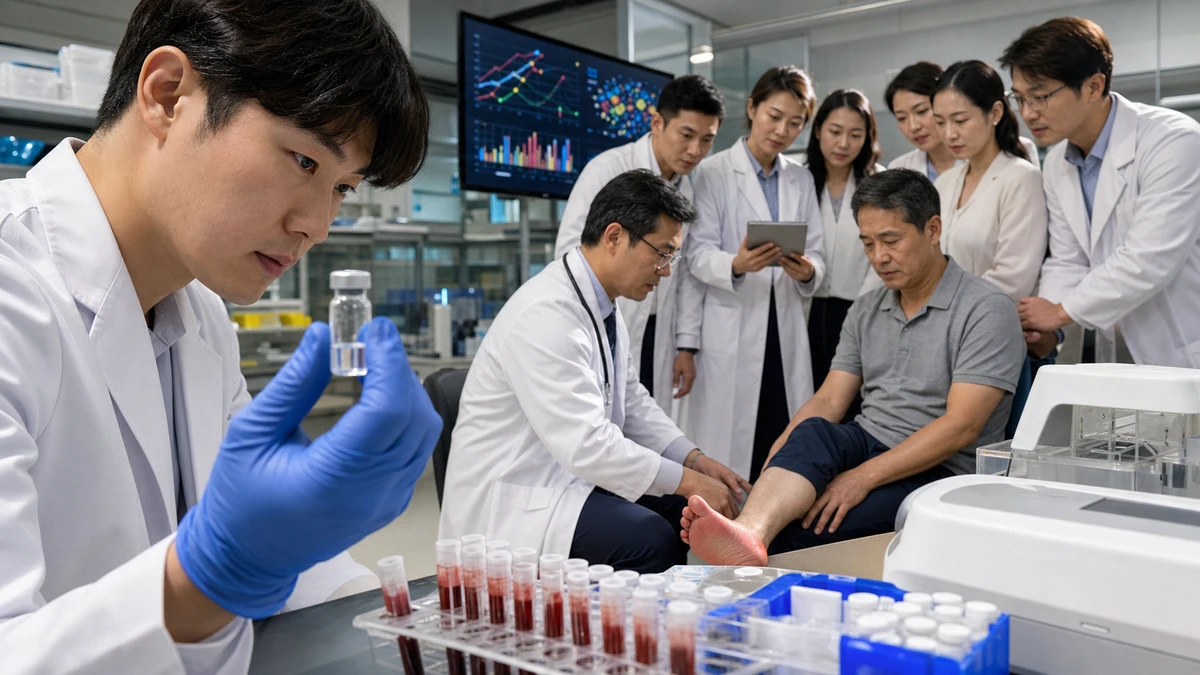
JW Pharmaceutical, known in Korea as JW JungWae Pharmaceutical, said it has confirmed the effectiveness of an experimental gout treatment called epaminurad in a multinational Phase 3 clinical trial conducted across five Asian countries and territories. The company said it is now preparing to seek marketing approval in South Korea, a step that would move the drug candidate from the research stage toward possible real-world use.
For American readers, that may sound like a routine drug-development update. Pharmaceutical companies announce trial results all the time. But in the Korean context, the development carries broader significance. It points to how the country’s biotech and pharmaceutical sectors are trying to evolve from domestic players into regional and potentially global developers capable of running large, late-stage trials across multiple health systems.
According to the company’s announcement, the trial enrolled 612 gout patients at 52 institutions in South Korea, Taiwan, Thailand, Malaysia and Singapore. That matters because Phase 3 trials are typically the point at which a drug candidate faces its most serious test in a broad patient population under conditions closer to actual clinical use. They are not simply about whether a compound looks promising in a lab or in an early, small-scale study. They are designed to generate the kind of evidence regulators, doctors and investors treat as a major checkpoint.
In this case, JW Pharmaceutical says the key result came at the 6-milligram dose of epaminurad, which the company has positioned as its main development dose. It said that dose showed superior uric-acid-lowering effects compared with febuxostat, an established gout medication that is widely prescribed in South Korea. The company also said it demonstrated safety in the comparison, though the announcement summarized top-line results rather than releasing the kind of detailed data set that outside experts would typically want to review in full.
The headline, then, is not that a Korean company has already brought a new gout drug to market. It has not. The headline is that the company says it has cleared an important late-stage hurdle and is moving into the regulatory phase, armed with comparative data against a standard therapy in a large Asian trial. That is a notable development both for patients and for South Korea’s growing ambitions in drug research.
Why gout still matters, even if many Americans think of it as an old-fashioned disease
To many Americans, gout can sound like the kind of illness associated with history books — a disease caricatured in paintings of kings, wealthy merchants and overindulgent aristocrats clutching a swollen foot after too much red meat and wine. That stereotype is incomplete and, in many cases, misleading.
Gout is a form of inflammatory arthritis caused by elevated levels of uric acid in the blood, a condition known as hyperuricemia. When uric acid builds up, it can form needle-like crystals in joints and tissues, triggering sudden episodes of intense pain, swelling, redness and tenderness. The big toe is a classic site, but gout can also affect ankles, knees, elbows, wrists and fingers. For some patients, it becomes a chronic condition that affects quality of life, mobility and long-term health.
In the United States, gout is common enough to be a mainstream medical issue, not a niche one. It is associated with aging, obesity, kidney disease, metabolic conditions and some dietary patterns, and it can overlap with the same chronic health challenges that drive much of America’s health care burden. It is also more than an occasional painful flare. Poorly controlled gout can lead to recurring attacks, joint damage, deposits of urate crystals known as tophi, and complications tied to persistent high uric acid.
That helps explain why new treatment options still attract attention. Existing therapies can work well, but not every patient responds the same way, and some treatments come with safety concerns, tolerability issues or practical limitations. In any market where a standard therapy already exists, a new drug must do more than simply function. It must show a clear reason for doctors to consider switching or prescribing it, whether because it lowers uric acid more effectively, causes fewer side effects, works better in certain patient groups or offers other clinical advantages.
That is why JW Pharmaceutical’s direct comparison with febuxostat is central to its announcement. The company is not merely claiming that epaminurad lowered uric acid compared with baseline. It is saying the drug performed better than a recognized treatment option at a commonly used dose. For clinicians, comparative evidence matters far more than a simple demonstration that a medicine has some biological effect.
What Phase 3 means — and why this was more than a one-country study
Drug development often gets described in shorthand that can obscure what is actually happening. In broad terms, Phase 1 trials focus mainly on safety and dosing, often in a relatively small number of participants. Phase 2 studies begin to explore efficacy and side effects in patients with the condition. Phase 3 is the bigger, more consequential test: larger patient groups, tighter comparisons and data intended to support a regulatory filing.
That does not mean a positive Phase 3 result guarantees approval. It does mean the program has advanced into the part of the process where a company is expected to show robust, organized evidence that a drug works and can be used safely under defined conditions.
JW Pharmaceutical’s trial also stands out because it spanned multiple countries and territories in Asia: South Korea, Taiwan, Thailand, Malaysia and Singapore. That breadth is significant in at least two ways.
First, multinational trials are operationally demanding. Running the same late-stage study across 52 sites means coordinating investigators, enrollment standards, data collection, regulatory expectations and clinical monitoring across different medical systems. That requires money, logistics and development experience. In other words, the trial says something not just about the drug but about the company’s ability to manage a complex development program.
Second, it reflects the geographic reality of where many Korean pharmaceutical companies now see opportunity. South Korea’s domestic market is important, but it is not large enough on its own to sustain every new-drug ambition. Companies increasingly want products that can travel across Asia first and, if successful, potentially beyond. A trial designed from the outset to operate across multiple Asian settings can serve as both a clinical exercise and a strategic statement: this is not just a Korea-only project.
That point may be especially relevant in an era when the Korean Wave, or “Hallyu,” has familiarized global audiences with the country’s cultural exports. The term Hallyu refers to the international spread of Korean popular culture, from music and television to beauty products and food. What is less familiar to many outside Korea is that the country has also been trying to expand its influence in high-value science and health industries. A successful multinational clinical program is not as flashy as a hit Netflix series, but it can be just as important to Korea’s long-term economic and strategic profile.
The key claim: better uric acid reduction than febuxostat
The company’s most attention-grabbing assertion is straightforward: at a 6-milligram dose, epaminurad showed superior uric-acid-lowering efficacy compared with febuxostat, which it described as the most widely prescribed gout treatment in South Korea at the 40-milligram dose used as a comparator.
For people outside medicine, a lowered uric acid level may sound like an abstract lab value. But in gout treatment, serum uric acid is a core therapeutic target. The goal is not only to treat the pain of acute flare-ups but also to reduce the underlying uric acid burden that allows crystals to form. In that sense, uric acid is something like LDL cholesterol in heart disease: not the whole story, but a critical marker that helps guide long-term management.
Still, the difference between a promising company announcement and a fully established clinical consensus is worth emphasizing. The public summary released so far does not, by itself, answer every question a physician or regulator would ask. How large was the advantage? What were the rates of adverse events? How did different patient subgroups perform? What were the secondary endpoints? How durable was the effect over time? Was the safety profile clean across people with different coexisting conditions?
Those details matter because the history of drug development is full of encouraging headlines that later met more complicated realities in peer review, regulatory scrutiny or broader clinical use. So while the company’s claim is meaningful, it is not the same thing as a final verdict from regulators or the medical community.
Even so, the comparison with febuxostat is important. In any established market, “better than something already on the shelf” is a much more useful proposition than “better than nothing.” If the data hold up under review, that could strengthen the case for epaminurad as a serious competitor rather than simply another entrant in an already crowded therapeutic category.
JW Pharmaceutical Chief Executive Ham Eun-kyung said the company had demonstrated superior efficacy and safety compared with febuxostat 40 milligrams, and that it would proceed without disruption in preparing its application for approval. As with any corporate statement tied to a development-stage drug, that is both a declaration of confidence and a message aimed at regulators, clinicians, investors and the broader market.
Regulatory prep is already underway in South Korea
One of the more telling aspects of the announcement is not just the trial result itself, but how far along the company appears to be in preparing for the next stage. Epaminurad had previously been selected for a pilot project under an innovation review initiative run by South Korea’s Ministry of Food and Drug Safety, the country’s drug regulator. The company said it completed two pre-submission face-to-face meetings with the regulator last month.
For American readers, the closest analogy would be the kinds of structured interactions drugmakers have with the Food and Drug Administration before formally filing an application. Such meetings do not guarantee approval. They do, however, give companies a chance to align with regulators on what evidence is expected, how materials should be organized and which questions are likely to become sticking points.
That matters because the hardest part of bringing a drug to market is often not a single scientific breakthrough. It is the long chain that follows: trial execution, data management, statistical interpretation, manufacturing readiness, safety documentation and regulatory presentation. A company can produce encouraging clinical results and still stumble if it cannot package those findings in a form regulators consider complete, credible and review-ready.
By highlighting the pre-submission meetings, JW Pharmaceutical appears to be signaling that it has not treated regulation as an afterthought. Instead, it is presenting the approval process as something integrated into the later stages of development. That is a mark of a maturing drug-development system. In newer or smaller pharmaceutical ecosystems, the science sometimes advances faster than the institutional capacity to navigate the final regulatory mile. South Korea has been trying to close that gap as it builds a more globally competitive life sciences sector.
Even with that preparation, the road ahead remains uncertain. Regulatory agencies do not approve drugs simply because a trial was large or multinational, and innovation-review programs do not substitute for hard evidence. The company now faces the more exacting task of turning top-line success into a persuasive application built on detailed efficacy and safety data.
A business story as much as a medical one
The announcement came alongside second-quarter business results that suggest JW Pharmaceutical is operating from a position of growing commercial strength. The company said revenue on a standalone basis rose 16.1% from a year earlier to 220.3 billion won, while operating profit increased 32.7% to 33.7 billion won. Its operating margin was 15.3%.
Prescription-drug sales were a major driver, rising 17.8% to 183.2 billion won. Sales in the company’s IV solutions business climbed 13.7% to 72.4 billion won, and over-the-counter products rose 19.9% to 14.7 billion won. Among those consumer products, the company said its Friends product line posted especially strong growth.
Those figures do not prove that epaminurad will become a commercial success. They do, however, provide useful context. Developing a new drug is expensive, especially when it involves a multinational Phase 3 trial. A company with healthier cash flow and established prescription business lines is generally better positioned to support the long and costly process that follows a late-stage clinical result.
In that sense, the news reads like a potential inflection point. Existing businesses appear to be generating enough momentum to help sustain research and development, while the research pipeline is beginning to produce late-stage outcomes that could, if approved, feed back into the core business. Investors often look for exactly that kind of transition: from a company that sells established products to one that can also create higher-value proprietary medicines.
For South Korea, the symbolism matters too. The country’s industrial success has long been associated with manufacturing, engineering and consumer technology. Biopharmaceutical development requires a different type of ecosystem — one built on clinical research networks, regulatory competence, scientific talent and patient recruitment across borders. A Korean company running a Phase 3 program across five Asian jurisdictions suggests that ecosystem is becoming more sophisticated.
What this says about Asia’s growing role in drug development
There is also a regional story here. For years, much of the pharmaceutical industry’s prestige and pricing power has flowed through the United States and Europe, where regulators, capital markets and large commercial opportunities often shape the trajectory of drug development. But Asia is increasingly not just a sales destination — it is becoming a development arena in its own right.
That shift is visible in different ways across the region. China has scaled up biotech investment and trial activity. Japan remains a major pharmaceutical market with a deep research base. South Korea has built strong capabilities in biosimilars, contract manufacturing and increasingly original-drug research. Southeast Asia, meanwhile, offers diverse patient populations and growing health systems that make multinational studies more feasible and strategically attractive.
JW Pharmaceutical’s gout trial fits into that larger picture. By carrying out one standardized study across multiple Asian medical settings, the company is effectively treating the region as a connected clinical-development space. That approach may become more common as Asian drugmakers seek to prove not just that they can invent compounds, but that they can validate them at scale.
For American readers, the larger takeaway is that innovation in medicine is becoming more geographically distributed. The next meaningful drug advance in a common disease area does not have to begin in Boston, Basel or the San Francisco Bay Area. It can emerge from Seoul and be tested through a web of hospitals stretching across Asia.
That does not mean every such effort will succeed globally, or that regional clinical success automatically translates into acceptance in the United States. But it does mean the map of pharmaceutical ambition is changing, and Korean companies increasingly want to be seen as participants in that change rather than followers of it.
What comes next — and what remains unproven
The next immediate milestone for epaminurad is clear: JW Pharmaceutical plans to file for approval in South Korea. If the application moves forward, regulators will examine whether the company’s evidence supports the drug’s safety, efficacy and proposed use. That review, not the company’s announcement, will determine whether the treatment can actually be marketed.
Beyond that, several open questions remain. Will the company publish full trial data in a peer-reviewed medical journal or present them at a scientific meeting? Will it pursue approvals outside South Korea? Could the drug eventually compete in markets such as the United States, where regulatory demands and commercial competition can be even more intense? And if approved, how will physicians judge its value relative to existing options once real-world prescribing begins?
Those questions matter because the path from clinical promise to medical practice is rarely linear. Some drugs win approval but struggle commercially. Others find a niche among specific patients. Still others become important only after additional studies clarify how best to use them. For gout patients, the most immediate interest is practical: whether another effective option may one day become available. For South Korea’s pharmaceutical sector, the interest is more strategic: whether companies can repeatedly convert domestic research into credible multinational drug-development programs.
At this stage, the most defensible conclusion is also the most measured one. JW Pharmaceutical has not yet delivered a finished product to patients. What it has done, based on its account of the data, is reach a significant late-stage development milestone with a drug candidate tested across five Asian countries and territories, directly compared against a standard therapy and positioned for regulatory review in South Korea.
That may not generate the immediate global buzz of a chart-topping K-pop act or a viral Korean drama. But if the results hold up under scrutiny and the regulatory process advances smoothly, it could represent something equally consequential: a sign that South Korea’s next export story may increasingly include original medicines developed, tested and advanced on a regional stage.
Comments
Post a Comment