A Korean Lab Used Stem Cell ‘Mini Brains’ to Probe GenX. The Findings Add to Global Questions About PFAS Replacements.
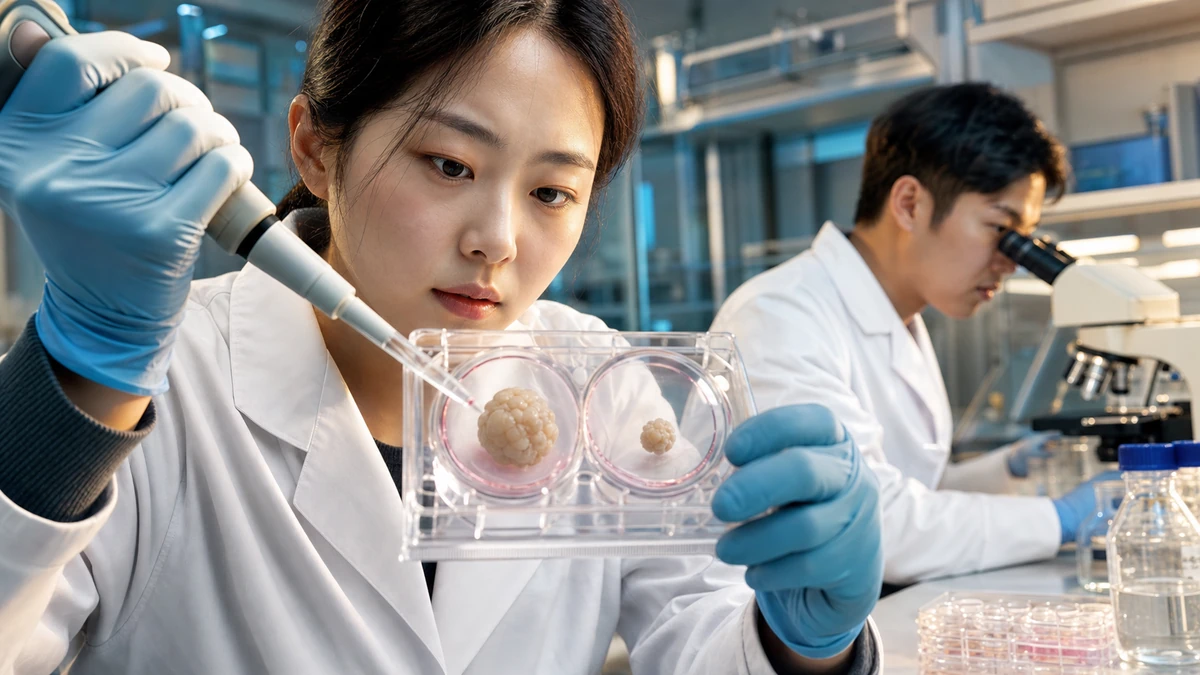
Image to help understand the article
A new warning sign in the search for safer chemicals
A South Korean government research institute says it has found evidence that GenX, a chemical introduced as a replacement for some older PFAS compounds, may interfere with early brain development in a human stem cell-based model sometimes described as a “mini brain.” The finding does not mean everyday consumer exposure has been shown to cause a specific disease in people. But it does sharpen a question that has become increasingly urgent in the United States and around the world: When industry swaps out one controversial chemical for another, how much do we really know about the substitute?
The research, announced by the Korea Institute of Toxicology, focused on cerebral organoids, three-dimensional clusters of human cells grown from stem cells that mimic some features of the developing brain. Scientists exposed those organoids to GenX and saw that they became smaller. At first glance, that kind of change could suggest that cells were simply dying off. But according to the Korean team’s analysis, that was not the main story. Instead, the researchers concluded that GenX appeared to suppress the growth process itself, affecting how brain-like tissue develops rather than just causing direct cell death.
That distinction matters. In toxicology, the difference between killing cells and disrupting development can shape how scientists think about risk, timing and vulnerability. A chemical that interferes with a growing system can raise different concerns than one that causes immediate, obvious damage. During fetal development and early life, the brain undergoes rapid, tightly coordinated growth. If a substance alters that choreography, researchers want to know how, when and under what conditions it happens.
For American readers, the broader context may sound familiar. PFAS, short for per- and polyfluoroalkyl substances, are often called “forever chemicals” because they do not break down easily in the environment and can accumulate over time. They have been used for decades in products prized for their resistance to water, grease and heat: nonstick cookware, stain-resistant fabrics, food packaging, firefighting foam and some industrial processes, among others. In the U.S., PFAS contamination has become a public health and political issue from North Carolina to Michigan, with communities discovering these compounds in drinking water, soil and even blood samples.
GenX belongs to that larger PFAS family. It was developed as an alternative to older legacy PFAS that drew regulatory scrutiny after mounting evidence linked them to environmental persistence and health concerns. That history is what makes the Korean findings resonate beyond a single laboratory result. The underlying issue is not just GenX. It is whether “replacement” has too often been treated as shorthand for “safe enough,” even when the science is still catching up.
What the Korean scientists actually found
According to the summary released in Korea, the research team used human stem cells to grow cerebral organoids that reproduce some structural and developmental features of the human brain. These organoids are not actual brains, and they do not replicate the full complexity of a person’s nervous system, blood supply, immune response or lifelong exposures. Still, they offer researchers a way to study human brain development more directly than many older lab methods allowed.
In this case, the organoids shrank after exposure to GenX. The Korean researchers said the reduction in size was not simply the result of cell death, a process known as apoptosis. Instead, detailed analysis suggested the chemical inhibited developmental growth itself. In plain terms, the tissue did not just lose cells; it seemed to have trouble expanding as it normally would during development.
That may sound like a technical nuance, but in developmental biology it is a significant one. If cells die, scientists ask what kind of damage triggered that death and whether the body can compensate. If growth is suppressed, they ask whether the chemical is interfering with the signals that tell immature cells when to multiply, specialize and organize into functioning tissue. Those are different biological pathways, and they can point to different risks.
Just as important is what the study did not show. The Korean summary did not provide real-world human exposure levels, did not estimate the likelihood of harm from ordinary environmental contact and did not connect the findings to a particular neurological disorder in people. In journalism, as in science, that limitation is worth stating clearly. A lab finding in organoids is not the same as proof of disease in children or adults. It is better understood as an early, potentially important signal that a chemical merits deeper scrutiny.
The researchers also framed their work as part of a growing effort to assess developmental neurotoxicity without relying solely on animal testing. That is a notable point in its own right. Scientists and regulators are increasingly interested in “next-generation” testing methods that use human cells and computational tools to identify hazards more efficiently and, ideally, with better relevance to human biology. Organoids are one of the most closely watched of those approaches.
Why GenX matters far beyond one compound
To understand why this story matters, it helps to zoom out from the lab bench. PFAS are not one chemical but a large class of substances, many of them engineered for industrial usefulness. Their carbon-fluorine bonds make them extraordinarily durable, which is great for keeping a rain jacket dry or helping industrial equipment perform under harsh conditions. It is less great when those same chemicals persist in rivers, groundwater, farmland and the human body.
In the U.S., Americans have grown accustomed to hearing about contamination crises tied to older PFAS compounds such as PFOA and PFOS. Those chemicals have been the subject of lawsuits, regulatory action and health studies, and they helped inspire the 2019 film “Dark Waters,” which introduced many viewers to the idea that a seemingly useful industrial chemical could leave behind a decades-long contamination trail. As regulatory pressure increased, manufacturers moved toward alternatives, including GenX chemistry.
That shift was often presented as progress, and in some ways it was. Industry cannot simply freeze technology in place if older compounds are deemed too hazardous. But the Korean study points to a deeper problem that environmental health advocates have raised for years: the possibility of “regrettable substitution,” a term used when one problematic chemical is replaced by another that later turns out to have its own risks.
GenX has already attracted attention in the United States, especially in North Carolina, where contamination connected to a manufacturing facility became a major public issue. Residents near the Cape Fear River spent years pressing for clearer answers about what was in their water and what it might mean for their health. That controversy helped move PFAS from a niche environmental topic into a kitchen-table concern. Americans who had never heard the acronym before suddenly found themselves asking whether invisible, synthetic compounds were in the tap water they used to make baby formula or cook dinner.
The Korean findings do not settle those debates, but they add a new piece to a global puzzle. If GenX can alter development in a human brain-like model, researchers and regulators will want to know how that maps onto exposure outside the lab: What concentrations matter? Are fetuses and infants more vulnerable? How do route, timing and duration of exposure change the picture? And how should public policy handle chemicals that are introduced as substitutes before their full long-term effects are understood?
How people can be exposed — and why that matters to public health
The Korean summary notes that GenX can be released primarily from manufacturing facilities and then spread through rivers, groundwater, soil and air. From there, exposure may happen indirectly through contaminated drinking water or through food, including agricultural products, livestock and seafood. That pathway is important because it shows how a chemical problem that begins inside a factory can move quietly into everyday life.
Americans have seen variations of this story before. It is the same general pattern that turns a technical industrial issue into a neighborhood one: a discharge into a waterway, contamination in a municipal water system, worries about crops or fish and then a long period of testing, legal wrangling and public confusion. Chemical exposure rarely arrives with the drama of a wildfire or a train derailment. More often it unfolds slowly, through reports, sampling data and uneasy town hall meetings where residents ask whether what they have already consumed can ever be undone.
That is one reason scientists study developmental toxicity so carefully. Exposure during pregnancy or childhood can be especially sensitive because organs and tissues are still forming. The fetal brain, in particular, develops through complex stages that depend on precise timing. A disruption during one stage may not look the same as a disruption during another. Even so, caution is needed when describing what any single lab study means for human pregnancy or child health. The Korean researchers did not claim that ordinary consumer use or typical environmental exposure has been shown to produce the same effect in people.
That restraint matters in a media environment where chemical stories can quickly swing between panic and complacency. Consumers do not need to assume that every product connected to PFAS alternatives carries the same danger, and the Korean announcement itself does not justify sweeping claims about all replacement chemicals. At the same time, the public should not be asked to accept “new” as a synonym for “thoroughly vetted.” The lesson is less about fear than about verification.
For policymakers, the issue is similarly practical. Chemical oversight often struggles with speed. New compounds can enter commerce faster than regulators can build complete toxicological profiles, especially when there are many related chemicals and limited long-term human data. Studies like this one are valuable because they help identify which substitutes deserve closer monitoring before problems become even harder to contain.
Why ‘mini brains’ are changing toxicology research
The phrase “mini brain” can sound like science-fiction shorthand, but it refers to a real and rapidly developing research tool. Cerebral organoids are small, lab-grown clusters of human cells derived from stem cells. Under carefully controlled conditions, those cells can organize into structures that resemble aspects of the developing brain. They do not think, feel or function like a full human brain, and scientists are typically careful not to overstate what they are. But they can model certain developmental processes in ways that traditional cell cultures cannot.
For years, toxicity testing has relied heavily on animal studies and simpler cell-based assays. Those methods remain important, but each has limits. Animal biology does not always predict human biology perfectly, especially for complex developmental questions. Flat layers of cells in a dish, meanwhile, may miss the three-dimensional interactions that shape tissue growth. Organoids occupy a middle ground: more biologically relevant than many conventional cell models, but still far simpler than a living person.
That is what makes the Korean study notable. The researchers did not just observe that exposed organoids were smaller; they used the model to ask why. Their initial assumption appears to have been that cell death explained the change. Further analysis suggested otherwise, pointing to suppressed developmental growth. In research terms, that is a meaningful refinement. It underscores that visible changes alone can be misleading unless scientists understand the mechanism behind them.
In the long run, organoid-based toxicology could help researchers detect subtler hazards that might otherwise be missed. A chemical may not trigger dramatic, immediate cell death and yet still alter how human tissue forms or matures. For developmental neurotoxicity — one of the most difficult areas to study — that possibility is especially important. The brain is not built all at once; it develops through overlapping waves of growth, migration and organization. Models that capture some of that complexity can reveal effects that simpler systems might overlook.
Still, the limitations are just as important as the promise. Organoids do not reproduce the entire body, and they do not account for metabolism, immune interactions or the many variables of real-world human exposure. They are hazard-identification tools, not crystal balls. The Korean findings therefore should be read as evidence supporting more precise evaluation, not as a final verdict on individual health outcomes.
What American readers should take from this
For U.S. readers, the most useful takeaway is not that a single overseas study has delivered a definitive answer about GenX. It has not. The more important message is that the scientific case for closely examining PFAS replacements is growing, and that researchers are developing better ways to do that work using human-based models.
There is also a cultural point worth explaining. South Korea has built a strong reputation in biomedical and technology research, and government institutes there often play a visible role in linking laboratory science to public health policy. In the American context, a rough comparison might be the way findings from agencies such as the National Institutes of Health, the Environmental Protection Agency or the National Toxicology Program can influence broader debates over regulation and consumer safety. When a Korean national research institute announces a result like this, it is not just a niche academic exercise; it is part of a larger conversation about how governments evaluate emerging risks.
Consumers, meanwhile, are often left navigating mixed signals. One label says “PFAS-free.” Another product uses newer fluorinated chemistry that most people have never heard of. News reports warn about forever chemicals, while industry groups emphasize that not all PFAS are identical. All of that can be true at once, which is exactly why rigorous testing matters. The Korean study supports a commonsense principle: replacement chemicals should be examined on their own merits, with attention to how they move through the environment and how they may affect human biology.
It also suggests a more nuanced way to talk about chemical risk. Public understanding often focuses on whether a substance “kills cells” or “causes cancer,” because those ideas are vivid and familiar. But developmental toxicology is often subtler. A compound may interfere with growth signals, timing or tissue organization without producing the kind of dramatic damage people intuitively expect. That does not automatically translate into disease in everyday life, but it does mean safety assessments need to be sophisticated enough to capture those quieter forms of disruption.
Ultimately, the Korean announcement is best seen as a call for disciplined follow-up, not alarm. It raises a credible concern about GenX in a human stem cell-based brain model. It reinforces the idea that safer substitutes cannot be assumed; they have to be demonstrated. And it shows how new tools such as cerebral organoids may help researchers spot potential problems earlier, before a replacement chemical becomes deeply embedded in the environment and in daily life.
For an American audience already familiar with the phrase “forever chemicals,” that may be the most consequential part of the story. The next phase of chemical safety is not only about cleaning up the legacy compounds we know are persistent. It is also about scrutinizing the successors before history repeats itself.
Comments
Post a Comment