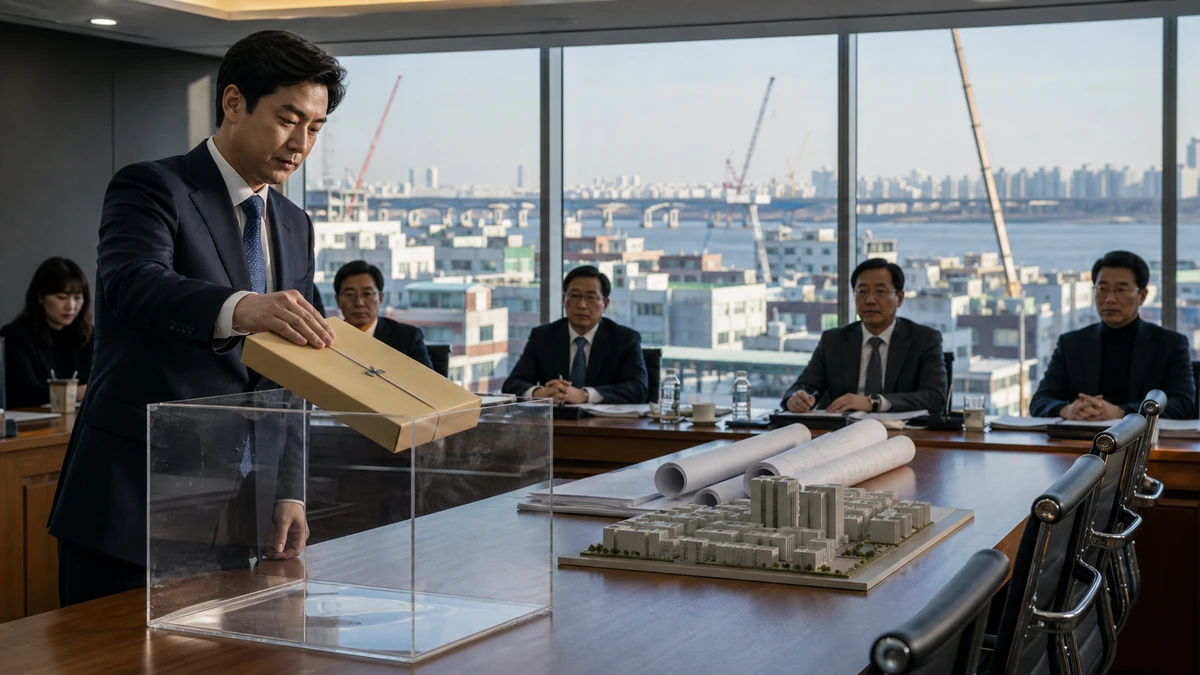
Image to help understand the article
A high-stakes project in one of Seoul’s trendiest districts has reached a turning point
A major redevelopment project in Seoul’s Seongsu neighborhood has moved closer to being built by Samsung C&T, one of South Korea’s best-known construction and engineering firms, after a second round of bidding again failed to attract more than one participant.
The project, known as Seongsu Strategic Redevelopment Zone 3, or Seongsu District 3, carries an estimated construction cost of about 1.8 trillion won, roughly equivalent to well over $1 billion depending on exchange rates. That price tag alone makes it one of the more closely watched urban renewal efforts in the South Korean capital. But the bigger story is not simply that Samsung C&T showed up. It is that the company was the only bidder twice in a row, changing the procedural path for how the project can move forward.
Under South Korea’s redevelopment rules, a competitive bidding process generally requires multiple participants. When only one company submits a bid, the tender is considered unsuccessful, even if the bidder itself is qualified and serious. That is what happened in the first round, and again in the rebid that closed on the 10th. On paper, that means the bid failed. In practice, it may have brought the project a step closer to a deal.
Because the same outcome occurred twice, the housing association overseeing the project now has a clearer legal basis to pursue a private contract with Samsung C&T rather than trying indefinitely to stage another public competition. That does not mean Samsung has been formally selected. The final decision still rests with the association’s membership, which must vote at a general meeting. But it does mean the process has shifted from open competition to a more focused negotiation with the only company that has consistently signaled it wants the job.
For American readers, the distinction is important. This is less like a city government automatically awarding a no-bid contract after a failed procurement, and more like a private association of property owners moving into a next phase after repeated attempts to solicit competing offers did not produce a contest. The decision is consequential not just because of the money involved, but because it reflects how large redevelopment projects in Seoul actually get done: through a mix of public rules, private ownership interests, and highly structured member approval.
In a city where land is scarce, housing costs are politically sensitive, and neighborhood identity can change almost overnight, that process matters as much as the eventual architecture.
Why Seongsu matters far beyond one construction contract
To understand why this story is drawing attention, it helps to understand Seongsu itself. Often described as one of Seoul’s fastest-changing neighborhoods, Seongsu has become a shorthand for urban reinvention. Americans might think of it as a place with echoes of Brooklyn’s Williamsburg or parts of downtown Los Angeles: a formerly industrial area that evolved into a magnet for cafes, design studios, pop-up retail, fashion events and young professionals, even as real estate pressures intensified.
Located in Seoul’s Seongdong district, Seongsu sits east of the city center and has, in recent years, become one of the capital’s most visible examples of gentrification and rebranding. Former factory spaces and warehouses helped give the area its reputation as a creative district. Global luxury brands and Korean fashion labels have staged events there. Trend-conscious consumers flock to the area’s coffee shops and concept stores. Developers, meanwhile, see the district as prime ground for large-scale residential and mixed-use projects.
That broader transformation gives extra weight to redevelopment decisions. In Seoul, redevelopment does not merely mean replacing old buildings with new ones. It can reshape who gets to live in a neighborhood, how much housing is added, what a district looks like from the skyline, and how an area is marketed to both domestic and international audiences. In that sense, Seongsu District 3 is not just a construction site in waiting. It is part of an ongoing contest over the future image and function of a high-profile Seoul neighborhood.
The project is also significant because urban redevelopment in South Korea often proceeds through resident or owner associations rather than top-down city action alone. These associations, commonly called “johap” in Korean, are organized groups of property owners who collectively push forward redevelopment plans, make key decisions and ultimately vote on major issues such as selecting a builder. That governance structure can be unfamiliar to foreign audiences, but it is central to understanding why the latest bidding result matters.
When a redevelopment association chooses a contractor, it is not making a routine vendor decision. It is selecting the company that may determine the project’s pace, financing framework, construction quality, branding and long-term marketability. In Korea’s competitive apartment market, the name of the builder can itself influence prestige and perceived future value. That is one reason large builders fiercely compete for flagship Seoul redevelopment deals, especially in neighborhoods poised for long-term appreciation.
What an “unsuccessful bid” means in South Korea’s redevelopment system
The Korean term at the center of this story is “yuchal,” often translated as a failed or unsuccessful bid. For English-speaking readers, that phrase can sound more dramatic than the reality. It does not necessarily mean a project has collapsed or that no company wanted it. In this case, it means only one company submitted a bid, so the requirements for a competitive tender were not met.
That procedural point is the heart of the news. Samsung C&T did participate. It simply did not face a rival. The same thing happened in the first round. After two such outcomes, the redevelopment association can now consider a private negotiated contract, known in Korean business and procurement language as “sui gyeyak.” In plain English, that means the association may be able to negotiate directly with Samsung C&T instead of reopening another public contest under identical conditions.
This is where nuance matters. Samsung C&T is not yet the confirmed builder. The company is best described as the leading and possibly only active candidate at this stage. The association still has to hold a general meeting, and its members still have to approve the final selection. Reports suggest that meeting could take place as early as before the Chuseok holiday next month, though that timing is not final.
Chuseok, for readers unfamiliar with Korea, is one of the country’s biggest holidays, often compared to Thanksgiving in the United States because it centers on family gatherings, travel and traditional observances. Mentioning the holiday in scheduling matters is a reminder of how deeply civic and business calendars in Korea remain tied to cultural rhythms that can shape everything from legislative timing to real estate meetings.
So the current state of play is best understood this way: the project has not stalled, but the route to selecting a builder has changed. It has narrowed. The lack of competition did not produce a winner by default, yet it did create conditions that make a direct agreement with Samsung more plausible than before. That distinction between “likely” and “official” is not semantic hair-splitting. It is the difference between a market expectation and a legally completed decision.
For investors, residents and industry observers, the next meaningful milestone is not whether another company appears at the last minute. It is whether the association members, who represent the property owners with the most at stake, agree to proceed with Samsung as the construction partner.
Why Samsung C&T’s presence carries weight
Samsung C&T is not just any contractor. It is part of the broader Samsung group, the sprawling South Korean conglomerate best known globally for smartphones and electronics but active in a wide range of industries. In Korea, the Samsung name carries social and commercial weight that extends far beyond consumer products. Its construction arm has been involved in major domestic and international projects and is widely seen as a marquee player in the country’s high-end redevelopment and reconstruction market.
That matters because South Korea’s major apartment developments function differently from how many Americans think about multifamily housing. Large-scale apartment complexes in Seoul are often branded products as much as residential structures. Builder reputation can influence buyer confidence, resale expectations and neighborhood status. In redevelopment projects where current owners are effectively deciding what will replace aging structures, the identity of the contractor can become a proxy for ambition: better design, stronger financing credibility, premium branding or all three.
Samsung’s repeated solo participation suggests two things at once. First, it signals that the company sees strategic value in the project and has been willing to keep showing up through formal process. Second, it raises questions about why competitors stayed away. The answer is not necessarily negative. Large redevelopment projects are expensive, politically sensitive and operationally demanding. Other builders may have concluded that the economics, risk profile or chances of winning did not justify a bid. Or they may have judged that Samsung had already established a strong enough position to make a head-to-head contest unattractive.
None of that means the outcome is predetermined. But it does help explain why industry watchers now view Samsung as the front-runner. In procurement terms, a single bidder can be a sign of weak competition. In redevelopment politics, it can also be evidence that the field has effectively consolidated around one credible candidate.
That consolidation may prove important as the association weighs what comes next. A direct negotiation would likely shift attention away from speculative rivalry and toward concrete questions: What are the construction terms? What are the design promises? How will costs, timelines and member benefits be framed? Those are the kinds of details that often decide whether an association vote succeeds.
The bigger lesson: In Seoul redevelopment, procedure can be the story
One reason this episode deserves attention is that it illustrates a broader truth about real estate in Seoul: the process can be as significant as the project itself. Outside Korea, headlines about redevelopment often focus on the finished result — the gleaming towers, the price per square foot, the celebrity architects or the impact on rents. In South Korea, the steps along the way can be just as newsworthy because they shape whether a project advances, who controls it and how disputes are resolved.
Seongsu District 3 is a textbook example. The estimated 1.8 trillion won budget highlights the scale. But the real development in recent days is procedural. Two consecutive single-bid outcomes have created a legal and practical opening for the association to move from public tender to potential private negotiation. That is not a flashy headline in the way a groundbreaking ceremony might be. Still, it may turn out to be the most important moment before actual construction decisions take shape.
For Americans, a useful comparison might be the difference between a city rezoning vote and the opening of a luxury condo tower. The public tends to notice the building when it rises. Professionals know that the decisive moment often came much earlier, in the hearing room or the contract stage, when the project’s path was locked in. Seongsu’s latest bid result is that kind of moment.
It also underscores how carefully Korean media and industry observers distinguish between stages. A failed bid is not the same as a failed project. A likely contractor is not the same as a confirmed one. A direct contracting option is not the same as a signed agreement. Those distinctions may sound technical, but they are crucial in a market where redevelopment timelines stretch for years and where each procedural milestone can trigger new negotiations, objections or votes.
That is why the current moment is best described not as an endpoint but as a narrowing of possibilities. The universe of likely outcomes has shrunk. The center of gravity is now unmistakably Samsung C&T. But the formal decision still belongs to the association, and until that vote is held, caution remains warranted.
What residents, investors and global real estate watchers will be watching next
The next key event is the association’s general meeting, where members are expected to decide whether to select Samsung C&T as the builder. If that happens, the project could move into a more concrete phase with greater clarity around implementation. If the vote is delayed, contested or produces an unexpected outcome, the timeline could shift again. Either way, the meeting is where procedural momentum either becomes a formal mandate or runs into resistance.
For local residents and property owners, the stakes are direct. Redevelopment in Seoul can dramatically alter home values, housing arrangements and neighborhood composition. Existing owners may stand to gain from improved property prospects, but redevelopment can also bring uncertainty, years of transition and difficult decisions about compensation, relocation and long-term affordability. Those tensions are common in major cities around the world, and Seoul is no exception.
For investors and global real estate analysts, the Seongsu case offers a window into how one of Asia’s most tightly watched property markets functions beneath the surface. Seoul is a city where modern apartment living, intense land scarcity and strong brand consciousness converge. That means builder selection is not merely a technical matter. It can shape financing assumptions, marketing value and the eventual identity of an entire development.
For urban policy observers, the project also raises familiar questions about who benefits when former low-rise or aging districts are remade into higher-value environments. Seongsu’s rise has already made it a symbol of how quickly Seoul can reinvent a neighborhood. The next phase of redevelopment may deepen that trajectory, adding another layer to an area already associated with trendsetting commerce, rising prestige and mounting real estate interest.
And for international readers who follow Seoul not only as a capital city but as a cultural engine — a place shaped by K-pop, fashion, design and global tourism — stories like this reveal the infrastructure beneath the image. The Korean Wave, or “Hallyu,” often reaches foreign audiences through music, drama and beauty brands. But the city producing that cultural influence is also being physically remade through vast redevelopment efforts, many of them governed by dense procedures and high-stakes member decisions that rarely make international headlines.
That is what makes the Seongsu District 3 story worth watching. It is not just about one company being the only bidder. It is about how a global city decides who gets to build its next chapter.
A narrowed path, but not a finished deal
For now, the clearest takeaway is this: Seongsu District 3 has not chosen its builder yet, but the route to that choice is becoming increasingly defined. Samsung C&T’s lone participation in two consecutive rounds has not produced a formal award. It has, however, transformed the procedural landscape, making direct negotiation possible and positioning the company as the strongest candidate heading into the association’s final decision-making stage.
That shift helps explain why the latest rebid result matters even without a final contract in hand. It is a reminder that in major redevelopment projects, the story often lies not in dramatic announcements but in the quiet accumulation of procedural changes that make one outcome more likely than another.
In Seongsu, one of Seoul’s most closely watched neighborhoods, those changes are now pointing in a clear direction. The association still has the last word. But after two unsuccessful competitive bids and one persistent bidder, the balance of probability has moved.
The next chapter will be written at the general meeting. Until then, the most accurate description is also the most journalistic one: Samsung C&T appears to be the leading contender for one of Seoul’s most significant redevelopment projects, but the final decision has not yet been made.
Comments
Post a Comment