A Narrow U.S. Strike in the Strait of Hormuz Carries Wider Risks for Washington, Oil Markets and America’s Middle East Posture
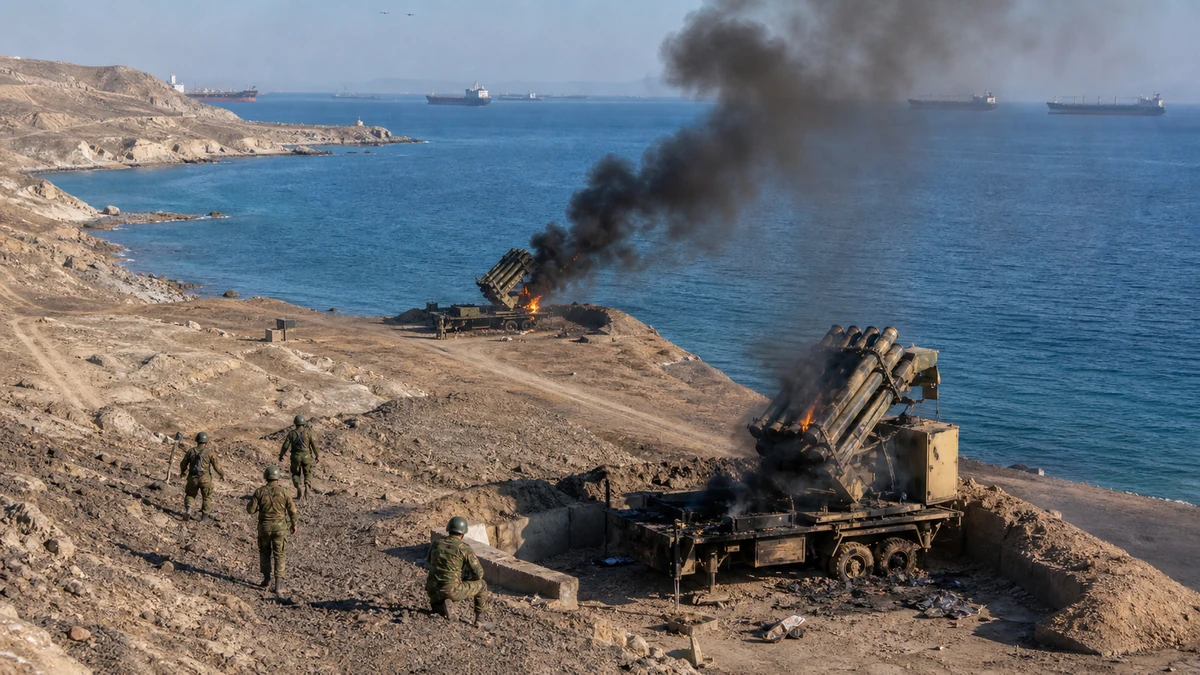
Image to help understand the article
A small strike with potentially large consequences
The latest U.S. strike on Iran looks limited on paper: two rocket launchers on Larak Island, near the Strait of Hormuz, targeted in what American officials described as a precise attack against an imminent threat. But in the Middle East, and especially in the waters around the Persian Gulf, even a narrowly framed military action can reshape the next phase of a confrontation.
According to U.S. accounts cited by Reuters and The Associated Press, American forces carried out the strike after detecting what officials said were preparations by Iran’s Islamic Revolutionary Guard Corps, or IRGC, to fire mine-equipped rockets into the strait. Iranian media reported at least two people were killed and two others injured. The attack marked the resumption of U.S. military action against Iran roughly a month after the previous round of strikes, underscoring that Washington’s pressure campaign never fully shifted away from the use of force, even as it leaned more heavily on sanctions and financial isolation.
The immediate military significance lies less in the scale of the attack than in the type of target. The United States was not publicly presenting this as the start of a broad air campaign against Iranian territory or command centers. Instead, it focused on systems that, according to the U.S. military, could be used to seed a vital global shipping lane with naval mines. In practical terms, that is a very specific message: Washington is signaling that it may tolerate rhetoric, posturing and even some regional proxy activity more than it will tolerate a direct threat to maritime traffic through one of the world’s most strategically important chokepoints.
That distinction matters. For years, U.S. officials have tried to separate “deterrence” from “escalation,” arguing that a carefully calibrated strike can remove a threat without opening the door to all-out war. The problem is that the other side rarely accepts that framing at face value. Iran has warned of retaliation, and once casualties are involved and the source of the attack is clear, the political pressure on Tehran to respond becomes harder to ignore.
That is why this episode deserves to be read not simply as a one-day military event but as a marker in a broader trend. The United States appears to be defining a new operational red line around mining activity in and around the Strait of Hormuz. Iran, for its part, appears unwilling to let such strikes pass without at least asserting that it can impose costs of its own. The result is a volatile pattern of limited action and limited reprisal that can remain contained right up until the moment it does not.
Why the Strait of Hormuz matters far beyond the Gulf
For many Americans, the Strait of Hormuz is one of those places that comes up in foreign policy coverage without much explanation, like the Bab el-Mandeb or the South China Sea. But it is one of the world’s most important maritime bottlenecks, a narrow passage between Iran and the Arabian Peninsula through which a large share of global oil and gas shipments moves. When security in the strait is threatened, the consequences are not confined to the Middle East. They can ripple through energy prices, insurance costs, shipping routes and financial markets from Houston to Seoul.
That is what makes mines so destabilizing. A naval mine is not just a weapon; it is a tool of uncertainty. It can force commercial shipping companies, insurers and military planners to assume the worst. Even rumors of new mine-laying can prompt route changes, slowdowns, emergency naval deployments and spikes in energy anxiety. In that sense, the launchers reportedly targeted on Larak Island represent more than a tactical threat. They point to a broader contest over who can shape the security environment in one of the world’s most sensitive trade arteries.
American officials have framed the attack as a direct response to an “imminent threat,” a phrase with legal and political weight in Washington. It suggests the administration is trying to justify military action not as punishment for past behavior but as prevention of a near-term danger. That approach may help the White House domestically, especially if it wants to show resolve without appearing to launch another open-ended Middle East war. But it also shifts future debate onto intelligence assessments the public may not fully see. If similar strikes follow, each will likely bring renewed questions about what evidence existed, how imminent the threat really was, and whether the administration’s threshold for action is slowly expanding.
The New York Times, as referenced in the Korean summary, characterized the operation less as a return to mass bombing and more as a limited strike. That distinction is important for investors, allies and adversaries alike. Markets tend to react differently to a one-off tactical intervention than to signs of a sustained air campaign. Regional governments also watch for that difference. A contained operation can be interpreted as a warning; a rolling series of such operations can start to look like a doctrine.
And that may be where this story becomes more significant. If the United States has effectively declared a “mine intolerance” policy in the Hormuz corridor, then any future sign of mine-related preparation by Iranian forces could trigger another strike. Once that logic is established, the path to repeated military exchanges becomes easier to imagine, even if neither side wants a full-scale war.
Trump’s red line on mines is now a policy, not just a warning
Five days before the attack, President Donald Trump said he had been informed by the U.S. Navy that mines in international waters in the Strait of Hormuz had been removed or destroyed. He also warned that any vessel laying new mines would be “immediately and systematically” destroyed. With the strike on Larak Island, that warning appears to have moved from rhetorical threat to operational practice.
That matters because one of the central questions in any crisis involving Trump is whether a statement is negotiating theater, domestic political messaging or a concrete policy signal. In this case, the answer increasingly appears to be the last one. The administration is showing that at least on this issue, it wants adversaries and allies to believe that crossing the mine threshold will bring a military response.
This is in keeping with a familiar U.S. strategic habit: drawing a narrow but highly visible line around freedom of navigation. Americans may debate many aspects of intervention abroad, but one of the longest-running points of bipartisan consensus in U.S. national security policy has been the need to keep major sea lanes open. Whether in the Persian Gulf, the Red Sea or the South China Sea, Washington tends to respond most sharply when it believes trade routes, naval access or commercial shipping are directly at risk.
Still, the challenge with red lines is that they create obligations for the side that declares them. If Washington fails to act after a new mine-related move, its deterrent credibility weakens. If it acts every time, it risks being pulled into an increasingly frequent cycle of confrontation. This is the classic trap of limited deterrence: the very policy designed to prevent escalation can create conditions in which repeated uses of force become harder to avoid.
There is also an information problem embedded in the U.S. approach. The justification for a preventive strike often depends on intelligence that is partially classified, quickly evolving or difficult for outsiders to verify in real time. Supporters of the administration will argue that the military must act on timely threat assessments before mines are deployed. Critics will respond that a doctrine built around preemption can gradually widen under pressure, especially in a crisis where both sides have incentives to frame events in ways that support their own narrative.
That dynamic is especially relevant now because the U.S. case is not simply about punishment or symbolism. It is about preserving a rule of access to a strategic waterway. Once Washington defines the issue at that level, the burden of consistency increases. Allies, energy markets and commercial actors will start judging American policy not by one successful strike, but by whether the United States can sustain a stable standard without stumbling into a larger conflict.
Iran’s response shows the danger of “controlled” escalation
Iran’s Revolutionary Guard said that on the same day as the Larak strike, it launched multiple missiles toward two air bases in Jordan used by U.S. forces, including facilities identified as Malik-Hussein and Azraq. The Guard claimed the missiles inflicted severe damage on technical infrastructure, maintenance areas and aircraft parking zones. U.S.-linked reporting, by contrast, said the missiles were intercepted.
That contradiction is not a side note. It is a central feature of modern conflict in the region. Military action is now paired almost instantly with an information battle in which each side tries to establish deterrence through narrative as much as through battlefield effect. The United States emphasizes that its strike was limited, precise and defensive. Iran emphasizes that its retaliation was real, costly and capable of reaching American positions beyond the immediate theater of the Hormuz dispute.
In one sense, both sides are trying to send the same message in opposite directions: we can hit you, but we are not the ones choosing all-out war. That posture can work for a while. It allows leaders to satisfy domestic audiences, reassure allies and maintain a measure of strategic ambiguity. But it is also a fragile formula. It depends on casualties staying relatively contained, on missile defenses working, on communications not collapsing and on no one overreading the other side’s intentions.
History offers enough warnings here. Many conflicts do not begin because one side openly decides on a large war from the outset. They begin because a series of supposedly bounded responses creates momentum, emotion and political pressure that leaders struggle to reverse. A strike on an island launcher, a retaliatory missile volley at a foreign base, an interception or a failure to intercept, a misidentified target, a rising body count — these are the kinds of steps through which “managed escalation” can become something less manageable.
The geographic expansion also matters. The exchange is no longer confined to Iranian territory or the waters around the strait. Once U.S. bases in Jordan become part of the active military picture, the conflict’s map broadens. That raises the stakes for regional partners that may not want to be dragged more deeply into a U.S.-Iran confrontation but host American assets that are hard to separate from it.
Even if the U.S. account is correct and the missiles were intercepted, Tehran has already demonstrated a willingness to make that threat visible. In crisis management, intent can matter almost as much as damage. A failed strike can still succeed in communicating that future attempts may come, perhaps in larger numbers or against different targets. That is one reason limited retaliation can still intensify a conflict: it tells the other side not only what happened, but what might happen next.
What this means for the United States
For American readers, the significance of this episode is not abstract. It touches U.S. energy interests, military posture, alliance management and the domestic debate over how much force Washington should use in the Middle East after two decades of war fatigue.
Start with economics. The United States is less directly dependent on Gulf oil than it once was, thanks in large part to domestic production and the shale revolution. But global oil prices are still global. A disruption in the Strait of Hormuz can affect gasoline prices in the United States, shipping costs for American businesses and inflation pressures that reach well beyond the energy sector. An attack on mine-laying systems may sound remote from everyday life in Ohio or California, but if it helps stabilize or destabilize confidence in the Gulf, American consumers can feel that through the price of fuel and freight.
Then there is the military dimension. The United States maintains a broad network of forces, facilities and partnerships across the Middle East, and those assets become more vulnerable when Washington and Tehran settle into a rhythm of direct exchange. Americans have seen versions of this pattern before: an administration promises a narrow, targeted action, only to find that force protection requirements expand, retaliatory threats multiply and regional bases become flashpoints. The memory of Iraq, Syria and repeated militia attacks on U.S. positions still hangs over any new confrontation.
There is also a political context unique to the U.S. system. Presidents often gain short-term latitude when they frame an action as defensive and limited, particularly when protecting shipping lanes or American troops. But sustained military activity against Iran would almost certainly trigger more intense debate in Congress and among the public over legal authority, war powers and end goals. Americans are generally more receptive to a strike designed to stop an immediate threat than to a strategy that appears to drift toward another long, undefined regional conflict.
For U.S. companies, especially those connected to energy, shipping, insurance and defense, the implications are immediate. Even a limited uptick in Gulf risk can affect underwriting decisions, rerouting costs and investor expectations. Defense firms may benefit from renewed emphasis on missile defense, surveillance and maritime security, while commercial firms face the downside of volatility and uncertainty. In that sense, the strike’s consequences are not evenly distributed across the American economy.
And there is a diplomatic layer. Washington’s allies, including partners in Asia and Europe, depend heavily on secure maritime trade. If the United States can convincingly police threats without provoking wider war, it reinforces America’s value as a security guarantor. If the confrontation spirals, allies may again question whether U.S. crisis management in the Middle East creates as many hazards as it resolves. That reputational test extends far beyond this one operation.
Why this also matters to South Korea and the wider U.S.-Korea relationship
Although this incident centers on U.S. and Iranian actions, it also matters to South Korea, one of America’s closest allies in Asia and a country whose economy is deeply exposed to disruptions in global energy shipping. That is one reason Korean media would treat a strike on mine-related systems in the Strait of Hormuz as more than a distant security story. For South Korea, a manufacturing powerhouse that imports most of its energy, stability in Gulf sea lanes is an economic issue as much as a diplomatic one.
For Americans, that should sound familiar in a different key. The U.S.-South Korea alliance is often discussed through the lens of North Korea, nuclear deterrence and Indo-Pacific strategy. But this story is a reminder that the alliance also exists inside a wider web of global commerce. What happens in the Gulf can affect South Korean refiners, shippers, automakers and electronics exporters, many of which are deeply integrated with the U.S. market. If energy costs rise or logistics become more complicated for Korean firms, American consumers and companies can feel the downstream effects through prices, supply chains and industrial planning.
This is one of the defining realities of the Korean Wave era. Americans may know South Korea best through K-pop, Korean dramas, films like “Parasite,” and brands such as Samsung, Hyundai and LG. But South Korea’s role in the U.S. economy is much broader than pop culture. It is a major investor, manufacturer and technology partner. When Korean policymakers or media outlets pay close attention to tensions in the Strait of Hormuz, they are not treating it as a peripheral issue. They are reading it as a direct threat to the commercial routes that help support one of the world’s most globally connected export economies.
That has implications for U.S.-Korea ties. Washington increasingly asks allies to think beyond their immediate neighborhoods and contribute to wider regional or global stability. Seoul, meanwhile, has to balance its alliance commitments with economic vulnerability and domestic caution about entanglement in distant conflicts. Episodes like this one can sharpen that tension. They remind both countries that the alliance is no longer just about deterring war on the Korean Peninsula; it is also about navigating a world where energy security, maritime protection and supply-chain resilience link the Middle East to East Asia and North America.
For American readers used to seeing Korea coverage filtered through entertainment or North Korea headlines, that is a useful shift in perspective. South Korea is not simply an observer of Middle East crises. It is one of the advanced industrial economies whose fortunes are tied to whether trade arteries such as Hormuz remain open and credible. In that sense, this U.S. strike is also part of a larger story about how American power, Korean economic interests and global shipping security increasingly intersect.
The bigger trend: dual-track pressure, with military force and economic isolation
The Korean summary points to another important feature of U.S. strategy: this is not a military-only campaign. After reportedly ordering a halt to military attacks on Iran last month, Trump and his administration put renewed emphasis on tightening economic pressure. Trump said the United States would pursue a sweeping economic isolation campaign against Iran, and Treasury Secretary Scott Bessent outlined a plan to target even third countries doing business with Tehran.
The strike on Larak Island shows that economic pressure was never meant to replace force entirely. Instead, Washington appears to be building a dual-track approach: broad sanctions and financial isolation on one hand, narrow military action against specific maritime threats on the other. That combination is designed to squeeze Iran across multiple fronts without committing the United States to blanket warfare.
Strategically, it is a familiar American model. Sanctions aim to constrict resources and international access; precision strikes aim to preserve deterrence and impose immediate tactical costs. The theory is that a state under both economic and military pressure will think twice before escalation. The risk, of course, is that it may instead look for asymmetric ways to answer back — through missile attacks, proxy activity, cyber operations or actions calibrated to raise costs without crossing Washington’s clearest red lines.
That is why the next question is not whether this strike was limited. It clearly was, at least relative to a major bombing campaign. The real question is whether it becomes the template for a new phase of recurring exchange. If Washington keeps applying the same standard to suspected mine-related threats, additional strikes become more conceivable. If Tehran believes failing to respond would invite more attacks, retaliatory action also becomes more likely. Each side then narrows its own room for restraint.
For now, the most accurate way to understand the moment is this: the United States has demonstrated it is willing to enforce a specific maritime red line with force, and Iran has signaled it intends to answer in ways that show reach and resolve. That does not guarantee a wider war. But it does make the line between deterrence and escalation thinner than either side may publicly admit.
And that is why a strike on just two launchers matters. In a region where shipping lanes, missile defense, oil flows, sanctions policy and alliance credibility are tightly connected, the meaning of an operation often exceeds its size. For the United States, for South Korea and for a global economy still vulnerable to shocks from narrow waterways, the story is not simply what was hit on Larak Island. It is what rules are now being tested — and how long they can hold.
Comments
Post a Comment