A Pennant-Race Twist in South Korea: KIA’s Comeback Win Shows Why the KBO Is Becoming Must-Watch Baseball for Americans
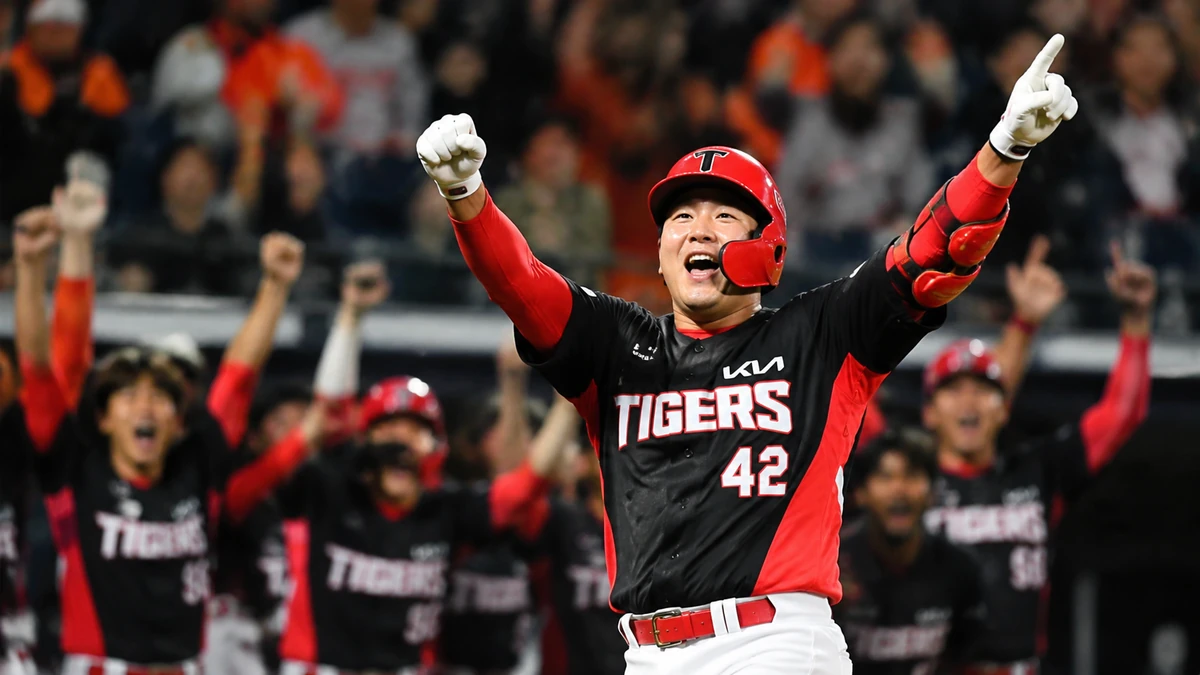
Image to help understand the article
A comeback that meant more than one night
In the long middle stretch of a baseball season, one game can look ordinary on paper and still reveal something larger about where a team is headed. That was the case when the KIA Tigers beat the Hanwha Eagles 10-6 in Daejeon on Tuesday, using a comeback burst and a go-ahead two-run home run from catcher Kim Tae-gun to climb into third place in the Korea Baseball Organization standings for the first time this season.
The game mattered not simply because KIA won, but because of how it won and when it won. Hanwha struck first on a two-run homer by Hwang Young-mook in the second inning, and for a moment the home side seemed positioned to control the night. Instead, KIA answered the way confident contenders often do: not with panic, but with sequencing. The Tigers pieced together hits in the fourth inning to take the lead, added on in the sixth, and then got the game’s emotional turning point when Kim delivered the kind of swing that changes dugout energy as much as it changes the scoreboard.
By the end of the night, KIA had extended its winning streak to five games and moved to 59-48-2, a .551 winning percentage. That was just enough to edge the LG Twins, who fell to .550, for third place. The numerical margin was almost absurdly thin: 0.001. In American sports terms, it is the kind of standings shift that feels less like a move and more like a nudge. But that is exactly what makes this point in the KBO season compelling. The race is tight enough that one game can alter not only a team’s position, but the conversation around its legitimacy.
For American readers who may know Korean baseball mainly through the brief burst of U.S. attention it received during the early months of the pandemic, this was a reminder of what the KBO can offer at its best: lively offense, sharp swings in momentum, and a standings table where every marginal edge matters. It was also a reminder that Korean baseball culture, while sharing obvious DNA with Major League Baseball, often places a premium on rhythm, collective pressure and late-inning resolve in ways that can feel both familiar and distinct.
Why this game resonated inside the KBO race
The headline moment was Kim Tae-gun’s go-ahead two-run shot, but the broader story was KIA’s sustained ability to erase an early deficit and keep scoring. That matters because pennant races are rarely decided by isolated bursts of power alone. Teams that climb late in the season usually do so because they can string together at-bats, survive an opponent’s first punch and force stressful innings on the other dugout. KIA did all of that.
After falling behind 2-0, the Tigers produced four hits in the fourth inning and turned them into three runs, flipping the game. They added another run in the sixth on an RBI hit by Harold Castro, then continued building toward a double-digit scoring night. Hanwha was not quiet. Kim Tae-yeon and Han Ji-yoon later hit two-run homers, and the Eagles finished with three home runs overall. But the contrast between the teams was telling. Hanwha generated offense in loud, concentrated bursts. KIA combined impact power with traffic on the bases, timely contact and the steady accumulation of pressure.
That distinction becomes more important in close races than in isolated box scores. Over a six-month season, clubs that rely too heavily on sporadic slugging can look dangerous without always looking stable. Teams that can keep an inning alive, turn multiple baserunners into runs and create comeback opportunities tend to weather volatility better. Tuesday’s game suggested KIA is increasingly behaving like the latter kind of club.
The stakes around the result were magnified by what happened elsewhere in the standings. KT Wiz remained first at 63-41-2, with the Samsung Lions second at 63-43-2. KIA and LG were effectively level in the chase pack, separated only by that microscopic difference in winning percentage. The Doosan Bears, meanwhile, remained close enough in fifth to keep the upper tier crowded and tense. In other words, this was not a ceremonial rise to third. It was entry into a live-wire race where places can change overnight and where teams do not have the luxury of treating August baseball as background noise.
There is also a psychological layer here that American fans would recognize from any MLB wild-card chase. Winning five straight does more than improve the record; it changes internal expectations. Players start believing an early deficit is survivable. Managers gain confidence in lineup depth. Opponents understand that a two-run lead may not feel safe. Those shifts are hard to quantify, but anyone who follows baseball closely has seen them. KIA’s climb looks significant precisely because it appears to be built on that kind of creeping certainty.
The cultural texture of Korean baseball, and why comebacks land differently
To understand why a game like this resonates in South Korea, it helps to understand how Korean baseball is experienced. The KBO is not simply MLB in another language. The sport is deeply professionalized, but it is also intensely communal. Fans often attend in organized cheering sections, with songs, chants, coordinated claps and a more continuous level of crowd participation than many Americans are used to outside college sports. A regular-season game can feel less like a passive night at the ballpark and more like an actively staged event.
That atmosphere changes the emotional shape of a comeback. In many U.S. stadiums, momentum is something fans sense. In Korea, momentum is often something they perform. When a trailing team strings together hits, the noise builds in layers. When a key batter comes up in a turning-point spot, the chants and drum rhythms can make the plate appearance feel amplified before the pitch is even delivered. So when Kim hit the two-run homer that pushed KIA ahead, the significance was not merely strategic. It fit a classic KBO script: the crowd’s emotional tide shifts, the dugout energy hardens, and the pressure visibly migrates to the opponent.
That helps explain why Korean coverage often emphasizes words like concentration, cohesion and flow alongside the usual baseball statistics. These are not just clichés. They reflect a sports culture that pays close attention to whether a team looks connected inning to inning. KIA’s comeback was important not only because it produced a win, but because it showed what Korean observers would describe as collective focus in the later stages of the game.
There is another layer of context worth noting for American readers. Korean professional baseball has long operated with fewer games than MLB and with a different public profile for players, teams and fan rituals. That can make stretches like this feel especially compressed. A 0.001 edge in winning percentage becomes a national sports discussion because standings movement is easier to visualize and because the league’s fan culture tends to dramatize every turn in the table. That is not hype detached from reality. It is the natural result of a tightly packed race in a league where daily results still land with real urgency.
What KIA’s surge says about the broader trend
The most revealing part of this story may be that KIA’s rise to third was not framed as a miracle but as the outcome of a trend. The Tigers did not leap because of one lucky bounce; they arrived here on a five-game winning streak, and Tuesday’s game compressed several qualities that matter in a stretch run. They absorbed an early blow, created offense through repeated contact, got a defining homer when they needed one and finished with 10 runs. That combination is usually a better predictor of sustainable success than a single standout pitching performance or one explosive inning.
The KBO standings right now appear to be entering the stage where underlying form matters as much as raw record. KIA and LG are nearly inseparable in percentage terms, and Doosan is close enough to make any brief skid costly. That means teams are being tested not just on talent, but on whether they can keep layering competitive at-bats and avoiding emotional letdowns. The Tigers are suddenly passing that test more often.
Hanwha, meanwhile, offers the other side of the same coin. The Eagles have now dropped six straight and fallen to eighth place at 48-56-3. Their offense showed power in this game, but the result underscored a problem common to teams sliding down the table in any league: isolated damage is not enough when the opponent keeps coming. Hanwha got home runs, but KIA controlled more of the game’s connective tissue, the sequences between the highlight moments where games are quietly won.
For analysts, that is where this game becomes more than a one-night recap. Korean baseball is often stereotyped abroad as offense-heavy and entertainment-forward, sometimes at the expense of strategic nuance. But the KIA-Hanwha game showed how much nuance still matters. The Tigers’ comeback was not just a fireworks show. It was a lesson in run creation, leverage and resilience. When observers say KIA’s rise looks real, that is what they mean.
The next question is whether this version of KIA can hold third, or even pressure the teams above it. The gap to first remains meaningful, and there is a difference between reaching a perch and defending it. But because KIA’s move was driven by a winning streak and by offensive depth rather than a fluky one-run escape, it is reasonable to view the Tigers as a genuine factor in the race rather than a temporary visitor in the top three.
Why Americans should pay attention
For U.S. audiences, there are at least three reasons this story travels beyond Korea. The first is the obvious one: baseball fans recognize drama when they see it. A standings race decided by decimal points, a comeback built inning by inning, and a decisive home run from a veteran catcher are easy narrative entry points for anyone raised on pennant races in New York, Boston, St. Louis or Los Angeles.
The second reason is that the KBO has become part of the wider American baseball imagination, if still on a niche level. Many U.S. fans first watched Korean baseball in 2020, when it was one of the only live professional sports available on American television during the pandemic shutdown. That exposure did not turn the KBO into a mainstream U.S. product overnight, but it did create a durable class of American viewers who now understand the league as more than a curiosity. They know the team names, recognize the fan culture and see Korean baseball as a legitimate part of the global game.
The third reason is that U.S.-Korea sports ties are deeper than casual viewers may realize. Major League Baseball has a long history with Korean talent, from Chan Ho Park to Choo Shin-soo to Kim Ha-seong and Lee Jung-hoo, and Korean baseball fans follow MLB with similar intensity. That exchange means standout KBO games often carry a secondary audience abroad: scouts, front-office analysts, Korean American fans, and baseball diehards who track how the sport evolves outside North America. Even when the players in a particular game are not immediate MLB candidates, the league itself is part of the shared baseball ecosystem between the two countries.
There is also something culturally legible here for Americans beyond the game itself. In the United States, sports audiences are increasingly comfortable following overseas leagues if the product feels distinctive. The English Premier League, Formula One and international basketball all gained U.S. ground not just because of star power, but because the viewing experience felt different enough to be compelling. The KBO’s blend of offense, atmosphere and emotionally expressive fandom fits that pattern. A game like KIA-Hanwha is not simply a local result; it is a showcase for why Korean baseball can hold attention well beyond Korea.
What this means for the United States
If there is a direct American angle to this story, it lies less in immediate transaction news and more in market relevance and audience habit. Every time the KBO produces a meaningful, high-drama standings swing, it strengthens the case that Korean baseball is not just exportable as a novelty, but sustainable as a media product for international viewers. That matters for U.S. broadcasters, streaming services, sponsors and sports platforms that have spent the last decade expanding their appetite for global content.
American companies and media outlets have already seen how Korean culture can travel. K-pop, Korean dramas and Korean films have gone from niche imports to regular features of the U.S. entertainment economy. Sports move differently, but the logic is comparable: once an American audience learns the rhythms of a foreign league and sees a few emotionally accessible storylines, barriers to entry begin to drop. The KBO’s regular-season races, with their constant movement and high-engagement crowds, offer exactly the kind of serialized drama that sports media executives like to package.
For American baseball itself, Korean games can also function as a mirror. MLB has spent years debating pace, entertainment, fan engagement and how to make regular-season games feel more alive to younger audiences. Korean baseball does not offer a simple blueprint, but it does present a vivid alternative atmosphere. Cheering sections, player songs and a more participatory crowd culture create a sense of eventfulness that many U.S. clubs have tried, in more restrained ways, to emulate. Americans watching games like this one are not just consuming another league; they are seeing another answer to the question of how baseball can feel urgent in real time.
The U.S.-Korea relationship adds a broader layer. These two countries are linked by trade, security, education and culture, and sports increasingly sit inside that exchange. Korean stars moving to MLB draw American attention to the KBO. American-born players and foreign imports in Korea create traffic in the other direction. Even a domestic Korean standings story can therefore matter to U.S. readers because it deepens familiarity with one of America’s closest Asian allies through a language many sports fans already speak fluently: baseball.
That does not mean every KBO result needs an American lesson attached to it. But in this case, KIA’s rise to third is a useful example of how Korean baseball is maturing as an international watch, not merely a local pastime. For U.S. audiences accustomed to following late-season races, the appeal is easy to understand. For U.S. companies and media platforms looking at the continued globalization of sports content, it is a reminder that Korea remains one of the most culturally exportable markets in the world.
What to watch next in the KBO race
The immediate question is whether KIA can hold onto third place now that it has finally reached it. The margin over LG is effectively microscopic, and that means every game in the coming days carries outsize weight. If the Tigers keep winning through the same formula they showed against Hanwha, deep innings, connected hitting and enough power to punish mistakes, they will have a real chance not just to defend their place but to force the top of the table to keep looking over its shoulder.
Just as important is whether Hanwha can stop the slide. Six straight losses have pushed the Eagles down to eighth, and the lower-middle part of the standings is also crowded enough that small swings matter there too. In both directions, this is the stage of the season where teams begin discovering whether they are built for stress or merely built for stretches.
For neutral fans, including those in the United States, that is the attraction. The KBO is entering the portion of the calendar where every game starts to carry postseason texture. KIA’s 10-6 win over Hanwha was entertaining on its own, but its larger significance lies in what it exposed: a team rising through confidence and execution, a rival collapsing despite flashes of power, and a league table so tight that one decimal point can redraw the hierarchy overnight.
In American baseball language, this was the kind of August game people circle in retrospect and say the race started to feel real there. In Korean baseball language, it was a night when concentration, momentum and one emphatic swing pushed a club into a new tier of belief. However you describe it, the message was the same. KIA is no longer just trying to stay in the picture. It is shaping the picture now.
Comments
Post a Comment