Image to help understand the article
A local health program in Seoul points to a bigger shift in how schools handle children’s health
In Seoul’s Yongsan District, local officials are taking a simple but potentially powerful step: bringing scoliosis screening directly into schools for older elementary and middle school students rather than expecting families to seek out separate medical appointments on their own.
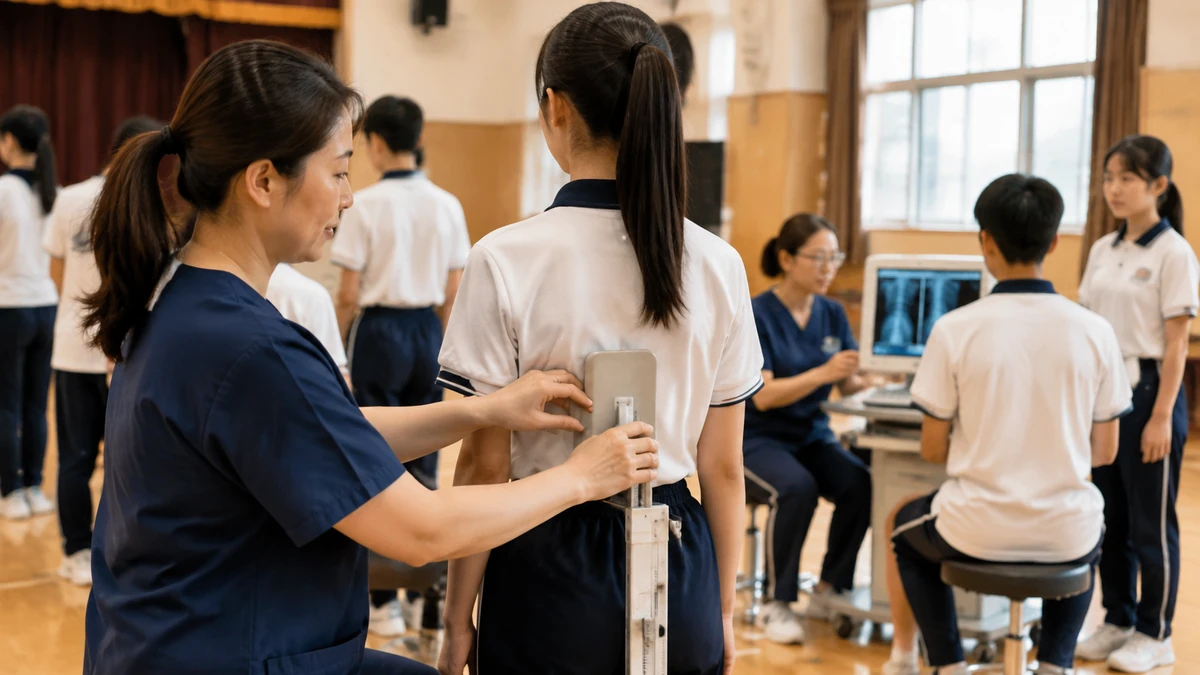
The program, announced for students in fifth and sixth grade of elementary school and second-year middle school classes through the end of the year, is designed around early detection during a period of rapid growth. Instead of asking students to visit outside screening centers, trained personnel will go to schools, perform an initial screening and, if needed, refer some students for follow-up X-rays to confirm whether the spine is curving and by how much.
On its face, that may sound like a modest municipal health initiative. But it also reflects a broader idea that has become increasingly important in both South Korea and the United States: preventive care works best when it is made easy, routine and close to where children already spend their time.
For American readers, the concept may feel familiar in spirit even if the details differ. In the U.S., many parents know the rhythm of school-linked health checks, whether for vision, hearing or vaccinations. What makes the Seoul case notable is not just the medical focus on scoliosis, a sideways curvature of the spine that often emerges during adolescence, but the deliberate effort to reduce friction. The student does not have to miss a separate day for an outside appointment just to get a first look. The screening comes to the student.
That approach matters because adolescence is exactly when physical changes can accelerate and when children may be least likely to recognize a problem themselves. A posture issue can be dismissed as slouching. Back asymmetry can go unnoticed under clothing. Parents may not see the signs, and students often do not know what to look for. A school-based screening system tries to close that gap before concerns become more serious.
Yongsan officials have framed the program not as a one-time check but as the beginning of a more systematic approach to monitoring spinal health in growing children. That distinction is important. Preventive health programs are most effective not when they simply identify an issue, but when they create a pathway for families, schools and health providers to respond in a clear, orderly way.
What Seoul’s program actually does, and why the two-step design matters
According to the summary of the program, the screening process has two stages. First comes an in-school check designed to identify possible abnormalities. Students whose trunk rotation is measured at 5 degrees or more are then directed to undergo spinal X-rays so clinicians can determine the actual degree of spinal curvature.
That 5-degree threshold is one of the most important details in the entire plan, because it underscores what the first screening is and what it is not. It is a sorting mechanism, not a diagnosis. In other words, an initial school screening that crosses the threshold does not mean a child has a confirmed scoliosis condition of a specific severity. It means the student should receive a closer look.
That may sound like a technical distinction, but it is crucial for parents and students. In school health programs, confusion often arises when an initial screening result is interpreted as a final medical verdict. Seoul’s design appears intended to avoid that problem by clearly separating the broad, low-burden first screen from the more definitive follow-up imaging.
There is a practical logic to that structure. If every student were sent immediately for imaging, the program would become more expensive, more time-consuming and more difficult to scale. By using an initial screen to identify the students most likely to need further evaluation, the district can focus medical resources where they are most needed while still checking a large student population.
That balancing act is at the core of many public health programs, whether in South Korea, the United States or elsewhere. The challenge is always the same: how do you make screening broad enough to catch cases early without turning it into an unnecessarily burdensome process for every family? Yongsan’s answer is to keep the first step accessible and the second step targeted.
Just as important, the district is presenting the screening as part of a larger health support system. Officials say the results will be used to systematically manage spinal health during children’s growth years and to maintain a prevention-centered support structure. That language suggests the district is trying to build continuity rather than merely collect data points.
For families, the most immediate lesson is straightforward. A first screening result should neither be ignored nor exaggerated. It should be understood in context. The school-based check identifies whether more evaluation is warranted. The X-ray, when needed, helps determine what is actually going on.
Why Korean schools are a natural setting for this kind of intervention
To understand why this program makes sense in South Korea, it helps to understand the role schools often play there. Korean schools are not just academic institutions; they are also major centers of daily structure in children’s lives. Students spend long hours in and around school settings, and educational institutions often function as the most reliable place to reach nearly all children in a specific age group.
That makes school-based health programs especially attractive for local governments. Rather than waiting for families to navigate appointments on their own, a district can meet students in a familiar environment and potentially raise participation simply by lowering inconvenience.
The Yongsan program is also aimed at specific grades: upper elementary students and second-year middle school students. That focus reflects the reality of growth spurts. These are years when rapid physical development can make changes in the body easier to miss if no one is looking systematically.
Korean officials are also explicitly linking screening with posture education and healthy daily habits. That is another culturally important point. In many Korean school and family settings, posture is often discussed not just as a matter of appearance but as part of discipline, physical well-being and long-term health. Yet the program summary is careful to distinguish those ideas. Proper posture education is not the same as a medical screening for scoliosis, and the two should not be conflated.
That clarity is useful. A child can be told to sit up straight without anyone knowing whether there is an underlying spinal issue. Conversely, a child may have a screening result that merits follow-up even if no obvious problem has been recognized in day-to-day life. By separating lifestyle education from clinical screening, the district can encourage healthier habits without suggesting that posture alone explains every spinal concern.
This is where the program seems to show a degree of administrative maturity. It recognizes that prevention is not just about identifying disease; it is also about helping children notice bodily changes, helping guardians understand what the results mean and helping schools connect education with appropriate next steps.
For readers outside Korea, the broader takeaway is that a school can be more than a place where health pamphlets are handed out. It can be the point where observation, communication and access come together. When that happens, prevention stops being an abstract policy goal and becomes part of a student’s ordinary routine.
What this means in the United States
For Americans, the most interesting aspect of Seoul’s initiative may be less the specific condition being screened and more the delivery model behind it. The U.S. has long debated how much responsibility schools should carry for health monitoring, mental health support and preventive care. Vision screenings, hearing checks and school nurses are familiar parts of the landscape, but access remains uneven, and policies on scoliosis screening vary widely by state and district.
That unevenness is exactly why a story like this lands beyond Seoul. In the United States, families often encounter a fragmented system in which pediatric care depends heavily on scheduling flexibility, transportation, insurance, parental work hours and the availability of local providers. A school-based first screen cannot solve all of that, but it can reduce the number of hurdles between a concern and a next step.
There is also a broader American conversation here about missed preventive care among children and adolescents. The pandemic disrupted routine appointments for many families, and even after schools and clinics reopened, access did not rebound uniformly. Any model that brings basic preventive checks closer to daily life is likely to attract attention from public health officials, school administrators and parents alike.
American readers may also recognize a familiar tension: how to balance early detection with concerns about over-screening, cost and parental anxiety. Yongsan’s two-step design offers one possible answer. It does not subject every student to imaging. It starts with a lower-burden screen, then escalates only when a threshold is met. That is not a complete solution to every debate, but it is a practical framework that tries to distinguish between broad access and unnecessary intervention.
There is another U.S. angle as well: communication. One persistent challenge in American school health programs is ensuring families understand what a screening result means. If a child comes home with a notice that sounds alarming or vague, parents may either panic or tune it out. The Korean summary repeatedly emphasizes that the first screen and the follow-up imaging are different stages serving different purposes. That kind of message discipline is something many U.S. districts would likely recognize as essential.
For American companies and organizations operating in school health, adolescent wellness or medical imaging, the Seoul program also illustrates a market and policy trend worth watching. Public institutions increasingly want interventions that are scalable, minimally disruptive and easy to explain to families. The winning model is often not the most technologically flashy one; it is the one that fits into the flow of everyday life.
And for the broader U.S.-Korea relationship, the story is a reminder that bilateral ties are not only about semiconductors, defense agreements and pop culture exports. They are also about how two advanced societies are wrestling with the same practical questions: how to care for children earlier, more equitably and with less friction for families. Public health innovation can be local in form and globally relevant in meaning.
The bigger trend: health care is moving closer to where people live, study and work
If this were only a story about one district screening students for scoliosis, it might be easy to overlook. But the larger pattern is unmistakable. Across many countries, health systems are trying to move care out of specialized facilities as the only gateway and bring more of it into everyday settings such as schools, workplaces, pharmacies and community centers.
The reasons are not hard to understand. People are busy. Parents delay appointments. Children do not always report symptoms clearly. Transportation takes time. Some families worry about cost, while others simply struggle with logistics. In that environment, access is not just about whether a medical service exists. It is about whether the service is realistically reachable.
School-based screening answers that question by shrinking the distance between a child and an initial assessment. In policy terms, it converts a passive system into an active one. Instead of saying, in effect, “Help is available if you go find it,” the institution says, “We will come to you for the first step.”
That does not make the system risk-free or universally applicable. Screening programs require trust, careful communication and clear follow-up. If the first screen identifies possible abnormalities but families do not understand the next step or cannot access it, the system breaks down. Likewise, if schools are not equipped to communicate results in understandable language, early detection can quickly turn into confusion.
Still, the Yongsan case highlights why these models keep gaining traction. They align with a prevention-centered mindset that is now shaping everything from chronic disease management to mental health to adolescent medicine. The old model waited for symptoms to become obvious enough to prompt action. The newer model tries to identify changes earlier, when there may be more time and flexibility to respond.
That is particularly relevant for conditions associated with growth and development. By the time a problem becomes unmistakable to an untrained eye, an opportunity for earlier intervention may already have passed. Screening does not guarantee an outcome, but it can change the timeline on which families and clinicians become aware of an issue.
In that sense, the Seoul initiative is less a one-off local announcement than a clear example of where public health administration is heading. It favors systems that are embedded, not distant; preventive, not purely reactive; and structured, not improvised after a concern emerges.
Why posture education is part of the story, but not the whole story
One of the more thoughtful aspects of the program is its insistence on linking screening with healthy habits while still keeping the two concepts distinct. Yongsan officials say they want adolescents to recognize changes in their bodies early and develop healthy everyday habits, including good posture. That may sound commonsense, but it addresses a real challenge in child health communication.
Parents and schools often gravitate toward what feels most controllable: reminders to sit straight, carry backpacks properly or avoid excessive slouching over desks and screens. Those habits may indeed matter for comfort and general musculoskeletal health. But a public health message that stops there can blur the line between lifestyle guidance and clinical evaluation.
The program summary is careful not to make that mistake. It states that possible spinal abnormalities are assessed through screening, with follow-up X-rays used when necessary to determine the degree of curvature. Healthy habits are framed as an additional goal, not a substitute for medical confirmation.
That distinction is especially valuable in an era when many children spend long hours sitting, studying or using devices. In both Korea and the United States, concerns about posture are wrapped up in broader anxieties about screen time, sedentary routines and academic pressure. It is easy for families to assume that any back-related concern must be caused by “bad posture” in a colloquial sense. But a screening program needs to be more precise than that.
What the district appears to be doing is using the school setting to teach two parallel lessons. First, pay attention to your body and build better habits in daily life. Second, understand that screening and diagnosis follow a process, and that a first sign of concern should lead to appropriate follow-up rather than guesswork.
That is a sophisticated public message, and one that many health systems struggle to deliver well. It treats children not just as passive recipients of care but as participants in noticing and understanding physical change. It also treats parents as partners who need clear explanations, not just test results.
What to watch next
The success of Yongsan’s school-based scoliosis initiative will not be measured only by how many students are screened before the end of the year. More telling questions will come later. Do families understand the difference between the initial screen and follow-up imaging? Do students who meet the threshold actually complete the next step? Are schools able to communicate the process in a way that avoids unnecessary alarm but still prompts action when needed?
Those questions matter because the hardest part of preventive care is often not the first contact. It is the handoff. A screening program can identify a possible issue, but its real value depends on whether the system guides families smoothly into whatever comes next.
For policymakers in the U.S. and elsewhere, that is the most transferable lesson from Seoul. Effective school health programs are not just about finding a condition. They are about designing a chain of action that is easy to enter, easy to understand and hard to fall out of.
The Yongsan case also deserves attention as a reminder of how local government can shape health outcomes in concrete ways. National health debates often focus on sweeping reforms, insurance structures or hospital systems. But for many families, the most meaningful policy change is something much smaller: a trained screener who shows up at school, a clear note explaining what a result means and a manageable next step that does not require parents to navigate the system alone.
That may be why this small story from one district in Seoul feels larger than it first appears. It reflects a form of public health that is practical rather than dramatic, built around prevention rather than crisis and rooted in the ordinary institutions that shape children’s daily lives.
For American readers, the headline is not that Korea has discovered scoliosis screening. It is that a local government has made a familiar health concern easier to catch by meeting students where they are. In a time when both the United States and South Korea are looking for ways to strengthen preventive care, reduce missed problems and support families more effectively, that is a lesson with resonance well beyond one Seoul neighborhood.
Comments
Post a Comment