Image to help understand the article
A runaway hit is reshaping the late-summer box office in South Korea
South Korea’s movie business has spent the past several years searching for stability after the pandemic scrambled theatrical habits around the world. Now, one film appears to have found the formula for commanding almost all of the attention in the room. According to weekly box-office data compiled by the Korean Film Council, or KOFIC, the film listed as “Odyssey” held the No. 1 spot for a fourth straight week from Aug. 24 through Aug. 30, drawing 1,755,593 admissions during that seven-day period and pushing its cumulative audience to 8,864,928.
In the Korean market, where admissions are often discussed as prominently as revenue, those numbers are striking on their own. They become even more notable when paired with market share: “Odyssey” accounted for 64.7% of weekly box-office revenue, taking in 19.87 billion won during the week. Put more simply, nearly two-thirds of all ticket sales money in South Korean theaters went to a single movie.
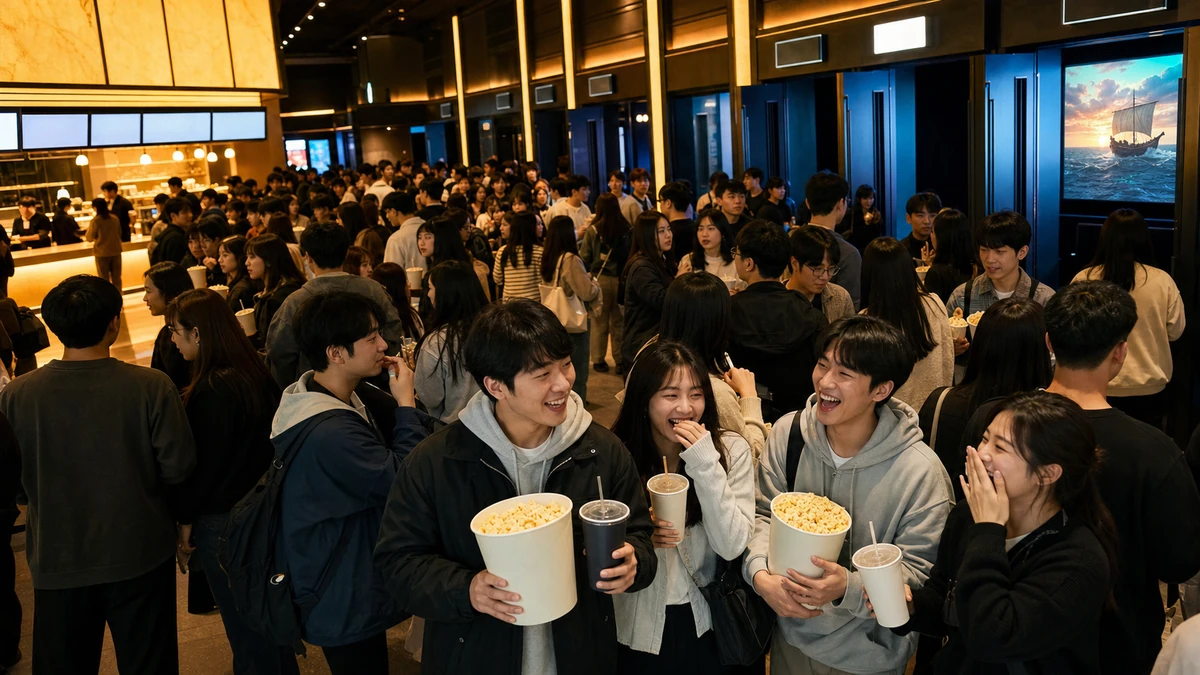
That is the kind of concentration that turns a hit into a market-shaping event. It suggests not just popularity but dominance — the ability of one title to absorb screens, showtimes and consumer attention long after opening weekend. The film, released Aug. 5, was still playing on 2,071 screens with 41,231 showings during the measurement period. In an industry where the biggest challenge is often maintaining momentum after the initial rush, “Odyssey” is doing the opposite: It is extending its lead deep into its run.
For American readers, the easiest comparison is the kind of long-tail theatrical phenomenon Hollywood still dreams about: a film that opens big, survives the second and third weekends, and then keeps pulling audiences back through sheer cultural conversation. Think less of a front-loaded franchise sequel and more of a title that becomes the default moviegoing choice for a month. In South Korea right now, “Odyssey” is that movie.
Its next milestone is also close enough to matter. The film sits just 135,072 admissions short of 9 million total viewers, a threshold likely to draw fresh attention in the next round of box-office reporting. In the Korean context, round-number audience milestones are often treated as cultural benchmarks, much the way U.S. outlets might focus on a movie crossing $100 million domestic or $1 billion worldwide.
What the numbers say about the Korean market right now
The most revealing detail in KOFIC’s weekly chart may not be that “Odyssey” is No. 1. It is how wide the gap has become between the top film and everything else. The No. 2 title, “Spider-Man: Brand New Day,” also held its position from the previous week, but it drew 420,800 admissions — strong enough for second place, yet still more than 1.33 million behind “Odyssey” for the week. Its cumulative total of 8,548,398 shows that it, too, has been a major success. But this week’s chart was not a close contest between two hits. It was one movie towering over another very successful movie, while the rest of the field trailed far behind.
Together, the top two releases accounted for 79% of the week’s revenue. That level of concentration tells a larger story about the structure of the theater business. It suggests that audiences are still going to cinemas in sizable numbers when they perceive a title as an event, but they are not spreading their attention evenly across the slate. That pattern is familiar to American exhibitors, who have increasingly lived and died by a handful of major releases while smaller films struggle for oxygen unless they have exceptional reviews, awards momentum or a sharply defined audience.
South Korea’s box-office culture has some distinctive features. Moviegoing remains deeply social, and multiplex concentration can amplify a breakout title quickly. KOFIC’s data system also gives the industry near real-time visibility into attendance, screen counts and showings, allowing market observers to see how theater allocation reinforces momentum. When one title keeps the most screens and the most showtimes several weeks into release, that is not just a reflection of popularity — it can become a mechanism that sustains popularity.
The weekly chart also captures the steep drop-off after the top tier. The No. 3 film, “Gyeongju Trip,” opened on Aug. 26 and climbed 23 places to 187,905 weekly admissions. No. 4, “The Last Day of Oak Street,” also opened Aug. 26 and rose 39 spots to 106,894 admissions. Those are respectable launches, especially for new titles entering below two entrenched leaders. But they also underscore how difficult it is for a fresh release to break through when one film has become the market’s center of gravity.
That does not mean the chart lacks variety. Horror, family animation, Japanese anime, action comedy and holdover dramas all appear in the top 10. What it does mean is that variety exists in the shadow of concentration. The Korean theatrical market, at least this week, is functioning a lot like the U.S. market at its most top-heavy: broad menu, narrow spending.
Why admissions matter so much in South Korea
For readers more accustomed to American box-office coverage, one important cultural and industrial distinction is worth explaining. In the United States, headlines often center on dollars — opening weekend gross, domestic total, international total. In South Korea, admissions are just as central, sometimes more so in everyday coverage. That is partly because ticket-buying numbers are an intuitive measure of how many people actually showed up, and partly because KOFIC’s reporting structure has made admissions a standard language of success.
That matters when interpreting “Odyssey’s” march toward 9 million viewers. South Korea has a population of roughly 51 million, so a theatrical audience nearing 9 million is not a niche achievement or a fandom-driven spike. It is evidence of broad reach. The comparison is not exact, because repeat viewings exist in every market and ticketing patterns differ, but a title approaching that level in Korea is playing on a genuinely national scale.
It also helps explain why industry watchers talk about “long-run hits” in ways that can sound slightly different from Hollywood discourse. In the U.S., the focus is often on weekend-over-weekend drops, premium-format share and global franchise performance. In Korea, the ability of a film to remain in the top tier for weeks, keep a dense screening footprint and steadily add admissions can be treated as a sign of staying power that is cultural as much as commercial. A movie that keeps filling seats after the opening rush has crossed from product to conversation.
KOFIC itself plays an important role in how that conversation is framed. The Korean Film Council is a public institution that tracks theatrical performance and supports the country’s film ecosystem. For American readers, it is not a direct equivalent to a studio trade body, nor exactly the same as a federal arts agency. It functions more like a national industry infrastructure node — part data hub, part policy actor, part cultural support system. When KOFIC numbers show one film controlling nearly two-thirds of weekly revenue, that becomes not just trivia for movie fans but a signal about the health and shape of the marketplace.
There is another Korean-specific nuance here: The balance between local films and imported films has long carried symbolic weight. South Korea is one of the few foreign markets where homegrown cinema has consistently competed strongly against Hollywood. So when a single film dominates, analysts are not merely asking whether it is a hit. They are also asking what that success says about audience confidence, genre appetite, release strategy and the ongoing negotiation between domestic storytelling and global franchise power.
The top 10 shows a market split between giants, newcomers and durable holdovers
The lower reaches of the chart make the week’s story more textured. “Spider-Man: Brand New Day” remained firmly in second place with 420,800 weekly admissions and 8,548,398 total admissions, taking 14.3% of weekly revenue. About a month after its July 29 release, that is still a robust number. By most standards, it is the profile of a healthy blockbuster. The problem for any No. 2 film this week is that it is competing not against average success, but against outlier success.
Below the top two, new openings made the most immediate moves. “Gyeongju Trip” debuted with enough force to land at No. 3, while “The Last Day of Oak Street” entered at No. 4. Their arrival pushed established mid-tier titles downward, including “Love’s Hachuping: The Legend of the Whale Jewel,” “Detective Conan: The Fallen Angel of the Highway,” and “Okay Madam 2,” each of which slid three spots from the previous week. That kind of synchronized downward movement is common when a chart gets fresh supply in the middle ranks. But here, it happened underneath a fixed ceiling: the top two positions did not budge.
Even more telling is what happened to “Hope,” which fell one place to No. 9 but remained in the top 10 despite having the earliest release date among the ranked titles, July 15. Its weekly admissions were just 16,699, but its cumulative total reached 4,535,081. In a year or week defined by smash hits, films like “Hope” can disappear from conversation. Yet they often tell exhibitors something important: there is still room for steady endurance even when the headlines belong to a giant.
No. 10, “Dog Star: Last Hope,” entered the chart with 11,718 admissions on 280 screens and 1,720 showings. That is a far cry from “Odyssey’s” industrial footprint, but it is also a reminder that the Korean theatrical ecosystem continues to cycle in new product at every scale. The problem is visibility. When one film commands 64.7% of revenue, every other title is competing not only for ticket buyers but for cultural bandwidth.
This is where the weekly chart becomes more than a scoreboard. It starts to look like a map of market behavior. Consumers are not abandoning theaters outright; if they were, no film would be posting “Odyssey’s” numbers. Instead, they are behaving selectively and, at least for now, flocking to a smaller number of titles they perceive as worth leaving home for. That is a pattern exhibition chains, distributors and streamers are all studying closely on both sides of the Pacific.
What this means for the United States
For American audiences and companies, South Korea’s box-office pattern matters for at least three reasons: it offers a read on global franchise competition, it underscores the continuing power of event cinema, and it reveals how deeply interconnected the U.S. and Korean entertainment industries have become.
First, the presence of “Spider-Man: Brand New Day” at No. 2 with more than 8.5 million cumulative admissions is itself a reminder that Hollywood still has enormous reach in South Korea. American superhero and franchise properties remain central to multiplex economics there, even as local films regularly fight them on equal footing in ways few foreign markets can manage. When a film like “Odyssey” decisively outpaces a major Spider-Man release, U.S. studios should not read that simply as a local anomaly. They should read it as a competitive signal: Korean audiences are willing to choose domestic or non-Hollywood event films over even the most recognizable American brands when the local theatrical conversation tips in that direction.
Second, the U.S. market is wrestling with the same basic question Korea is: What still gets people to theaters consistently? American exhibitors have seen the answer narrow toward “must-see” titles — films with scale, urgency or cultural momentum. The Korean results this week reinforce that lesson. “Odyssey” is not just winning; it is absorbing demand. That is what every U.S. studio wants from a major release and what every theater chain needs from the calendar. Theaters do not simply want movies that open. They want movies that dominate the social mood.
Third, the bilateral cultural relationship between the United States and South Korea makes Korean box-office trends more relevant to Americans than they might have seemed a decade ago. Korean entertainment is no longer a niche import in the U.S. market. K-pop fills stadiums. Korean dramas sit high on streaming charts. Korean filmmakers, actors and production companies are now part of mainstream awards, distribution and remake conversations in Hollywood. A theatrical breakout in Seoul can shape business decisions in Los Angeles — about co-productions, acquisitions, release timing, subtitling strategy, marketing partnerships and talent development.
American distributors and streamers, in particular, watch Korean theatrical performance as an indicator of what kinds of stories and genres are building audience heat before they travel abroad. Not every Korean hit becomes a U.S. crossover. But strong local performance can influence whether a film receives broader international promotion, festival positioning or a premium platform rollout. The U.S. market has become more comfortable with subtitled entertainment than in previous eras, even if theaters still lag streaming on that front. A sustained Korean hit therefore carries implications that extend beyond Korea’s borders.
There is also a cautionary message here for U.S. companies. Market concentration can be lucrative in the short term, but it leaves the broader ecosystem fragile if too many titles fail to connect. American studios know this from years in which a handful of tentpoles carried the box office while mid-budget dramas, comedies and adult-oriented films lost theatrical ground. Korea’s current chart suggests a similar pressure point. If one movie takes nearly two-thirds of revenue, everyone else is squeezed — and that squeeze can alter what gets financed next.
A trend story, not just a one-week story
The easiest way to read this week’s Korean box office is as a victory lap for a hit movie nearing 9 million admissions. The more useful reading is broader: This looks like another data point in the global transition toward a winner-take-most theatrical economy.
That trend did not begin in South Korea, and it certainly did not begin this week. But the current chart makes it unusually visible. A fourth consecutive week at No. 1, a screening footprint above 2,000 screens, and a 64.7% revenue share all point in the same direction. The theatrical business is not disappearing. It is reorganizing around fewer films that carry more of the burden.
In some ways, that is an old Hollywood story. Summer blockbusters and holiday event films have always mattered disproportionately. What feels different now is the degree of concentration and the speed with which it can harden. Once a movie becomes the thing to see — because of word of mouth, scale, critical reception, brand recognition or social media conversation — exhibitor allocation and audience behavior can reinforce each other fast. More screens lead to more convenience. More convenience leads to more admissions. More admissions generate more headlines. More headlines produce more urgency.
South Korea’s theater culture, with its dense multiplex networks and high public visibility for admissions data, can make that flywheel especially clear. But the underlying logic is universal. It is visible in the United States whenever one title takes over premium large formats, dominates online chatter and crowds out smaller releases. It is visible in Japan when anime phenomena concentrate the market. It is visible in China when patriotic blockbusters or major domestic releases become national events. What Korea shows this week is not an exception to the global rule. It is a particularly vivid example of it.
That is why the next set of questions matters more than whether “Odyssey” reaches 9 million in the next reporting period. Can “Gyeongju Trip” or “The Last Day of Oak Street” hold their new positions and build word of mouth? Can “Spider-Man: Brand New Day” keep defending second place with a strong enough weekly audience to remain relevant as the chart evolves? And beyond the immediate leaderboard, what does a heavily concentrated market do to the pipeline of films still waiting for breathing room?
Those are not just Korean questions. They are American questions, too. The United States and South Korea may have different industry structures, different audience habits and different star systems, but their theatrical sectors are confronting the same strategic puzzle: how to sustain a broad moviegoing culture when only a few titles can reliably command mass attention.
What to watch next
The next box-office update will likely focus on whether “Odyssey” crosses 9 million cumulative admissions, and that is a meaningful benchmark. But the more revealing signal may be how the rest of the chart responds. If the top film keeps its overwhelming share while new releases struggle to grow, that would reinforce the view that Korea is in a highly concentrated theatrical moment. If newer titles start to chip away at the middle ranks and narrow the gap beneath the top two, the market could begin to look more balanced.
Either way, this week’s results already tell us something important. South Korean audiences are still willing to show up in very large numbers. The theatrical experience remains potent there. But the path to those crowds is increasingly narrow, and increasingly tied to films that feel like events rather than mere options.
For American readers, that makes South Korea less a distant curiosity than a useful mirror. The same forces reshaping moviegoing in the United States — audience selectivity, franchise competition, pressure on mid-tier releases, and the outsize value of cultural momentum — are visible in Seoul’s multiplexes right now. The names on the marquee may differ. The market logic does not.
And that is what makes “Odyssey’s” four-week run more than a local success story. It is a snapshot of where theatrical cinema may be heading across borders: fewer casual winners, more dominant champions, and a growing premium on films that can turn attention itself into box-office power.
Comments
Post a Comment