A South Korean City Moves to Halt New Unstaffed Vape Sales, Reflecting a Wider Debate Over Youth Access and the Limits of Retail Automation
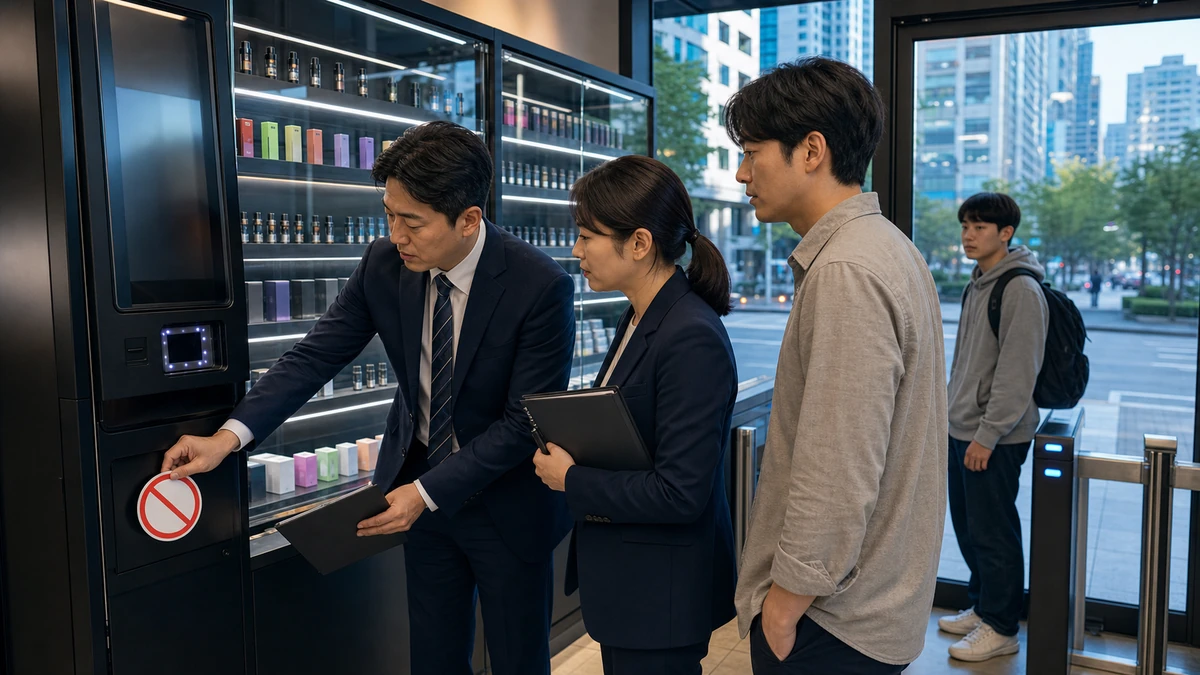
Image to help understand the article
A local rule in South Korea points to a bigger public health question
In Seongnam, a large city just southeast of Seoul, officials are drawing a clear line between retail convenience and youth protection. Beginning Thursday, the city will stop issuing new tobacco retail permits to unstaffed stores where employees do not directly sell tobacco products. The move is aimed especially at unmanned e-cigarette shops, a retail format that has spread in parts of South Korea alongside the country’s broader embrace of automated storefronts, self-service kiosks and late-night convenience retail.
On paper, the change is narrow. It does not amount to a blanket ban on e-cigarettes in Seongnam. It does not shut down all vape sales. And it does not immediately force existing unmanned tobacco retailers to close. Instead, the city revised its rules for designating tobacco retailers so that, going forward, stores without in-person employee oversight will not be approved to sell tobacco. Existing shops will be given a two-year transition period to either add staff and move to face-to-face sales or switch to another line of business if they want to remain unstaffed.
But the policy matters beyond one city’s permitting system because it gets at a question that regulators in the United States and elsewhere are also wrestling with: How much can retailers automate the sale of age-restricted products before the verification process becomes too weak to protect minors? Seongnam’s answer is that there are some products for which technology alone is not enough.
That is especially relevant in a country where unattended stores are no longer a novelty. South Korea has seen a notable expansion of unmanned ice cream shops, self-service snack stores, small automated convenience outlets and specialty retail spaces that rely on cameras, remote monitoring and ID checks rather than a cashier behind the counter. For many products, that model is mostly a story about efficiency. For tobacco, Seongnam officials are signaling, it becomes a story about risk.
The city’s rationale is straightforward: minors may still find ways around non-face-to-face age checks, including by using someone else’s identification or entering a store with an adult. In other words, the problem is not simply whether a machine can read an ID card. It is whether anyone is actually present to judge whether the person using that ID is the rightful owner, or whether an adult is facilitating a purchase by a teenager. The policy restores a human checkpoint to the point of sale.
What Seongnam is actually doing — and what it is not
It is important to be precise about the policy, because the facts do not support some of the broader claims that often follow regulation stories involving tobacco or vaping. Seongnam is not outlawing all e-cigarette shops. It is not announcing a nationwide ban. And it is not ordering every existing unmanned tobacco retailer to shut its doors overnight.
The rule change applies to new permits. Under the revised standard, stores in which employees do not directly sell tobacco will not be approved as tobacco retailers. In practice, that means unmanned vape shops and similar unstaffed formats will no longer be able to newly enter the market in Seongnam as licensed tobacco sellers. For applications submitted after Aug. 31, 2026, new permit requests for unmanned e-cigarette sales will be rejected under the city’s revised approach, according to the Korean news summary.
Existing stores, however, are being given time to adapt. Seongnam has built in a two-year grace period for businesses already operating under the unmanned model. During that period, owners can decide whether to bring in employees and continue selling tobacco through face-to-face transactions, or maintain an unstaffed operation by dropping tobacco sales and changing the business model. That matters because it shows the city is trying to phase in a public health measure while avoiding an immediate shock to existing business operators.
The distinction also reveals the core logic of the policy. The city is not singling out e-cigarettes as a product category for a fresh prohibition. It is targeting the sales environment. The issue, in Seongnam’s view, is not merely what is being sold, but whether the sales process for an age-restricted product includes meaningful oversight by a person on site.
That may sound technical, but it is central to how tobacco policy often evolves. Regulation frequently begins not with an outright ban but with a redesign of access points: where products can be sold, how they are displayed, what warnings are required and who must verify the buyer’s age. In Seongnam, the city has chosen to intervene at the licensing stage, effectively saying that future retail expansion in this category will have to include direct human involvement.
Why youth access is at the center of the debate
The policy is being framed primarily as a measure to protect minors from vaping and broader tobacco exposure. That focus reflects a familiar pattern in both South Korea and the United States, where officials have often treated youth uptake as the most urgent argument for tighter controls on e-cigarettes.
In Seongnam’s case, city officials cited specific concerns: teenagers using another person’s identification and teenagers entering with adults. Both scenarios exploit the limits of automated compliance systems. A scanner may confirm that an ID card is valid or that the birth date printed on it is over the legal age threshold. What it cannot fully determine is whether the person standing in front of the machine is the same person pictured on the ID, or whether an adult is helping a minor get around the rules.
For American readers, the underlying concern is not hard to recognize. It mirrors long-running arguments in the U.S. over online alcohol delivery, self-checkout sales of restricted products and the role of convenience stores in preventing underage purchases. American regulators and retailers have also learned that age verification is not just a technical challenge. It is a social one. The gap between compliance on paper and behavior in the real world can be wide.
That is part of why Seongnam’s policy is notable. It does not assume that stronger machines or better scanners will fully solve the problem. Instead, it appears to conclude that some retail settings are simply too vulnerable to circumvention when no employee is present. The city is adopting a prevention-first model: reduce the number of places where an underage buyer might have an easy shot at obtaining tobacco products, rather than relying only on penalties after a sale takes place.
There is also a broader public health message here. Officials are concerned not only with direct purchases by minors but with what Korean policymakers often describe as harmful tobacco environments — in effect, everyday settings where youth are too easily exposed to tobacco products, tobacco advertising cues or normalized use. For an American audience, this is comparable to debates over flavored vape displays, point-of-sale marketing near schools or whether nicotine products are becoming too woven into ordinary youth retail spaces.
By focusing on “purchase possibility,” as the Korean summary puts it, Seongnam is emphasizing opportunity structure. If the sales channel itself is easy to access, then prevention becomes much harder. The city’s response is to make that channel less available over time.
What this says about Korea’s automated retail boom
To understand why this story matters in South Korea, it helps to understand the setting. South Korea is one of the world’s most digitally connected societies, with dense urban neighborhoods, widespread mobile payment adoption and a consumer culture that has readily accepted self-service retail. Unmanned stores fit naturally into that environment. They promise lower labor costs, longer operating hours and convenience for customers accustomed to doing almost everything by phone or kiosk.
That retail shift has taken place during years of rising interest in automation across many sectors, accelerated in part by pandemic-era concerns over contactless services. What might feel futuristic in some parts of the United States can seem routine in Seoul-area neighborhoods: self-ordering screens, remote-monitored stores and low-staff or no-staff formats serving people late into the night.
Yet age-restricted goods expose the limits of that model. Tobacco is not like bottled water or instant noodles. The sales process carries a legal and public health burden that is hard to fully delegate to software. Seongnam’s new rule therefore reflects a broader tension inside modern retail: the same technologies that make transactions faster and cheaper can weaken social safeguards that depend on human judgment.
That tension is becoming more visible worldwide. Automated systems are often introduced with the assumption that exceptions can be managed with add-on verification tools. But over time, regulators discover that a product’s legal sensitivity may require not better automation, but less automation. In Seongnam, the city has effectively concluded that face-to-face confirmation is not an optional upgrade for tobacco sales; it is part of the minimum standard.
There is a useful analogy in the American context. U.S. retailers have embraced self-checkout for groceries and general merchandise, but many still place restrictions on who can complete alcohol purchases, and where. Some states and retailers require an employee to intervene. Others ban certain categories of self-service sale entirely. The principle is similar: convenience has limits when the product carries an age threshold and a history of public health harm.
Seen that way, Seongnam’s move is less an outlier than an early local example of a policy argument that is likely to spread. As more cities and companies experiment with cashierless or lightly staffed retail, governments will have to decide where human supervision remains nonnegotiable.
What this means for the United States
For Americans, Seongnam’s decision is more than a local Korean policy curiosity. It offers a real-time case study in how a technologically advanced ally is trying to police youth access to nicotine products without banning the products outright. That has implications for U.S. regulators, retailers, public health advocates and American companies doing business in the broader ecosystem of vaping, age-verification technology and convenience retail.
First, the policy underscores a point that has been central to the American vaping debate for years: youth access remains the issue most likely to drive stricter regulation. In the United States, the Food and Drug Administration and state attorneys general have repeatedly focused on underage use, flavored products, marketing tactics and retail enforcement. If Korean local governments increasingly conclude that unmanned sales are incompatible with meaningful age checks, that could reinforce a global regulatory trend in which the burden shifts from proving youth harm after the fact to redesigning retail channels in advance.
Second, American companies should pay attention to the operating principle behind the rule. Seongnam is not saying digital ID checks are useless. It is saying they may be insufficient on their own. That distinction matters for U.S. firms selling compliance technology, kiosk systems, remote monitoring tools or automated retail platforms. The market question is no longer just whether a machine can authenticate an ID. It is whether regulators trust that system enough to replace an in-person clerk. Seongnam’s answer, at least for tobacco, is no.
Third, the move has relevance for American consumers and fans of Korean culture because South Korea often functions as a high-visibility test bed for broader lifestyle and retail trends. K-beauty moved from niche to mass-market in U.S. stores. Korean convenience store culture has become familiar to many younger Americans through travel, social media and Korean dramas. Even the aesthetics of hyper-efficient, tech-enabled shopping have traveled with the Korean Wave. But this story is a reminder that the Korean model is not simply about speed and novelty. It is also about regulation catching up with technology.
Fourth, the decision speaks to the U.S.-Korea relationship in a quieter but meaningful way. Washington and Seoul increasingly share policy conversations not only on security and semiconductors, but also on digital governance, health regulation and consumer technology. While Seongnam’s ordinance is local, the underlying challenge — how democratic societies regulate automated systems that interact with vulnerable populations — is part of a much larger trans-Pacific conversation.
Finally, there is an industry comparison Americans will recognize. In the U.S., Big Tobacco and vape makers have faced repeated scrutiny over whether innovation outpaced oversight. Seongnam’s move suggests a parallel concern in Korea: retail innovation may have moved faster than the safeguards needed for youth protection. American readers have seen similar cycles before, from Juul-era backlash to restrictions on flavored products to debates over social media age checks. The pattern is familiar. A new convenience arrives, adoption grows quickly, then regulators ask whether the system was built with children in mind.
Why the policy may matter beyond one city
The Korean summary is careful not to overstate the scope of the rule, and so should any responsible coverage. This is a Seongnam measure, not a national Korean ban. The source material does not say other municipalities have adopted the same approach, nor does it say Seoul or the central government will automatically follow. Still, local rules can become signals.
City-level regulation often serves as an early indicator of where broader policy may head, particularly when it addresses a visible loophole. If Seongnam’s approach is seen as workable — protecting minors while giving existing businesses time to transition — other local governments in South Korea could consider similar permit standards. That does not mean a wave of copycat rules is inevitable. It simply means the city has provided a practical template: do not ban all sales immediately, but halt new unmanned expansion and force a gradual move back to staffed transactions.
That gradualism is important. Public policy on tobacco often advances through incremental constraints rather than one sweeping law. Restrictions on flavors, store placement, advertising, packaging and age verification have all tended to emerge as layered responses to specific access problems. Seongnam’s regulation fits that pattern. It focuses on one particular weak point in the chain: the unattended point of sale.
There is also a governance lesson here. Rather than waiting for a scandal large enough to force national action, a local government is using licensing power to address a known vulnerability. In the United States, many meaningful public health shifts have also begun locally, whether on indoor smoking bans, sugar-drink rules or restrictions on where cannabis and tobacco products may be sold. Seongnam’s move will likely resonate most with readers who understand how often cities become the first arena for testing ideas that later travel upward.
What happens next will depend on enforcement and business adaptation. Existing unmanned sellers now have a countdown. Some may install staff and remain in tobacco sales. Others may pivot away from nicotine products altogether. Consumers may notice little change at first, since current shops are not being forced to close immediately. Over time, though, the city is clearly aiming to reduce the footprint of places where tobacco can be bought without direct human oversight.
The larger lesson: not every problem has a frictionless fix
At a moment when automation is often marketed as the solution to nearly everything in retail, Seongnam is making a more old-fashioned argument: some forms of friction are protective. A clerk asking for ID, looking at a customer and deciding whether the sale should proceed is slower than a scanner. It is also, in the city’s judgment, safer.
That may be the most important takeaway from this Korean story for an American audience. The debate is not really about whether technology belongs in commerce; it already does. The debate is about which decisions can be responsibly handed to machines and which still require a person in the room. When the product is age-restricted, addictive and tied to long-running public health concerns, Seongnam has decided that a machine alone does not meet the standard.
In practical terms, residents of the city are likely to see fewer new unmanned vape shops open in coming years. Existing operators face business decisions now, even if the deadline is later. Parents and schools may view the change as a modest but meaningful effort to narrow easy access points for teenagers. Retail entrepreneurs, meanwhile, are being told that efficiency is not the only value city hall will recognize.
For the rest of Korea — and for the United States — the significance lies in the policy logic. Regulators do not have to ban a product to change how available it feels in everyday life. They can intervene at the point where technology, commerce and public health intersect. That is what Seongnam is doing.
As vaping rules continue to evolve around the world, this South Korean city’s decision is worth watching not because it settles the argument, but because it clarifies the stakes. Retail automation may be one of the dominant consumer trends of the decade. Youth nicotine access remains one of the most politically sensitive public health issues. When those two trends collide, Seongnam is betting that human oversight still matters — and that the future of retail, at least for tobacco, may need to be a little less seamless.
Comments
Post a Comment