A South Korean Container Ship Enters Arctic Waters, Testing a Sea Route That Could Redraw Global Trade
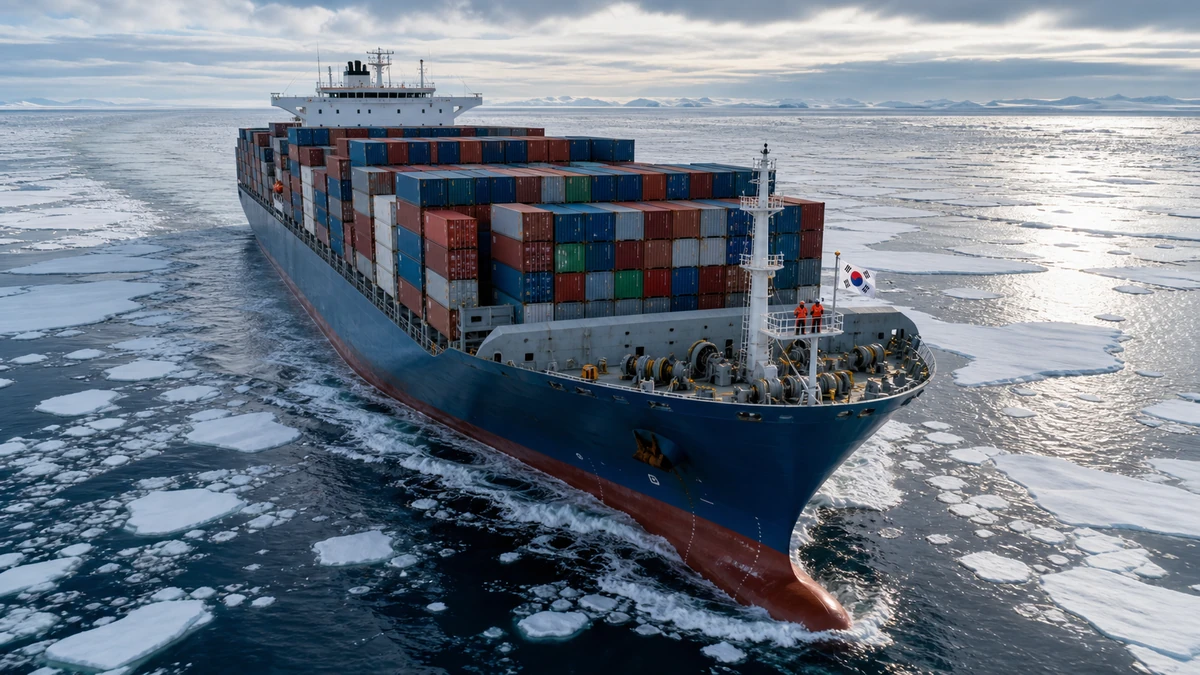
Image to help understand the article
A first for South Korea, and a signal beyond one voyage
A South Korean container ship has entered Arctic waters for the first time, marking a notable milestone not just for the country’s shipping industry but for the wider debate over how climate change is reshaping the map of global commerce. The vessel, PANSTAR ACRO, left Busan New Port on Aug. 22 and reached the Arctic region on the morning of Aug. 31, according to the reported sailing plan. If the trip proceeds as scheduled, the ship will pass through the Arctic Ocean, call at Felixstowe in Britain and then continue to Rotterdam in the Netherlands before making a return trip to South Korea through the same waters.
On paper, this is a trial run by one vessel. In practice, it is something bigger: a real-world experiment by a major export-driven economy to see whether a route once treated as geographic fantasy can become part of the logistics mainstream. South Korea depends heavily on maritime trade to move manufactured goods, industrial inputs and consumer products around the world. That makes any potential shortcut between Asia and Europe more than a curiosity. It is a possible strategic asset.
The route in question is commonly known as the Northern Sea Route or, more broadly, an Arctic shipping passage. As sea ice has retreated because of global warming, shipping firms and governments have taken a renewed interest in whether vessels can move between Asia and Europe faster than they can via traditional paths such as the Suez Canal. That possibility has circulated in industry circles for years. What gives this voyage weight is that a South Korean company is now gathering operating data with an actual container ship, the kind of vessel that underpins modern just-in-time trade.
That distinction matters. Bulk carriers and specialized ships have operated in northern waters before, but container shipping is an especially unforgiving business. Reliability is often as important as speed. A route is not truly useful to container lines, importers and retailers unless cargo can arrive on a timetable close enough for ports, trucking networks, warehouses and store shelves to plan around it. In other words, this is not simply a story about a ship going north. It is about whether one of the world’s most timetable-driven industries can make sense of an increasingly unstable environment.
For that reason, the most important outcome of this voyage may not be whether PANSTAR ACRO reaches Rotterdam a few days faster than expected. It may be the information generated along the way: how weather and sea ice affect speed, how often routing adjustments are required, how accurately arrival windows can be forecast and what the return leg reveals about repeatability. In shipping, especially container shipping, hard operational data is often more valuable than a dramatic headline.
Why the Arctic route is suddenly more than a theoretical shortcut
The commercial appeal of an Arctic route is straightforward enough for American readers to recognize. Imagine a trucking company that spots a potentially shorter interstate route between two major distribution hubs. If the shortcut saves time and fuel, it could become a competitive advantage. But if the road is prone to closures, sudden weather changes and uncertain conditions, the shortest route on a map may not be the best route in practice. The Arctic presents exactly that dilemma, only on a global scale and with much higher stakes.
The attraction is the shorter distance between Asia and Northern Europe. For countries such as South Korea, whose economy is deeply entwined with exports, shaving time or fuel from maritime transport can translate into meaningful gains. South Korean companies sell everything from cars and auto parts to petrochemicals, batteries, electronics and industrial goods into European markets. A route that reduces sailing distance could, in theory, improve efficiency and offer shipping lines a new option when traditional trade lanes are congested or disrupted.
That possibility looks especially relevant after recent years of supply chain shocks. Americans have become more familiar with the fragility of global logistics since the pandemic, semiconductor shortages, port backlogs and disruptions in major canals pushed shipping onto front pages instead of business pages. The Suez Canal blockage in 2021 gave the public a vivid lesson in how one chokepoint can ripple across the world economy. The Panama Canal’s water-related constraints have offered another reminder that infrastructure and climate are increasingly intertwined. Against that backdrop, it is easy to see why shipping companies and governments are scouting alternatives.
Still, the Arctic is not simply another route to be plugged into a spreadsheet. It is a volatile environment shaped by harsh weather, changing ice conditions and significant safety concerns. South Korea’s Ministry of Oceans and Fisheries has said the ship’s speed is being adjusted in light of weather and sea ice conditions, and that the schedule could change. That may sound like a routine caveat, but it points to the central issue. If a vessel must repeatedly slow down, reroute or absorb uncertain arrival times, the theoretical benefit of a shorter route can narrow quickly.
That is why experts tend to treat Arctic shipping not as a solved efficiency play but as a balancing act between distance and unpredictability. A faster route is valuable only if it is sufficiently dependable. For container operators, dependability is not a luxury. It is the product. Retailers, manufacturers and freight customers pay for logistics networks that can hit narrow windows. A route subject to large swings in transit time may work for some cargoes and seasons, but not necessarily for the broader rhythm of global container trade.
What South Korea is really testing: not speed alone, but business reality
Viewed from Seoul or Busan, the significance of this voyage lies less in symbolism than in proof. South Korea has long had the industrial scale and maritime expertise to study the Arctic route. What it lacked was the kind of direct, route-specific operating experience that can anchor future decisions. This voyage begins to fill that gap.
The reported plan itself shows why the industry is likely to pay close attention. PANSTAR ACRO is not merely dipping into northern waters for a narrow demonstration segment. It is attempting a broader round-trip voyage that links departure from Busan, Arctic transit, a call in Felixstowe, final arrival in Rotterdam and then a return to Korea through the same general corridor. That gives South Korean stakeholders a wider set of observations than a one-way partial test would provide.
For shipping companies, logistics firms and policymakers, the value lies in the details collected along the journey. How much must speed be adjusted? Under what conditions? How often does weather force changes in operations? How closely can estimated times of arrival match actual arrivals? How do northern conditions affect fuel planning, crew operations, insurance assumptions and downstream port scheduling? These are not glamorous questions, but they are the ones that determine whether a route moves from pilot project to repeatable business model.
South Korea is particularly well positioned to care about those answers. It is one of the world’s most trade-dependent advanced economies, and its economic success is closely tied to maritime connectivity. The country also has a major shipbuilding industry, sophisticated port infrastructure and companies with global logistics ambitions. In that sense, this trial touches several layers of national strategy at once: shipping, exports, industrial competitiveness and long-term adaptation to changing trade geography.
There is also a subtle but important point here about experience. Shipping routes are often discussed in abstract terms, as if geography alone determines their usefulness. But operational knowledge can itself become a competitive advantage. Companies that build early familiarity with difficult environments may be better prepared if those routes become more commercially viable later. Even if the Arctic route does not become a routine lane anytime soon, the know-how developed now could matter in future planning, partnerships and risk assessment.
That is why this voyage should be read less as a declaration of victory than as a disciplined exercise in learning. South Korea is not proving that the Arctic route has already arrived as a commercial norm. It is testing whether the route can be understood on realistic terms rather than promotional ones. In a shipping industry often tempted by big claims about efficiency, that measured approach may be the most important part of the story.
What this means for the United States
For Americans, a South Korean container ship entering Arctic waters may sound remote at first, but the implications are not. The United States is tied to South Korea through one of the world’s most significant economic and security relationships, and both countries are deeply embedded in the same trading system. When South Korean logistics companies experiment with new ways to move goods to Europe, American businesses, ports, consumers and policymakers have reason to pay attention.
Start with supply chains. South Korean companies are major players in industries that matter directly to the U.S. economy, including autos, batteries, semiconductors, chemicals, steel and consumer electronics. Many American companies also work with Korean suppliers or compete alongside them in global markets. If Korean firms eventually gain more routing flexibility between Asia and Europe, that could affect freight pricing, vessel availability and competitive calculations across multiple regions, including the United States. It would not instantly reshape U.S. import patterns, but it could alter the broader shipping ecosystem in which American companies operate.
There is also a strategic angle for U.S. logistics and maritime policy. American officials and businesses have spent the past several years talking about supply chain resilience, friend-shoring and the risks of overdependence on vulnerable chokepoints. The Arctic route sits squarely inside that conversation. It represents the possibility of diversification, but also the reality that climate change is opening pathways that carry their own risks. For Washington, that raises difficult questions about commerce, environmental stewardship, Arctic governance and national security.
American audiences can think of this as a maritime version of a familiar domestic dilemma: a new shortcut appears, promising efficiency, but it runs through a place where the rules, hazards and long-term consequences are not fully settled. That is one reason Arctic developments have drawn growing attention from U.S. strategists, not only because of trade but because the region is increasingly seen as an arena where economic, environmental and geopolitical interests collide.
There is a business lesson here as well. U.S. retailers and manufacturers learned the hard way during the pandemic that logistics choices once considered back-office matters can suddenly shape prices, inventories and consumer behavior. If Arctic shipping becomes even seasonally more credible, American freight planners, ocean carriers, insurers and ports will need to factor that into their long-range models. Not because it will replace existing routes overnight, but because even a marginal new option can influence rates and routing decisions across the network.
And for American consumers, the story offers a stark contradiction of the modern economy. The very warming that is helping make Arctic routes more navigable is also a source of deep global instability. In other words, the same climate trends that create a commercial opening are a reminder of a mounting planetary cost. That tension is likely to shape how U.S. companies and policymakers talk about Arctic shipping in the years ahead.
Climate change is the enabling force, and the moral complication
No serious analysis of Arctic shipping can avoid the central fact behind it: this route is drawing attention because ice conditions are changing as the planet warms. That makes the story economically intriguing, but ethically and politically complicated. A shipping company may see a shorter path. Environmental observers may see evidence of a world changing in dangerous ways.
Those two realities do not cancel each other out. They coexist, and that is part of what makes Arctic logistics such a consequential subject. On one hand, firms are rational to investigate routes that could lower transit distances and potentially improve flexibility. On the other hand, the route’s increased accessibility is itself tied to climate disruption, which is already contributing to extreme weather, coastal threats and ecosystem stress around the world.
For American readers, this tension may feel familiar. Many industries in the United States are already adapting to climate-driven shifts while also contributing to the debate over responsibility and response. Utilities, agriculture, insurance and transportation all face versions of the same question: how do businesses operate in a changing climate without treating that change as merely another market opportunity detached from its broader consequences?
The Arctic adds another layer because it is not just a commercial space. It is an environmentally sensitive region with outsized importance to the planet’s climate systems and to indigenous communities that are often absent from logistics-centered discussions. That does not mean shipping experiments should be dismissed out of hand. It does mean they should be understood in full context. The line between adaptation and exploitation can be politically charged, and public scrutiny is likely to grow as Arctic activity expands.
For South Korea, the immediate task is operational learning. For the international community, the larger question is whether the opening of Arctic waters becomes another example of commerce racing ahead of governance. That is where the story moves beyond a single vessel and into a broader debate about rules, standards, environmental safeguards and the pace at which global trade adjusts to a transformed planet.
What to watch next in global shipping
The easiest mistake would be to overstate this moment. One successful trial would not mean the Arctic route is ready to become a routine container highway. One delay-ridden trip would not necessarily prove the opposite. What matters is the pattern that emerges over time, especially if additional voyages produce usable operational records across different conditions.
Several questions will determine whether this becomes a meaningful trend. First is schedule reliability. Can ships moving through Arctic waters arrive with enough consistency to serve the needs of container customers? Second is seasonality. A route that is viable only in narrow windows may still have value, but it would function differently from year-round trade lanes. Third is cost. Shorter distance does not automatically equal lower cost once ice conditions, insurance, specialized planning and potential delays are accounted for.
There is also the issue of scalability. A trial can be closely managed in a way that regular commercial service may not be. The real test is whether lessons from one voyage can be turned into systems, procedures and confidence that support broader use. Shipping companies will also be watching how ports, regulators and customers respond. Even the most efficient route is limited if the rest of the logistics chain is not prepared to work with it.
For South Korea, the immediate benchmark is straightforward: the ship’s eventual exit from Arctic waters, its European port calls, arrival in Rotterdam and safe return to Korea. The broader benchmark is more strategic: whether the data gathered from the voyage helps Korean firms judge the balance between opportunity and volatility with greater clarity. In that sense, the voyage is less a verdict than a baseline.
For the United States and other trade-dependent economies, the lesson is similar. The map of global shipping is no longer fixed in the way many assumed a generation ago. Canal constraints, geopolitical shocks, climate change and supply chain redesign are all forcing companies to revisit old assumptions about how goods move. The PANSTAR ACRO voyage is one more sign that the search for alternatives is no longer theoretical.
What changed is not simply that a South Korean container ship entered Arctic waters. What changed is that another major trading nation has decided the route is worth testing with the most commercially sensitive kind of cargo system it has. That decision reflects a world in which climate, commerce and strategy are becoming harder to separate. If this voyage yields credible data, it may help shape how the next chapter of Eurasian shipping is written.
For now, the prudent conclusion is also the most revealing one: the Arctic route remains promising, uncertain and politically complicated all at once. That combination is precisely why this voyage matters.
Comments
Post a Comment