A UAE Royal’s Big Stake in a Trump Family Crypto Bank Venture Raises Familiar U.S. Questions About Power, Money and Influence
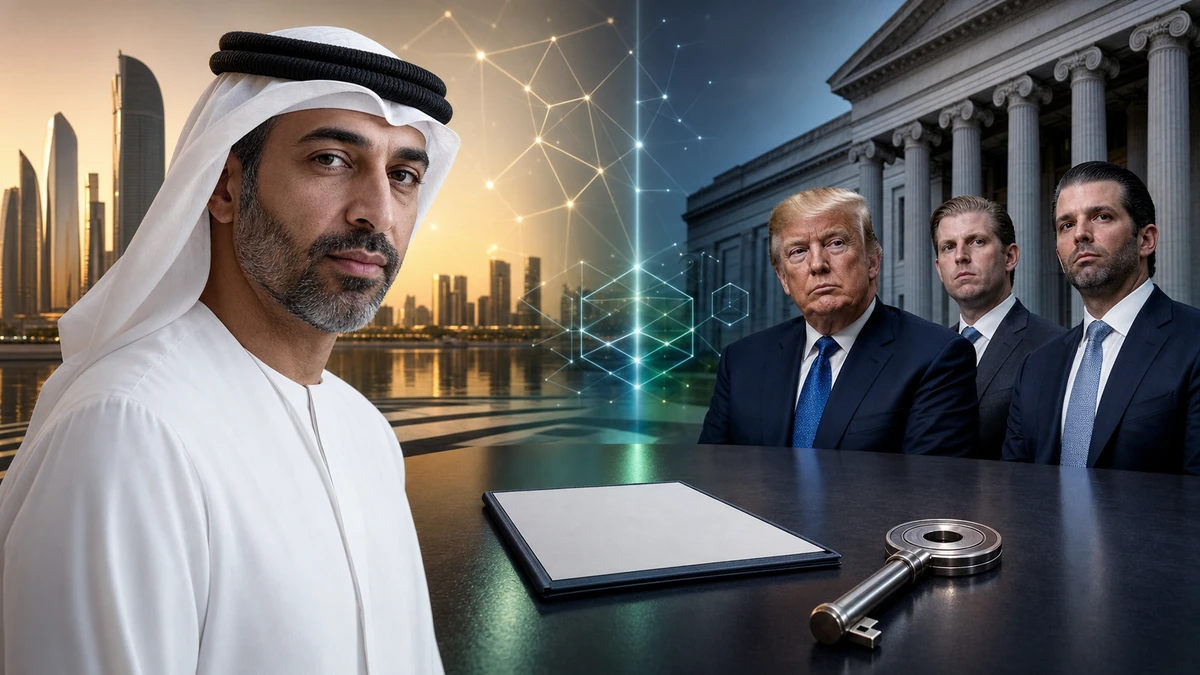
Image to help understand the article
A deal that lands at the crossroads of crypto, politics and foreign influence
A reported investment by a company tied to Sheikh Tahnoon bin Zayed Al Nahyan, the brother of the president of the United Arab Emirates, has placed a foreign royal and senior national security official in a striking position inside a Trump family financial venture. According to reports, the Sheikh Tahnoon side has secured a 49% stake in WLTC Holdings, the holding company connected to an effort by President Donald Trump’s family to launch a cryptocurrency-focused bank. That stake, while not a majority, is reportedly large enough to make the UAE side the single biggest shareholder.
On paper, 49% is a simple number. In practice, it is the kind of number that immediately prompts more important questions: Who really controls the company? What voting rights come with that stake? Who gets seats on the board? Who can see sensitive information? And in a case involving the family of a sitting U.S. president, how cleanly can private business interests be separated from public power?
Those questions matter because this is not just another startup financing round in an industry known for bold promises and blurry lines. The venture at issue is not merely a crypto token project or speculative trading platform. It is tied to the effort to establish a crypto bank through a national trust bank structure, putting it squarely inside a far more sensitive world of federal regulation, financial supervision and institutional trust. In the United States, banks occupy a special place in the economy and political system. They do not simply sell products; they hold money, process transactions, manage risk and rely on public confidence in a way few businesses do.
The political dimension makes the arrangement even harder to dismiss as routine globalization. Sheikh Tahnoon is not just a wealthy foreign investor. He is a major power center in Abu Dhabi and the UAE, serving as national security adviser and deputy ruler of Abu Dhabi, while also chairing influential investment and technology entities including MGX and G42. That overlap among state authority, security policy and high-tech capital is one reason Washington has paid such close attention to Gulf investment in strategic sectors. When a figure with that profile becomes the largest shareholder in a financial venture tied to a U.S. president’s family, the story stops being only about business.
At this stage, there is no public evidence in the material provided that laws were broken or that improper influence was exercised. That distinction is important. Foreign investment in American business is common, legal and often beneficial. Large shareholdings are not proof of control, and political discomfort is not the same thing as illegality. But in Washington, the appearance of a conflict can be nearly as politically combustible as a proven one, especially when a president’s relatives are involved in a regulated business and a foreign government insider is positioned so prominently within it.
That is why this story is likely to resonate well beyond crypto enthusiasts or Trump supporters and critics. It touches several anxieties that Americans already understand: unease about foreign money in domestic institutions, skepticism about whether political families can truly separate office from private profit, and growing concern that crypto is no longer a fringe arena but is moving into the core of the financial system.
Why 49% matters more than it may sound
The headline number invites easy misunderstanding. A 49% stake is not a majority. It does not automatically mean full control. Corporate governance in the United States is determined not only by ownership percentage but also by the structure of voting rights, board representation, shareholder agreements and regulatory conditions. In some companies, a minority investor can exercise substantial influence. In others, even a large shareholder may be constrained by contractual limits or oversight requirements.
That is why the most consequential details in this case may not be public yet. If the UAE-linked investor is treated as a passive investor, regulators and company lawyers would be expected to define what “passive” means in operational terms. Does that investor have the right to appoint directors? Does it have veto power over major decisions? Can it review sensitive internal reports? Is it entitled to expanded access to nonpublic information? Those questions are far more important than the raw percentage itself.
Reports indicate that the Office of the Comptroller of the Currency, the federal agency that charters and supervises national banks, issued preliminary conditional approval related to the effort to establish a national trust bank. The agency reportedly required certain shareholders to sign passive investor commitments. That detail may sound bureaucratic, but it is central to the issue. A passive investor commitment is one way regulators try to distinguish between a backer supplying capital and an owner who is effectively steering the institution.
For American readers, the easiest comparison is not to Silicon Valley venture investing but to the scrutiny that comes with any attempt to buy a meaningful slice of a bank, media company or defense-related business. Regulators care not only about who owns the asset, but about whether ownership creates leverage, access or pressure points. In a presidency already shaped by debate over conflicts of interest, that distinction becomes even more important.
The fact that the investor would be the largest single shareholder also matters symbolically. Even if legal documents sharply limit direct control, being the biggest owner can change how outsiders view the company. Employees may assume influence. Business partners may behave as though influence exists. Foreign governments and domestic political actors may interpret the ownership structure as a channel of access, whether or not one is formally available. In ethics controversies, perceived pathways can be almost as significant as documented ones, because they affect public trust.
That is especially true in banking. Unlike a fashion label, real estate brand or entertainment company, a financial institution depends heavily on credibility with customers, counterparties and regulators. When ownership is unusual or politically sensitive, the burden of transparency rises. The issue is not simply whether the company is allowed to operate, but whether the public can reasonably understand who stands behind it and how decisions are made.
Crypto is colliding with the old rules of American finance
For years, much of the crypto industry marketed itself as an alternative to traditional banking. It promised decentralization, freedom from gatekeepers and a future less dependent on old institutions. Yet as the industry matures, it keeps running into a basic reality: once digital assets move closer to regulated banking, the old questions come rushing back. Who owns the institution? Who controls it? Who supervises it? What happens if the public loses confidence?
This case is a reminder that crypto’s biggest battles are no longer just about technology or ideology. They are increasingly about ownership structures, compliance obligations and political risk. A trust bank charter or similar banking foothold can confer legitimacy, but it also invites scrutiny of the kind the crypto world often tried to avoid. That scrutiny becomes more intense when the business is linked to politically connected families or foreign state-adjacent investors.
Americans have seen versions of this movie before, even if not in precisely the same form. During earlier waves of financial innovation, from junk bonds to private equity to special-purpose vehicles, the products often received the headlines while the real power lay in the underlying governance. Who sat on the board? Who had side agreements? Who had the ability to push management? Those same issues now apply to crypto, despite the industry’s frequent branding as something radically new.
The involvement of a figure like Sheikh Tahnoon also shows how crypto is being absorbed into a broader contest over strategic capital. Gulf investors have become major players across sports, technology, real estate and infrastructure. At the same time, Washington has become more alert to the geopolitical implications of foreign investment in sectors tied to data, payments, cloud computing and artificial intelligence. Because Sheikh Tahnoon’s profile spans national security and advanced technology, his presence in a U.S.-regulated financial venture is likely to be interpreted through that broader strategic lens.
That does not mean every such investment is suspect. It does mean regulators and lawmakers are likely to ask whether a crypto bank should be treated more like a niche financial experiment or more like a critical node in a sensitive system. If digital asset institutions want the legitimacy of bank-like status, they may also inherit bank-like expectations on governance, disclosure and insulation from political conflicts.
In that sense, the story may be less about one company than about a phase change in the crypto economy. The industry is not living at the edge of finance anymore. It is trying to enter the front door. Once it does, it cannot reasonably insist that questions about control, influence and public trust are outdated or unfair. Those questions are the price of admission.
The conflict-of-interest problem Washington never fully solved
Even without crypto, a president’s family pursuing business ventures while that president holds office would trigger scrutiny. Americans have long been uneasy about the blurry line between public office and private enrichment. The concern is not always that explicit favors are traded for money in a cinematic, quid-pro-quo sense. More often, the issue is subtler: whether people with business before the U.S. government might see advantage in deepening financial ties with the president’s family.
That concern is hardly unique to one administration. U.S. politics has a long history of debate over blind trusts, disclosure requirements, family business entanglements and the ethics framework surrounding presidents, vice presidents and cabinet officials. But the presidency is different from many offices because the symbolic expectations are so high. Americans expect the office, at minimum, to appear independent from private financial pressure, especially when foreign political elites are involved.
In this case, the concern described in the Korean report is not that wrongdoing has been proved, but that the structure itself invites questions. That distinction matters in journalism and in law. There is no basis in the provided material to conclude that policy decisions were changed in exchange for investment or that the foreign investor gained improper benefits. But there is ample basis to say the arrangement raises classic conflict-of-interest concerns because it links a foreign senior official’s capital to a business associated with a sitting president’s family.
For many Americans, the comparison point may be less crypto than the broader ethics controversies that have followed political families of both parties. The most enduring public questions in those cases tend to be practical rather than theoretical: Are there guardrails? Are the guardrails public? Who enforces them? And do they rely on voluntary restraint or binding legal obligations?
That is why the details of governance and disclosure will matter so much if this project moves forward. If the Trump family venture and its holding company can demonstrate strict separation between family financial interests and any public policy role, the political temperature could cool, at least somewhat. If the structure remains opaque, the controversy is likely to expand. Congressional Democrats, watchdog groups, ethics lawyers and perhaps even some Republicans concerned about precedent could ask for more information about ownership, board influence and regulatory commitments.
Public trust in institutions is already fragile in the United States. Polling over the past decade has repeatedly shown declining faith in government, media, big business and finance. In that climate, arrangements that look unusually close between foreign power and presidential family business are almost guaranteed to draw suspicion, even if the legal paperwork is technically sound. In modern Washington, opacity is often its own political liability.
What this means for the United States
For the United States, the significance of this case goes beyond one Trump-linked venture or one Gulf investor. It raises a larger question about how America wants to govern the intersection of crypto, foreign capital and political power. If a crypto bank connected to a president’s family can attract a near-controlling stake from a foreign royal who also serves as a national security official, then Washington may need to decide whether existing ethics and banking rules are sufficient for the new era.
That debate matters to several American constituencies at once. For regulators, the issue is whether ownership reviews for crypto-related financial institutions need extra rigor when politically exposed persons or foreign officials are involved. For lawmakers, the issue is whether gaps in disclosure or conflict-of-interest law have become too large to ignore. For the financial sector, the issue is whether the mainstreaming of crypto could import not just innovation but also new reputational and governance risks into regulated banking.
For U.S. companies, there is also a competitive and strategic dimension. American banks, fintech firms and crypto platforms are all watching how federal agencies handle charters, trust structures and investor approvals. If one politically connected venture appears to receive a path into regulated finance while surrounded by unresolved questions about ownership and influence, competitors are likely to ask whether the rules are being applied evenly. In American business culture, claims of regulatory favoritism can be nearly as damaging as ethics allegations themselves.
For American audiences, the story lands in familiar emotional terrain. Many voters are already skeptical of both crypto and political dynasties. Add a foreign royal from a close but strategically important Middle Eastern partner, and the story becomes easier to understand through a frame that many U.S. readers know well: access, influence and the premium value of proximity to power. Whether that perception is fair in every detail is almost beside the point politically. It is the perception that drives demands for oversight.
The U.S.-UAE relationship adds another layer. The Emirates is a key American security partner in the Gulf and an increasingly important source of capital and technology investment. Washington works with Abu Dhabi on defense, intelligence and regional stability, while also watching carefully how Gulf money flows into strategic sectors. That relationship is not inherently problematic; it is part of normal statecraft. But when a senior Emirati official’s sphere of influence appears to overlap with a U.S. president’s family business, normal diplomacy can start to look uncomfortably personal.
There is also a precedent question. If this type of arrangement becomes normalized, future political families from either party may see foreign state-linked investment in family ventures as acceptable so long as no direct evidence of policy favoritism emerges. Critics would argue that such a standard is too weak. Supporters might say global business is global business. The United States has not fully settled that argument, and this case may sharpen it.
For now, the practical takeaway is straightforward: the American significance of this story lies less in the existence of a foreign investment than in the nature of the investor, the sensitivity of the industry and the family at the center of the deal. Those three factors together make this a test of whether U.S. institutions can still draw clear lines between public power and private gain in the digital-finance age.
Why this matters in South Korea and across the wider U.S.-Asia conversation
The fact that this story emerged from Korean media coverage is also revealing. South Korean news organizations often follow the intersection of U.S. politics, global finance and emerging technology with particular intensity because the country sits at the crossroads of all three. South Korea is one of the world’s most digitally connected societies, home to a large and active crypto-investing population, and deeply exposed to shifts in U.S. regulation, geopolitical alignments and capital flows.
For Korean readers, a story like this is not simply gossip about an American political family. It is a window into how U.S. power, Gulf capital and next-generation finance are increasingly intertwined. That is relevant in Seoul because South Korean companies and investors operate in markets shaped by both Washington and Gulf sovereign wealth. Korean tech firms, chipmakers, AI players and financial institutions all have reasons to watch how strategic money moves between the United States and the Middle East.
For American readers, the Korean angle offers a useful reminder: the governance choices the U.S. makes are not watched only at home. Allies and partners study them closely for clues about how seriously Washington takes transparency, rule-making and institutional integrity. If the United States wants to persuade partners in Asia that it offers a stable and principled model for digital finance and advanced technology, then high-profile cases involving politically connected businesses will inevitably become part of that argument.
That is especially relevant in an era when Asian governments are trying to balance openness to innovation with caution about financial risk and political influence. South Korea has wrestled with crypto regulation, exchange oversight and investor protection. Japan has taken a more rules-based approach after painful lessons from earlier crypto failures. Singapore has tried to position itself as a tightly supervised digital-asset hub. In that environment, a U.S. case combining presidential family interests, a bank charter and foreign elite capital will be read as a signal about how America itself plans to govern the sector.
The wider Korean Wave, or Hallyu, may seem far removed from a crypto-bank ownership dispute, but the connection is cultural as much as economic. As Korean entertainment, technology and finance become more globally integrated, audiences in both countries are increasingly used to stories in which culture, business and geopolitics blend together. American readers who follow K-pop, Korean dramas or Korean consumer brands are already seeing how deeply South Korea is woven into broader trans-Pacific systems of influence and commerce. Financial governance is simply a less glamorous, but arguably more consequential, part of the same global story.
What to watch next
The next phase of this story is likely to turn on documents, not rhetoric. The most important unresolved questions concern governance: the precise rights attached to the 49% stake, the composition of the board, the existence and scope of passive investor agreements, and any additional conditions attached to regulatory approval. Those details will determine whether the deal looks more like a passive capital infusion or a meaningful channel of influence.
Regulatory process will matter, too. Preliminary conditional approval from the Office of the Comptroller of the Currency is not the same thing as a fully operational green light. Federal banking approvals often involve staged reviews, compliance checks and continuing obligations. If regulators demand additional disclosures or limitations, that will be an important signal that they view the ownership structure as sensitive. If they move forward without public clarification, critics will likely intensify calls for oversight.
Congressional reaction is another area to watch. Even in a polarized environment, few topics unite Washington faster than the chance to question ethics, foreign influence or uneven regulatory treatment. Hearings, letters from lawmakers or requests from watchdog groups could follow if the story gains traction. In the United States, political scrutiny often escalates not because a new fact proves wrongdoing, but because basic facts remain unanswered.
Finally, the broader crypto sector will be watching for precedent. If the project advances, other politically connected or globally financed digital-asset ventures may see an opening to seek similar structures. If it stalls under pressure, the lesson could be the opposite: that crypto’s path into mainstream finance will depend not only on technology and capital, but on governance standards strong enough to withstand national political scrutiny.
That may be the clearest takeaway of all. In an earlier era, the central question around crypto was whether it could escape the old rules. Now the central question is whether it can survive them. This case, with its mix of presidential family ties, Gulf royal capital and bank-regulatory complexity, suggests the future of digital finance will be decided less by slogans about innovation than by old-fashioned questions of ownership, accountability and trust.
Comments
Post a Comment