
A long flight home, then straight to the domestic agenda
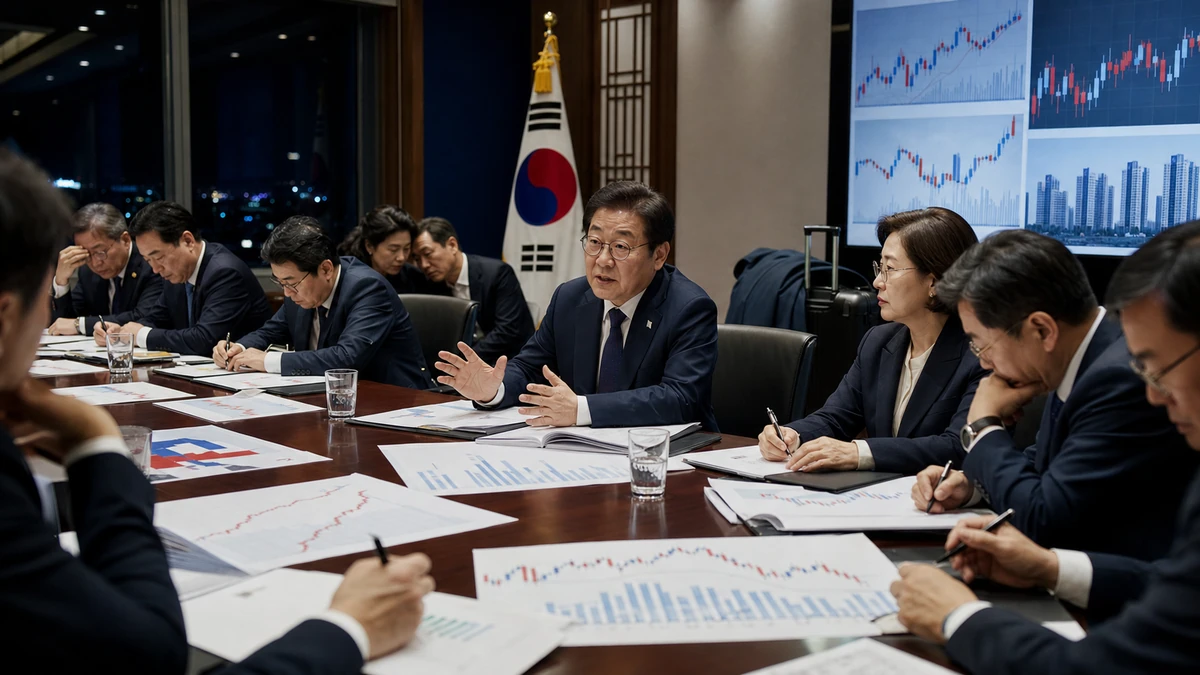
South Korean President Lee Jae-myung landed back in Seoul late in the morning after an 11-day overseas trip that took him through the United States, South America and Germany. Within hours, according to the presidential office and South Korea’s Yonhap News Agency, he was back at work chairing a closed-door meeting on two issues that can make or break public confidence in any modern economy: real estate and the stock market.
The meeting began at 3 p.m. and lasted until 10:30 p.m. — 7 1/2 hours focused on housing and equities, with the prime minister, ministers and working-level officials in attendance. For American readers, the image may be familiar even if the setting is not: a president returning from a globe-spanning diplomatic swing and immediately pivoting to kitchen-table concerns at home. Think of a White House fresh off a NATO summit, then spending the same day in talks about mortgage affordability, retirement accounts and market volatility.
That kind of swift transition matters politically. In South Korea, as in the United States, foreign policy can project leadership, but voters tend to judge governments most sharply on the cost of living, the value of their homes and the health of their savings. By holding a marathon session the day he returned, Lee signaled that his administration wants to show there is no gap between headline-grabbing diplomacy abroad and economic stewardship at home.
What remains unclear is what, exactly, came out of the meeting. The presidential office disclosed the existence of the session, its duration and who attended, but did not release detailed policy conclusions. That leaves analysts and investors with an important political message, but not yet a fully spelled-out policy roadmap. In other words, the symbolism is strong; the specifics are still to come.
Why South Korea’s housing market matters so much
To understand why a South Korean president would devote so much time to real estate, it helps to know just how central housing is to the country’s economic and social life. In the Seoul metropolitan area, home prices have long been a source of public anxiety, political anger and generational frustration. For many younger South Koreans, owning an apartment in or near Seoul can feel as distant as buying a home in Manhattan, San Francisco or parts of greater Los Angeles. Housing is not just shelter; it is a measure of class mobility, family security and future opportunity.
South Korea’s housing market also operates within a social and financial framework that may be unfamiliar to many Americans. The country’s apartment culture is highly developed, with large blocks of high-rise residential complexes dominating urban life. A significant share of household wealth is tied up in property. On top of that, Korea has historically used a mix of taxes, lending rules and supply-side policies to manage overheating in the market. The result is that even technical changes in tax policy can quickly turn into major political debates.
One reason is that housing in South Korea often sits at the center of wider concerns about inequality. When prices rise too quickly, younger people and non-homeowners can feel permanently locked out. When taxes rise on owners, middle-class and older households may argue that the government is punishing people whose wealth exists mostly on paper. This tension is not unlike American fights over property taxes, mortgage rates and zoning, but it plays out in a denser country where the pressure around Seoul is especially intense.
That helps explain why Lee’s meeting was more than a routine briefing. A real estate discussion in South Korea is never only about construction permits or tax schedules. It is also about public anger, political credibility and whether the government can convince people that the rules of the game are fair. The stakes are high because so much personal wealth, and so much political trust, is bound up in the housing market.
Stocks and housing in one room: a sign of broader concern
What stood out in the meeting was not only its length but also its design. Officials reviewed the real estate market and the stock market together, rather than treating them as entirely separate policy tracks. That matters because the two markets function differently. Housing responds to supply, credit conditions, taxes and long-term expectations. Stocks move faster and often react in real time to earnings, global interest-rate shifts, political headlines and investor sentiment.
Still, the two are linked in the way ordinary people experience economic security. For many households in South Korea, as in the United States, property and financial investments together make up the core of family wealth. A government that sees stress building in both areas at once is likely to worry not just about prices, but about confidence. If people feel their homes are unaffordable and their investments are unstable, that can weigh on consumption, political sentiment and trust in leadership.
Bringing ministers and working-level staff into the same meeting also suggested that Lee’s office views the issue as a whole-of-government challenge, not something to leave to a single ministry. That distinction is important in South Korea’s policymaking culture. When the presidential office convenes senior officials across departments, it often means the issue has risen from a bureaucratic concern to a presidential priority. In Washington terms, it is the difference between an agency conference call and a West Wing-led economic coordination session involving multiple departments.
At the same time, caution is warranted. A 7 1/2-hour meeting does not automatically mean dramatic intervention is imminent. Long meetings can reflect complexity as much as urgency. Officials may have reviewed scenarios, debated trade-offs and compared departmental views without settling on immediate action. Since no detailed outcome has been announced, it would be premature to assume that a major package is ready. The key test will be whether the government can eventually explain its thinking in a consistent and credible way to lawmakers, markets and the public.
The tax debate behind the scenes
The timing of Lee’s meeting is particularly notable because it coincided with the government’s announcement of a broader tax revision package framed as a move toward “tax normalization.” Among the proposals are changes tied to real estate taxation, including South Korea’s comprehensive real estate holding tax, a levy that has become one of the most politically charged features of the country’s housing debate.
For Americans, the closest comparison would be a politically explosive mix of property tax reform, capital gains debate and broader questions about whether government should cool asset inflation or protect homeowners from heavier burdens. In South Korea, these disputes are often wrapped in a language of fairness: Are wealthy property owners receiving excessive advantages? Or are tax changes hitting ordinary households whose main asset is their home? Governments of different stripes have answered those questions differently, and voters have often reacted strongly.
Lee’s administration says the proposed changes are meant to restore balance and fairness in taxation by normalizing what it sees as excessive benefits. But the response inside the ruling Democratic Party appears more cautious than triumphant. Lawmakers have signaled that the government’s proposal is only the beginning of a process, not the final word. In practical terms, that means the package must go through parliamentary review, committee scrutiny and wider public debate before any major provisions become law.
That procedural point may sound dry, but it matters enormously for market expectations. In both Seoul and Washington, investors know that a policy announcement from the executive branch is not the same as enacted law. If ruling party lawmakers are sending signals of caution, markets will take that as a sign that the final legislation could be softened, delayed or reshaped. One lawmaker from the ruling party, speaking in terms that capture the political difficulty of real estate policy almost anywhere, suggested there may be no perfect 100-point answer — and that even an 80-point solution would count as a respectable result.
That remark may resonate with American audiences because housing policy rarely offers clean wins. Efforts to cool prices can anger owners. Efforts to protect owners can lock out first-time buyers. Tax reform can be defended as fair in theory and still trigger backlash in practice. South Korea is wrestling with that same balancing act, and Lee’s lengthy review underscores how aware his administration is of the political minefield.
From diplomacy to “bread-and-butter” politics
There is also a deeper political narrative here: the challenge of converting foreign-policy momentum into domestic legitimacy. South Korean presidents often place great emphasis on summit diplomacy, especially with the United States, Europe and key partners in Latin America and Asia. These trips can strengthen alliances, expand trade opportunities and burnish a leader’s international profile. But back home, voters typically want to know what any of that means for their own daily lives.
That is where Lee’s same-day meeting carries symbolic weight. By moving straight from an overseas tour into an hourslong session on markets and housing, he appeared to be making a simple argument: diplomacy abroad and economic stability at home are part of the same job. For American readers, this is a familiar political rhythm. Presidents can earn praise for statesmanship overseas, but if mortgage rates are high, rent is climbing and retirement portfolios feel shaky, domestic approval can erode fast.
In South Korea, the pressure may be even more acute because the political system moves quickly and public opinion can be intensely reactive. The country’s media environment is fast-paced, and economic policy is closely watched by a public with high levels of financial awareness. Home prices, stock performance and policy signals are not niche concerns; they are dinner-table issues. A president who appears detached from those concerns risks looking out of touch, especially after a lengthy foreign trip.
That helps explain why the presidential office publicized not just the meeting, but its duration. Seven and a half hours conveys seriousness. It suggests the president was not simply being briefed in passing, but immersed in the details with senior and working-level officials alike. Whether that translates into effective policy is another matter. Still, in politics, optics can shape expectations, and Lee’s office appears to want the public to see a leader re-centered on domestic concerns the moment he got off the plane.
What comes next for Lee and South Korea’s markets
For now, the most important fact is not that the government has unveiled a sweeping new market rescue plan. It has not — at least not publicly. The clearest takeaway is that Lee has elevated real estate and the stock market as top domestic priorities immediately after his return from a major international trip, and that his government’s tax proposals are entering what is likely to be a contentious legislative and public review process.
The next phase will depend on three things. First, how clearly the administration explains its policy goals. If officials emphasize fairness without clarifying practical effects, they risk fueling uncertainty. If they move too abruptly, they could unsettle markets. If they move too cautiously, they may appear indecisive. Second, the National Assembly will matter. South Korea’s legislature is not a rubber stamp, and tax legislation can become a venue for broad social arguments about wealth, class and generational inequality. Third, market reaction will hinge on predictability. Investors and households can absorb bad news more easily than confusing news; what they dislike most is not knowing where policy is headed.
There is another layer as well. South Korea’s economy is deeply connected to global conditions, including U.S. interest rates, trade flows and investor sentiment. That means no domestic meeting, however long, can fully insulate the country from outside pressures. But what national leaders can do is shape the policy environment at home: how stable it feels, how coherent the message is and whether people believe the government understands the risks they are facing.
In that sense, Lee’s marathon review session may be less about immediate action than about setting tone. It says the administration sees asset markets not as isolated technical matters, but as central to governance and public confidence. For Americans used to watching presidents toggle between global crises and household economics, that instinct will feel familiar. The details, however, are distinctly Korean: a high-pressure housing market centered on Seoul, a politically loaded real estate tax debate and a public that has learned to read economic policy with unusual intensity.
What the world saw on Lee’s overseas trip was South Korea acting as a globally engaged middle power, moving between alliance management, economic diplomacy and international outreach. What the country saw when he got home was something more immediate and more intimate: a president confronting the kinds of anxieties that shape everyday life — the price of a home, the direction of the stock market and the question of whether the government can keep either from slipping beyond control.
That is the real significance of the day. Not that a single closed-door meeting solved South Korea’s housing or market worries, but that the government chose to place those worries at the center of its agenda the moment the diplomatic tour ended. In democracies, foreign travel can elevate a leader. Domestic economics is what usually defines him. Lee’s challenge now is to prove that the urgency implied by a 7 1/2-hour meeting can be turned into policy that is coherent enough for markets, careful enough for lawmakers and credible enough for a public that has heard many promises before.
A familiar dilemma, in a distinctly Korean setting
For readers outside Korea, it is tempting to view the episode simply as another example of technocratic economic management. But it is better understood as a window into how political authority works in South Korea today. The country is a wealthy democracy, highly wired, export-driven and globally connected. Yet it also faces the same tensions haunting many advanced economies: wealth inequality, frustration among younger generations, distrust in institutions and a sense that asset markets often reward those who got in early while locking everyone else out.
That makes South Korea’s debate more relatable to an American audience than it might first appear. The vocabulary may differ. The tax instruments may be different. The urban geography is more compressed, and the social norms around education, family wealth and apartment ownership are distinct. But at the heart of the issue is a question Americans know well: Can a government make markets feel fairer without making them less stable?
Lee’s government has not yet offered a full answer. What it has offered is a signal — one delivered through timing, personnel and endurance. He came home from a major international tour and spent the rest of the day on the politics of asset anxiety. In South Korea, that is not a side issue. It is the main stage.




0 Comments