At KCON Los Angeles, a Quiet Meeting Signals How Deeply K-pop Has Entered the Global Music Mainstream
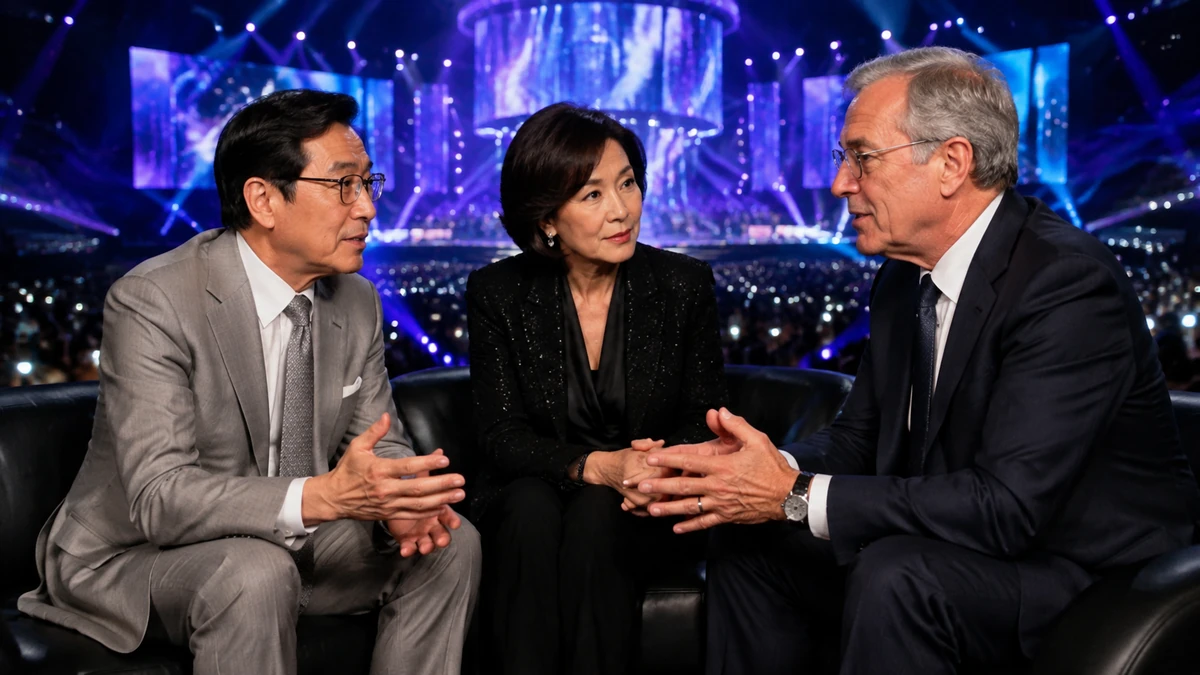
Image to help understand the article
A backstage conversation that says more than a formal deal announcement
Not every consequential moment in the entertainment business comes with a splashy contract signing, a merger filing or a carefully choreographed press conference. Sometimes the more revealing development is simply who shows up, where they meet and what that setting says about the direction of an industry. That is why a recent meeting in Los Angeles between CJ Group Chairman Lee Jae-hyun, CJ Vice Chair Miky Lee and Universal Music Group Chairman and CEO Lucian Grainge has drawn attention far beyond the usual circle of K-pop trade watchers.
According to the Korean account of the meeting, the three executives met at KCON LA 2026 and discussed the global growth of Korean culture and the future of the entertainment industry. No new partnership, investment or distribution agreement was announced. On paper, that can make the meeting sound modest. In practice, it looks like a vivid marker of where K-pop and the broader Korean cultural wave now stand in the global hierarchy of media and music.
CJ ENM, the entertainment arm of the larger CJ conglomerate, has spent decades helping package, produce and export Korean cultural content. Universal Music Group, or UMG, is one of the most powerful companies in the world music business, with a roster and global infrastructure that reach nearly every major market. When the senior leadership of those two spheres meets not in a corporate boardroom but at a fan-centered convention and concert in Los Angeles, it suggests that K-pop is no longer treated as a niche import or a passing youth trend. It is being discussed where live audiences, fandom, content strategy and global business all intersect.
That distinction matters. For years, Western coverage often framed K-pop as an internet phenomenon: highly polished music videos, intense fan communities and eye-catching choreography traveling quickly through YouTube, social media and streaming platforms. But KCON’s significance lies in something larger. It is not just a concert. It is a place where music, beauty, food, fashion, television and fan identity come together under the broader banner of what Koreans call “K-culture,” shorthand for the ecosystem of Korean popular culture that extends beyond songs alone. Meeting there, rather than in a hotel conference suite, underscored that the business of K-pop now depends as much on cultural experience and fan participation as on recorded music sales.
For American readers, the equivalent is not easy to pin down because there is no exact U.S. counterpart. KCON has elements of a music festival, a Comic-Con-style fan convention and an industry showcase, all at once. It offers a reminder that in the K-pop model, the audience is not merely consuming a finished product. Fans are part of the circulation system: they amplify performances, build communities, translate content, set trends and create the social energy that turns a song or artist into a durable transnational brand.
Why the location matters: KCON as a symbol of what K-pop has become
The Korean summary of the meeting puts unusual emphasis on the venue itself, and with good reason. Los Angeles is not just another stop on a global touring circuit. It is one of the most important gateways between the U.S. entertainment industry and Asian media markets. It is home to major labels, film studios, talent agencies, streaming executives and multicultural fan communities. When KCON takes place there, it becomes more than a celebration of Korean pop culture. It becomes a test site for how Korean entertainment travels, lands and evolves in the American market.
That helps explain why the choice of setting carries symbolic weight. K-pop’s globalization cannot be reduced to the idea that a catchy song crosses borders. The genre’s expansion depends on a wider package: performance spectacle, visual identity, artist storytelling, parasocial intimacy, organized fandom and the sense of participation that fans experience both online and in person. A live event like KCON lets executives and creators watch that system functioning in real time. They can see what resonates, how audiences respond, what kinds of experiences travel well and where the next growth opportunities may lie.
In that sense, the meeting between Lee, Miky Lee and Grainge appears to have been less about a single transaction than about taking the measure of a shifting market. The fact that top executives discussed the future of entertainment in a venue built around fan experience is its own statement. It reflects a growing consensus that the business side of global pop cannot be separated from the emotional and communal mechanisms that sustain fandom.
That is one reason KCON has long mattered to CJ ENM. The company has spent more than 30 years building Korean cultural businesses, according to the Korean summary, and KCON functions as one of its most visible international platforms. For a company like CJ, this kind of event is not just a marketing tool. It is infrastructure: a distribution channel for attention, an incubator for loyalty and a showcase for how Korean content can move across sectors. Music leads people in, but many leave with a larger attachment to Korean drama, beauty products, food and style. That cross-pollination is central to the Korean Wave, known in Korean as “Hallyu,” the term used to describe the international spread of South Korean popular culture since the late 1990s.
The takeaway is that K-pop’s rise is increasingly inseparable from the spaces where audiences gather physically. In the streaming era, that may sound counterintuitive. But live events now do more than monetize popularity. They produce visibility, validate cultural relevance and generate the social content that continues circulating after the lights go down. A convention floor, a photo line, a performance clip and a fan reaction video all become part of the same commercial and cultural feedback loop.
From genre to system: what global music companies see in K-culture now
The most important point in the Korean coverage may be what the meeting did not include. There was no announcement of a new joint venture, no acquisition, no artist launch, no direct investment figure. That absence is significant because it forces observers to focus on the broader meaning rather than the easy headline. If executives at this level are taking time to discuss K-pop and K-culture in terms of future growth and industry change, they are acknowledging that Korean content has become a standing topic of strategic interest, not a novelty item.
That marks a real shift in the global music business. For a long time, the international industry treated local-language pop from outside the U.S. and Western Europe as regional, even when it was commercially formidable at home. Latin music was one of the first major categories to break that assumption in the American mainstream over the last decade, with artists such as Bad Bunny, J Balvin and Karol G proving that English-language dominance was not a prerequisite for global scale. K-pop has followed a different path, leaning heavily on group identity, intensive training systems, synchronized performance and unusually organized fandom. But the strategic lesson is similar: local culture can travel globally when the business model around it is sophisticated enough.
That is likely part of what makes Korean entertainment compelling to a company like UMG. The appeal is not only the music. It is the larger industrial model: how intellectual property is developed, how artists are introduced, how fan ecosystems are activated and how one piece of content can lead audiences toward others. For global executives trying to understand the next phase of the music business, K-pop is relevant not just as a chart category but as a case study in how to build highly engaged audiences in a fragmented media environment.
The Korean summary also notes that the conversation ranged beyond K-pop to K-culture and the future of entertainment more broadly. That matters because it points to a truth that American companies have increasingly recognized: today’s strongest entertainment franchises do not live in one format. They spread across music, live events, social media, merchandise, television, film, gaming and commerce. Korean companies have become especially adept at building those connections. Even when they do not dominate every individual market, they often excel at making the whole ecosystem feel coherent.
For U.S. readers, the closest comparison may be the way Disney thinks about intellectual property, or the way major American music companies now try to turn artists into multi-platform brands. The difference is that K-pop industrialized this logic within a fan-driven music culture earlier and more visibly than many of its Western peers. That does not mean the Korean system is universally replicable, or free from criticism. But it does mean global executives increasingly view it as a serious source of insight.
What this means in the United States
For the United States, the meeting is a reminder that Korea is no longer just exporting successful artists into the American market. It is helping reshape how the market thinks about audience development, event strategy and cross-platform cultural branding. That influence is visible in obvious places, such as sold-out arena tours and festival lineups, but also in quieter shifts inside the business itself.
American record labels, promoters and streaming services have spent years trying to understand what makes K-pop fandom so durable. Part of the answer is simple: fans are given more ways to participate. They are not treated as passive listeners waiting for the next release. They are invited into a continuous experience that includes behind-the-scenes content, livestreams, merchandise drops, social media rituals and in-person events. U.S. artists and labels have increasingly borrowed from that playbook, whether by creating more structured fan communities, emphasizing collectible physical releases or treating visual storytelling as central rather than supplementary.
KCON’s Los Angeles presence also shows that the U.S. is not merely a destination market for Korean entertainment. It is one of the key places where Korean cultural products are tested, translated and reinterpreted. That has implications for American companies. Live Nation, AEG, major arenas, streaming platforms, retailers and brand sponsors all have a stake in whether Korean acts and Korean fan events continue drawing large, engaged audiences. Even when no deal is announced, the fact that senior leaders from CJ and UMG are meeting in Los Angeles speaks to the city’s role as a hinge between Korean content production and American commercial infrastructure.
There is also a consumer-side story here. Korean entertainment’s U.S. audience is no longer confined to Korean Americans or Asian American early adopters, though those communities were essential in building the foundation. K-pop and the broader Korean Wave now reach a much wider demographic, including younger Americans who move fluidly between English- and non-English-language content on TikTok, YouTube, Netflix and Spotify. For that generation, the old distinction between “domestic” and “foreign” pop culture often matters less than whether something feels emotionally immediate, visually compelling and socially shareable.
That helps explain why an event like KCON can matter in the United States beyond any one weekend’s ticket sales. It shows American media and music companies that fandom itself has become a strategic asset. In an era when streaming has made music abundant and attention scarce, the industries that win are often the ones that create the deepest sense of belonging. K-pop has been unusually effective at that, and U.S. companies are clearly paying attention.
It also matters for U.S.-South Korea relations more broadly, though not in a formal diplomatic sense. Cultural influence has become one of South Korea’s most visible forms of soft power, the kind of national presence that shapes foreign perceptions without requiring government messaging. When American audiences attend KCON, stream Korean artists or watch Korean dramas, they are participating in a relationship that reaches beyond trade agreements and military alliances. They are building familiarity with a country that has become one of America’s most significant partners in technology, security and culture. That does not erase differences in business practices or cultural expectations, but it does deepen the everyday relationship between the two societies.
Fans are not the audience anymore. They are part of the infrastructure.
One of the sharpest observations in the Korean summary is that fans are not peripheral to K-pop’s global expansion; they are near its center. That idea can sound flattering, but it is also economically precise. The business conversation at KCON carried weight because it unfolded in front of a living demonstration of fan power. The crowds, the reactions, the online spillover and the multilingual sharing all help prove that K-pop’s reach is not sustained by executives alone.
This is one of the most important distinctions between K-pop and older models of international pop export. In the traditional framework, a song might break in a foreign market through radio, television or a big label push. Fans appeared at the end of the process as consumers. In the K-pop framework, fans often help propel the process from the beginning. They organize streaming campaigns, subtitle interviews, introduce artists to new audiences and keep attention alive between official promotional cycles. They are not replacing corporate power, but they are amplifying it in ways that global companies can neither ignore nor fully control.
That is one reason the site of the meeting matters so much. A boardroom would have signaled top-down strategy. KCON suggests a more complicated truth: strategy in global entertainment now has to respond to communities that are visible, measurable and culturally productive in their own right. The event floor is not just a backdrop. It is evidence.
American readers may recognize a parallel in the way fandom operates around major franchises like Taylor Swift, Marvel or certain esports leagues, where the community around the product becomes part of the product’s value. But K-pop makes that relationship especially explicit. The fan experience is not the last stop in the chain. It is the engine that sends content back into circulation, giving it longevity far beyond a release week spike.
That dynamic may be why a conversation without a concrete announcement still attracted notice. The absence of a deal does not mean the meeting lacked substance. If anything, it suggests that the central question was larger: how do global music and content companies build the next stage of growth in a world where culture travels through deeply networked fan communities rather than only through traditional gatekeepers?
What to watch next in the U.S.-Korea entertainment relationship
The most responsible reading of the meeting is also the most restrained one. There is no public basis yet to conclude that CJ and UMG are preparing a specific partnership from this conversation alone. The Korean summary explicitly says no concrete collaboration, contract or investment plan was announced. That means the significance lies in signaling, not in any confirmed transaction.
Still, symbolic moments can be revealing when they happen at the right time. Korean entertainment has reached a stage where the next question is no longer whether it can attract global attention. It can. The real question is how that attention is converted into long-term, cross-market staying power. For companies on both sides of the Pacific, that likely means deeper thinking about distribution, touring, fan engagement, artist development and cultural translation.
American observers should watch for several things. One is whether more global music executives begin treating fan conventions and cultural festivals as strategic hubs rather than peripheral promotional events. Another is whether U.S. companies continue adapting pieces of the K-pop playbook, especially around collectible releases, fan communication and event-driven branding. A third is whether Korean entertainment firms broaden their reach in America not only through superstar acts but through mid-tier artists, lifestyle experiences and adjacent categories such as television, beauty and consumer products.
There is also a broader trend line worth noting. Entertainment industries around the world are looking for growth models that can survive an era of platform volatility, algorithm shifts and audience fragmentation. K-pop’s answer has been to build unusually strong bridges between music, identity and participation. That does not solve every challenge. But it does offer a model of resilience that larger global companies clearly want to study.
Seen in that light, the Los Angeles meeting was not a minor celebrity-business footnote. It was a snapshot of an industry adjusting to a world in which Korean cultural production is no longer an outsider looking for Western validation. It is a central player helping shape the conversation about where global entertainment goes next.
For American audiences, that is the real story. The rise of K-pop is no longer just about whether a Korean act can crack the Billboard charts or sell out a U.S. arena. It is about how Korean entertainment has become part of the way the American industry thinks about fandom, globalization and cultural scale. If a gathering at KCON in Los Angeles showed anything, it is that the future of music is increasingly being negotiated not only in executive offices, but also in the spaces where fans gather and prove what kind of culture can endure.
Comments
Post a Comment