Bonchon’s Next Owner Is Thai: What the Sale of a Korean Fried Chicken Chain Says About the Global Korean Wave
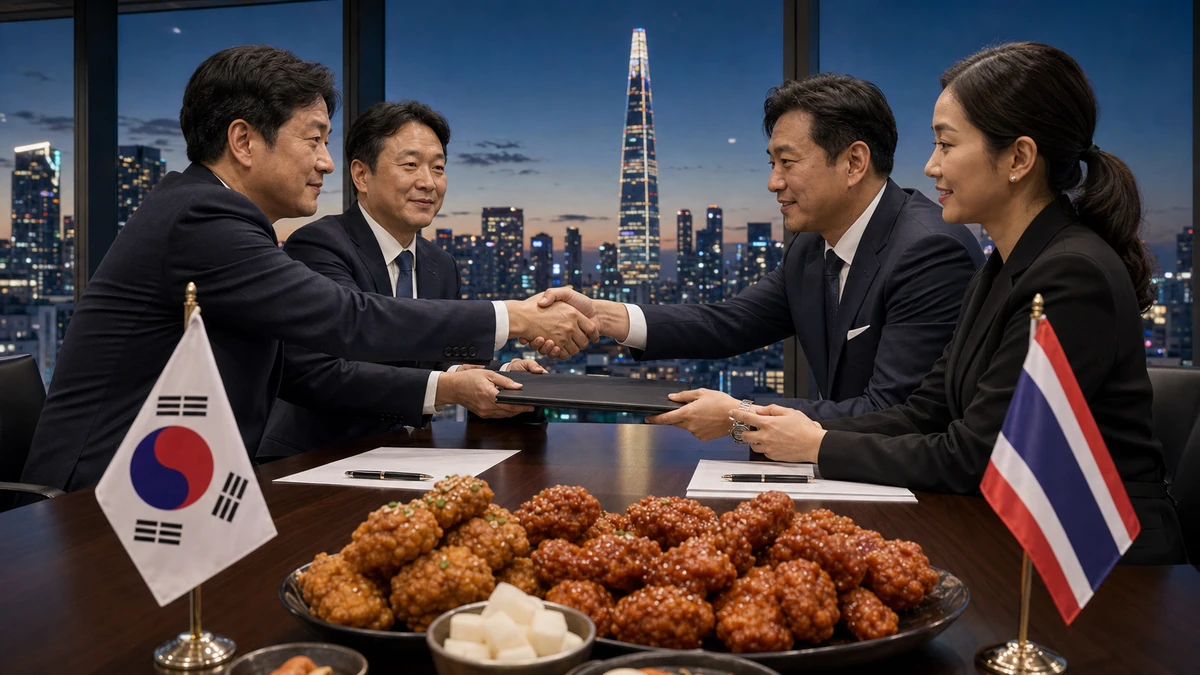
Image to help understand the article
A Korean fried chicken brand changes hands
Bonchon, the Korean fried chicken chain that helped introduce a broader swath of American diners to the crackly, double-fried style popular in South Korea, is set to be sold in full to Thailand-based Minor Group, according to South Korean investment banking industry reports cited by Yonhap News, the country’s national wire service.
The seller is VIG Partners, a South Korean private equity firm that bought a 55% stake in Bonchon International in 2018 and spent the past eight years helping expand the brand’s footprint. The remaining 45%, held by founder Seo Jin-deok’s side, is also included in the deal, meaning Minor Group is poised to take full ownership and management control if the transaction closes as expected later this month.
The purchase price was not disclosed, and without it there is no clean way to calculate VIG’s final return. But even absent that headline number, the deal matters for what it signals: A Korean restaurant brand that was nurtured by Korean capital, scaled across multiple countries and especially in the United States, has become attractive enough for a major foreign strategic buyer to acquire outright.
For American readers, this is more than a routine mergers-and-acquisitions story. It is another marker of how the Korean Wave — often called “Hallyu,” the term used for the global spread of Korean pop culture — has evolved beyond K-pop, K-dramas and beauty products into something more durable and everyday: the food business. Korean culture in the United States is no longer just streaming on Netflix or topping the Billboard charts. It is showing up in strip malls, urban retail corridors, sports-arena food courts and suburban takeout orders.
Bonchon sits squarely inside that shift. To many U.S. diners, it is one of the names most associated with Korean fried chicken, a category that has grown from niche ethnic dining to mainstream interest. Its sale to a Thai conglomerate underscores how Asian consumer brands are increasingly being built, financed and traded across borders in ways that would have been far less common a generation ago.
How private equity helped scale Bonchon
VIG Partners invested about 60 billion won — roughly the equivalent of tens of millions of dollars, depending on exchange rates — to acquire its 55% stake in Bonchon International in 2018. In private equity terms, the basic playbook is familiar to American business readers: buy into a company, professionalize and expand it, and eventually exit through a sale or another transaction once the business has gained value.
But the Bonchon case is notable because it was not a quick flip. VIG held the company for about eight years, a relatively long stretch that suggests the firm was betting not only on operational improvements but also on the long arc of global consumer demand for Korean food. During that period, it reportedly recouped some of its original investment through dividends and capital restructuring, while continuing to hold the stake until a full sale became possible.
The most visible measure of that growth is store count. When VIG acquired its stake, Bonchon had about 325 locations globally. That number has since grown to around 500. In the United States, the chain expanded from 85 stores to more than 150, according to the Korean report. In other words, the company added roughly 175 stores worldwide, including at least 65 in the U.S. market alone.
That kind of expansion in the restaurant industry is not just a matter of signing leases. Franchising at scale requires repeatable operations, supply chain discipline, reliable franchise partners, brand consistency and quality control. It also requires the ability to translate a food concept across regional tastes without losing the core identity that made it distinctive in the first place. Bonchon’s growth suggests it managed to clear enough of those hurdles to become a globally legible brand rather than a one-country novelty.
There is also a broader investment story here. South Korea is often viewed in American business coverage through the lens of its major manufacturers and technology giants — Samsung, Hyundai, LG, SK and the like. But this transaction points to another dimension of Korean economic power: the ability not just to export products, but to build consumer-facing brands in lifestyle categories and make them attractive acquisition targets on the international stage.
Why Bonchon matters in America
For many Americans, fried chicken needs little explanation. It is one of the country’s most contested comfort foods, with deep roots in the South, generations of Black culinary innovation, and endless regional loyalties extending from independent neighborhood spots to national chains like KFC, Popeyes, Wingstop and Raising Cane’s. That is exactly why Bonchon’s U.S. rise is significant. It entered one of the most competitive food categories in America and still found room to grow.
Korean fried chicken differs from the American versions many diners grew up with, though the lines have blurred as the style has spread. The Korean version is often double-fried for an especially thin, shattering crust, then coated in sauces that skew sweet, spicy, garlicky or soy-forward. It is typically eaten as a shareable meal with beer — a pairing so common in South Korea that it has its own shorthand, “chimaek,” a blend of the Korean words for chicken and beer.
That social context matters. In South Korea, fried chicken is not just fast food; it is also late-night food, delivery food, game-day food and group food. It occupies a place that may feel familiar to Americans who associate pizza or wings with hanging out, watching sports or ordering in with friends. Bonchon helped package that sensibility in a form that could travel internationally.
Its U.S. expansion also coincided with a time when Korean culture became increasingly visible in mainstream American life. BTS and Blackpink helped normalize Korean-language pop on U.S. charts. “Parasite” won the Academy Award for best picture. “Squid Game” became a cultural phenomenon. Korean skincare moved into big-box retail. Korean grocery chains expanded in metropolitan areas. And Korean flavors — gochujang, kimchi, bulgogi — became familiar enough that even major American fast-casual brands began using them in limited-time menus and fusion offerings.
Bonchon benefited from that cultural tailwind, but it also helped create it. Long before many Americans could explain what Hallyu meant, chains like Bonchon were giving them a low-friction entry point into Korean cuisine. A diner might come for wings and leave having learned, perhaps for the first time, that Korean food in the American market is not limited to barbecue grills built into restaurant tables.
The chain’s more than 150 U.S. locations matter because they suggest Korean food has moved beyond a trial phase. This is not a story about a handful of flagship stores in Los Angeles, New York or Koreatown districts alone. It is about national scalability. Once a brand reaches that size, it stops being simply an immigrant-community success story and starts becoming part of the broader American restaurant landscape.
Who is Minor Group, and why this buyer stands out
The buyer, Minor Group, is based in Thailand and is known across Asia as a major hospitality and consumer company with interests spanning hotels, restaurants and lifestyle businesses. While the Korean summary did not lay out Minor Group’s detailed plans for Bonchon after the acquisition, the identity of the buyer is important in itself. This is not another financial investor cycling through an asset. It is a strategic buyer — a company that likely sees Bonchon as part of a longer-term operating business.
That distinction matters. A private equity owner and a strategic owner typically look at a business through different lenses. A financial sponsor may focus on operational efficiency, expansion metrics, franchising discipline and eventual exit value. A strategic owner may still care about all those things, but it also tends to evaluate whether the acquired brand can fit into a larger ecosystem — whether by geography, supply chain, customer demographics or restaurant portfolio strategy.
For Bonchon, that could mean a new stage of expansion under an owner with deep regional knowledge in Asia and broad experience operating consumer-facing businesses internationally. It could also mean fresh resources for entering new markets or strengthening existing ones. None of that is guaranteed, and no public operating roadmap has been disclosed. But full ownership gives Minor Group the latitude to shape Bonchon’s next phase without the complexity of split control.
There is a bigger geopolitical business angle here, too. In the United States, stories about international consumer deals often center on American or European acquirers. This transaction is a reminder that capital flows within Asia are becoming just as consequential. A Korean-founded brand scaled by Korean private equity and sold to a Thai conglomerate is a strong example of how Asian corporate networks now operate on a regional and global level, not simply in relation to Western markets.
For American readers used to seeing Asia discussed as a collection of separate national stories, that is worth emphasizing. The business of the Korean Wave is no longer just about Korea exporting culture outward. It is also about other Asian companies recognizing the commercial value of Korean-origin brands and moving to own, operate and expand them.
The founder’s exit and what full control means
Another important piece of the transaction is that founder Seo Jin-deok’s side is selling its 45% stake along with VIG’s 55%. That makes this an all-in sale rather than a partial secondary transaction. In practical terms, it means Bonchon is not simply getting a new major shareholder while old stakeholders remain influential in the background. It is set for a full transfer of ownership and management control.
That kind of clean handoff can matter in franchise businesses, where clarity of authority is crucial. Franchisees want to know who sets strategy, who controls standards and who will be making decisions about expansion, marketing, menu direction and corporate support. A complete transaction can reduce ambiguity, even if it also raises new questions about how a brand’s identity will be managed under foreign ownership.
Those questions are not trivial. Consumers often care, at least symbolically, about whether a Korean brand remains “Korean” once it is owned by a non-Korean company. But in the restaurant world, ownership and identity do not always move in lockstep. A brand’s cultural legitimacy is shaped by many things: menu consistency, storytelling, design, sourcing, customer experience and whether it continues to present itself with fidelity to the culinary tradition it claims to represent.
That issue is especially sensitive with Korean food because its global spread is intertwined with national image. South Korea has spent decades building soft power, the ability to influence the world through culture rather than coercion. Food has become one of the most tangible parts of that strategy, even when the growth has been driven by private businesses rather than the state. When a Korean food brand succeeds abroad, it often functions as both a commercial enterprise and a kind of informal cultural ambassador.
Still, global restaurant history offers plenty of examples of brands changing owners without losing their core identity. American consumers rarely track the ownership structures behind the chains they frequent unless something visibly changes in quality or concept. If Bonchon continues to deliver the crisp texture, signature sauces and branded experience that customers expect, many diners may not notice the difference. Industry observers, however, will be watching closely to see whether the chain’s positioning shifts under its new parent company.
What this says about Korean brands and the next stage of Hallyu
The most important takeaway from the Bonchon sale may be what it reveals about the maturity of Korean global brands. For years, much of the conversation about South Korea’s international cultural influence focused on visibility: Was Korean entertainment breaking through? Could Korean products find audiences abroad? Would non-Korean consumers embrace Korean flavors, fashion and storytelling?
At this point, those questions are no longer the right ones. The better question is what happens after breakout success. Can Korean brands scale? Can they standardize across countries? Can they generate enough predictable value to become targets in global M&A markets? Bonchon suggests the answer is yes.
The chain’s growth from roughly 325 global stores to around 500, including a meaningful U.S. buildout, gave potential buyers something concrete to evaluate. Store counts are not the only measure of health, but in franchising they are one of the clearest visible signals that a concept has moved beyond promise to execution. Without disclosed earnings or valuation multiples, those network numbers become the most accessible evidence of business traction.
This is also a sign that Korean consumer influence is diversifying beyond categories where South Korea is already widely associated with excellence, such as electronics, automobiles and entertainment. A fried chicken chain may sound less glamorous than an Oscar-winning film or a globally dominant smartphone maker. But in some ways it is a stronger test of durable everyday adoption. A hit show can go viral. A restaurant chain has to survive rent, labor, supply costs, local competition and fickle consumer habits week after week.
That may be why Bonchon’s trajectory is so instructive. It shows how Korean cultural exports can mature into operational businesses with real infrastructure. It also suggests that Korean capital is learning not just how to create buzz, but how to build enterprise value in categories that can be scaled, sold and re-expanded under new ownership.
For American audiences, there is a familiar analogy here. In earlier eras, Japanese consumer culture moved from novelty to ubiquity in the United States through food, retail, cars and electronics. More recently, Mexican food, once treated by many national chains as a narrow category, became so embedded in American eating habits that it supports everything from local taquerias to publicly traded giants. Korean food is not following the same path exactly, but it is undergoing a similar transition from trend to institution.
What comes next
The transaction is not final until it closes, and the Korean report notes that the parties are aiming to complete follow-up procedures by the end of this month. Until then, it is worth keeping the distinction clear between a signed stock purchase agreement and a fully closed deal. Regulatory reviews, contractual conditions and final administrative steps can still shape timing.
Assuming the acquisition is completed as planned, the next questions will be straightforward but consequential. Will Minor Group accelerate Bonchon’s growth in the United States, where Korean food still has room to expand beyond major coastal markets? Will it prioritize Southeast Asia, where Korean cultural influence is already strong and restaurant growth dynamics may differ sharply from the U.S.? Will the menu or brand positioning change? And will Bonchon remain primarily a Korean fried chicken specialist, or evolve into a broader Korean quick-service or casual dining platform?
For now, the known facts are enough to make this a significant story. A Korean private equity firm invested in Bonchon eight years ago, helped oversee substantial global and American expansion, and has now agreed to sell the company in full — alongside the founder’s stake — to a Thai strategic buyer. The price remains private, but the operational arc is clear.
That arc tells us something important about where Korean business stands today. South Korea is not only exporting culture; it is also creating branded consumer companies that can travel, scale and command interest from major international buyers. Bonchon’s sale is not just about chicken. It is about the globalization of Korean taste, the professionalization of Korean consumer brands, and the increasingly interconnected way Asian companies are reshaping the global marketplace — one familiar, highly competitive, deeply local meal at a time.
Comments
Post a Comment