
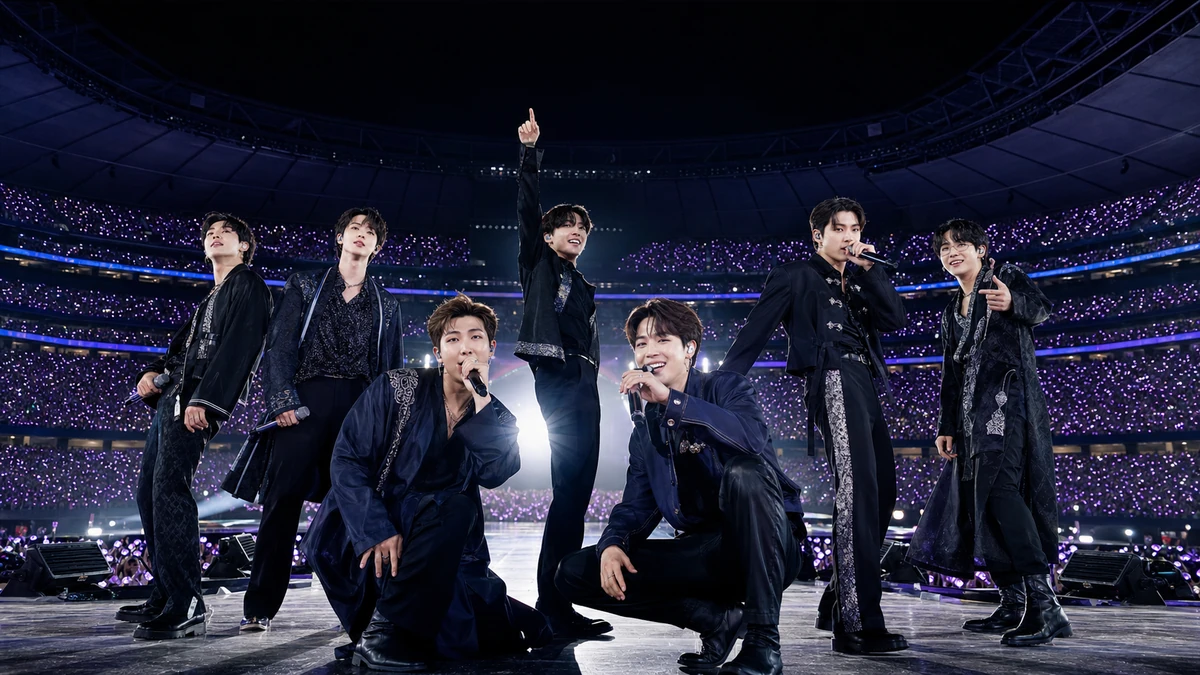
Image to help understand the article
BTS’ latest tour numbers are not just impressive. They mark a shift in the global concert business.
BTS generated $102.5 million in ticket revenue in July alone from eight shows on its new world tour, “ARIRANG,” according to Billboard’s monthly tour rankings cited in Korean media reports. That put the group at No. 2 on Billboard’s monthly Top Tours chart, behind The Weeknd, who posted $124.4 million over the same period. On paper, that may look like a close but ordinary race between two major global acts. In practice, the comparison says something bigger: BTS came close to matching the month’s top-grossing artist while playing only half as many shows.
That is the kind of result that gets attention far beyond fandom circles. In the live music business, raw gross matters, but so does efficiency. Filling stadiums across multiple countries is hard enough. Doing it consistently, with fewer dates and revenue concentrated into a smaller number of events, suggests an act with unusually strong ticket demand. In plain English, BTS is not just popular; it is operating at the level where each individual stadium date becomes a major economic event.
The Korean summary of the Billboard data also says the “ARIRANG” tour has now reached about 600 billion won in cumulative revenue, or roughly the equivalent of several hundred million U.S. dollars depending on exchange rates. The exact dollar conversion can vary, but the broader point does not: this is the biggest tour revenue record of BTS’ career, and it places the group firmly in the top tier of the global touring market.
For American readers, the easiest comparison is this: BTS is no longer a phenomenon that needs to be explained mainly through YouTube views, social media trends or fan enthusiasm online. The more meaningful measure now is the same one used for Beyoncé, Taylor Swift, Bad Bunny, The Weeknd or Bruce Springsteen: how many people show up in person, in how many cities, at what price level, and with what consistency. On that score, BTS is not chasing legitimacy. It already has it.
What makes the July numbers especially noteworthy is that they support a broader trend in pop music rather than a one-off headline. The center of gravity for global superstardom has been moving toward touring for years, as recorded music revenue alone became less decisive in measuring cultural power. The artists who can turn global attention into stadium attendance are the ones defining the market. BTS’ latest run suggests K-pop’s biggest act is not simply participating in that system. It is helping redraw it.
Why eight shows matter almost as much as $102.5 million
The most revealing number in this story may not be the revenue total but the show count. Billboard’s chart put BTS at No. 2 for the month behind The Weeknd, but The Weeknd reached his total over 16 performances while BTS did it in eight. In other words, BTS generated nearly the same monthly gross in half the number of dates.
That distinction matters because the live-event business is built on more than celebrity. It depends on logistics, pricing power, venue scale, repeat demand and the ability to turn a stop in one city into a must-see event rather than just another date on a long itinerary. A highly efficient tour does not simply sell a lot of tickets. It sustains premium demand at a scale that allows fewer events to produce blockbuster results.
For years, K-pop coverage outside Korea often focused on export symbolism: a Korean act breaking into U.S. charts, drawing a viral audience or winning awards in markets once dominated by English-language music. Those milestones mattered, but they could also flatten the conversation, making every accomplishment seem like a novelty. What this new BTS figure underscores is something more concrete and mature. The story is not that a Korean act did unexpectedly well overseas. The story is that one of the world’s largest touring acts generated elite-level revenue with extraordinary efficiency.
That has implications for how the broader industry evaluates global demand. A stadium can be booked. It cannot be willed into being full. Unlike streaming, where repeated plays can blur the picture, live touring is brutally specific. Fans must commit time, travel and money. They must buy seats in a particular city on a particular night. And they must keep doing that as the tour moves from country to country. The fact that BTS’ July performance held up across multiple cities suggests durable, geographically broad demand rather than a fan surge concentrated in one market.
For analysts and promoters, that is the kind of data point that changes assumptions. It means BTS belongs in the same revenue conversations as the highest-grossing touring artists in the Western pop and R&B world, not in a separate “international” or “K-pop” category. The business case stands on its own.
The Europe box office results show this was not one lucky weekend
Another important detail from the Korean report is that every BTS concert held in July landed in Billboard’s Top Boxscore top 10. That chart tracks the performance of individual shows rather than a monthly aggregate, making it a useful test of consistency. If one or two giant nights had carried the month, that would still be impressive. But it would tell a different story. What the box-office rankings suggest instead is a tour that delivered comparable strength across multiple venues and countries.
According to the report, BTS’ show at Stade de France in Paris ranked No. 3 on Billboard’s Top Boxscore list, while concerts at Tottenham Hotspur Stadium in London, Allianz Arena in Munich and King Baudouin Stadium in Brussels placed between No. 5 and No. 7. Those are not minor arenas or peripheral stops. They are marquee stadium locations in some of Europe’s largest and most competitive live-entertainment markets.
That matters because Europe has sometimes occupied an awkward place in global pop narratives. For American audiences, the U.S. market still functions as the main benchmark, while Asia is often treated as K-pop’s natural home base. Europe can get discussed as secondary terrain, important but not always central. Yet from a touring standpoint, Europe is one of the clearest tests of whether an act’s demand is truly multinational. Success there requires a fan base distributed across languages, transport systems, local promoters and different price sensitivities.
In that sense, the July box-office performance says something fundamental about BTS’ reach. This was not a case of one symbolic overseas breakthrough. It was a demonstration that the group can sustain top-tier stadium business across several European capitals and major cities at once. That kind of spread is what separates a global tour from a series of international appearances.
There is also a cultural point embedded in those numbers. For much of the last decade, K-pop’s international rise was frequently described through digital metrics because they were the easiest to compare across borders. Views, streams and social media engagement helped tell the story. But the “ARIRANG” results reflect a different stage in that evolution: physical attendance at scale. A streaming hit shows interest. A sold-out or high-performing stadium date shows commitment. When every July show lands in the upper tier of Billboard’s box-office rankings, the case for BTS as a live-market powerhouse becomes difficult to dismiss as fandom hype.
What “ARIRANG” says about K-pop’s current phase
The tour’s title carries Korean cultural resonance that many American readers may not immediately recognize. “Arirang” is widely regarded as one of Korea’s most iconic folk songs, more a shared cultural touchstone than a single pop reference. It has long been associated with Korean identity, emotion and national memory, and it is often invoked in contexts that connect modern Korea to deeper historical feeling. Using “ARIRANG” as a tour title does not, by itself, tell us everything about the production or set list, and it should not be overinterpreted without more detail. But it does suggest an act comfortable presenting itself not only as a global pop machine, but as a Korean cultural force with enough reach to bring a distinctly Korean symbol into the center of an international stadium tour.
That matters because K-pop’s global rise has entered a more complicated stage. The first phase was about visibility: Could Korean acts break into markets long dominated by American and British music? The second phase was about proof of concept: Could that attention hold long enough to generate reliable sales, touring and mainstream recognition? BTS’ latest results suggest the next phase is about normalization at the top end. The question is no longer whether K-pop can compete globally. It is how often, how profitably and at what scale it can do so against the biggest names in the business.
The Korean report explicitly frames the “ARIRANG” numbers as evidence that K-pop touring should now be judged by a different standard. That reading makes sense. For years, headlines about overseas K-pop concerts often emphasized the fact of expansion itself: a first date in a certain city, a new country added to an itinerary, a major festival booking. Those milestones were important in an emerging market. But mature touring businesses are judged less by novelty than by repeatable performance. Can the act return and still fill the building? Can it move across regions and keep the numbers up? Can it translate online passion into real-world purchasing power month after month?
By that standard, BTS’ July appears significant because it combines three kinds of evidence at once: high total revenue, strong per-show efficiency and a broad geographic spread across Europe. Add the reported cumulative tour gross of about 600 billion won, and the takeaway is not simply that BTS remains famous. It is that the group has become a case study in what a fully scaled K-pop live enterprise looks like in the 2020s.
That may influence how other Korean agencies, promoters and artists think about the next stage of global expansion. It is one thing to dream of global touring. It is another to build a model sturdy enough to compete with the most established Western touring acts on revenue charts that do not care where the music comes from.
What this means for the United States
For the United States, the significance of BTS’ July performance goes well beyond a successful overseas run. It is a reminder that the American music business now operates inside a global fan economy in which Korean acts are no longer niche imports. They are market-shaping players.
That matters first at the consumer level. American fans helped establish BTS as a major force years ago, but the group’s current touring scale reinforces the point that K-pop audiences in the U.S. are not a passing wave. They are part of a durable demand base that buys albums, merchandise, premium tickets and travel experiences. In the U.S. concert business, where live events have become one of the industry’s most important revenue engines, that level of loyalty is exactly what promoters and venues covet.
It also matters for American companies. U.S. ticketing platforms, promoters, sponsors, media partners and merchandising firms all have a stake in how global acts perform. When BTS posts numbers that place it alongside artists like Beyoncé and Bad Bunny in rarefied touring territory, it strengthens the commercial argument for treating K-pop not as a specialized international genre but as a major category of live entertainment. That can influence everything from venue strategy to brand partnerships to how aggressively American companies pursue Korean talent and Korean entertainment partnerships more broadly.
There is a diplomatic and cultural dimension, too. South Korea’s global cultural influence, often called the “Korean Wave” or “Hallyu,” has become one of the country’s most effective soft-power assets. In Washington, U.S.-South Korea ties are usually discussed through the lens of security, semiconductors, defense cooperation and North Korea. Those issues remain central. But culture has become part of the relationship in a more practical sense than it once was. Korean music, television, film, beauty products and food now shape everyday American consumer life in visible ways. BTS’ ability to command stadium-level economics on the world stage reinforces South Korea’s cultural presence as not just symbolic but commercially consequential.
For American readers, there is a familiar parallel here. U.S. audiences are used to thinking of Hollywood, Broadway, Nashville and major American pop tours as export industries that also project national image. South Korea now does something similar through K-pop and screen entertainment, often with a speed and digital fluency that American companies admire and sometimes scramble to match. BTS’ latest tour numbers are one more indicator that this is no longer a side story in the U.S.-Korea relationship. It is part of the mainstream cultural and business landscape.
There is also a competitive lesson for the U.S. industry. American artists still dominate much of the global live market, but the field is more international than it used to be. If BTS can produce these results in Europe and across multiple months, then American executives, promoters and artists need to think in broader terms about audience behavior, multilingual fandoms and the ways community-driven pop cultures translate into ticket sales. The lesson is not that American acts are losing ground. It is that the definition of a global top-tier act has widened, and the U.S. market is now one arena within that bigger system, not the sole gatekeeper it once was.
Why the comparison to Beyoncé and Bad Bunny matters
Billboard, as cited in the Korean report, said BTS became only the third artist ever to top $100 million in monthly tour revenue across multiple months, joining Beyoncé and Bad Bunny. Even without overstating the comparison, that is a striking category to enter. Those are not just stars; they are defining live-business benchmarks of the era.
The significance lies partly in what those artists represent. Beyoncé stands for premium, eventized pop spectacle at the highest level. Bad Bunny represents the transformation of Spanish-language music from crossover story to center-of-market force. If BTS belongs in that same statistical neighborhood, it suggests K-pop has completed a similar transition. It is no longer best understood as a genre trying to cross over into the Western mainstream. At its highest level, it is part of the mainstream global market already.
For American audiences, this matters because U.S. music culture has historically tended to treat English-language dominance as the default setting of global pop. That assumption has been weakening for years. Latin music helped accelerate the change. Afrobeats has also expanded international expectations. K-pop, led in large part by BTS, is now part of that broader realignment. The center of pop is less singular, more multilingual and more distributed than it was a generation ago.
Monthly tour grosses over $100 million are hard to reach precisely because they require more than celebrity headlines. They demand repeatable demand from city to city, a fan base willing to spend, and a production model that can sustain interest over time. The Korean article notes that BTS has crossed that benchmark over multiple months, not just once. That adds the most important word in the live-music business: consistency.
Consistency is what turns an eye-popping result into a durable market position. Anyone can have a big night. Only a handful of acts can keep doing it while moving across countries and sustaining premium scale. That is the company BTS is now being measured against, and it is why this story deserves to be read as more than a celebratory update for fans.
What to watch next in the global touring business
If there is a larger takeaway from the “ARIRANG” performance, it is that global touring may be entering a period in which the most powerful acts are defined less by genre or home country than by their ability to organize transnational fandom into repeat stadium demand. That sounds technical, but the implications are straightforward. The most valuable artists in the next phase of the music business may be those who can convert digital intimacy into large-scale physical gathering, across borders and over long stretches of time.
BTS appears to be doing exactly that. The July figures point not only to massive demand but to demand that is stable enough to travel. That is a crucial distinction. Plenty of acts generate intense attention in one market. Fewer can replicate it in Paris, London, Munich and Brussels in the same reporting window and land every show in Billboard’s top 10 box-office ranking.
For K-pop as an industry, the next question is whether more acts can follow this model, even if not at BTS’ scale. For American companies, the question is how to position themselves around that growth, whether through touring partnerships, distribution, sponsorships or broader investments in Korean entertainment. For fans, the question is simpler: whether this level of international demand means future tours become even bigger, pricier and more competitive to attend.
The Korean report argues that “ARIRANG” shows K-pop has moved beyond the stage of generating buzz from the margins of the global concert market. That is persuasive. When a Korean group can be compared directly with Beyoncé, Bad Bunny and The Weeknd on the same revenue charts, the old language of novelty starts to break down. The better framework is market power.
In that sense, BTS’ $102.5 million July is not just a blockbuster month. It is evidence of a larger cultural and commercial shift. Korean pop’s biggest act is no longer merely proving that it belongs on the world stage. It is helping define what the world stage looks like now.


0 Comments