Disney Didn’t Expect Korean Shows to Travel This Far. Brazil’s Response Signals a New Phase for Global Streaming.
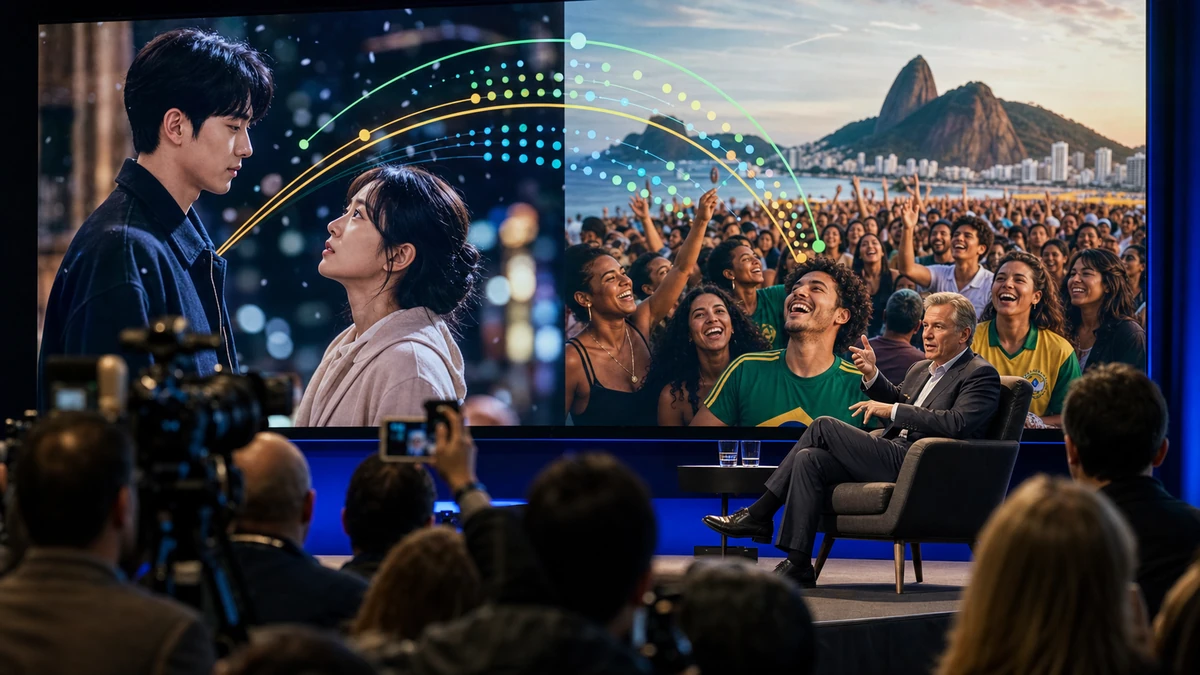
Image to help understand the article
A surprise in Anaheim says a lot about where global entertainment is headed
For years, the rise of Korean popular culture has often been told through familiar milestones: K-pop stadium tours, Oscar wins for “Parasite,” the worldwide shock wave of Netflix’s “Squid Game,” and the way Korean beauty, food and fashion have become recognizable far beyond Seoul. But a recent comment from a top Disney executive suggests the next chapter of that story may be less about headline-grabbing breakthrough moments and more about something subtler and, in business terms, more consequential: Korean content is no longer just traveling to the places global media companies expected it to reach.
Speaking at a Disney+ international content strategy session in Anaheim, California, Eric Schrier, president of direct-to-consumer international originals, strategy programming and emerging media at The Walt Disney Co., said Korean content has been finding an audience not only in South Korea and the broader Asia-Pacific region, but in Brazil as well. What stood out was not simply the claim that Korean programming is doing well abroad. It was that Disney said even it did not foresee this level of response in Brazil and is now studying why it happened.
That may sound like an ordinary executive comment, but in the streaming business it is not. Entertainment companies are constantly trying to predict what will work, where it will work and why. If a platform the size of Disney+ is publicly acknowledging that a Korean title’s appeal in a distant, non-Korean-speaking market exceeded its expectations, that is a sign the old assumptions about how stories cross borders are breaking down.
Brazil matters here for obvious reasons. It is a major media market with its own strong television traditions, a different language from Korean, and cultural reference points that do not map neatly onto East Asia. This is not a case of a Korean show finding viewers in a neighboring country with similar habits or long-established cultural overlap. Disney’s point, as described in the Korean report, is that the reaction itself has become something worth analyzing. In other words, Korean content is no longer just succeeding abroad. It is doing so in ways big platforms did not fully model in advance.
That is an important distinction. The global success of Korean entertainment has often been framed as a wave, or in Korean, “Hallyu,” a term used to describe the international spread of South Korean culture. Waves imply momentum, but they can also imply impermanence. What Disney is describing sounds more structural. If executives are treating Korean content not as an isolated phenomenon but as a test case for how deeply local stories can scale globally, then the implications go well beyond one country’s entertainment exports.
The old globalization formula is giving way to something more specific
For decades, much of the conventional wisdom in international entertainment was that the surest path to global appeal was to smooth out cultural particularities. The thinking went like this: the less local a story feels, the easier it is for everyone to watch. Settings should be broadly familiar, emotional cues should be easy to decode across cultures, and narrative structures should avoid alienating viewers who do not share the same social context.
Disney’s remarks point in the opposite direction. The company’s stated strategy is to make local stories for local audiences — French stories for France, Spanish stories for Spain and, by extension, Korean stories for Korea. That is not a minor programming choice. It reflects the streaming-era view that authenticity, not generic “globalness,” can be the stronger foundation for international reach.
Korean content has become one of the clearest examples of this paradox. Stories built around specifically Korean relationships, institutions, family structures and emotional codes can be deeply rooted in their home culture while still resonating abroad. A show does not have to strip away its Koreanness to travel. In some cases, that very specificity may be part of the appeal.
American audiences have already seen versions of this dynamic. “Parasite” did not succeed by pretending to be culturally neutral. Its class critique was deeply tied to South Korean housing inequality, family aspiration and social hierarchy. Yet viewers around the world recognized the broader pressure points: precarious work, status anxiety, wealth gaps and the humiliations of economic dependence. Likewise, “Squid Game” was visually and culturally distinct, but its central themes — debt, desperation, competition and systemic cruelty — felt understandable almost everywhere.
The lesson for media executives is not that every local story will automatically become a worldwide hit. It is that the route to global relevance may run through cultural specificity rather than around it. Korean content has helped prove that audiences are often more willing than executives assume to cross linguistic and cultural boundaries, especially when streaming platforms make discovery frictionless and subtitles or dubbing routine.
That may be why Disney’s admission matters. The company is not merely celebrating a success. It is trying to understand the mechanics of that success. Why did Korean content connect in Brazil? Was it emotional intensity, genre storytelling, production values, star power, platform recommendation systems, fandom behavior, social media spillover or some combination of all of them? The answer is not yet public, and it would be reckless to reduce it to a single cause. But the fact that Disney is asking the question tells us the industry now sees Korean content as a serious strategic case study.
Why Brazil is such a revealing test case
Brazil’s importance in this discussion goes beyond geography. It represents a large, vibrant audience with strong domestic viewing habits and a history of consuming both local and imported entertainment. For a Korean show to break through there, even without Disney disclosing titles or performance data, suggests that the pathways of cultural circulation are becoming less predictable.
In older media models, international performance was often easier to forecast through familiar clusters: English-language content moves broadly because English dominates global entertainment; Spanish-language content travels across many Latin American markets; neighboring regions may share tastes through proximity or colonial histories. Those frameworks still matter, but they are less decisive than they used to be. Streaming has rearranged the map.
On a streaming platform, a viewer in Sao Paulo is only a click away from the same library that a viewer in Seoul or Los Angeles sees, even if the recommendation algorithms and local catalogs differ. That may sound obvious, but it changes how cultural discovery happens. A Korean series no longer needs to be imported through a slow, heavily mediated pipeline. It can appear on a global interface alongside Hollywood franchises, true-crime documentaries and local reality shows. The competition is bigger, but so is the opportunity.
Brazil also highlights something else: the appeal of Korean content may not depend on cultural similarity in the narrow sense. South Korea and Brazil are far apart linguistically and geographically, and their popular media traditions developed under different circumstances. Yet emotional storytelling, family conflict, romance, suspense and social pressure are not confined to one culture. If Korean programming is thriving in that context, then “distance” may not be the barrier executives once assumed.
There is also a caution embedded in this moment. Disney has not released detailed numbers or identified which titles drove the response. That means analysts should resist turning one executive comment into a sweeping universal law. The more credible reading is narrower and more useful: major platforms are seeing enough evidence of unexpected cross-market traction to investigate Korean content as a model for how local storytelling scales.
That alone marks a shift. For years, industry talk about non-English content often framed it as niche, prestige or breakout exception. What Disney’s comment suggests is a move toward normalizing the idea that a locally grounded Korean production can overperform in a distant market and force a multinational company to revisit its forecasting models.
What this means in the United States
For American audiences and companies, this matters on several levels. First, it reinforces that Korean entertainment is no longer a specialty interest in the United States. It is part of the mainstream streaming environment. American viewers have grown accustomed to subtitle-driven hits, whether from South Korea, Spain, Germany or Japan, but Korean content occupies a particularly visible position because it spans multiple categories at once: prestige film, bingeable television, idol-driven fandom, reality programming and music-industry crossover.
That has implications for U.S. media companies. If Disney is studying why Korean content resonates in Brazil, executives in Hollywood are almost certainly asking parallel questions about how Korean storytelling fits into broader international strategy, including in the American market. U.S. studios have traditionally dominated global distribution, but the streaming era has made them more dependent on international subscriber growth and more open to content produced outside English-language centers. Korean programming is now part of that equation, not a side note to it.
Second, the comment underscores how the U.S.-Korea entertainment relationship has matured. A decade ago, Korean content in America was often discussed primarily through diaspora communities, dedicated fan circles or internet subcultures. Today, South Korea is a major creative partner in the U.S. media ecosystem. American streamers license, commission and market Korean titles as part of their core offerings. Korean actors and filmmakers are increasingly legible to U.S. awards voters, critics and consumers. And American companies are watching South Korea not just as a source of exportable content, but as a creative laboratory.
Third, there is a business lesson here for American executives who still divide content too neatly into “domestic” and “international.” If a story made first for Korean viewers can find traction in Brazil, the United States and beyond, then the question for American companies is not simply whether to invest in local-language production overseas. It is how to recognize which local stories carry emotional or thematic signals that travel. That is harder than chasing formula. It requires better development instincts, better audience analysis and, perhaps most of all, more humility about what viewers want.
For American audiences, the broader effect may be cultural normalization. Korean content increasingly reaches U.S. viewers without needing a breakthrough scandal, award sweep or viral meme to justify attention. It can simply be another thing people watch. That shift matters because it reduces the sense that foreign-language entertainment is homework or trend-chasing. It becomes part of ordinary viewing behavior, the way Scandinavian crime dramas or British historical series gradually became familiar to many Americans.
There is also a competitive angle for U.S. creators. Korean series have built a reputation, fair or not, for sharp pacing, high emotional stakes and concise season structures compared with some American streaming shows that sprawl across too many episodes or too many years. As U.S. studios confront audience fatigue, subscription churn and pressure to make programming travel internationally, Korean content offers both competition and inspiration. It shows that culturally specific storytelling can feel fresh to audiences raised on Hollywood patterns.
Finally, this moment fits into the larger context of U.S.-South Korea ties. The alliance between Washington and Seoul is usually discussed through security, semiconductors, trade and geopolitics. But cultural exchange has become a soft-power dimension of that relationship. When American companies like Disney treat Korean programming as strategically important, that is not diplomacy in the formal sense. Still, it shapes how Americans understand South Korea: not just as an ally facing North Korea and regional tensions, but as a cultural producer with global influence.
Why platforms are now asking not just what works, but why
The most revealing part of Disney’s comment may be the company’s insistence that it is still analyzing the reasons behind the success. That signals a more mature phase in the international content business. The first stage of the streaming boom was expansion: enter markets, fill libraries, grow subscriptions, chase breakout hits. The current stage is more analytical. Growth is harder, budgets face more scrutiny, and companies want to know which investments create repeatable value rather than one-off surprises.
In that environment, Korean content becomes especially interesting. It offers a body of work large enough to study, varied enough to avoid simplistic conclusions, and successful enough to command executive attention. The question is no longer whether Korean entertainment can produce global interest. That has already been answered. The question is which parts of its success can be understood well enough to shape future commissioning, marketing and distribution decisions.
There are several possibilities platforms may be examining, even if Disney has not publicly settled on any of them. One is the power of authenticity: stories that do not dilute their social texture may stand out in a crowded content environment. Another is genre fluency: Korean creators often move confidently among thriller, melodrama, romance and social commentary, sometimes within the same series. A third is format discipline: tightly structured storytelling may help international audiences commit more easily.
Just as important may be the digital ecosystem around the shows. Global fandoms today do not rely on traditional gatekeepers. Viewers recommend titles on TikTok, YouTube, X, Instagram, Reddit and fan forums. Clips circulate. Reaction videos spread. A show can gather momentum because online communities transform it into a conversation. In that sense, a platform may release the title, but the audience helps determine its cross-border life.
Still, the industry will need to be careful not to over-formulaize what is, at least in part, an organic cultural process. Hollywood has a long history of spotting a trend and then trying to mass-produce a version of it until the novelty disappears. If executives conclude only that they need “more Korean content,” they may miss the more valuable lesson: authenticity is difficult to manufacture by committee. The success of local storytelling abroad depends partly on trusting creators to be specific, not on sanding down the material for easy export.
What to watch next in the Korean content boom
The next phase will likely be less about whether Korean stories can travel and more about how global companies respond to that reality. Disney’s comments did not include new investment numbers, title-specific performance metrics or announced programming changes. That limits what can be responsibly concluded from this moment. But it does not make the moment unimportant.
One thing to watch is whether platforms begin talking more openly about unexpected cross-market performance for non-English content. If Korean programming in Brazil becomes part of executive presentations and strategy panels, that suggests companies see these examples as evidence for broader investment logic, not just anecdotes. Another thing to watch is whether streamers double down on the principle Disney described: local stories for local audiences, with the expectation that some may scale globally.
There may also be ripple effects in how content is marketed. If platforms increasingly believe that viewers are open to stories from places they know little about, then promotional campaigns may shift from treating cultural specificity as a barrier to treating it as a selling point. That could mean more confidence in subtitled releases, more emphasis on creator identity and setting, and less pressure to frame non-English shows as exotic novelties.
For South Korea, the larger challenge will be sustainability. Global demand can create opportunity, but it can also create pressure to repeat past successes or produce to external expectations. The healthiest future for Korean content may lie not in trying to make every show a worldwide phenomenon, but in preserving the local creative conditions that made international resonance possible in the first place.
For the United States, the lesson is increasingly clear. American entertainment companies no longer sit at the uncontested center of the global story factory. They remain powerful, but they are operating in a landscape where a Korean production built for Korean viewers can become essential viewing somewhere as far away as Brazil and influential in corporate strategy discussions in California. That is not a passing curiosity. It is a sign of how culture now moves.
In the end, Disney’s comment is valuable precisely because it is restrained. The company did not claim to have solved the mystery. It said it is still studying it. That is probably the right posture. The cross-border success of Korean content may not come down to a single formula, and that is what makes it so significant. In a media environment long obsessed with predictive certainty, one of the most consequential developments may be that audiences are proving more adventurous, more emotionally flexible and less bound by old cultural maps than the industry expected.
For American readers, that should sound familiar. Hollywood spent a century teaching the world to watch its stories. Streaming has accelerated a reversal of that flow. Now American viewers — and American companies — are learning to watch the world back. Korean content’s unexpected reach into Brazil is one more sign that this exchange is only becoming more complex, and more important.
Comments
Post a Comment