How a Korean Reformer Used Newspapers, Civic Groups and an American Reinvention to Help Open Korea’s Modern Public Square
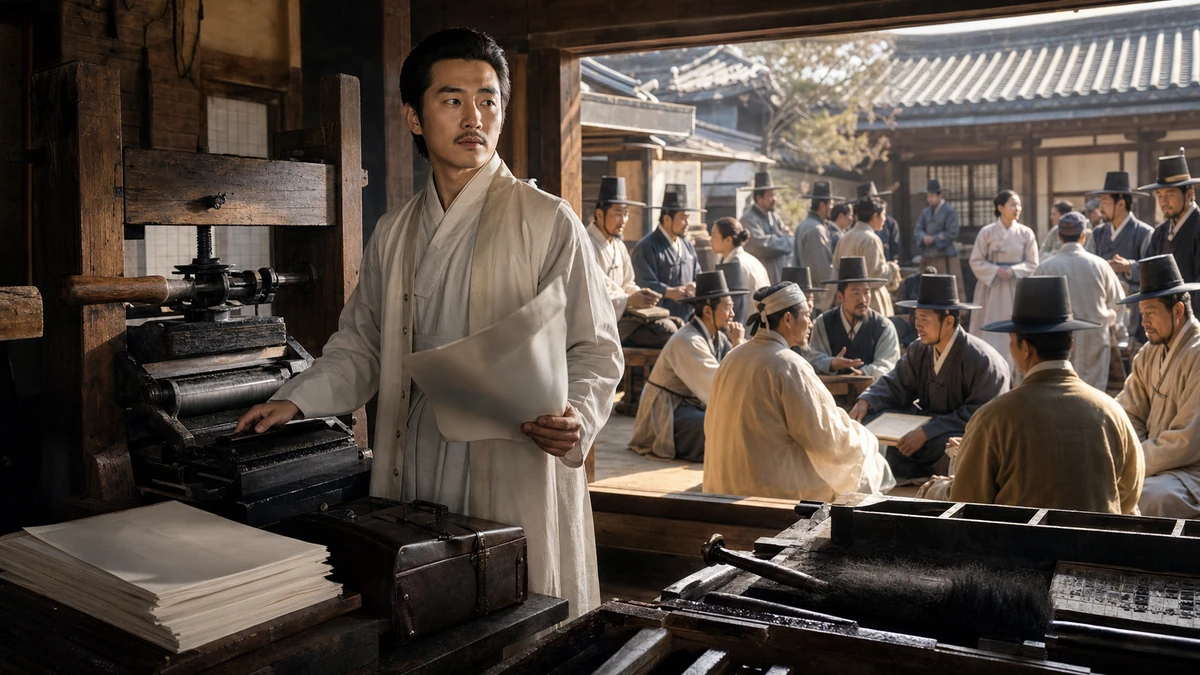
Image to help understand the article
A Korean reformer who mattered far beyond Korea
Long before South Korea became globally familiar through K-pop, Oscar-winning films and Samsung smartphones, Korea was wrestling with a much older question that Americans would recognize: Who gets to speak in public, who gets to shape politics, and how does a society move from elite rule toward broader civic participation?
One of the most important figures in that transition was Seo Jae-pil, better known in the United States as Philip Jaisohn. His life reads almost like several American biographies compressed into one: a precocious student from a once-prominent but financially diminished family, a young political radical, an exile, an immigrant who remade himself in the United States, and a public intellectual who returned home to build institutions for debate rather than relying only on palace politics or armed intrigue.
In Korean history, Seo is remembered for founding The Independent, widely regarded as Korea’s first private newspaper, and for helping establish the Independence Club, a civic organization that promoted debate, public lectures and political participation in the late 19th century. Those achievements matter because they helped create what modern scholars often call a public sphere — the social space where citizens encounter news, exchange ideas and make claims on the state.
That phrase can sound academic, but the underlying idea is familiar in the United States. It points to the role played by early newspapers, town halls, voluntary associations and pamphleteers in American political life. In Korea, Seo’s work came at a moment when the old order was under intense strain. The Joseon dynasty, which had governed Korea for centuries through a Confucian bureaucratic system and a rigid social hierarchy, was under pressure from foreign powers, internal reformers and fast-moving technological change. Seo helped push political discussion out from elite circles and toward a broader reading public.
His story also carries an additional layer that makes it especially resonant for American readers: He was not only a Korean reformer but also, according to the historical record summarized here, the first Korean to become a naturalized U.S. citizen. That dual identity shaped the way he thought about reform, public communication and citizenship. He was part of a generation that encountered Japan’s modernization, America’s civic culture and Korea’s struggle for sovereignty all at once. In that sense, Seo’s life was not an isolated episode from a distant past. It was an early chapter in the long and complicated relationship between Korea and the United States.
From provincial childhood to the center of reform
Seo was born in 1864 in what is now South Jeolla Province and spent his early years in several regions before being brought to the capital, then known as Hanseong, today’s Seoul. That movement from countryside to capital was more than a change of address. It placed him close to the institutions that defined status and power in late Joseon Korea.
For American readers unfamiliar with the period, Joseon society was governed by a scholar-official class often compared, loosely, to a hereditary elite whose route to power ran through mastery of classical texts and success on civil service examinations. The tests were not democratic in any modern sense, but they represented an established path into state service. Seo excelled in that world early. He studied the Chinese classics, earned distinction in examinations and entered government service while still very young.
Yet the significance of his early life is not simply that he succeeded within the old order. It is that he encountered alternatives to it. While preparing for official life in Hanseong, he came into contact with leading reform-minded figures including Kim Ok-gyun and others associated with the gaehwa, or “enlightenment,” movement. In Korean history, gaehwa generally refers to late-19th-century reform currents that argued Korea needed to adopt new knowledge, institutions and technology from abroad in order to survive in a rapidly changing international environment.
That reform impulse was not abstract. Seo and his peers were exposed to mathematics, telescopes, globes, maps, chemistry, new military ideas and other forms of knowledge coming from outside the traditional classical curriculum. For a young official trained in the old exam system, this encounter seems to have been transformative. It suggested that national strength would depend not only on literary accomplishment or court connections but also on science, institutional reform and public education.
There is also an important personal detail in the story passed down about Seo’s youth: He was remembered as unusually self-possessed, physically bold and unafraid of authority. Such anecdotes can be romanticized in retrospect, but they help explain why he would later move from elite advancement to more confrontational reform politics. He was not content simply to rise within the existing hierarchy. He wanted to change the terms on which Korean public life operated.
Japan, military modernization and the limits of elite reform
Like many reformers across Asia in the late 19th century, Seo looked to Japan as a nearby example of rapid modernization. After the Meiji Restoration, Japan had become the most visible case of a non-Western society adopting modern military, educational and bureaucratic systems at speed. For Korean reformers, that model was both inspiring and troubling. Japan seemed to offer lessons in survival, but it would also become an imperial threat.
Seo traveled to Japan in 1883 with a group of young Koreans, many of them from commoner backgrounds, to study new systems and military training. That detail matters. The willingness to work across status lines hinted at a break from the rigid class assumptions of old Joseon society. He reportedly learned Japanese quickly, observed institutions closely and absorbed the practical mechanics of state modernization, from schooling to military drill.
Back in Korea, he and other reformers pushed for a more modern military structure and official training institutions. But this phase of Seo’s life also shows the weakness of reform that depends heavily on a small circle at the top. Court politics in late Joseon were entangled with rival domestic factions and the influence of larger powers, especially Qing China and Japan. Reformers faced resistance not only because their ideas were new but because institutional change threatened established interests.
That tension culminated in the failed Gapsin Coup of 1884, a short-lived attempt by reformist officials to seize the initiative and rapidly transform the state. For Americans, it may be tempting to hear the word “coup” and place Seo in a simple category of anti-democratic conspirator. History is rarely that tidy. The late-19th-century reform landscape in Korea did not offer clean liberal pathways of the kind later associated with mature constitutional democracies. Seo’s significance lies partly in the fact that, after the failure of violent political change, he turned toward open persuasion through newspapers, associations, lectures and civic petitioning.
The failure of the coup destroyed his life in Korea as he had known it. It also set in motion the American chapter that would redefine him. In that sense, exile was not merely an interruption. It was the bridge between an aristocratic official culture and a more modern understanding of citizenship and public argument.
America did not just shelter Philip Jaisohn. It changed his politics.
After the failed coup, Seo fled Korea by way of Japan and eventually settled in the United States, where he took the name Philip Jaisohn. According to the historical summary provided, he became the first Korean to obtain U.S. citizenship, in 1890. He later worked in America as a physician and pathologist and also wrote as a poet and novelist. That reinvention is central to understanding his later role in Korea.
For immigrant communities in the United States, reinvention is a familiar theme. But in Jaisohn’s case, the shift was not just personal or economic. He moved from being a participant in a hereditary bureaucratic order to becoming a professional in a republic where public association, print culture and citizenship carried a different meaning. America in the late 19th century was hardly an egalitarian paradise; it was an era marked by exclusion, nativism and sharp inequality. Still, its civic habits — newspapers, meetings, advocacy groups, reform clubs and a comparatively open culture of public debate — offered a working model of how ideas could circulate beyond court politics.
When Jaisohn returned to Korea in 1895 at the invitation of the reform government, he did not come back merely as the same young radical who had left. He returned with American experience. And what he chose to build says a great deal about what he believed Korea needed. He did not begin with another military gamble. He began with media, civic organization and public education.
That shift resembles a broader pattern Americans know well from their own political history: durable reform tends to require institutions that shape public opinion, not just dramatic moments of power seizure. Newspapers can educate or inflame. Civic groups can widen participation or harden factionalism. But without them, politics often remains the property of elites.
Jaisohn’s American period also helps explain why he stands out in Korean history. He was among the earliest Korean figures to live deeply inside more than one national system. Today we might call that transnational fluency. In the 1890s, it was rarer and more consequential. He could compare political cultures from direct experience. He had seen the limits of palace-centered reform in Korea, the aggressive modernizing example of Japan and the civic life of the United States. His later work in Korea was an attempt to synthesize those lessons without surrendering Korea’s own sovereignty.
The Independent and the birth of modern civic debate in Korea
In 1896, Jaisohn launched The Independent, described in the source material as Korea’s first private newspaper. Later that year, he helped found the Independence Club. Together, those institutions became the heart of his legacy.
To understand why that mattered, it helps to explain what was new about it. Korea had official channels of communication before this, and political argument existed among elites. But an independent newspaper and a civic association created a more open venue for public discussion. Instead of confining debate to court insiders or private reform circles, Jaisohn sought to reach a broader audience through print, speeches, petitions, meetings and demonstrations.
That is why historians regard this period as the opening of a modern Korean public sphere. The newspaper was not simply a delivery mechanism for information. It was a tool for cultivating readers as political actors. The club was not merely a social group. It was a space where people could gather, listen, debate and press demands. In American terms, it combined some of the functions of an editorial page, a lecture circuit, a civic reform league and a grassroots pressure group.
Jaisohn used these platforms to introduce ideas that are now commonplace in democratic societies but were highly consequential in that setting, including popular political participation and broader public rights. He also advocated overseas study and direct engagement with foreign knowledge, arguing that Korea had to learn from the world if it wanted to avoid being dominated by it.
There is an irony here that remains relevant today. National independence and global openness are often treated as opposites in political rhetoric. Jaisohn’s career suggests the reverse: that a country may need outside knowledge and internal openness precisely in order to defend its autonomy. Korea in the 1890s faced pressure from stronger powers. His response was not isolation but civic strengthening.
That experiment had limits. The Korean government eventually expelled him, and the reform moment was constrained by broader geopolitical forces. But the importance of The Independent and the Independence Club does not depend on their immediate victory. Their significance lies in establishing a precedent: that ordinary people, not only rulers and aristocrats, could be addressed as participants in national life.
What this means for the United States
For Americans, Jaisohn’s story is more than a historical footnote in another country’s modernization. It sits at the intersection of several issues that still shape U.S. public life: immigration, the power of ethnic diasporas, the role of media in democracy, and the long arc of U.S.-Korea ties.
First, his life underscores how deeply Korean and American histories have been connected for longer than many Americans realize. Contemporary Americans often encounter Korea through consumer culture — BTS, Blackpink, “Parasite,” Netflix dramas, Hyundai and Korean beauty brands. Policy audiences know the alliance through troops, trade and the North Korean nuclear threat. But Jaisohn’s life shows that the U.S.-Korea relationship also has an intellectual and civic history. A Korean exile became an American citizen, trained as a physician and then carried ideas about public discourse back across the Pacific. That is not a side note to bilateral ties. It is an early example of them.
Second, his career illustrates the role that immigrant experience can play in democratic development abroad. The United States often debates immigration in domestic economic or border-security terms. Jaisohn offers another lens. Immigrants do not merely absorb American institutions; they can reinterpret and transmit them. Sometimes they carry back professional expertise. Sometimes they carry political habits. Sometimes they build bridges that neither government alone could create. Korean Americans today operate in a much larger and more developed version of that same transnational space, linking universities, media, business and civil society in both countries.
Third, the media lesson is strikingly contemporary. Americans are living through their own arguments about trust in journalism, fragmented audiences, disinformation and whether public debate is becoming too performative to be constructive. Jaisohn’s wager — that a newspaper and organized civic debate could create more informed citizenship — sounds idealistic from today’s vantage point, but it also reminds us what the democratic purpose of media is supposed to be. Not just content production, not just audience capture, but the formation of a public capable of argument.
There are also market implications, even if indirect. American publishers, streaming platforms, universities and cultural institutions increasingly invest in Korean content and Korean studies because U.S. interest in Korea has broadened far beyond security policy. Stories like Jaisohn’s matter in that environment because they deepen the frame. They show that Korea’s global relevance is not only about entertainment exports or semiconductor supply chains. It is also about a long history of reform, sovereignty, media modernization and trans-Pacific exchange.
Finally, there is a political reminder for Washington. U.S.-Korea ties are strongest when they are understood as more than military coordination. They are also about shared democratic practice, however imperfectly realized in each country’s history. Jaisohn belongs in that longer narrative. He represented a Korean search for modern citizenship that was informed, in part, by American experience but directed toward Korean needs. That distinction still matters in bilateral relations today: partnership works best when it is grounded in mutual respect, not simple imitation.
Why his story matters now
Seo Jae-pil’s life can be told as biography, but it is perhaps most useful as trend analysis. He stands at the point where several modern forces met: collapsing old hierarchies, rapid information change, geopolitical pressure, foreign study, migration and the emergence of civic politics. Those forces remain familiar.
Across democracies today, political systems are again under strain from elite mistrust and media upheaval. People argue over who counts as the public, which institutions deserve authority and whether new technologies are broadening participation or simply creating noise. Jaisohn’s answer, in his own time, was not to wait for society to modernize on its own. It was to build platforms where political literacy could grow.
His example also complicates easy narratives about modernization in Asia. Korea’s path was not a neat march from tradition to democracy. It involved failed coups, imperial pressure, exiles, experiments in print culture and repeated reversals. Jaisohn’s contribution was to insist that reform could not remain the guarded property of a handful of insiders. It had to be argued in public.
That is why he remains relevant, especially for international readers trying to understand Korea beyond headlines about pop culture or North Korea. The modern Korean story did not begin with postwar industrialization alone. It also includes an earlier struggle over speech, association and public reason. Jaisohn helped make that struggle visible.
In the United States, where Korea is now a major ally, trading partner and cultural presence, that history deserves wider recognition. It helps explain why democratic language, media activism and civic association occupy such an important place in South Korea’s modern political identity. And it reminds Americans that the traffic of ideas across the Pacific has never been one-way. More than a century ago, a Korean exile became an American citizen, then carried a version of modern civic politics back to Korea. The institutions he built did not solve everything. Few institutions do. But they changed the field on which Korean politics could be contested.
That is usually how democratic history moves: not through a single triumphant event, but through the creation of places where a public can begin to see itself. In Korea, Seo Jae-pil helped create one of those places.
Comments
Post a Comment