A Different Kind of Race: No Winners, No Stopwatch, No Pressure
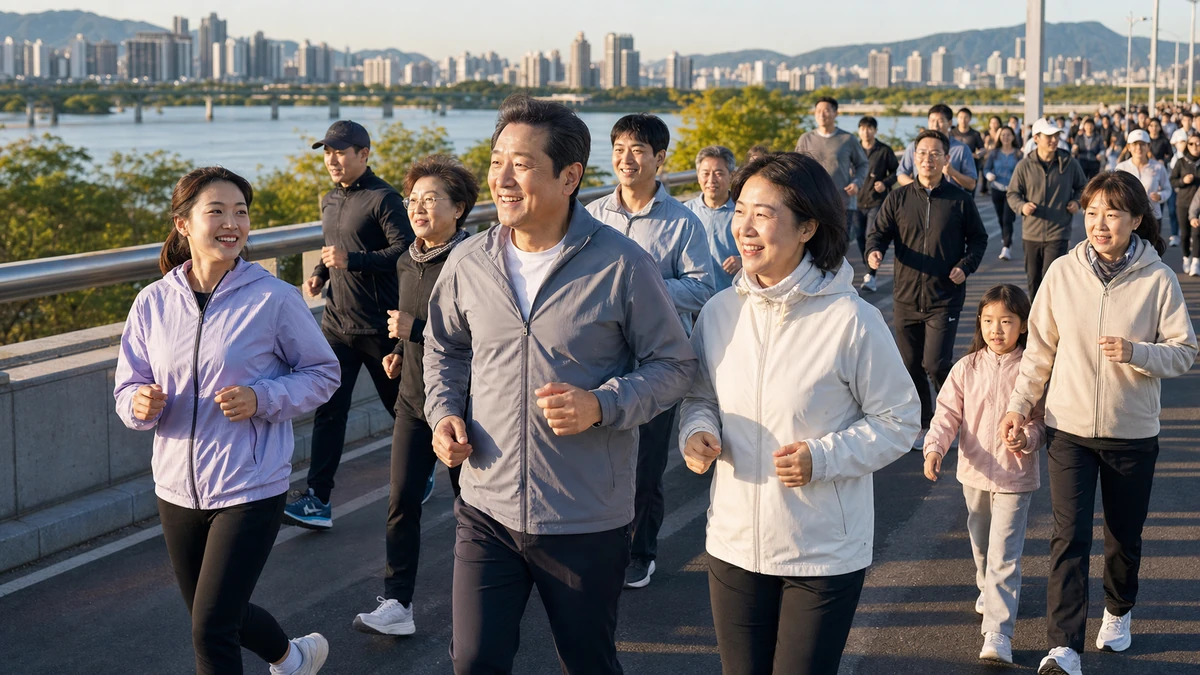
On a recent Sunday morning in Seoul, one of the world’s most densely populated and fast-moving capitals tried something notably unhurried. A stretch of roadway usually reserved for cars was opened instead to walkers and runners, as thousands of residents were invited to move at their own pace across a bridge over the Han River — not to post a personal record, outpace a rival or collect a finisher’s medal, but simply to get moving.
Seoul Mayor Oh Se-hoon joined residents for the event, known as “Swi-eom Swi-eom Morning,” a Korean phrase that loosely conveys the idea of taking things easy, catching one’s breath and going at a manageable pace. The program unfolded around Gwangnaru Hangang Park and Gwangjin Bridge in eastern Seoul, where participants covered a 2-kilometer route out and back between the southern and northern ends of the bridge. Before the walk and run began, organizers also offered a fitness-check station, giving people a chance to assess their condition before deciding how hard — or how gently — they wanted to exercise.
For Americans accustomed to road races defined by bib numbers, official times and ranking by age group, the concept may sound almost radical in its simplicity. But the point of the Seoul event was not athletic achievement in the traditional sense. It was accessibility. Organizers deliberately stripped away the competitive framework that can make exercise feel intimidating, especially for beginners, older adults, casual walkers and anyone who has ever looked at a 5K starting line and thought: that’s not for me.
That approach reflects a broader public health idea taking root in many global cities: If the barrier to exercise is too high, fewer people will start. And if movement is treated only as something for the highly motivated, the already fit or the highly disciplined, it becomes harder to build a culture where ordinary people feel that walking, stretching, light jogging or even just showing up counts as success.
What Seoul is trying here is not just a recreational event. It is a subtle redesign of urban life, one that asks what happens when a city makes room for movement without turning it into a contest.
How Seoul Turned a Car Lane Into a Neighborhood Gym
The event was organized by the Seoul Metropolitan Government and the Seoul Sports Council as part of a public sports initiative aimed at bringing exercise into everyday life. In practice, that meant temporarily converting ordinary traffic lanes into space for physical activity. In a city where streets are often tightly programmed for commuting, deliveries and commercial activity, that change matters. It alters not only what people can do in the space, but how they imagine the city itself.
At the starting point in Gwangnaru Bicycle Park, participants could check their physical condition at what the city calls the “Seoul Fitness Center,” a pre-exercise assessment area meant to encourage people to think about their current health rather than pushing blindly toward distance or speed. That detail may seem small, but it aligns with the event’s central philosophy: move in a way that fits your body, not someone else’s expectations.
Then came the 2-kilometer out-and-back course over Gwangjin Bridge, a structure that spans the Han River, the wide waterway that divides Seoul and also helps define it. If New York has the Hudson and East rivers, and Chicago has Lake Michigan as a civic backdrop, Seoul has the Han — both a geographic landmark and a major site of public leisure. Riversides in Seoul are not marginal spaces. They are central to city life, with parks, bike paths, sports areas and gathering places that fill up in warmer weather.
That setting helped reinforce the event’s message. This was not a marathon staged in an isolated athletic venue. It was a health program placed in a familiar public landscape. Participants did not need to enter a gym, pay for a boutique fitness class or train for months. They simply showed up in a recognizable part of the city and took part in a low-pressure morning activity that met them where they were.
That kind of design has a practical payoff. Public officials in cities around the world routinely say they want residents to live healthier lives, but advice to “exercise more” often remains abstract. By contrast, temporarily opening a road, creating a short route and surrounding it with options like walking, jogging and stretching turns that message into something visible and immediate. It says: Here is the space. Here is the time. Here is a version of exercise that is not asking you to prove anything.
What “Sports for All” Means in a Korean City
In South Korea, the phrase “everyday sports” or “sports for all” carries a specific civic meaning. It generally refers not to elite competition or spectator sports, but to accessible physical activity that ordinary residents can practice regularly as part of daily life. The Seoul event was built around that idea. It was not a showcase for professional athletes, nor a city-branded race designed to attract tourism. It was a local wellness program aimed at making movement feel routine rather than exceptional.
That distinction is important for readers outside Korea because South Korea’s public image abroad is often dominated by its global exports: K-pop, Korean dramas, beauty products, technology and food. Less visible is the way local governments in Korea often use highly organized public programming to shape everyday urban life, from neighborhood festivals to health campaigns to riverfront events. In Seoul, city government plays an unusually active role in creating structured civic experiences, especially in public spaces.
The “Swi-eom Swi-eom Morning” program fits squarely into that tradition. It was first tested in March and began regular operation last month, according to city officials. Earlier editions were held on routes linking other recognizable parts of Seoul, including one around the Han River near Yeouido and Mapo Bridge and another running from Seoul Plaza through Sejong-daero to Sungnyemun, the historic gate also widely known in English as Namdaemun. Together, those events drew 6,807 participants.
That number alone does not prove long-term health gains. Public officials everywhere can point to turnout as a measure of popularity, but participation counts are not the same as evidence of sustained behavioral change. Still, turnout does suggest that the program is meeting a real demand. It also indicates that people are willing to try exercise when it is embedded in places they already recognize — roads, bridges, plazas and river parks — rather than confined to specialized facilities.
For American readers, there are echoes here of “Open Streets” programs in cities such as New York, Los Angeles and Minneapolis, where streets are periodically closed to cars and opened for pedestrians, cyclists and community programming. But Seoul’s version appears more tightly centered on the idea of gentle, repeatable morning exercise. The emphasis is not on spectacle or one-day novelty. It is on habit formation.
Why the Absence of Competition Matters
The most striking feature of the event may be what it left out: no rankings, no finish-time hierarchy and no suggestion that faster is better. That structure lowers the psychological threshold for participation in ways that health experts have long recognized but public events do not always reflect.
For many people, exercise is not hard because walking or jogging is physically impossible. It is hard because the culture around exercise can be alienating. Competitive formats, social comparison and the assumption that progress must be measured in speed, mileage or visible transformation can discourage the very people cities most want to reach: beginners, people returning from inactivity, adults managing chronic conditions and residents who simply do not identify as “fitness people.”
By eliminating comparison as the organizing principle, Seoul’s event reframed physical activity as something less performative and more personal. Participants could walk, jog or alternate between the two. A 2-kilometer route — roughly 1.24 miles — is short enough to feel achievable for a wide range of ages and fitness levels, yet long enough to create the feeling of shared movement and purposeful outing. The goal was not to conquer the course. The goal was to inhabit it.
That may sound modest, but modesty is precisely the point. Public health messaging often fails when it confuses ideal behavior with realistic behavior. A city can tell residents to run farther, train harder or chase ambitious goals, but many people will opt out before they begin. Telling them instead to start with their own pace, check their current condition and choose the form of movement that feels sustainable offers a more realistic invitation.
There is also an important social dimension. In a noncompetitive setting, people with different abilities can share the same space without one group defining success for the other. That helps normalize exercise as a common civic activity rather than a niche pursuit. It turns physical activity into something closer to going to a park or strolling a waterfront than entering a contest.
In the United States, where organized recreational culture often gravitates toward goals, metrics and self-optimization, this model may resonate with a growing countercurrent. From walking clubs to “soft fitness” trends on social media, many people are increasingly drawn to wellness practices that prioritize consistency over intensity. Seoul’s program gives that instinct an official urban form.
More Than Running: Yoga, Photos and a Cultural Space Under the Bridge
The Sunday event was not limited to walking and running. Under the bridge, at a multipurpose cultural space known as “Gwangjin Bridge No. 8,” residents could also join a morning “healing yoga” class and take part in a photo event. Those elements expanded the program beyond a narrow definition of exercise and suggested a broader understanding of what health-oriented civic programming can look like.
That matters because many public fitness initiatives unintentionally create a binary: you either participate in the athletic activity on offer, or you do not participate at all. Seoul’s approach was more flexible. Someone uncomfortable with jogging could walk. Someone not interested in walking the entire route could join the yoga session. Someone drawn more to the atmosphere than the exercise itself could still engage through the cultural programming.
In Korean public culture, the term “healing” is commonly used in ways that extend beyond medical recovery. It often refers to emotional refreshment, stress relief or restorative experiences — something closer to recharging than treatment. A “healing yoga” session, then, would be understood not simply as exercise but as a calming, wellness-oriented activity that helps participants start the day in a gentler frame of mind. That kind of language may sound slightly different to American ears, but the underlying idea is familiar: mindfulness, stretching and low-pressure movement as part of a healthy routine.
The inclusion of photography also points to how Korean cities often merge lifestyle, aesthetics and public participation. Events are frequently designed not just to be attended, but to be documented and shared, whether through official promotion or personal social media use. In that sense, the photo component was not incidental. It helped turn the morning into a community experience, giving participants another mode of engagement beyond physical exertion.
Taken together, those choices suggest that Seoul is trying to broaden the meaning of exercise. Rather than treating health as synonymous with strenuous training, the event bundled multiple forms of activity into one accessible package: walking, light running, body awareness, yoga and scenic enjoyment. That is a notable shift away from an all-or-nothing approach to fitness and toward a more inclusive model of public well-being.
A Mayor on the Course, and the Politics of Public Wellness
Mayor Oh’s presence at the event added a political layer that is common in city-led initiatives but still worth noting. Elected officials frequently attend public wellness programs to signal responsiveness, accessibility and commitment to quality-of-life issues. In this case, the mayor walked and ran alongside residents while emphasizing the value of maintaining health through steady exercise in daily life.
That message aligns with a practical reality facing major cities across the globe. As urban populations age and lifestyle-related health concerns continue to rise, local governments are under pressure to do more than manage infrastructure. They are increasingly expected to shape the conditions that influence well-being: access to parks, safe walking routes, recreational programming and social environments that make movement easier to sustain.
In Seoul, a city known as much for its speed and intensity as for its public order and efficiency, a program built around slowing down may carry particular symbolic weight. South Korea has long grappled with the pressures of competitive schooling, long work hours and a culture that can place heavy emphasis on performance. Against that backdrop, an official program that explicitly removes performance metrics and encourages residents to move at their own pace can be read as a small but meaningful civic statement.
It does not mean Seoul is abandoning ambition. Rather, it suggests the city is experimenting with a different definition of achievement: not the fastest runner, but the widest possible participation; not peak output, but repeatable habits. That is a message many modern cities are likely to find attractive as they search for ways to improve public health without moralizing or excluding people who are least likely to sign up for conventional fitness culture.
There is, of course, a limit to what a single Sunday event can accomplish. No one should mistake a 2-kilometer walk-run and yoga class for a comprehensive answer to urban health challenges. But policy is often made visible through small repeated gestures. If a city routinely opens roads, normalizes gentle exercise and creates welcoming public rituals around movement, those choices can gradually reshape how residents think about health and public space.
What Other Cities Can Learn From Seoul’s Morning Experiment
The most interesting takeaway from Seoul’s “Swi-eom Swi-eom Morning” may be how transferable its basic logic is. The ingredients are not exotic: a short route, temporary road access, pre-activity health information, multiple participation options and a clear message that people should move according to their own abilities. Yet assembled together, they create something many cities struggle to offer — a low-stakes public environment where exercise feels ordinary, social and achievable.
That idea has obvious relevance beyond South Korea. In the United States, public officials often debate how to encourage healthier lifestyles while dealing with car dependence, unequal park access, rising rates of loneliness and persistent barriers to recreation. Large sporting events can bring excitement, but they do not necessarily build daily habits. Gyms can be useful, but they are not universally accessible or appealing. The Seoul model suggests another route: transform familiar civic spaces into temporary wellness spaces and remove the pressure that keeps many people away.
The bridge route in Seoul also offered a visual metaphor that is hard to miss. A structure built for movement and transit became, for a few hours, a place where movement itself was the destination. That inversion helps explain why open-space exercise programs can feel so powerful. They remind residents that a city is not just machinery for getting somewhere else. It can also be a place where health, leisure and community happen in plain view.
For American audiences, the event is also a useful reminder that the Korean Wave is not only about entertainment exports. South Korea’s global influence increasingly includes urban policy ideas, civic design experiments and public lifestyle trends that speak to broader questions about how modern societies live. A low-pressure Sunday fitness program may not command the same attention as a chart-topping K-pop group or a hit Netflix drama, but it reveals something equally important: how a global city is trying to make everyday life a little healthier, a little more communal and a little less governed by competition.
On that Sunday in Seoul, the message was straightforward enough to cross languages and cultures. Start where you are. Move at your own pace. Let the city meet you halfway.
Comments
Post a Comment