In South Korea, AI Robots Are Learning K-pop Choreography — and Offering a Glimpse of Entertainment’s Next Act
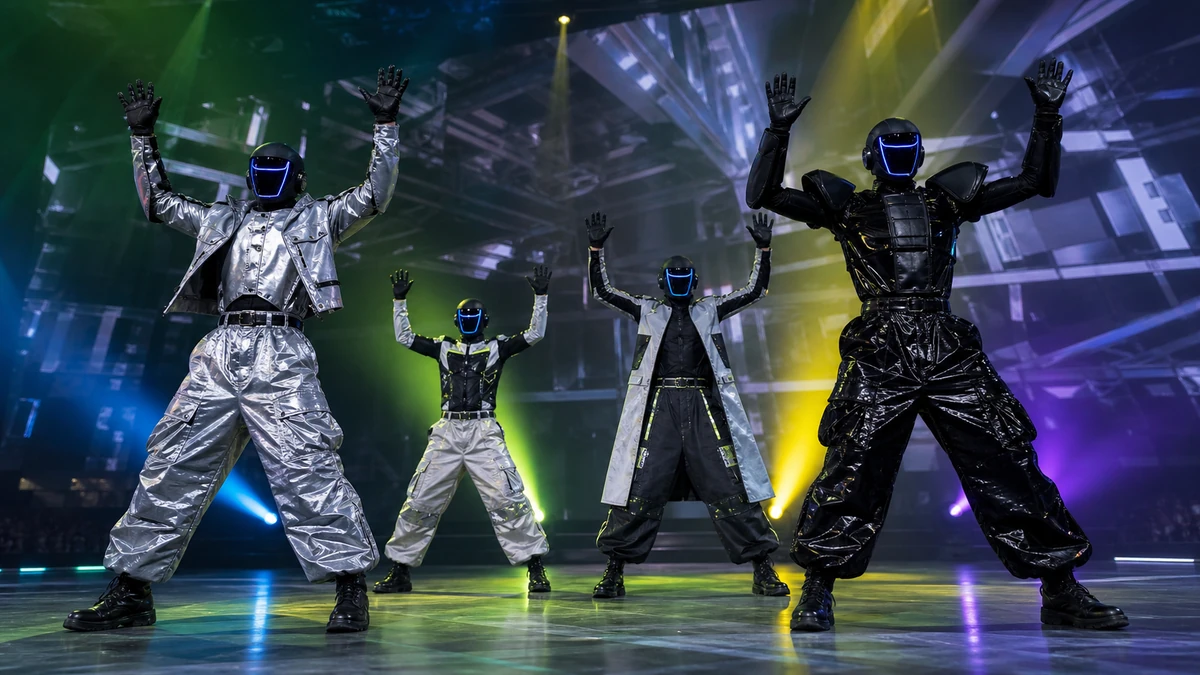
Image to help understand the article
A robot dance stage in South Korea is drawing crowds for more than novelty
In South Korea, where pop culture is often treated as both a major export industry and a national calling card, a new attraction is turning one of the country’s most recognizable cultural products into a live demonstration of artificial intelligence. At a large robot-themed cultural space featured by Korean broadcaster KBS, humanoid robots are performing synchronized dance routines to K-pop, keeping formation with one another, changing direction on cue and even delivering spinning kicks that recall taekwondo, the Korean martial art known to many Americans through Olympic competition and suburban dojangs.
More than 20,000 visitors have reportedly come through the venue since its temporary opening in May, a significant turnout for a space devoted not to a chart-topping idol group, a blockbuster film franchise or a conventional science museum, but to robots as performers. The facility itself is large — about the size of two soccer fields, according to the report — and the appeal goes beyond a single stage show. Visitors can also see a four-legged robot behaving like a pet, a robot playing the piano and another sketching portraits after observing human subjects.
Still, it is the K-pop dance performance that appears to have become the emotional and visual centerpiece. That is not hard to understand. K-pop choreography is one of the most globally legible forms of Korean culture: even viewers who do not speak Korean can understand the precision, timing and spectacle of a well-executed group routine. For many audiences, especially younger fans raised on YouTube dance practice videos and TikTok challenge clips, choreography is not just an accessory to the music. It is part of the product itself.
What makes the South Korean robot performance notable is that it moves beyond the familiar tech demo. These robots are not merely waving arms or walking in place to prove that their motors work. They are being presented as stage performers in a format audiences already know how to judge. Can they stay in line? Can they match the beat? Can they turn together? Can they make difficult movements look natural rather than mechanical? By choosing K-pop as the test case, the operators have effectively translated engineering performance into pop-cultural language.
That helps explain why the show is resonating with visitors. A machine can be impressive in a factory or laboratory. But when it dances to a familiar beat, it enters a far more crowded and emotionally charged space: entertainment. In that setting, audiences are not only evaluating technical capability. They are asking a broader question that is increasingly relevant in both Asia and the United States: What happens when AI learns not just to calculate or classify, but to perform culture?
Why K-pop is such a powerful proving ground for robots
To an American audience, it may help to think of K-pop choreography as a hybrid of the visual discipline of a marching band routine, the exactness of a Super Bowl halftime rehearsal and the fandom intensity attached to a major pop tour. One of K-pop’s defining features is what Koreans often call “kalgunmu,” a term used to describe knife-sharp synchronized group dancing. It refers to performances in which multiple dancers appear to move as one body, hitting the same angles and beats with near-military precision.
That style makes K-pop especially well suited to robotics. A solo vocalist’s charisma is hard to reduce to data. A perfectly timed group formation, by contrast, is measurable. Distance between performers can be tracked. Rotation speed can be modeled. Timing can be synchronized. Balance during kicks or turns can be tested and refined. In other words, the very qualities that make K-pop choreography visually satisfying also make it an unusually useful benchmark for machine learning and coordinated robotics.
According to the Korean report, the robots’ movements were not created simply by repeating pre-programmed joint motions. Human dance was first recorded as video data, then used to train AI systems, which translated the learned motion into robot performance. That distinction matters. It suggests an attempt to capture not just isolated poses but the flow of movement — the transition from one step to the next, the rhythm of limbs extending, the timing required to pivot in unison. The goal is not only to get from point A to point B, but to do so in a way that viewers recognize as dance.
The spinning kicks also carry cultural significance. To Korean audiences, taekwondo is not just sport; it is one of the country’s most recognizable traditional practices, taught to children, exported internationally and often woven into the broader story South Korea tells about itself. When a robot executes a taekwondo-style kick on a K-pop stage, the machine is not just demonstrating balance. It is performing a compressed version of Korean identity — one that blends global pop modernity with a deeply familiar national symbol.
That helps explain why visitors quoted in the Korean coverage responded the way they did. Some marveled that the robots seemed to dance better than they or their children could. Another noted that while he knew taekwondo himself, seeing a robot perform the movement made it seem even cooler. Those reactions are important because they show how technology becomes more accessible when presented through recognizable cultural forms. Most people cannot assess a robot’s codebase or control architecture. They can assess whether a robot seems to move gracefully, whether it keeps time and whether it surprises them.
In this sense, the show is not just entertainment. It is public-facing technology communication. Instead of explaining AI through technical jargon, it lets people understand machine learning through music, movement and spectacle. That may be one of the smartest things about the project.
From factory machine to cultural performer
For decades, the popular image of a robot has oscillated between two poles in American culture: industrial utility and science-fiction anxiety. Robots either weld car frames in factories or threaten humanity in movies. What this Korean venue offers is a third category, one that has been growing quietly in parts of Asia: the robot as cultural companion, performer or participant in leisure.
That shift matters. A robot that dances, plays piano or draws a portrait invites a different kind of public relationship than a robot behind a safety barrier on an assembly line. The machine is no longer presented primarily as labor-saving hardware. It becomes an object of interaction, conversation and even affection. The four-legged robot tilting its head like a pet is part of that same logic. It narrows the emotional distance between people and machines.
In the Korean report, children reportedly laughed when they received portraits drawn by a robot that had studied their faces and even reflected details such as clothing style or background choices. That is a telling image. The point is not simply that the machine can render an image. It is that visitors leave with a personalized artifact and a story to tell. The technology becomes memorable because it enters social life.
American audiences are already seeing early versions of this phenomenon in different forms: AI-generated playlists, virtual influencers, digital art tools and increasingly sophisticated animatronics at theme parks and live events. But South Korea’s robot K-pop stage offers a more literal embodiment of the trend. It shows how AI can move from the background — recommendation engines, editing tools, fan analytics — to the foreground, where the technology itself becomes part of the performance audiences pay to see.
There is also an important distinction to preserve. The most thoughtful reading of this development is not that robots are about to replace dancers or idols. The Korean summary itself points in a more measured direction: this is better understood as an example of how human creativity and machine expression can connect. The source material remains deeply human. Human dancers created the movement. Human artists developed the performance language of K-pop. Human audiences supply the recognition that makes the robot show interesting in the first place.
In that sense, the robot stage works because it is derivative in the best possible way. It does not ask viewers to care about machine movement in the abstract. It asks them to watch something they already know — K-pop choreography, taekwondo gestures, portrait drawing, piano performance — reappear in unfamiliar form. That tension between familiarity and strangeness is where the fascination lives.
What this means for the United States
For American readers, the South Korean robot stage is more than a quirky overseas attraction. It is a useful case study in where entertainment, robotics and AI may be heading in the United States as well — especially as Korean cultural exports continue to shape American consumer habits, concert markets and technology partnerships.
K-pop is no longer a niche import in the United States. Major Korean acts sell out arenas, appear on U.S. television, top Billboard charts and anchor brand campaigns for companies that want younger, digitally engaged audiences. American fans are used to experiencing Korean entertainment not just through music but through a broader package of choreography, fandom infrastructure, merchandise, livestreams and social media participation. That means any new technology that enhances or reimagines K-pop performance has a built-in runway in the American market.
There are several possible implications. First, U.S. live entertainment companies, venue operators and experiential museums are likely paying attention to any model that turns robotics into a ticketed attraction rather than a back-end technology. The American comparison might not be a typical concert so much as a blend of immersive art space, science museum and themed live show — something halfway between a technology expo and a family entertainment destination. If South Korean operators can attract tens of thousands of visitors by packaging robotics through culture, U.S. companies will almost certainly explore similar formats.
Second, the story speaks to the evolving relationship between American entertainment and machine-assisted performance. In the United States, debates around AI in music and film have often centered on job loss, deepfakes, copyright and synthetic voices. Those concerns are real, and they are likely to intensify. But the Korean case highlights a more consumer-facing possibility: audiences may accept AI most readily when it is framed not as a substitute for artists but as a new layer of spectacle. American sports halftime shows, Las Vegas residencies, theme-park attractions and branded pop-up experiences are obvious sectors where such experiments could surface.
Third, there is a broader U.S.-Korea business angle. South Korea has spent years positioning itself at the intersection of cultural production and advanced technology, from gaming and semiconductors to streaming and consumer electronics. The United States is one of the most important overseas markets for Korean culture and one of the most important partners for technology investment. If robot performance spaces become commercially viable in Korea, American firms — whether in entertainment, robotics, retail or tourism — may look for partnerships, licensing deals or co-developed experiences.
Finally, the American audience itself may be unusually prepared for this fusion. U.S. consumers are comfortable with crossover entertainment formats, from hologram-assisted shows to AI-powered recommendation ecosystems and increasingly interactive museum environments. What Korea may be demonstrating first is not a radically different future, but a more visible version of one the United States is already approaching: entertainment in which the technology is no longer hidden behind the curtain.
That does not mean Americans will embrace every robot stage uncritically. U.S. labor politics, union concerns and cultural attitudes toward automation differ from those in South Korea. Any attempt to introduce similar experiences in America would likely spark questions about whether machines are augmenting human creativity or displacing it. But that debate is precisely why this Korean example matters. It gives the United States an early look at how one close ally and cultural competitor is trying to turn AI from an abstract policy issue into a mass-market experience.
A window into South Korea’s larger strategy
This robot performance story also fits into a larger pattern in South Korea, where culture and technology are often developed not as separate sectors but as mutually reinforcing assets. The country’s global rise in soft power — through K-pop, film, television, beauty products and online platforms — has coincided with a national reputation for high-speed connectivity, electronics manufacturing and technology adoption. Put simply, South Korea has become very good at making innovation feel consumer-ready.
That helps explain why a robot cultural complex would lean on K-pop rather than, say, a purely technical demonstration. In South Korea, culture is not an afterthought to the tech sector; it is often the delivery system. K-pop in particular offers a globally recognized visual language that can make advanced technology understandable in seconds. A concertgoer does not need to know anything about neural networks to recognize that several machines have managed to stay perfectly aligned through a fast routine.
There is also a practical national-branding benefit. For years, K-pop has served as an entry point into broader interest in Korean language, food, fashion and tourism. A robot performance tied to K-pop extends that logic into the innovation economy. It suggests that Korea is not only exporting stars and songs, but also new ways of staging technology for the public. That is a subtle but meaningful form of soft power.
At the same time, the story captures something deeper about where AI is headed culturally. Much of the global conversation around artificial intelligence has focused on text generation, image generation and workplace productivity. Robotics can feel like a separate track, one associated more with engineering labs than with daily life. But when robotics meets K-pop, those worlds collapse into one another. The result is not just automation. It is embodiment — AI with a visible, kinetic body performing in front of a crowd.
That changes the emotional stakes. A chatbot can impress or unsettle, but it remains on a screen. A dancing robot occupies physical space, invites comparison to human bodies and creates a social event. In a media economy increasingly saturated with digital simulations, that kind of physical presence may prove commercially valuable. People still leave home for experiences that feel tangible, surprising and shareable. A synchronized robot dance troupe checks all three boxes.
For South Korea, then, this is not only a charming local attraction. It may also be an early example of how the country intends to keep expanding the reach of its cultural industries: by merging content, hardware and AI into experiences that are exportable in concept even when the original installation stays local.
What to watch next in AI entertainment
The immediate lesson from this Korean robot venue is not that machines are ready to inherit the stage from human performers. It is that audiences are increasingly willing to see AI as part of the show itself. That shift has implications far beyond one exhibition hall.
The first question to watch is whether these experiences scale. A successful local attraction does not automatically become a durable business model. But if attendance remains strong, operators in Korea and elsewhere may expand the concept into touring installations, museum partnerships, theme-park collaborations or branded tie-ins with entertainment companies. The strongest opportunities are likely to come where people already expect spectacle and experimentation.
The second question is how much originality audiences will demand from robotic performance. Right now, much of the fascination comes from watching machines reproduce familiar human cultural forms. That works because the novelty lies in the embodiment. Over time, though, viewers may begin asking whether robots can contribute something aesthetically distinct rather than simply imitating people. Can machine performers develop their own style, or is the point always to mirror human choreography more precisely?
The third issue is ethical and economic. If human movement becomes training data, creators will want to know how that data is sourced, credited and compensated. Those debates are already underway in music, film and publishing in the United States, and they are likely to intensify as AI tools become more deeply embedded in performance industries. A robot dancing beautifully onstage may look frictionless. The pipeline behind that moment is anything but.
Even so, the South Korean example points to a useful corrective in the broader AI conversation. Not every meaningful AI story is about disruption, deception or apocalypse. Some are about translation: taking a technical achievement and expressing it in a form ordinary people can feel, judge and enjoy. That may be why this robot K-pop stage has struck such a chord. It turns a difficult technological question — how machines learn coordinated human motion — into a simple audience experience: watch, compare, react.
And perhaps that is the clearest sign of where things stand now. AI in culture is no longer confined to the invisible layers of software that recommend songs or optimize feeds. It is stepping into the spotlight, sometimes literally, moving to a beat the crowd already knows. In South Korea, that beat happens to be K-pop. In the United States, the soundtrack may differ. But the underlying trend — machines learning to participate in entertainment, not just enable it — is one Americans should be watching closely.
Comments
Post a Comment