Japan’s Bid to Bypass the Strait of Hormuz Signals a New Era in Energy Security — and the U.S. Has a Stake in It
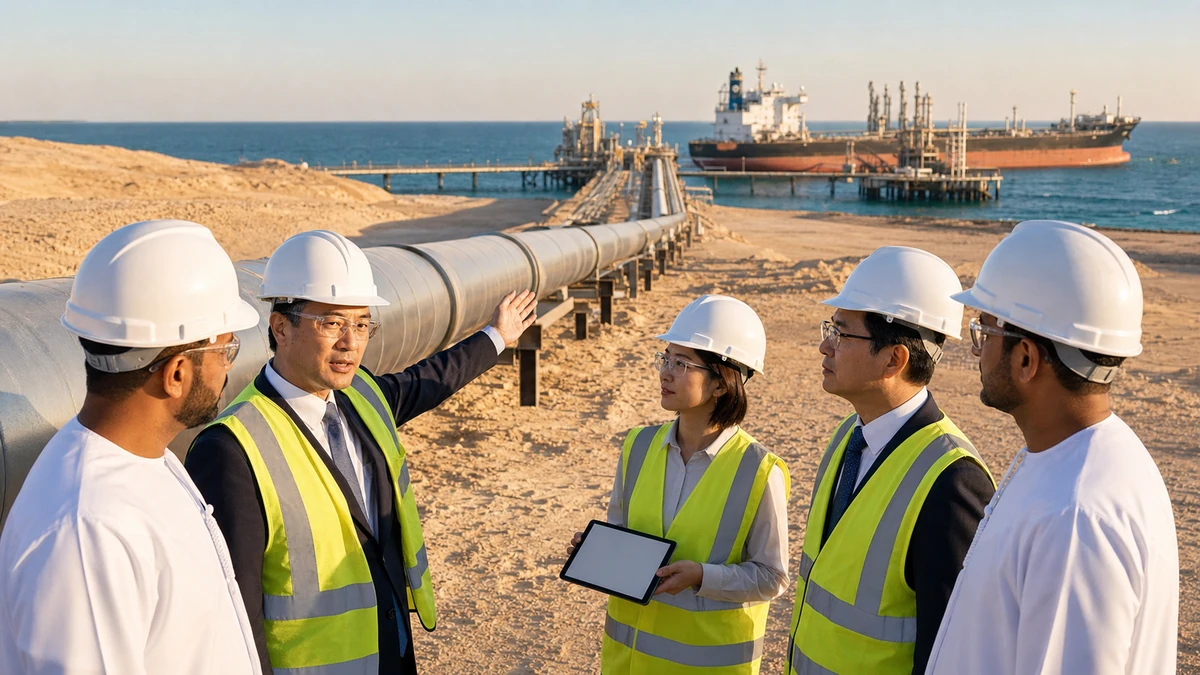
Image to help understand the article
Japan shifts from buying oil to securing the route it travels
Japan is moving toward a significant rethinking of energy security: not just where its oil comes from, but how that oil gets to port. According to the Korean summary of Japanese reporting, Tokyo plans to support pipeline projects in the Middle East that would allow crude oil to bypass the Strait of Hormuz, the narrow waterway between Iran and Oman that remains one of the world’s most critical energy choke points. Japan is also expected to create a subsidy program to help domestic refiners cover the higher shipping costs of importing oil through routes that do not pass through Hormuz.
That may sound technical, but the shift is more consequential than it first appears. For decades, energy security was often treated as a matter of supply contracts, storage and price. Japan’s emerging approach suggests something broader: a country highly dependent on imported fossil fuels is beginning to treat transportation corridors themselves as strategic infrastructure. In other words, having oil available on paper is no longer enough if the route carrying it can be disrupted by war, sanctions, military threats or insurance shocks.
For American readers, the closest comparison may be the way Washington talks about semiconductors, rare earths or shipping lanes in the South China Sea. The issue is not only whether a product exists, but whether it can move reliably through a system exposed to geopolitical risk. Japan, one of the world’s largest economies and a major U.S. ally, appears to be applying that same logic to crude oil at a moment when Middle East instability, U.S. sanctions policy and rising long-term electricity demand are colliding.
The reported plan comes as Prime Minister Sanae Takaichi is expected to present a policy agenda linking reduced dependence on specific oil transport routes, stronger energy self-sufficiency and stable energy supplies in what Japanese officials are calling the AI era. That phrase matters. It suggests Tokyo is not treating this as a temporary wartime hedge, but as a structural adjustment for a future in which data centers, advanced manufacturing and electrified industry require far more dependable energy systems than in the past.
The details still appear limited. The Korean summary notes that the exact scale of support, qualifying conditions and project list have not yet been disclosed. But the strategic direction is already clear: Japan wants to reduce the risk that too much of its energy lifeline runs through a single maritime bottleneck.
Why the Strait of Hormuz matters far beyond the Middle East
The Strait of Hormuz is one of those places many Americans may only hear about during a crisis, but it plays an outsized role in the global economy. A large share of the world’s seaborne oil and liquefied natural gas passes through the narrow channel. When tensions rise there, markets do not have to wait for an actual shutdown to feel the impact. Freight rates, insurance premiums, delivery schedules and benchmark prices can all move on fear alone.
That helps explain why Japan’s thinking is evolving. Its concern, as described in the Korean summary, is not simply whether Saudi Arabia, the United Arab Emirates or other producers can keep pumping oil. The concern is whether that oil can be delivered on time, at predictable cost, through a route that remains open and commercially usable. A producing country may have ample supply, but if a tanker route becomes too dangerous, too expensive or politically constrained, the practical value of that supply falls sharply.
In the American context, this is easy to understand through the lens of supply-chain disruptions Americans have already lived through. During the pandemic, consumers learned that goods delayed in transit might as well not exist for the purpose of keeping shelves stocked. The same logic applies to energy, except with even broader consequences. If refineries cannot count on stable deliveries, the ripple effects reach electricity costs, industrial competitiveness, inflation and consumer prices.
The Korean summary points to Middle Eastern efforts, especially by Saudi Arabia and the UAE, to expand or build land-based export routes that avoid Hormuz. Such projects are not new in concept, but Japan’s reported willingness to support them marks a notable escalation in consumer-country involvement. It would mean an importing nation is not merely hoping producers solve the problem. It is putting policy weight behind the infrastructure that could make alternative delivery pathways commercially and strategically viable.
That also reflects a deeper reality of today’s energy markets: resilience costs money. Detours are often more expensive than the most efficient route. Pipeline construction takes time. Maintaining multiple supply options can look uneconomic in calm periods. But governments increasingly appear willing to absorb those costs as the price of insurance against bigger disruptions later. That is the heart of Japan’s approach.
Subsidizing alternative routes is a bet on resilience, not efficiency
The transportation subsidy portion of the Japanese plan may prove just as important as the pipeline support itself. Building physical bypass capacity is one thing; getting companies to use it is another. If alternative routes exist but remain too expensive for regular use, refiners may still default to the cheapest route through Hormuz until a crisis forces them to scramble. By then, contracts, logistics and commercial relationships may be too underdeveloped to scale up quickly.
Japan appears to be trying to solve that problem in advance. The Korean summary says the government plans to support Japanese refiners and others that procure oil without passing through Hormuz by helping offset transportation costs. In effect, Tokyo would narrow the price gap between the traditional route and safer alternatives, creating an incentive for companies to build real operational experience with diversified sourcing paths even before an emergency.
For American readers, think of it like paying a premium for backup power or maintaining duplicate suppliers for critical components. In ordinary times, it can look inefficient. In a disruption, it can prevent a much larger failure. The new policy suggests Japan is redefining energy security not as the ability to buy the cheapest barrel, but as the ability to keep barrels moving under different geopolitical scenarios.
That is a meaningful conceptual shift. For years, governments often treated resilience and efficiency as competing priorities. What Japan seems to be signaling is that the old definition of efficiency was too narrow. If a low-cost supply chain can be knocked offline by a single choke point, then its apparent cheapness may be misleading. The true cost includes fragility.
This way of thinking is spreading well beyond oil. Across advanced economies, policymakers are reexamining just-in-time models in everything from medicine to defense production to computer chips. Japan’s move matters because it shows the same logic now being applied to fossil-fuel transport infrastructure, even as the world continues to talk about energy transition and decarbonization. The message is not that oil will dominate forever. It is that the transition period may be more geopolitically unstable than many governments once assumed, and they want more control over how they navigate it.
What this means for the United States
For the United States, Japan’s strategy matters on several levels: alliance coordination, global energy pricing, corporate planning and the broader U.S.-led conversation about economic security. Even though the United States has become a major energy producer, Americans are not insulated from turmoil in the Gulf. Oil remains globally priced. A shock in one part of the system can still raise costs for U.S. consumers, rattle financial markets and complicate foreign policy.
Japan’s push to diversify transport routes aligns with a broader American strategic interest in keeping global energy flows stable without relying exclusively on military deterrence in one narrow corridor. Washington has long devoted substantial attention to protecting freedom of navigation in the Gulf. But Japan’s reported plan suggests another layer of risk management: reducing how much commerce must pass through the choke point in the first place. From a U.S. perspective, that is not a replacement for naval presence or diplomacy, but it can be a useful complement.
There is also a strong corporate angle. American companies with exposure to shipping, refining, commodity trading, engineering, insurance, port operations and energy infrastructure all watch the Strait of Hormuz closely. If Japan helps make bypass pipelines and alternative shipping routes more commercially viable, U.S. firms may find new opportunities in financing, technology, logistics and risk management. At the same time, any rerouting of trade can alter who captures transport margins and how energy contracts are structured.
For American consumers, the impact is indirect but real. U.S. gasoline prices are influenced by global crude prices, not just domestic drilling volumes. If major Asian importers such as Japan become better able to cushion disruptions, that could modestly reduce volatility in global markets over time. That is not the same as lower prices, and it would be wrong to promise immediate benefits. But lower vulnerability in one major importing economy can help reduce panic-driven swings that spill across borders.
There is also a policy parallel Americans will recognize. In recent years, Washington has poured resources into supply-chain resilience for semiconductors, batteries, critical minerals and pharmaceuticals. Japan’s oil-route strategy fits the same worldview: trusted partners should not wait for a crisis to discover they are overdependent on one vulnerable node. The lesson is familiar from the CHIPS Act era: redundancy that once looked wasteful is increasingly treated as a strategic necessity.
Most of all, the Japanese move underscores how tightly U.S. and allied economic security are linked. When Tokyo changes how it thinks about energy risk, Washington should pay attention, because Japan is often both an early stress detector and a bellwether for how other import-dependent economies may respond.
Middle East tensions, sanctions and diplomacy are moving in opposite directions at once
One reason Japan’s plan deserves attention now is that it emerges amid a confusing and contradictory regional picture. The Korean summary describes a moment in which the United States is reportedly tightening sanctions related to Iran while also preparing to normalize some diplomatic operations in the Middle East after wartime emergency measures. That combination is important because it shows why energy importers can no longer rely on a simple peace-or-war framework when assessing risk.
Even if fighting eases, sanctions can still reshape payment flows, insurance availability, shipping practices and the willingness of companies to touch certain transactions. Even if embassies reopen or diplomats return, commercial confidence may lag. Even if producers remain willing to sell, market participants may price in uncertainty around routes, regulations or retaliatory threats. The system is layered, and each layer can affect whether oil physically moves.
That complexity helps explain the Japanese preference for route diversification over prediction. Rather than betting on one specific geopolitical outcome, Tokyo seems to be preparing for a future in which instability comes in different forms: military pressure, sanctions escalation, intermittent threats to shipping or simply commercial reluctance to rely too heavily on one exposed passageway. In that environment, flexible infrastructure can be more valuable than any single forecast.
For U.S. officials and businesses, that logic should feel familiar. American companies have spent years learning that geopolitical risk is no longer episodic background noise. It is part of the operating environment. Japan’s response suggests that in energy, as in technology and trade, the winners may be those that build systems capable of functioning across multiple scenarios rather than optimizing for the cheapest scenario alone.
That may also influence how other Asian importers think. If Japan demonstrates that government-backed transport diversification can work, even at higher upfront cost, countries such as South Korea, India and others may face pressure to reevaluate their own exposure to shipping chokepoints. For Washington, that could open a new area of allied coordination around energy resilience, infrastructure finance and maritime risk reduction.
The AI-era energy argument adds a new dimension
One of the more striking elements in the Korean summary is Japan’s effort to connect oil-route security with the demands of the AI era. At first glance, that may seem odd. Artificial intelligence is usually associated with data centers, chips and electricity demand, not crude tankers. But the connection becomes clearer when viewed through national planning.
Advanced computing requires reliable power. So do the factories that make semiconductors, batteries, industrial robots and next-generation materials. Even as countries add renewable power, many still depend on complex mixes of imported fuels, thermal generation and globally traded commodities to stabilize their systems. Japan, which has long wrestled with energy self-sufficiency constraints, appears to be arguing that the digital economy cannot thrive on fragile logistics.
That matters in the U.S. too. American utilities, tech companies and regulators are in the middle of a growing debate over whether the electric grid can keep up with data-center expansion. Japan’s framing suggests a more expansive view: future competitiveness is not only about generating more power but also about securing the supply chains, fuels and infrastructure that underpin industrial continuity.
In that sense, Japan’s reported policy is part of a broader transition in how governments define national strength. Economic security is no longer confined to trade balances or domestic output. It includes ports, pipelines, undersea cables, shipping lanes, grid stability and the hidden architecture that keeps modern economies running. A country that cannot guarantee energy continuity may struggle to lead in AI, advanced manufacturing or defense production, no matter how sophisticated its technology base.
That does not mean oil is the future. It means the path to the future still runs through legacy energy systems that remain exposed to old geopolitical hazards. Japan is acting as though those hazards could become more salient, not less, during a period of technological acceleration.
What to watch next
The first question is practical: which projects will Japan support, under what terms, and how quickly can those arrangements move from announcement to implementation? Pipeline projects are capital-intensive, politically sensitive and dependent on host-country cooperation. Their strategic logic can be compelling, but their execution is rarely simple. Investors and allied governments will want to see whether Tokyo’s support is symbolic, selective or large enough to shift commercial behavior.
The second question is whether Japanese refiners actually use the new incentives to diversify their procurement mix. Subsidies can encourage experimentation, but long-term success depends on whether companies build durable contracts, logistics routines and risk-management systems around alternative routes. If they do, Japan may create a model other energy-importing democracies study closely. If they do not, the plan could remain a well-intentioned signal without much operational effect.
The third question is whether this approach spreads. If the global energy market enters a period in which major consumers more directly support transport infrastructure and route diversification, that would mark a notable change from earlier eras, when governments focused more heavily on reserve levels, producer diplomacy and spot pricing. The center of gravity in energy policy would shift toward the plumbing of trade itself.
For the United States, the most important takeaway may be strategic rather than technical. An ally deeply exposed to imported energy is telling the world that resilience now requires intervention not just at the point of purchase, but across the route from wellhead to refinery. That is a warning, and an opportunity. The warning is that old assumptions about cheap, uninterrupted global flows no longer hold. The opportunity is for the U.S. and its partners to build a more durable framework for energy security that connects infrastructure, diplomacy, finance and industrial planning.
Japan’s reported move does not solve the Middle East’s instability, and it does not eliminate market shocks. But it does capture a broader trend that American policymakers and businesses increasingly recognize in other sectors: when a single bottleneck can disrupt an entire system, resilience becomes a strategic asset worth paying for. In that sense, this is not just a story about Japan and oil. It is a story about how advanced economies are learning, sometimes belatedly, that in an age of geopolitical fragmentation, the route may matter as much as the resource.
Comments
Post a Comment