Japan’s Fukushima Soil Policy Moves Beyond Tokyo, Testing Public Trust in the Long Shadow of Nuclear Disaster
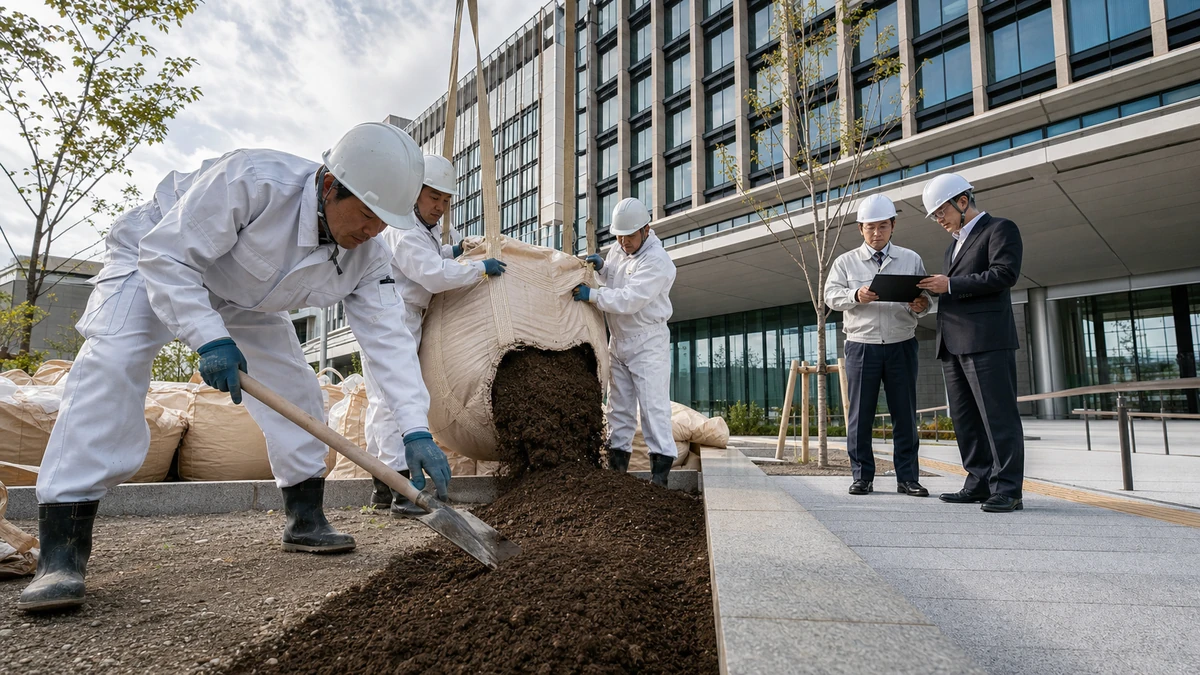
Image to help understand the article
Japan expands a politically sensitive Fukushima policy beyond the capital
More than 14 years after the 2011 Fukushima Daiichi nuclear disaster, Japan is entering a new phase in one of the least visible but most politically delicate parts of the cleanup: what to do with the enormous volume of soil removed during decontamination work. Japan’s Environment Ministry said it plans to reuse decontaminated soil collected after the disaster at government office complexes in Sendai and Saitama, according to Japanese media reports, marking the first time such material will be used outside Tokyo.
That may sound like a bureaucratic detail. It is not. In practical terms, the decision widens the geography of post-Fukushima management from central government facilities in the capital to state-run sites in other regions. In political terms, it signals that Tokyo is trying to turn a long-running storage problem into a national policy with a broader footprint. And in social terms, it raises a question familiar in many democracies, including the United States: How far can a government ask local communities to share in the burdens of a national emergency years after the original crisis faded from daily headlines?
The two sites identified are the Sendai Joint Government Building in Miyagi prefecture and the Saitama Shintoshin Joint Government Building in Saitama prefecture. Until now, the soil has been used at 12 government sites in Tokyo, including around the prime minister’s office and central ministries. That concentration carried symbolic weight. It suggested the central government was keeping responsibility close at hand, at least spatially, by placing the material in places under its own direct watch and inside the nation’s political center.
Moving beyond Tokyo changes the public meaning of the policy, even if the sites remain national government properties. The users are still government institutions. The communities living near those properties, however, are no longer only those in the capital. That matters in Japan, where local consent, administrative trust and public sensitivity around radiation remain deeply important. It also matters internationally, because Fukushima has long served as a case study in what happens after a nuclear accident moves from emergency response into the slower, more difficult realm of long-term public policy.
The announcement does not appear to include key details such as how much soil will be used at each site, precisely how it will be applied, or when the work will begin. Those omissions are significant. On technical questions involving contaminated or formerly contaminated material, public confidence often depends less on broad assurances than on granular disclosure: how much, where, under what engineering standards, with what monitoring and for how long.
What decontaminated soil means, and why this is not ordinary recycling
The soil in question is not just leftover dirt from construction. It is material generated when topsoil was stripped from homes, farmland and other areas affected by radioactive fallout after the Fukushima accident, which followed a massive earthquake and tsunami in March 2011. That distinction is central to understanding why the issue remains controversial.
In ordinary public works, recycled material is usually discussed in terms of cost, sustainability or landfill reduction. Fukushima soil sits in a completely different moral and political category. It is tied to a national trauma that combined natural disaster, technological failure and institutional scrutiny. For many Japanese people, and especially for residents of Fukushima and surrounding areas, it carries the memory of evacuation, contamination fears, shattered livelihoods and years of stigma.
That helps explain why the reuse of the soil cannot be treated simply as an engineering or waste-management decision. It is also a question of risk communication, symbolic responsibility and social consent. Even when the government argues that reused soil meets safety standards, the public debate often turns on whether those standards are transparent, whether oversight is independent and whether affected communities are being asked rather than merely informed.
The Environment Ministry’s choice of government office grounds, not private commercial developments or broad public-use land, appears designed to show caution. In effect, the state is saying it will first expand use within spaces it directly manages. That is a more controlled and politically defensible step than immediately moving into private property or widely used civic spaces. But caution does not eliminate controversy. It simply narrows the first circle of exposure.
There is also a difference between reuse and final disposal, a distinction that can easily get lost in public debate. Reusing decontaminated soil at government sites does not mean Japan has solved the larger problem of permanently disposing of it. Rather, it suggests Tokyo is trying to build a pathway between long-term storage and eventual disposal, while also demonstrating that some portion of the material can be managed in regulated settings outside Fukushima.
That is why this latest move deserves attention beyond Japan. It illustrates a reality seen in many environmental controversies: the hardest part is often not the initial cleanup, but what comes after. Removing hazardous or potentially hazardous material from one place only creates a second question. Where does it go next? And who agrees to live near it?
The pressure of a 2045 deadline
The timing of Japan’s decision is shaped by law, not just logistics. Japanese law sets a principle that final disposal of the decontaminated soil must take place outside Fukushima prefecture by March 2045. That deadline gives the issue a clock. The government cannot simply store the material indefinitely and hope political resistance softens on its own.
Deadlines like that have a way of turning technical matters into tests of state capacity. For years, governments can frame such problems as temporary. As the legal cutoff approaches, temporary measures begin to look like policy failure unless they evolve into a workable system. In that sense, the move to Sendai and Saitama is less about one construction choice than about proving that Japan can operationalize a national plan before the window narrows further.
The challenge is that legal deadlines do not automatically generate public legitimacy. Residents living near a selected site may understand the state’s obligations and still object to becoming part of the solution. That tension is hardly unique to Japan. In the United States, communities have repeatedly resisted becoming hosts for hazardous waste facilities, spent fuel storage, incinerators and other unwanted infrastructure, even when officials argue the facilities serve a broader public need. The phrase “not in my backyard” may oversimplify such disputes, but the politics are instantly recognizable to American readers.
Japan’s case is even more sensitive because the material is inseparable from the memory of Fukushima. For the national government, expanding use at state-controlled facilities may be a methodical way to accumulate experience and demonstrate safety. For local residents, however, the more immediate concern is likely to be concrete and personal: What exactly will be placed here? How will it be monitored? What happens in heavy rain, earthquakes or future redevelopment? Who bears responsibility if standards change or trust breaks down?
The government’s success may hinge on how clearly it answers those questions. If Tokyo relies mainly on abstract necessity, legal obligation or expert reassurance, it may struggle to build durable consent. If it releases detailed engineering plans, monitoring systems and chains of responsibility, it has a better chance of turning a sensitive national policy into something communities can at least evaluate on the merits.
That is one reason the first expansion outside Tokyo matters so much. Pilot cases often become precedents. If these projects are perceived as carefully explained, tightly managed and transparently monitored, they may open the door to broader implementation elsewhere. If they are viewed as opaque or dismissive of local concerns, they could harden opposition and make the 2045 timeline much harder to meet.
Why Sendai and Saitama matter politically
The site selection itself sends a message. Sendai is the major city of Miyagi prefecture, not Fukushima. Saitama is a core urban center adjacent to Tokyo, part of the greater metropolitan orbit but outside the capital. Choosing those places suggests a deliberate middle course. The government is not keeping all responsibility confined to Tokyo, but it is also not making the boldest possible move into ordinary civilian spaces or far-flung municipalities with little direct administrative connection to the center.
In other words, this looks like a phased expansion strategy. The facilities remain under government management. The locations are prominent enough to signal national responsibility. Yet the move also begins normalizing the idea that the legacy of Fukushima is not Fukushima’s burden alone, nor only Tokyo’s. It is a national issue that may increasingly involve other prefectures and communities.
That is a consequential shift in narrative. For years, much of the visible debate around Fukushima has centered on evacuees, fisheries, agricultural reputations, treated water releases and the decommissioning of the damaged plant. Decontaminated soil has been part of that story, but usually in a less public-facing way. Bringing the material into government complexes outside the capital makes the issue more tangible. It moves the conversation from remote storage and abstract planning into everyday administrative landscapes where civil servants work and citizens visit.
It may also be an attempt to show that the state is not outsourcing risk to weaker actors. Using national government facilities first allows officials to argue that they are bearing responsibility themselves rather than asking private landowners or municipalities to go first. That has symbolic value. Still, symbols only go so far. Communities often judge governments not by whether they invoke responsibility, but by whether they provide full information and accept scrutiny.
The reports summarized so far leave important unknowns. The quantity of soil, the exact application method and the timeline have not been publicly detailed. Without those specifics, it is difficult to assess whether this is a modest pilot, a major operational shift or a carefully staged political signal ahead of broader rollout. Those details will matter enormously in shaping public reaction.
For that reason, the next phase of the story may be less about the announcement itself than about what follows. Do officials publish technical standards in plain language? Are local meetings held? Are monitoring results made public and easy to understand? Is there a mechanism for outside review? The answers to those questions will determine whether this policy is seen as a model of cautious governance or as another example of a state underestimating how much explanation modern publics demand.
What this means for the United States
For Americans, the immediate temptation may be to treat this as a distant Japanese administrative issue. That would miss the larger point. Fukushima has had a powerful place in the American imagination since 2011, when images of explosions at the plant circulated worldwide and sparked fresh debate over nuclear power, disaster planning and energy security. Japan’s struggle with decontaminated soil is part of the unfinished aftermath of that event, and it offers lessons that resonate in the United States today.
First, the story speaks to how advanced democracies handle the long tail of technological disaster. In the United States, debates over nuclear waste have dragged on for decades, from Yucca Mountain to interim spent-fuel storage. Americans are familiar with the pattern: technical experts may present one view of manageable risk, while local residents, state officials and activists raise concerns about trust, fairness and long-term accountability. Japan’s effort to expand reuse of Fukushima soil shows how those tensions do not disappear with time. They often intensify as governments move from emergency promises to permanent arrangements.
Second, the issue matters because the United States and Japan are close allies with deep ties in energy policy, environmental governance and disaster management. American policymakers, utilities and researchers have watched Fukushima closely for years, not just because it was a major nuclear accident, but because it occurred in a technologically sophisticated, highly regulated ally. How Japan manages the post-disaster burden can influence broader international conversations about nuclear resilience, public communication and the credibility of cleanup standards.
Third, there is a market and industry angle. As the U.S. debates the future of nuclear energy as a low-carbon power source, questions of waste, decommissioning and accident recovery remain central to public acceptance. American companies involved in engineering, environmental monitoring, materials management and nuclear services pay close attention to how governments structure long-term remediation. A case like this does not provide a simple template for the U.S., but it does underscore that the economics and politics of nuclear power extend far beyond reactor operations.
There is also a cultural dimension. American audiences have become much more engaged with Japan and Korea through travel, streaming media, food and online communities, but familiarity with pop culture does not always translate into familiarity with the infrastructure politics of East Asia. Stories like this help fill that gap. They show a Japan that is not only a source of global entertainment and consumer brands, but also a country wrestling with the same hard public-policy dilemmas that the U.S. faces: environmental risk, federal-local tension and the challenge of persuading a skeptical public to accept technically complex solutions.
For American readers, the most relevant takeaway may be this: the real test of nuclear policy is not just how safely plants operate in ordinary times, but how honestly, transparently and patiently governments manage the consequences when things go wrong. On that score, Japan’s latest decision is worth watching closely.
A regional issue with implications beyond Japan
This development also matters in a broader East Asian context, where environmental decisions made by one country can quickly become matters of regional concern. The legacy of Fukushima has long had diplomatic and psychological spillover beyond Japan’s borders. South Korea, China and other neighboring countries have closely followed Japanese decisions related to contaminated materials, food safety and water releases from the Fukushima site. Even when the technical subject changes, the underlying issue remains the same: trust.
That is one reason the expansion of decontaminated soil reuse beyond Tokyo carries weight beyond domestic Japanese politics. It reflects how the management of a nuclear accident becomes, over time, not just a cleanup operation but a sustained test of governance. Each incremental step can affect how neighboring publics judge Japan’s transparency and how Japanese citizens judge their own institutions.
For South Korea in particular, Fukushima-related issues have often drawn intense public attention, shaped by geographic proximity, historical sensitivities and strong consumer awareness around environmental and food-safety matters. While this latest move concerns soil reuse at Japanese government sites rather than a cross-border environmental release, it still fits into a wider regional pattern in which Japanese decisions are scrutinized well beyond Japan. That scrutiny does not mean every policy becomes an international dispute. It does mean Japanese officials are operating in an environment where domestic communication and international credibility are closely linked.
There is a broader lesson here for governments across Asia and beyond. In the early stages of a crisis, authorities often focus on emergency response, physical containment and immediate public protection. But in the later stages, the challenge becomes something harder to measure: maintaining legitimacy over years or decades as policy moves into areas where scientific assessments, legal mandates and community emotions overlap. That is the terrain Japan is navigating now.
If the government handles the Sendai and Saitama projects with unusual transparency, they could become examples of cautious institutional learning. If not, they may reinforce the view that governments too often treat public explanation as an afterthought. In an era when mistrust can spread faster than technical detail, that distinction matters.
The real issue is not expansion alone, but proof
It would be easy to frame this story as Japan simply broadening a recycling program. But that description is too thin for what is actually at stake. The deeper issue is whether the Japanese government can demonstrate, not merely assert, that its long-term handling of Fukushima decontamination soil is safe, accountable and fair.
Expansion from 12 sites in Tokyo to two government complexes outside the capital marks a turning point because it moves the policy from a tightly bounded central-government setting into a wider national space. Even though the new locations are still state-run facilities, the social footprint is larger. More communities are being asked to live alongside the practical legacy of Fukushima. That makes explanation and verification more important, not less.
The unresolved nature of the problem is also important. The 2011 disaster is often remembered through dramatic footage and immediate fallout. But the aftereffects are administrative as much as emotional: decades of storage, disposal, monitoring and public persuasion. This is what the long shadow of a nuclear accident looks like in reality. It is measured not only in radiation levels or engineering milestones, but in meeting notices, legal deadlines, local anxieties and the credibility of institutions.
For now, the announcement appears to represent an initial step rather than a finished strategy. Much depends on what the government discloses next. The specifics of volume, method, oversight and timeline will determine whether this becomes a manageable model or a flashpoint. The choice of government sites suggests Tokyo understands the sensitivity. The test now is whether it understands that sensitivity requires more than control. It requires proof that people can see, question and verify.
That may ultimately be the central lesson for Japan, for its neighbors and for countries like the United States that continue to debate the future of nuclear power. Long after the headlines move on, a disaster’s political life continues. What matters then is not only the technical fix, but whether the public believes the people in charge have earned the right to carry it out.
Comments
Post a Comment