Image to help understand the article
Japan’s Famous Vending Machines Face a New Economic Reality
For decades, Japan’s vending machines have been more than simple places to buy a drink. They have been a symbol of the country’s reputation for convenience, safety and technological efficiency. Visitors from the United States often notice them immediately: rows of brightly lit machines standing on quiet streets, outside train stations, near office buildings and even in areas where a traditional store would seem unlikely.
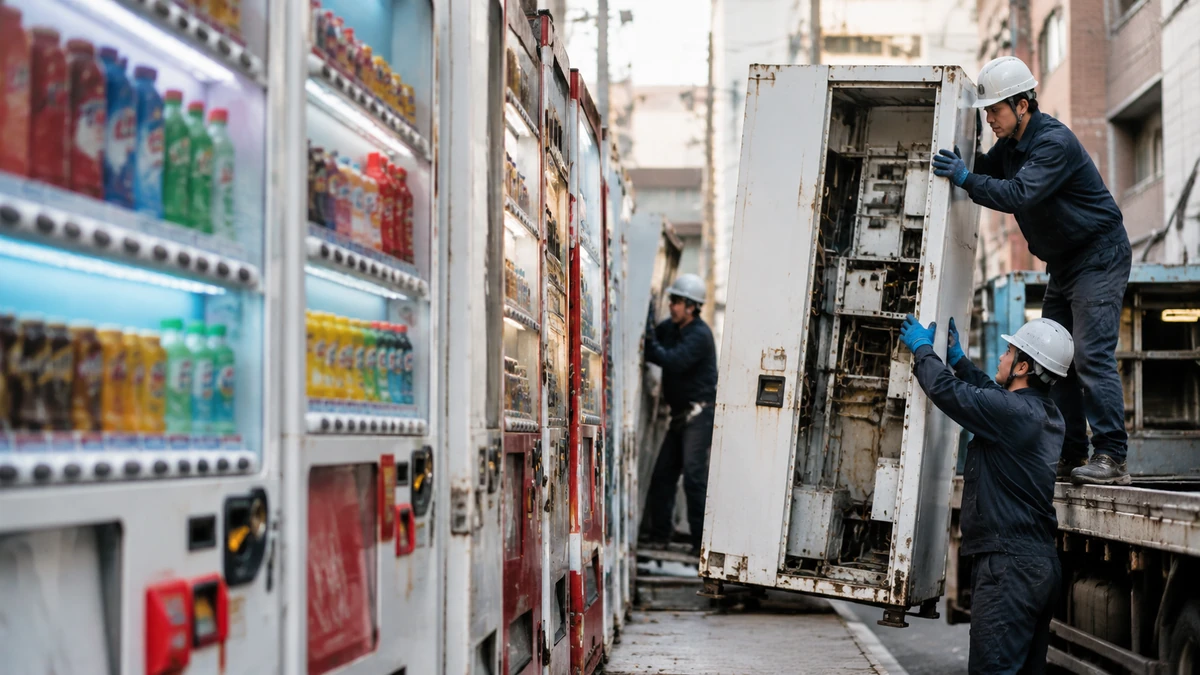
But one of Japan’s most recognizable urban features is entering a period of decline. The number of operating beverage vending machines in Japan has fallen from a peak of about 2.47 million units in 2014 to roughly 1.95 million in 2025, according to Japan’s beverage industry data cited in Korean media reports. The drop of about 20% over a decade reflects a broader transformation in Japanese retail, where companies are reassessing the cost of maintaining large networks of physical sales points.
The change does not mean vending machines are disappearing from Japan overnight. Instead, it shows how even a deeply established part of daily life can be challenged by inflation, changing consumer habits and new competition. The machines that remain must now prove they can generate enough revenue to justify their operating costs.
Why Japanese Beverage Companies Are Removing Unprofitable Machines
The vending machine business depends on location, maintenance and steady customer traffic. A machine placed near a busy train station or office district can generate consistent sales, but one in a lower-traffic area still requires electricity, repairs, restocking and regular management.
Those costs have become increasingly difficult for operators to absorb. Rising prices for ingredients, higher electricity bills and increased labor expenses have pressured beverage companies across Japan. At the same time, companies have found it harder to raise vending machine prices without pushing consumers toward cheaper alternatives.
Japanese beverage companies are responding by reducing their networks and focusing on efficiency rather than simply maintaining the largest possible number of machines. Pokka Sapporo Food & Beverage announced plans to sell its vending machine business in March, while DyDo Group Holdings has said it intends to remove about 20,000 unprofitable machines from its nationwide network of roughly 270,000 units.
The decisions show a shift in corporate thinking. In the past, the number of machines itself represented market strength. Today, companies are paying closer attention to whether each individual machine produces enough profit. The question is no longer how many vending machines a company operates, but whether each machine earns its place.
A Consumer Shift: Convenience Alone Is No Longer Enough
Japan’s vending machine culture developed around a powerful idea: immediate access. Consumers could purchase a cold drink or coffee without waiting in line or entering a store. For decades, this convenience matched the fast-paced rhythm of Japanese cities.
However, convenience is facing stronger competition from other retail channels. Supermarkets, drugstores and discount retailers have expanded their beverage selections while offering lower prices. Many Japanese consumers, especially during a period of rising living costs, are becoming more price-conscious and willing to buy drinks elsewhere.
This trend is familiar to American consumers as well. In the United States, convenience stores, grocery chains and online retailers have changed how people think about everyday purchases. A product that was once bought because it was nearby must now compete on price, selection and overall value.
Japan’s vending machine industry illustrates a similar global retail transition. Physical access remains important, but consumers increasingly expect competitive pricing and a wider range of choices. A machine located on a street corner may still be convenient, but convenience alone is becoming less powerful as a business advantage.
What Japan’s Vending Machine Decline Means for the United States
For American companies and consumers, Japan’s vending machine changes offer a useful example of how mature retail systems evolve. The United States has its own history with vending machines, from office snack machines to airport drink dispensers, but the Japanese market has long represented a more advanced and widespread model of automated retail.
Japan’s experience may provide lessons for American retailers exploring automated stores, smart vending systems and unmanned shopping technology. The challenge is not simply installing more machines. Companies must determine where automated sales truly create value and where they become an expensive substitute for more efficient retail options.
The shift also connects to broader economic ties between the United States and Japan. Both countries face similar pressures: aging populations, higher operating costs and consumers looking for better prices. Japanese companies have often been early adopters of retail automation, and changes in Japan’s market can provide signals for companies elsewhere that are investing in similar technologies.
For American consumers familiar with Japan through tourism, anime, food culture and entertainment, the vending machine has become an iconic image of Japanese everyday life. Its decline is not simply about fewer machines on streets. It represents a larger question facing developed economies: how traditional forms of convenience adapt when technology, costs and consumer expectations change.
The Future of Japan’s Vending Machine Industry
The future of Japanese vending machines is likely to involve fewer machines but more strategic use of each location. Companies may focus on higher-performing sites, smarter inventory management and machines that provide services beyond basic beverage sales.
Japan has already experimented with advanced vending concepts, including machines offering digital payment options, customized products and additional services. The next stage may involve using technology to improve efficiency rather than expanding the number of machines.
The decline of vending machines also reflects a broader transformation in Japan’s economy. Many industries built around large physical networks are being forced to reconsider their models. Retailers, restaurants and service providers are increasingly asking whether scale alone is enough or whether efficiency and adaptability matter more.
For decades, Japan’s vending machines represented a vision of the future: automated, reliable and available everywhere. Today, they represent a different lesson. Even the most successful systems must adjust when economic conditions change. The story of Japan’s vending machines is not only about disappearing machines; it is about how one of the world’s most innovative consumer markets is redefining what convenience means.
Comments
Post a Comment