Nepal Floods Put South Korea’s Overseas Citizen Protection System to the Test — and Offer a Warning for Global Companies, Including in the U.S.
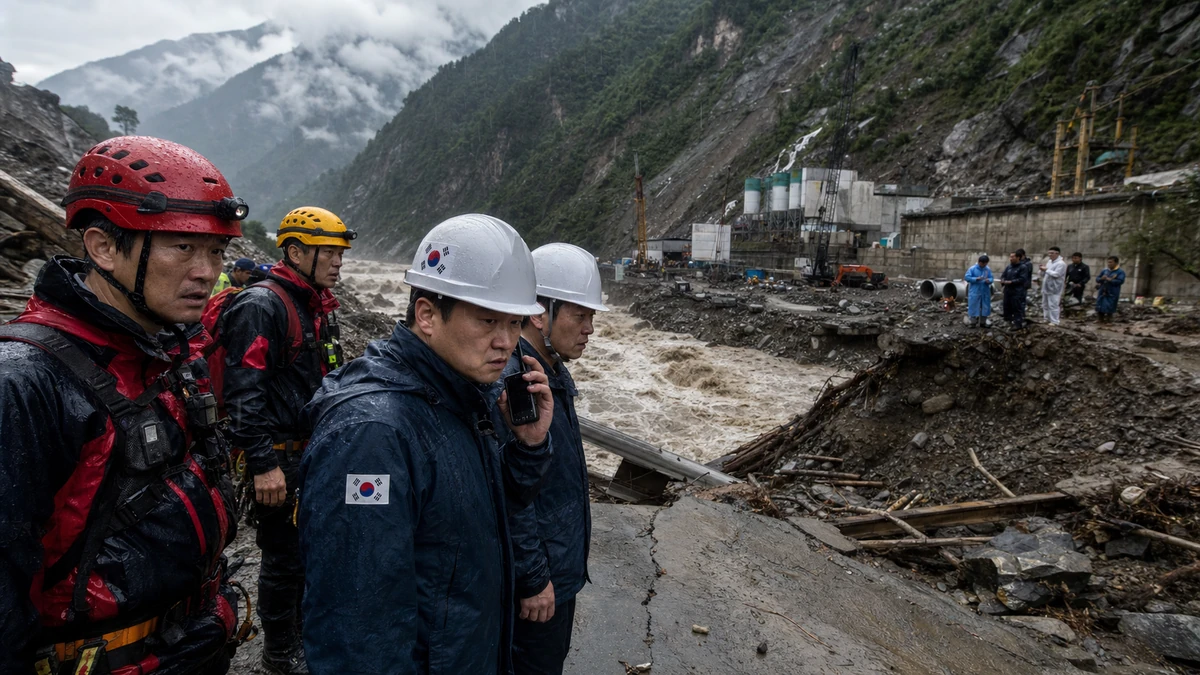
Image to help understand the article
A disaster in Nepal becomes a test of state capacity
The sudden flooding in Nepal’s Rasuwa region that left nine South Koreans unaccounted for and temporarily stranded 10 others is, on its face, a breaking-news disaster story. But it is also something more revealing: a real-time stress test of how a modern government protects its citizens when they are working far from home in dangerous and complicated environments.
According to South Korean authorities, the missing people were employees connected to Korea South-East Power, a state-run energy company, and Doosan Enerbility, a major private-sector industrial firm. The workers were involved in a hydropower plant construction project in Nepal when flooding hit the area on June 26. South Korea’s Foreign Ministry later said the safety of 10 other South Koreans who had been isolated was confirmed, even as the search for the missing continued.
That distinction matters. In the early hours of a disaster, numbers often change as governments, companies and embassies sort through incomplete reports, disrupted communications and conflicting information from the ground. In this case, the number of unaccounted-for South Koreans was initially reported as eight, then revised to nine after the South Korean Embassy in Nepal confirmed that an additional Korean national locally hired by Doosan Enerbility had also lost contact.
For American readers, this may sound familiar. Whether after wildfires, hurricanes, earthquakes or overseas attacks, the first official casualty or missing-person counts are often provisional. The challenge is not simply speed; it is credibility. Families want immediate answers, but officials cannot responsibly promise certainty before they have it. Every number represents a person, and every revision can either build public trust through transparency or deepen anxiety if it appears chaotic.
That is why this story is not only about a flood in the Himalayas. It is about the mechanics of modern diplomacy, crisis management and corporate globalization. South Korea is one of the world’s most export-oriented economies, and its companies routinely place engineers, project managers and technical staff in far-flung infrastructure sites. When a disaster strikes in one of those places, the state’s responsibility does not end at the border. It begins there in a different form.
The South Korean government responded by activating its overseas citizen protection system, coordinating between the Foreign Ministry, the embassy in Nepal, other ministries and the companies involved. President Lee Jae-myung, according to the presidential office, ordered officials to use every available means to support search and rescue efforts, prioritize the lives and safety of South Korean nationals, work closely with Nepalese authorities, support families and prevent further harm. Foreign Minister Cho Hyun convened a meeting of the government’s overseas citizen protection headquarters, and Seoul said it planned to dispatch a joint rapid-response team involving the Foreign Ministry, fire authorities and police.
In other words, this is not just a consular problem. It is a whole-of-government problem. And that makes it a revealing case for how countries increasingly define national protection in a globalized labor market.
Why the information confusion matters as much as the rescue effort
One of the most important details in this story is easy to overlook: the number of missing people changed from eight to nine as officials refined the facts. In ordinary political discourse, such revisions can quickly be weaponized as evidence of incompetence. In actual disaster reporting, they usually signal something else — that authorities are working through the messy reality of fragmented information.
The workers in Nepal were tied to multiple institutions at once. Some were connected to a state-owned enterprise, others to a private corporation, and at least one was a Korean national hired locally. That means the reporting lines were unlikely to be uniform. A headquarters in South Korea may have one personnel list. A subcontractor or local office may have another. The embassy may receive separate notifications from families, employers and local authorities. In a mountainous disaster zone where communications and movement are unstable, reconciling those lists becomes a critical and time-sensitive task.
This is one reason overseas disaster response often looks slower or more confusing from the outside than the public expects. Before a government can search effectively, it has to answer basic questions: Who was on site? Under whose authority were they working? Were they direct employees, subcontractors or local hires? When was the last verified contact? Which routes in and out are still accessible? Which information comes from a witness, which from a company, and which from local rescue command?
For journalists, and for the public, there is a temptation to treat a revised count as a correction to a simple clerical error. But in situations like this, the revised number exposes a structural issue: global workforces do not always fit neatly into a single reporting chain. That matters not only for rescue operations but also for how governments define whom they are responsible for assisting and how quickly they can account for them.
South Korean officials have publicly separated the 10 people whose safety was confirmed from the nine whose whereabouts remained unknown. That may sound bureaucratic, but it is a crucial distinction. In a fast-moving disaster, mixing the categories of “isolated,” “evacuated,” “confirmed safe” and “unaccounted for” can generate false hope or unnecessary panic. Clear labeling of uncertainty is not a sign of weakness. It is a core part of responsible crisis communication.
American audiences have seen similar dynamics in domestic emergencies and overseas incidents involving U.S. citizens. What often determines public confidence is not whether the first report is perfect — it rarely is — but whether officials clearly explain what is confirmed, what is still being checked and who is in charge of updating the picture. South Korea now faces that familiar test under intense public scrutiny.
South Korea’s overseas citizen protection system is under the spotlight
South Korea’s response also illustrates how the country increasingly treats overseas citizen protection as a central function of foreign policy rather than a narrow consular afterthought. That is an important shift in a country whose diplomatic profile has grown alongside the international reach of its corporations, construction firms and energy projects.
For decades, South Korean diplomacy was often understood abroad through summit meetings, trade deals, North Korea policy or, more recently, the global rise of K-pop, Korean film and television. But another, less glamorous layer of Korean international presence is just as significant: engineers, plant operators, logistics specialists and contractors working across the Middle East, South Asia, Southeast Asia and beyond. The Korean Wave may be what many Americans notice first, but industrial Korea has long been global.
The Nepal flood response shows the less visible side of that global footprint. When Koreans work overseas on infrastructure projects, protecting them requires coordination between diplomatic posts, government ministries, rescue services, law enforcement and employers. Seoul’s plan to send a joint team involving not just diplomats but also fire and police officials suggests recognition that embassy assistance alone may not be enough in a disaster zone.
That approach reflects a broader understanding of what consular protection means today. It is not just issuing emergency travel documents or relaying messages to families. It includes integrating technical rescue expertise, security management, local liaison work and verified data from companies operating on the ground. In crisis response, an embassy may be the front door, but it cannot be the entire house.
There is also a political dimension. Leaders from both South Korea’s governing camp and opposition have publicly urged a swift response and safe returns. In a polarized democracy, bipartisan concern over citizens caught in an overseas disaster is hardly surprising, but it still matters. It gives the government wider room to act quickly and signals to families that, at least in this moment, domestic political competition is not the main story.
At the same time, a serious test remains ahead. Announcing a task force, convening a ministerial meeting and promising rapid deployment are the visible parts of crisis management. The harder part is whether those systems produce accurate family notifications, effective cooperation with local rescuers and sustained attention after the first headlines fade. Disaster response is measured not only by mobilization but by follow-through.
Why Nepal’s role is central — and why foreign governments cannot go it alone
Another crucial reality in this story is that South Korea cannot simply run its own rescue operation in Nepal. The search and rescue effort on the ground is being led by Nepalese authorities, including teams involving the army and police. That is not a diplomatic courtesy; it is the practical and legal structure of international disaster response.
In mountainous terrain after flooding, the host government controls access routes, local security, heavy equipment deployment and the basic command structure for rescue personnel. Foreign governments can provide information, request support, coordinate lists of missing nationals and dispatch liaison teams. But they generally cannot bypass local authorities and operate independently. That makes the quality of bilateral cooperation decisive.
For South Korea, success depends on how well its officials can align their information with Nepal’s rescue operations. If Seoul can quickly supply accurate personnel lists, last-known locations, employer affiliations and communication records, Nepalese rescuers may be better able to narrow the search. If those lists are fragmented or constantly shifting, the response can lose valuable time.
This is one reason the revised missing-person count matters beyond public messaging. It underscores the need for a unified roster that combines information from the embassy, corporations and relevant ministries. In a domestic emergency, a state can compel agencies to share data. In an overseas project involving public and private actors in another sovereign country, that coordination becomes harder and slower unless systems have already been built in advance.
Nepal, for its part, is no stranger to difficult terrain or disaster risk. But every major flood or landslide strains resources, especially in remote regions where roads, communications and weather conditions complicate access. That means foreign governments with nationals in the area must calibrate their expectations carefully. Public pressure at home may demand immediate outcomes, while operational realities on the ground allow no such guarantees.
For American readers, this is a useful reminder of how global interdependence actually works. When citizens of one country are caught in a disaster in another, there is often a strong emotional expectation that “our government should do something.” It should. But in practice, what it can do is often inseparable from the capacity, consent and infrastructure of the host country. Diplomacy, in moments like this, is not abstract statecraft. It is the difference between parallel systems and coordinated ones.
What this means for the United States
The American angle here is not hypothetical. U.S. companies, contractors, aid organizations and engineering firms also place personnel in high-risk environments abroad, from infrastructure corridors and mining regions to post-disaster zones and politically unstable areas. The questions South Korea is confronting in Nepal are questions the United States knows well: How quickly can a government identify its nationals in a chaotic overseas emergency? How effectively can it work with employers? And how clearly can it communicate with families when verified information is scarce?
There is also a direct U.S.-Korea relevance. South Korea is one of America’s closest allies, and the relationship is often described through defense ties, semiconductor supply chains, electric vehicles and the cultural pull of K-pop and Korean dramas. But alliance management increasingly includes something more practical and less discussed: how each country protects its people, companies and industrial interests across third countries. As U.S. and South Korean businesses expand in shared global markets, they encounter many of the same logistical and security risks.
American firms have long learned that supply chains do not end at the factory gate. A hydropower construction site in Nepal may feel remote from consumers in Chicago or Atlanta, but the underlying pattern is familiar. Large projects depend on multinational labor, local contractors, regional governments and complex lines of authority. When something goes wrong, the crisis is never only local. It ripples through investors, corporate reputations, diplomatic channels and public expectations back home.
There is also a communications lesson here for U.S. audiences. South Korea’s distinction between those confirmed safe and those still unaccounted for mirrors best practices American agencies have had to learn, sometimes painfully, in disaster response. The public often wants certainty faster than institutions can responsibly provide it. Governments that overpromise risk losing credibility; governments that communicate too cautiously risk appearing detached. The balance is difficult, and it is one both Seoul and Washington have to strike.
For American fans of South Korea — and there are millions, thanks to the global success of Korean music, film, television, food and beauty brands — this episode is also a reminder that the country’s global story is not only about entertainment exports. South Korea’s international presence is deeply tied to heavy industry, public utilities, engineering and energy development. The same nation that sends chart-topping artists to U.S. stadiums also sends technical workers to demanding project sites abroad. Understanding modern Korea means seeing both.
If there is a broader lesson for the United States, it is that overseas citizen protection is becoming a bigger part of economic statecraft. As American and allied companies spread operations across climate-vulnerable and infrastructure-strained regions, disaster preparedness cannot be treated as a side issue. It is part of doing business globally. Seoul’s response in Nepal will be watched not just by families and diplomats, but by companies and allied governments asking how prepared they are for the next crisis.
A trend bigger than one flood: globalization meets climate risk
The deeper significance of this story lies in the collision between two forces: the globalization of technical labor and the rising frequency of severe weather and disaster risk. Workers are more mobile than ever, and major infrastructure projects increasingly place personnel in regions where geography, weather and weak transportation links can turn an emergency into a prolonged crisis.
That does not mean every disaster should be read as evidence of a single global pattern, and it would be wrong to claim more than the known facts support. But this case does fit a broader reality facing governments and corporations alike. Climate-related hazards, from floods to landslides to extreme heat, are not abstract environmental concerns when they hit project sites where foreign nationals are deployed. They become labor issues, diplomatic issues and boardroom issues all at once.
For South Korea, whose companies remain active in overseas construction, plant engineering and energy development, that trend raises unavoidable questions. Are worker rosters integrated across public agencies and private employers? Are local hires and direct hires captured in the same emergency protocols? Are family notification systems fast and consistent? Are embassies resourced to function as information hubs during geographically remote disasters?
Those questions are not unique to Korea. They are equally relevant to the United States and other countries with globally dispersed workforces. What the Nepal floods reveal is that the old separation between foreign policy and corporate risk management is breaking down. When citizens work abroad at scale, embassies become crisis nodes. When disasters intensify, consular affairs becomes operational. When public and private actors share a worksite, accountability becomes collective whether institutions are ready or not.
That is why this episode may matter beyond the immediate search effort. It offers a window into how governments are adapting — or struggling to adapt — to a world in which national responsibility travels with citizens into remote job sites, unstable communications networks and climate-exposed regions.
What to watch next
In the short term, the most important question is the fate of the nine South Koreans who remain unaccounted for. Officials in Seoul have said efforts are continuing with Nepalese authorities, and the line between hope and realism in such situations is always painfully thin. Families will want verified updates, not speculation, and the public will watch whether the government can maintain clarity as facts evolve.
Beyond that immediate concern, several indicators will show whether South Korea’s response system performed effectively. First is whether officials can maintain a clear separation between confirmed facts and unresolved reports. Second is whether the planned joint rapid-response team, involving diplomatic, fire and police personnel, translates into better coordination on the ground. Third is whether Seoul can provide families with consistent information while avoiding the confusion that often follows overlapping institutional channels.
Another question is whether companies and government agencies draw longer-term lessons from the role of locally hired Korean nationals and mixed employer structures in this case. If the revised missing-person count exposed blind spots in personnel tracking or reporting chains, pressure may grow for more standardized emergency protocols for overseas projects involving both public and private entities.
For the United States and other allies, the larger takeaway is less about the specifics of Nepal than about the architecture of global risk. Countries increasingly need systems that can move quickly across ministries, across borders and across private-public lines when citizens are caught in disasters abroad. That is not a niche concern. It is part of what globalization now requires.
The flood in Nepal is first and foremost a human tragedy and an ongoing rescue matter. But it is also a revealing measure of how states care for their people in an interconnected world. South Korea’s response is being watched at home as a test of competence and compassion. Abroad, it deserves attention as a case study in what modern diplomacy looks like when the emergency is far from the capital, the information is incomplete and the stakes are counted person by person.
Comments
Post a Comment