North Korea Launch Puts Japan on Alert, Underscoring How East Asia’s Missile Tensions Reach the U.S.
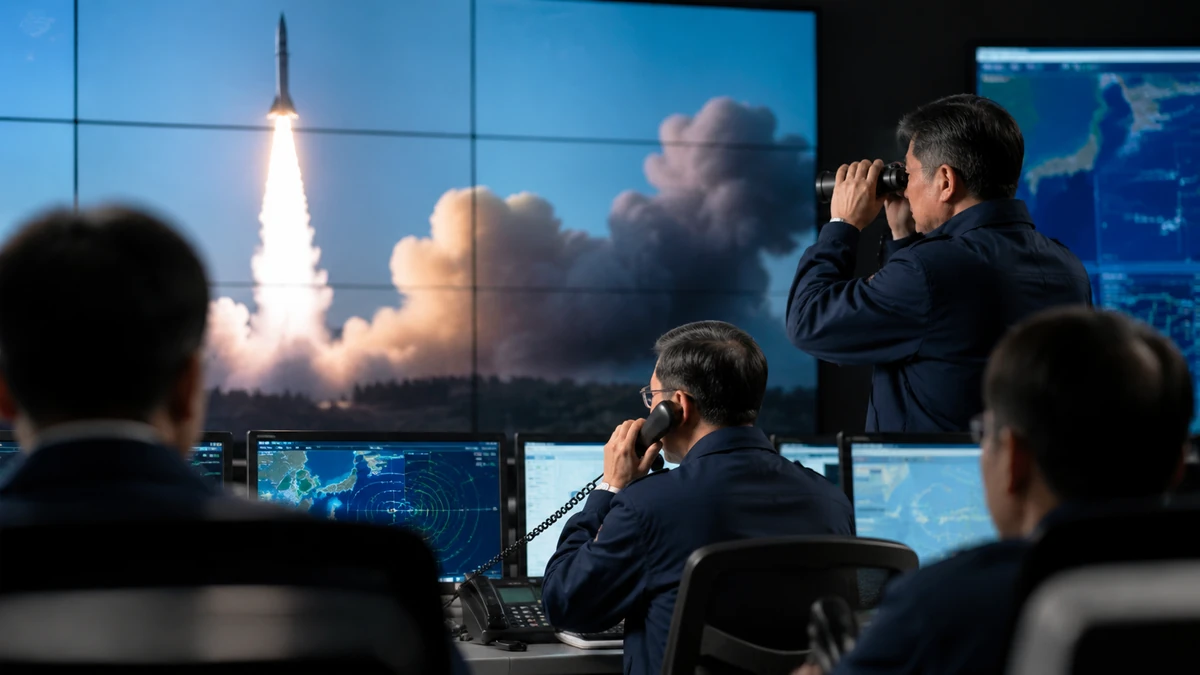
Image to help understand the article
Japan’s early warning reflects a familiar pattern in Northeast Asia
Japan’s Defense Ministry said Tuesday that North Korea launched what it described as a possible ballistic missile, and that the object was believed to have already fallen outside Japan’s exclusive economic zone, or EEZ. Japanese authorities said they were still gathering information to determine whether there had been any effect on Japan, while the Japan Coast Guard urged ships in nearby waters to pay close attention to follow-up announcements and official guidance.
That combination of caution and urgency is typical of the first hours after a North Korean launch. Officials in Tokyo did not immediately identify the projectile with certainty as a ballistic missile, instead using more limited language: an object that could be a ballistic missile. They also stopped short of presenting a final impact point, saying only that it appeared to have fallen outside Japan’s EEZ. For readers in the United States, that wording matters. It signals that this was an initial detection announcement, not a final technical assessment.
In practical terms, the confirmed facts remain narrow. Japanese authorities said a launch was detected from North Korea. They said the object was likely missile-related, though not yet conclusively identified in the public statement. They said it appeared to have landed outside Japan’s EEZ, meaning outside the maritime zone where Japan holds special economic rights over resources and related activities. And they said they were still checking whether the launch had any impact on Japan. There has been no public announcement from Japan of damage inside its territory or waters, and no detailed public accounting yet of the projectile’s range, altitude, exact splashdown point or debris pattern.
That limited public record is important because North Korea launches often produce an immediate flood of speculation. In Washington, Seoul and Tokyo, analysts routinely try to infer political intent from launch timing, type and trajectory. But the Japanese government’s own language points to the limits of what was known at the moment of the announcement. For now, the most responsible reading is also the simplest one: a launch was detected, the object is believed to have landed outside Japan’s EEZ, and Japan activated both its security review and maritime safety procedures while further analysis continues.
Even so, events like this rarely stay local. A launch from North Korea is never just a matter between Pyongyang and its nearest neighbors. It is part of a larger security story involving the United States, the U.S.-Japan alliance, U.S. forces in the region, commercial shipping lanes and the broader question of how democracies manage military risk in an age of rapid, incomplete information.
Why landing outside Japan’s EEZ does not end the safety concern
To American readers, the phrase exclusive economic zone can sound technical, even abstract. But in maritime Asia, the EEZ is a central organizing concept. Under international law, an EEZ generally extends 200 nautical miles from a coastal state’s shoreline, giving that country special rights over marine resources and certain economic activities. It is not the same as sovereign territorial waters, and it is not a simple line between danger and safety. That distinction helps explain why Japanese authorities continued to issue warnings even after saying the object appeared to have fallen outside the EEZ.
A splashdown beyond Japan’s EEZ does not automatically eliminate risks to vessels at sea. In the immediate aftermath of a launch, authorities still need to clarify the projectile’s actual flight path, whether it broke apart, whether fragments fell over a wider area and whether any civil aviation or shipping routes might have been affected. That is why the Japan Coast Guard’s advisory to ships should not be mistaken for proof of damage or a sign that a direct strike was expected. It is better understood as a standard safety step in an uncertain maritime environment.
Americans have seen similar logic in domestic emergency communications. When the National Weather Service issues a watch before a warning, or when the Federal Aviation Administration reroutes flights during an unfolding security issue, officials are not necessarily saying the worst has happened. They are acknowledging that uncertainty itself can be dangerous if people ignore it. In that sense, Japan’s maritime warning functioned less like an alarm bell for confirmed harm and more like a notice to mariners: stay alert, monitor updates, and be prepared for revised navigation guidance as more data comes in.
This distinction also matters politically. North Korea’s missile activity often triggers sharp rhetoric, but not every launch produces the same level of immediate danger. A projectile landing outside Japan’s EEZ is not a trivial event, especially given the broader military backdrop in the region, but neither is it equivalent to a confirmed strike inside Japanese-controlled waters. Keeping those categories separate is essential for understanding what happened and for avoiding the kind of exaggerated interpretation that can quickly spread online and inflame public tensions.
In other words, the Japanese response shows how modern security management works in real time. Defense officials analyze the launch as a military and intelligence question. Coast Guard officials treat the same event as a navigation and public safety issue. Both responses can be active at once, even when the publicly confirmed facts are still limited.
The wording of Japan’s announcement shows the boundaries of what officials know early on
Perhaps the most revealing part of Japan’s initial response was not what it said, but how carefully it said it. The phrases “possible ballistic missile” and “appears to have fallen” are the language of provisional assessment. They tell the public that the government is moving quickly to disclose a potentially serious event, while also signaling that the evidence is still being processed.
That kind of disciplined ambiguity is not bureaucratic hedging for its own sake. It is a feature of crisis communication in a region where seconds matter but overstatement carries costs. If officials speak too definitively before radar, satellite and tracking data are reconciled, they risk spreading inaccurate information at home and abroad. If they say too little, they leave space for rumor and panic. Japan’s phrasing in this case suggests it was trying to draw a line between those two dangers.
For U.S. audiences, there is a useful comparison in the way the Pentagon, NORAD or the Department of Homeland Security sometimes handle fast-moving incidents. Initial public statements are often tightly limited to what can be confirmed immediately: something was detected, the situation is being assessed, there is no confirmed threat to the public at this time, or more information will follow. Those formulations can frustrate people looking for instant clarity, but they exist for a reason. In strategic environments, speed and certainty do not always arrive together.
That is especially true with North Korea, whose weapons activity has repeatedly tested the surveillance, analysis and messaging systems of neighboring governments. A launch can be detected quickly, but its full profile may take longer to establish. Was it short-range or something more capable? Was it a single projectile or part of a larger pattern? Did it follow a standard ballistic path or a more unusual one? None of those questions were answered in the initial Japanese statement summarized here, and the absence of those answers should shape how the event is interpreted.
This is more than semantic caution. In East Asia, the language governments use in the first hours after a launch can influence markets, public anxiety, military posture and diplomatic signaling. A restrained public description is one way authorities try to keep a security incident from spiraling into an information crisis before the facts are settled.
What this says about a larger regional trend, not just one launch
While this incident is limited in confirmed detail, it fits a broader pattern that has become familiar across Northeast Asia: military activity by North Korea is now interpreted not only through the lens of capability, but also through the lens of information management. The region’s security challenge is no longer just about what Pyongyang launches. It is also about how quickly neighboring states can identify it, classify it, communicate it and reassure the public without minimizing risk.
That is one reason the event matters beyond the single day’s headlines. In periods of recurring launches, what changes over time is not simply the number of projectiles or the sophistication of North Korea’s arsenal. What also changes is the operating rhythm of governments around it. Japan, South Korea and the United States have had to build systems that can respond to ambiguous moments with enough speed to protect public safety and enough discipline to avoid premature conclusions.
The summary of Japan’s response in this case reflects exactly that balance. On one track, the Defense Ministry continued analyzing whether the object was in fact a ballistic missile and whether it had any impact on Japan. On another, the Coast Guard told vessels to remain attentive to follow-up notices. Those are not contradictory reactions. They are the dual mechanics of modern deterrence and civil preparedness: intelligence review on one side, practical risk management on the other.
There is also a political dimension to this rhythm. In East Asia, every missile-related announcement is absorbed into a longer-running debate about escalation, deterrence and alliance credibility. Even when a projectile lands outside a country’s EEZ, the fact of the launch itself reinforces the reality that North Korea remains a live military problem for the region. For Japan, that helps explain why even incomplete launch information is treated with public seriousness. For outside observers, it is a reminder that what might look like a narrowly technical event still feeds into much bigger strategic calculations.
At the same time, restraint matters. The available facts in this case do not support sweeping claims about motive, retaliation or a dramatic shift in the regional balance. The most defensible trend line is narrower: governments in the region are continuing to refine how they handle uncertainty in public view, and North Korean launches continue to test those systems repeatedly.
What it means for the United States
For Americans, the immediate instinct may be to see this as a distant dispute involving North Korea and Japan. But that reading misses how tightly U.S. security and economic interests are woven into events like this. The United States is treaty-bound to Japan, maintains a large military presence in the region and has spent years deepening coordination among Washington, Tokyo and Seoul. When North Korea launches a suspected missile, it is not just a regional headline for the State Department briefing room. It is part of the operating environment for one of America’s most important alliance networks.
The U.S.-Japan alliance is central here. Japan depends on the United States for extended deterrence, including the broader military umbrella that helps dissuade adversaries from testing allied resolve. The United States, in turn, depends on Japan as a critical security partner in the Indo-Pacific, home to major U.S. bases and a cornerstone of regional logistics, intelligence cooperation and force posture. A launch near Japan therefore carries implications well beyond Japan’s shores, even if the object ultimately fell outside Tokyo’s EEZ and caused no reported damage.
There is also the question of American forces and assets in the region. Any North Korean launch prompts scrutiny because U.S. personnel, installations and operations are part of the same strategic map. Even when the event does not directly threaten the U.S. mainland, it tests the warning architecture that underpins American defense commitments in Asia. For U.S. policymakers, a key issue is not only the projectile’s technical profile, but also how seamlessly Japan, South Korea and the United States share data, synchronize public messaging and maintain deterrence without accidental escalation.
The American market angle is subtler but still real. Northeast Asia contains some of the world’s busiest shipping routes, major electronics supply chains and crucial nodes in the global economy. A single launch outside Japan’s EEZ is not, by itself, evidence of disruption to trade. Still, repeated military tensions in the region force shipping companies, insurers, investors and multinational firms to pay attention. U.S. companies with exposure to East Asian manufacturing and transport networks understand that even events that stop short of crisis can raise operational risk and sharpen concerns about resilience.
There is a domestic political angle in the United States as well. American debates over defense spending, missile defense and alliance burden-sharing are often abstract until an event like this puts them back in concrete terms. North Korean launches underscore why Washington continues to invest in early-warning systems, regional coordination and military readiness in Asia. They also feed the broader bipartisan argument that the Indo-Pacific is not a peripheral theater for the United States, but a central one.
For American audiences, there is a useful industry comparison too. Just as a cybersecurity breach at a close ally can trigger immediate concern inside U.S. government and business circles because networks are interconnected, a missile-related security incident in Northeast Asia resonates in Washington because deterrence networks are interconnected. The event may happen near Japan, but the strategic consequences are shared across the alliance system.
Why careful reporting matters when the facts are still developing
One lesson from this episode is that the information ecosystem around security events can be almost as consequential as the events themselves. In an age of instant alerts and viral speculation, an initial government statement can be amplified globally within minutes, often stripped of its cautions and qualifiers. That makes the distinction between confirmed facts and preliminary assessments especially important.
In this case, the key boundaries are clear. Japanese authorities said a launch was detected from North Korea. They said the object was possibly a ballistic missile, not definitively one in their initial public wording. They said it appeared to have fallen outside Japan’s EEZ. They said they were checking whether Japan was affected, and the Coast Guard urged ships to monitor further guidance. Beyond that, major elements remained unresolved in the public account at the time summarized here, including the object’s exact type, flight distance, altitude and precise impact location.
For news organizations, analysts and readers alike, that should set the terms of discussion. It is fair to recognize the seriousness of any suspected missile-related launch by North Korea. It is also fair to note that Japan activated both defense and maritime safety procedures. But it is not responsible to treat unresolved details as settled, or to inflate a precautionary maritime advisory into evidence of confirmed damage or immediate escalation.
American readers are familiar with this challenge from crisis coverage at home, whether involving natural disasters, aviation emergencies or national security scares. The first official account is often necessary but incomplete. The discipline lies in resisting the urge to convert uncertainty into certainty just because audiences are demanding instant answers. In that sense, the most important detail in Japan’s initial announcement may be its modesty: it told the public what was detected, what was suspected and what still needed to be verified.
That kind of communication can seem unsatisfying in the short term, but it is vital in a region where misinterpretation can quickly sharpen tensions. The better test of a government response is not whether it produces immediate omniscience, but whether it gives the public a reliable baseline without outrunning the evidence.
What to watch next
The significance of this launch will depend largely on what Japanese and possibly allied authorities establish in follow-up findings. The most important questions are straightforward. Was the object ultimately classified as a ballistic missile? Did subsequent analysis confirm the initial judgment that it landed outside Japan’s EEZ? Were any maritime or aviation routes affected? And did Japan, South Korea or the United States release additional technical information that clarified the launch’s trajectory or strategic meaning?
Until those answers arrive, the event is best understood as a case study in how Northeast Asia handles security ambiguity. It shows Japan moving quickly but cautiously, separating what is known from what is still being assessed. It shows that even a splashdown outside Japan’s EEZ can trigger practical safety measures for ships. And it shows why North Korea’s launch activity remains inseparable from the alliance politics and economic interdependence that tie East Asia to the United States.
For Americans, that last point is the most important. This is not simply a story about a projectile over distant waters. It is a story about how a volatile security issue in Asia intersects with U.S. alliances, U.S. military planning, U.S. business interests and the broader challenge of managing risk without overreaction. If the last several years have taught Washington anything, it is that stability in the Indo-Pacific depends as much on credible communication and coordinated response as it does on military hardware alone.
What happened Tuesday may or may not prove to be a major event in technical terms once more data is released. But even in its limited initial form, it offers a clear window into the region’s new normal: recurring military tests, carefully calibrated public warnings and an alliance system that must process uncertainty in real time. That reality matters not only in Tokyo and Seoul, but in Washington as well.
Comments
Post a Comment