North Korean Troops in Russia, Now With Drone Units, Signal a Deeper and More Dangerous Phase of the Ukraine War
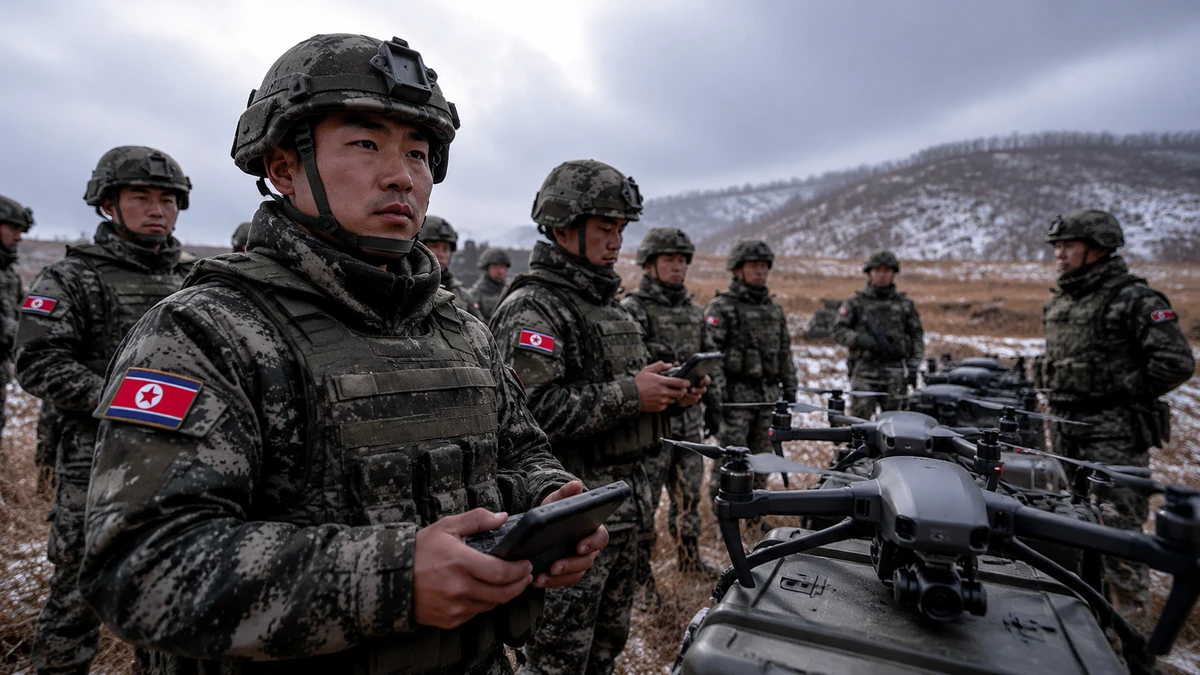
Image to help understand the article
A new claim points to a broader North Korea role in Russia’s war effort
Ukraine’s military intelligence agency says roughly 8,500 North Korean troops have been deployed in Russia and that the force includes drone units capable of reconnaissance and attack missions. The claim, attributed to Vadym Skibitskyi, a deputy chief of Ukraine’s Defense Intelligence Directorate, was reported by CNN and described the North Korean troops as being based mainly in Russia’s Kursk region.
That figure and those details have not been independently verified, and neither Moscow nor Pyongyang is cited in the source material as confirming them. That matters. In wartime, intelligence disclosures can serve several purposes at once: informing allies, shaping public understanding and signaling urgency. Any claim coming from one side in an active conflict requires scrutiny, especially when it involves troop numbers, battlefield roles and weapons transfers.
Still, even with that caution, the Ukrainian assessment is significant because it describes something more consequential than a simple manpower infusion. If North Korean personnel in Russia include units that operate reconnaissance and strike drones, that suggests Pyongyang’s support may be expanding beyond sending soldiers and ammunition into functions that help identify targets and carry out remote attacks. In modern warfare, that distinction is critical. Infantry can hold ground or reinforce strained units. Drone operators can help shape the battle itself by locating enemy positions, relaying battlefield intelligence and directing or conducting strikes at a distance.
For much of the war, public discussion of North Korea’s role has centered on artillery shells, rockets and the possibility of labor or troop support to help Russia sustain a long, grinding campaign. The new Ukrainian claim points to a more integrated kind of military cooperation, one that would tie North Korean personnel not just to Russia’s need for numbers, but to the increasingly central technologies of the war.
That is why this development, if borne out, matters well beyond the headline figure of 8,500. It suggests that the war in Ukraine is continuing to internationalize in ways that are not limited to aid packages from NATO countries or commercial sanctions on Russia. It also suggests that relationships among authoritarian states are evolving from political solidarity into more operational military exchange, with each side providing what the other lacks.
Why drone units matter more than the raw troop count
To an American audience, the word “drone” can sound deceptively familiar. The United States has spent two decades associating drones with everything from overseas counterterrorism operations to consumer quadcopters sold at electronics stores. In Ukraine, however, drones have become something closer to a daily organizing principle of war. They are used to observe trenches, spot artillery targets, adjust fire, surveil logistics routes and strike individual vehicles or personnel. In some sectors, soldiers on both sides operate under almost constant observation from unmanned aircraft.
That is what gives Ukraine’s claim its weight. A drone unit is not just another support detachment. Depending on its training and equipment, it can extend a force’s eyes and reach. Reconnaissance drones can identify targets and track movement. Attack drones can translate that intelligence into immediate action. If North Korean units are doing both, then Pyongyang’s role would not be limited to adding bodies to Russian formations. It would mean participating in the information-to-strike chain that defines much of this war.
The summary of the Korean report is careful on this point, and so should any responsible analysis be. Ukraine says those drone units could surveil or attack targets inside Ukraine. That does not prove what missions they have already performed, how frequently they operate or under whose command they function in practice. It does, however, show that Ukrainian officials are now talking about North Korean forces in terms of capability, not simply presence.
That change in emphasis is important. In military analysis, the question is not only how many troops are present but what equipment they have, what jobs they are assigned and how tightly they are woven into command structures. A few thousand infantry troops can matter locally. A smaller number of skilled personnel in drones, air defense or targeting can matter strategically. That is especially true in a war where relatively inexpensive unmanned systems have altered the battlefield faster than traditional procurement cycles can keep up.
For U.S. readers, a useful comparison is the way American military planners have spent years warning that the next major conflict would turn on networks, sensors, munitions and data links as much as on troop formations. The Ukrainian claim implies that North Korea may be entering that ecosystem on Russia’s side, however limited or unevenly. If that is right, it would represent a more mature level of military cooperation than many observers had assumed.
The Kursk detail offers a clue about how Russia may be using foreign forces
Another notable part of the Ukrainian claim is geographic: the troops are said to be stationed mainly in Russia’s Kursk region. Kursk sits near the Ukrainian border and has become part of the broader war zone created by cross-border fighting, strikes and military staging. By identifying a main deployment area rather than implying that all North Korean troops are spread evenly along the front, Ukraine is sketching a more organized picture of where and how those forces may be used.
That matters because location can hint at mission. Troops based inside Russia but near the border could be used for rear-area security, training, logistics support or cross-border operational tasks. If drone units are part of that deployment, the place they are based and the range of the systems they operate do not necessarily have to match exactly. A force can be stationed in one location and still support operations deeper into a conflict zone through reconnaissance or remote strike roles.
In other words, the Kursk reference suggests that North Korean participation may be structured, not ad hoc. Ukraine is not merely alleging that foreign troops are somewhere in Russia. It is saying there is a concentration in a specific region and that the deployed units may include specialized capabilities. That combination strengthens the argument that Russia is treating North Korean personnel as part of a broader force mix rather than as a symbolic or temporary supplement.
Again, caution is necessary. The public does not have the full intelligence picture. Open-source analysts, Western governments and independent researchers may eventually confirm, refine or challenge Ukraine’s assessment. But the specific mention of Kursk shows that this is no longer being framed as an abstract fear about North Korean involvement. It is being framed as a concrete, evolving military arrangement with known locations and identified roles.
That shift alone should get policymakers’ attention. Wars rarely stay confined to their original participants once the material demands become severe enough. Russia has already relied on outside supplies to sustain its campaign. If North Korean forces are now part of the equation in a more visible way, the conflict’s international dimension is becoming harder to dismiss as peripheral.
A possible exchange of troops, ammunition and air defense systems raises the stakes
The Ukrainian official cited in the Korean summary also said North Korea asked Russia for the S-400 air defense system in return for providing troops and ammunition. Separately, Ukraine’s intelligence service says it believes North Korea has already received Pantsir surface-to-air missile systems from Russia. Those are two different claims and should be treated differently. According to the summary, the S-400 was described as a request, not a confirmed transfer. The Pantsir system was described as a transfer Ukraine believes has already occurred.
That distinction is not a technical footnote. It goes to the heart of responsible reporting. One of the easiest ways to mislead readers in fast-moving security stories is to blur the line between a demand, a negotiation and a completed delivery. Based on the source material here, it would be wrong to say that Russia has definitely transferred S-400 systems to North Korea. It would be more accurate to say Ukraine claims North Korea requested them and separately claims North Korea has already obtained Pantsir systems.
If even part of that alleged exchange is true, the implications are substantial. It would suggest a barter-like structure in which North Korea sends labor-intensive and consumable military inputs, such as troops and ammunition, while Russia provides technology and systems that could improve North Korea’s long-term air defense capabilities. That would be a different order of partnership than a one-off arms shipment. It would mean the war in Ukraine is not only reshaping Europe’s security landscape but also potentially affecting the balance of military capability in Northeast Asia.
Americans should pay attention to that possibility because North Korea’s weapons development has never been just a regional issue. It is a recurring concern in U.S. alliance planning with South Korea and Japan, a persistent subject of sanctions enforcement and a factor in Pentagon force posture across the Indo-Pacific. Any transfer that improves North Korea’s ability to defend key assets or absorb pressure from adversaries would reverberate far beyond the Russia-Ukraine battlefield.
This is also where the trend line matters more than any single allegation. The individual pieces in the Ukrainian account — troops, ammunition, drone units, air defense systems — point in the same direction. They suggest the relationship between Moscow and Pyongyang may be widening across multiple military domains at once. Whether every detail is confirmed or not, the pattern Ukraine is describing is one of growing depth and reciprocity.
What this means for the United States
For the United States, the most important takeaway is not simply that North Korea may be helping Russia. Washington has long assumed that adversarial states learn from one another, trade around sanctions and look for openings when U.S. attention is divided. What appears to be changing is the degree of operational overlap between two countries that are both central to major American security concerns — Russia in Europe and North Korea in Asia.
If North Korean personnel are now part of Russia’s battlefield ecosystem, and if Russia is compensating Pyongyang with military technology or systems, the United States is no longer looking at two separate security files. It is looking at a feedback loop. The war in Ukraine could end up strengthening a U.S. adversary in East Asia, while North Korea’s support could help Russia sustain pressure in Europe. That is the kind of cross-theater problem American strategists worry about because it complicates deterrence, procurement and alliance management all at once.
The U.S. angle is also practical, not just strategic. Ukraine’s warning comes as Kyiv faces mounting vulnerability from the depletion of air defense munitions, including U.S.-made Patriot interceptors mentioned in the Korean summary. American policymakers are already debating the cost, pace and political durability of support for Ukraine. A battlefield environment in which Russia can draw not only on domestic production and Iranian-style drone warfare lessons but also on North Korean manpower and possibly drone operators makes that debate harder to keep compartmentalized.
There is also a domestic American reference point here. The U.S. military and defense industry have spent years racing to adapt to a world where low-cost drones can threaten expensive legacy systems. Ukraine has been the most visible real-world laboratory for that shift. If North Korean forces are gaining operational experience around drone reconnaissance and strike roles in or near this war, that experience itself has value. It could inform North Korea’s own doctrine, training and future military planning in ways that matter to U.S. forces stationed in South Korea and the wider region.
For American allies, especially South Korea and Japan, the stakes are obvious. For the United States, they are indirect but immediate. U.S. treaty commitments in Asia mean that any meaningful upgrade in North Korea’s military capabilities is also an American problem. And because Washington remains Ukraine’s most important backer, any new outside support for Russia is also an American problem. That is why this story belongs not only on the foreign desk but also in the broader conversation about how interconnected today’s security crises have become.
What this says about the globalization of modern war
One of the clearest lessons of the Ukraine war has been that 21st-century conflicts are rarely self-contained. Weapons come from one set of countries, sanctions from another, financing and industrial support from others still. Commercial technology gets repurposed for military use. Intelligence flows across alliances. The front line may be in one place, but the supply chain stretches across continents.
The Ukrainian assessment of North Korean troops and drone units fits that pattern. It suggests that the longer the war lasts, the more likely it becomes that outside states will contribute not just matériel but specialized capabilities. That is a sign of how attritional this conflict has become. Long wars consume ammunition, personnel and political bandwidth. They also create incentives for governments under pressure to seek help from whichever partners are willing to assist, regardless of international isolation.
There is a Cold War echo here that American readers will recognize, but the mechanics are more contemporary. This is not simply ideological bloc politics. It is transactional, adaptive and technology-aware. States are not just aligning in theory; they are exchanging concrete military value based on immediate needs. Russia needs manpower and munitions. North Korea may want advanced systems, know-how or leverage. Ukraine wants allies to understand that the battlefield it faces is not static.
That makes verification all the more important. The next phase of reporting and analysis should focus on separating three questions: whether the 8,500 figure remains current, what missions any North Korean drone units are actually performing and what evidence emerges regarding transfers of Pantsir systems or any movement toward an S-400 deal. Those are related issues, but they are not identical, and treating them as interchangeable would only muddy public understanding.
At the same time, waiting for perfect certainty can obscure real shifts underway. Intelligence claims often arrive before full proof is available in public. That is frustrating but not unusual. What journalists and policymakers can do now is track whether new evidence supports the broader conclusion Ukraine is advancing: that North Korea’s contribution to Russia’s war effort is becoming more complex, more technical and more strategically meaningful.
What to watch next
The immediate question is whether outside governments, including the United States and South Korea, publicly corroborate any part of Ukraine’s account. Even partial confirmation — on troop concentrations, drone roles or air defense transfers — would strengthen the case that the Russia-North Korea relationship has entered a new phase. Another key indicator will be whether future disclosures continue to describe North Korean involvement in terms of specialized units rather than general troop presence.
Watch, too, for how Washington frames the issue. If U.S. officials begin talking about Ukraine and the Korean Peninsula in more connected terms, that will be a sign they see this as more than a one-off wartime workaround by Moscow. It would suggest growing concern that military cooperation forged under the pressure of the Ukraine war could outlast the conflict itself.
For American readers, that is the larger story. This is not only about whether 8,500 North Korean troops are in Russia or whether a drone unit is operating near the front. It is about the way a European war may be reshaping security dynamics in Asia and, by extension, the strategic burdens facing the United States. The details still need independent verification. The trajectory, however, is becoming harder to ignore.
If Ukraine’s assessment is even broadly accurate, then North Korea is no longer just a distant supplier on the margins of Russia’s war. It is becoming part of a more integrated military relationship — one that spans troops, ammunition, unmanned systems and potentially air defense technology. That would mark a meaningful escalation in the internationalization of the conflict, and a warning that the consequences of this war are spreading in ways Washington can no longer afford to treat as regional.
Comments
Post a Comment