Panama Canal drought cuts ship traffic, offering a stark warning for U.S. supply chains and climate-era trade
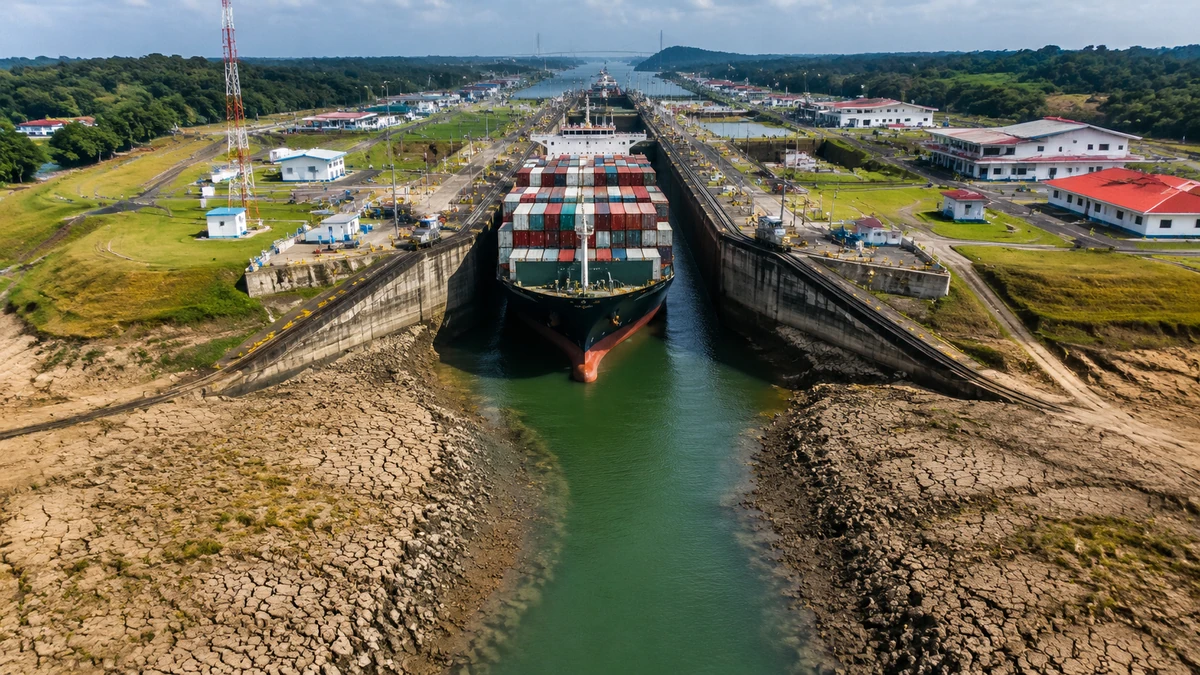
Image to help understand the article
A climate bottleneck at one of the world’s most important trade routes
The Panama Canal, one of the most important shortcuts in global commerce, is being forced to slow down because it does not have enough water. The Panama Canal Authority said it will reduce the number of ships allowed to pass each day from a maximum capacity of 40 to 34 beginning on the fourth of next month, and then to 32 beginning on the 15th. That may sound like a technical scheduling change, but for a trade system built on precision and tight timetables, it is a meaningful cut.
The canal is not simply a regional waterway in Central America. It is a critical junction that helps move goods among Asia, the East Coast of the United States, Latin America and Europe. When traffic through the canal is reduced, the impact does not stay in Panama. It ripples outward into shipping schedules, port planning, freight costs and, eventually, the prices and availability of goods for businesses and consumers far from the canal itself.
The immediate cause is low water levels linked to drought and extreme heat. The deeper story is that climate stress is no longer just a backdrop to the global economy. It is beginning to dictate the real operating capacity of major infrastructure. In other words, the issue is not whether the canal physically exists or whether its locks are intact. The issue is whether nature still provides the water needed to run it at full strength.
That distinction matters. For years, public debate around infrastructure often focused on construction, expansion and engineering limits. But the Panama Canal case shows that in a warming world, headline capacity and usable capacity can diverge. A waterway built to handle 40 ships a day may, under climate pressure, only be able to move 32. That turns weather from a temporary inconvenience into a structural business constraint.
The authority’s staged reduction also sends a signal. This is not being treated like a one-day disruption caused by a storm or an accident. The schedule moves in two steps, first to 34 vessels and then to 32, suggesting managers are preparing for the possibility that dry conditions will persist rather than quickly disappear. For shipping companies and cargo owners, that means less confidence that existing plans can simply go ahead as expected.
In supply chains, timing is a form of value. A missing slot at a major waterway can force a company to delay a shipment, reroute a vessel, reshuffle inventory or renegotiate delivery commitments. One ship is not the whole story. The cumulative effect of fewer ships, day after day, is what raises concern.
Why a reduction from 40 ships to 32 matters more than it sounds
On paper, the change looks straightforward: eight fewer ships per day than the canal’s stated maximum capacity. In practice, it is a reduction of about one-fifth of the canal’s top daily throughput. The first cut, to 34 ships, reduces capacity by roughly 15%. The second cut, to 32, amounts to a 20% drop from the maximum.
For ordinary readers, it may help to think about a major airport suddenly reducing the number of takeoff and landing slots every day for an indefinite period. Flights would still operate, but airlines would have to compete for fewer openings. Delays would build, connections would be missed and the entire network would become less predictable. The Panama Canal works in much the same way for maritime trade. It is not only the total volume that matters. It is the scheduling certainty that allows the system around it to function.
Shipping networks are highly interconnected. A vessel delayed at one chokepoint can arrive late to its next port, miss a berth window, disrupt onward rail or truck arrangements and throw off inventory planning downstream. That is why the concern extends beyond the canal itself. A bottleneck at a single strategic passage can echo across the logistics chain.
The canal authority’s announcement is important in part because it gives dates and numbers, not vague warnings. That creates a window for carriers, exporters, importers and ports to adjust. But advance notice does not eliminate the disruption. It simply changes the nature of it. Instead of chaos caused by surprise, companies face the challenge of deciding which cargo moves first, which routes must be altered and who absorbs the added cost of reduced flexibility.
The shipping industry has spent years trying to make supply chains more resilient after the shocks of the pandemic, port congestion and geopolitical tension. Yet the Panama Canal situation underlines a different kind of vulnerability: infrastructure that remains fully standing but cannot be fully used because the surrounding environment has changed. That is a harder problem than repairing a damaged asset. It requires redesigning operations around volatility that may recur.
The canal’s reduced throughput is also a reminder that logistics capacity is not only about cranes, terminals and ships. Water itself is a production input. Without enough of it, throughput falls. That idea may seem obvious in agriculture or power generation, but it is becoming newly relevant in shipping as climate-driven drought alters waterways that trade has long treated as dependable.
What this means for the United States
For Americans, the Panama Canal is not a distant story. It is part of the hidden architecture behind everyday economic life. The canal is a key route for cargo moving between Asia and the U.S. East Coast, and its efficiency helps shape how retailers, manufacturers and agricultural exporters plan their business. If the canal can move fewer ships, American companies may face longer transit times, tougher scheduling decisions and potentially higher transportation costs.
That matters especially in a country where supply chains have already become a political and economic issue. Americans got a crash course in logistics during the pandemic, when factory shutdowns, shipping delays and port congestion helped drive shortages and inflation. The lesson from that period was that the public may not think much about ports and shipping lanes until something goes wrong. The Panama Canal cuts fit that pattern. Most consumers will not follow daily vessel counts, but they may feel the effects if shipping becomes slower, less flexible or more expensive.
U.S. importers are likely to watch this closely because the canal is part of the routing logic that connects global manufacturing with American consumption. Companies do not merely choose the shortest line on a map. They choose routes based on cost, timing, reliability and available capacity. If canal access tightens, cargo may have to wait or take longer alternative routes, which can alter the economics for everything from seasonal merchandise to industrial inputs.
American exporters also have reason to pay attention. When a major trade artery becomes less predictable, it can complicate outbound shipments as well as inbound ones. Businesses selling abroad often depend on narrow delivery windows and freight arrangements made well in advance. A reduced number of transit slots introduces uncertainty into those commitments.
There is also a broader policy angle for Washington. The United States has spent the last several years talking about supply-chain resilience, strategic infrastructure and economic security. Much of that conversation has focused on domestic manufacturing, semiconductor policy and friend-shoring with allies. The Panama Canal story adds another layer: even if the United States and its partners diversify suppliers, the physical routes that connect those suppliers to markets remain exposed to climate risk.
For U.S.-Korea ties, this is especially relevant because South Korea is deeply embedded in global trade, from electronics and autos to industrial materials and shipping. American companies depend on Korean firms in multiple sectors, and Korean exporters rely on reliable maritime networks to reach North American customers. If key chokepoints become harder to use at full capacity, it affects not only bilateral trade volumes but also the predictability that modern just-in-time business models expect.
American audiences may also recognize a familiar pattern from domestic experience. In the United States, climate stress has increasingly disrupted systems that once seemed routine: low river levels affecting barge traffic, heat straining power grids, drought stressing water supplies and wildfires disrupting transportation corridors. The Panama Canal restrictions are the international version of that same reality. Critical systems do not need to collapse to become less useful. They only need to lose enough operating margin that routine commerce starts to slow.
For U.S. companies, the practical takeaway is not panic but recalculation. Businesses that depend heavily on schedule certainty may need to build in more time, diversify routes where possible and treat climate-driven infrastructure constraints as part of normal risk planning rather than as rare exceptions. For American policymakers, the message is that supply-chain resilience cannot stop at factory location. It must also include climate exposure along the trade routes that connect those factories to U.S. markets.
Why this is bigger than one canal or one dry season
The Korean report places the Panama Canal announcement alongside disruptions at energy facilities in Europe, where extreme heat and drought have also created operating problems. Those are different industries in different regions, but the pattern is strikingly similar. Infrastructure can be technically sound and still underperform when environmental conditions move outside the assumptions built into normal operations.
That is the larger analytical frame here. Climate risk is no longer just about catastrophic destruction after storms, floods or fires. It is also about chronic operational degradation. A system can look intact from the outside and still deliver less than expected. That makes the economic consequences easier to overlook at first and harder to address over time.
In traditional disaster coverage, the storyline is often visible damage followed by repair. A bridge collapses, a power line falls, a port floods. The response is to rebuild. In Panama’s case, the canal authority is not describing a ruined facility. It is proactively lowering usage because water levels are too low for normal throughput. That means the constraint arrives before a dramatic break. It is an operational response to a changed baseline.
This shift matters for investors, governments and businesses because it changes how resilience should be measured. For decades, infrastructure strength was often judged by maximum designed capacity. But in an era of more frequent heat and drought, a more useful question may be how much capacity can be maintained under adverse but increasingly common conditions. The difference between theoretical maximum and dependable real-world output may become one of the most important numbers in global commerce.
That logic applies far beyond shipping. Energy plants need cooling water. Rivers support cargo transport. Agricultural systems depend on rainfall patterns. Urban transit systems strain under heat. What links these cases is that natural conditions once treated as stable background assumptions are becoming more variable and more disruptive. As that happens, climate stops being just an environmental topic and becomes a core economic management issue.
The canal reductions also suggest a change in business culture. Companies have long modeled risk around labor disruptions, fuel costs, exchange rates and political instability. They may now need to place water availability and heat stress in the same category. That does not mean every drought will produce a crisis. It does mean climate variables are moving from the margins of planning to the center.
For readers in the United States, this is similar to the way hurricane season changed from a local weather concern into a national insurance, energy and logistics issue. Once environmental volatility begins repeatedly affecting core systems, it becomes part of mainstream economic planning. The Panama Canal is now offering that same lesson to global shipping.
South Korea’s perspective helps explain why the story resonates globally
The original Korean framing is telling. South Korean media are approaching the Panama Canal restrictions not merely as a foreign weather story but as a warning about global logistics. That makes sense. South Korea is one of the world’s most trade-dependent economies, with a large export sector and a close stake in how efficiently goods move across oceans. When a country like South Korea pays close attention to water levels in Panama, it is because a disruption in one region can affect production schedules, delivery commitments and trade confidence elsewhere.
That perspective is useful for American readers too. The Korean Wave, or Hallyu, is often discussed in the U.S. through entertainment — K-pop, Korean television dramas, film and beauty products. But beneath that cultural visibility is a broader reality: South Korea is a major commercial power whose fortunes are closely tied to global shipping, energy access and infrastructure reliability. Stories like this one show the other side of modern Korea, not just as a cultural exporter but as a sophisticated observer of global supply-chain risk.
There is also an important reason such a story travels well across borders. The canal’s reduced vessel count is a simple, concrete sign of a larger phenomenon. Climate change is often covered through abstract targets, international conferences or scientific warnings that can feel distant to ordinary readers. A canal cutting traffic from 40 ships to 32 is different. It turns an abstract climate threat into an operational number with immediate business implications.
That is likely why the Korean report also links the canal issue with heat and drought problems at European energy facilities. The point is not that the two situations are identical. It is that they reveal the same economic truth: modern infrastructure is still dependent on natural systems, even when it appears highly engineered and globally integrated.
For American readers accustomed to thinking of globalization as fast, frictionless and highly managed, the Korean perspective offers a useful corrective. The global economy may be digital in many places, but it still rests on physical systems — water, ports, power plants, shipping lanes — that can become less reliable under climate stress. That is as true for a semiconductor supply chain as it is for a container of consumer goods.
What businesses, policymakers and consumers should watch next
The first thing to watch is whether the canal restrictions remain at the announced levels or tighten further. The summary available here does not say how long the lower throughput will last, and it would be premature to predict a longer or deeper reduction without more evidence. But the fact that the authority has already laid out a two-step schedule suggests that managers are planning for continuing pressure rather than a quick return to normal.
The second issue is how shipping companies respond. Some may absorb delays, while others may try to reshape schedules or redirect cargo. The key question is not only whether goods still move, but whether they move with the same reliability. In logistics, reliability is often as important as speed, because manufacturers and retailers plan inventories around expected arrival windows.
Third, this episode is likely to feed a broader debate about what counts as resilient infrastructure. Governments and companies may increasingly ask whether global trade routes need more contingency planning for climate variability. That could influence investment decisions, sourcing strategies and the way transportation contracts are structured. It may also push firms to hold more inventory than they would in a perfectly predictable system, even though that can raise costs.
Fourth, the canal restrictions are a reminder for policymakers in the United States and allied countries, including South Korea, that economic security and climate adaptation are now overlapping agendas. It is no longer enough to identify strategic industries. Governments also need to understand the environmental exposure of the routes, facilities and utilities those industries depend on.
Finally, consumers should understand that climate-related disruptions do not always arrive as dramatic emergencies. Sometimes they appear first as slower transit, tighter capacity and more complicated planning for the companies that keep store shelves stocked and factories running. Those shifts can seem invisible until they accumulate.
The Panama Canal’s decision to reduce daily ship traffic because of low water levels is, in that sense, more than a shipping bulletin. It is a case study in how climate pressure is beginning to rewrite the operating rules of the global economy. For the United States, for South Korea and for every country tied into international trade, the message is increasingly hard to ignore: the question is no longer whether climate risk affects commerce, but how often and how deeply it will constrain the systems the world depends on most.
Comments
Post a Comment