Samsung’s U.S. Exports More Than Doubled. The Real Story Is America’s AI Boom and Korea’s Growing Role Underneath It
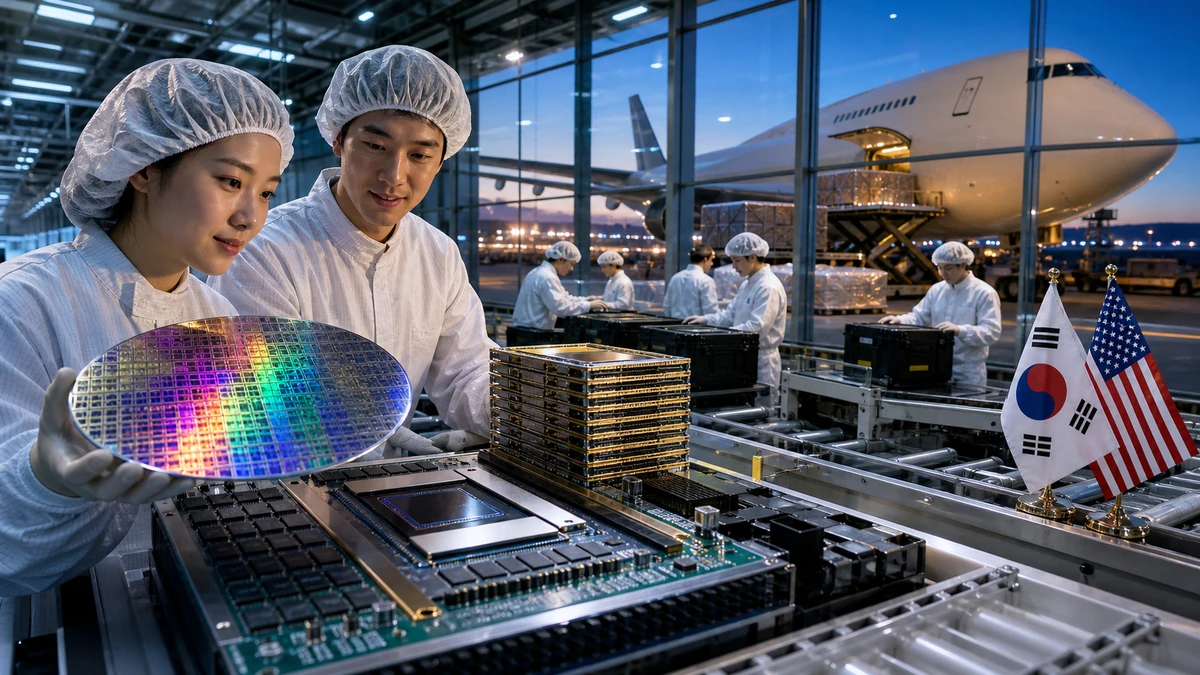
Image to help understand the article
A Korean electronics giant’s export surge says less about phones and more about the hidden machinery of artificial intelligence
Samsung Electronics’ exports to the United States more than doubled in the first half of this year, reaching 70.6 trillion won, or roughly tens of billions of dollars at current exchange rates, according to the company’s newly released half-year report. That compares with 33.5 trillion won in the same period a year earlier, a jump so large that it is difficult to explain through consumer gadget sales alone.
The more important story is not about Americans buying more televisions, refrigerators or Galaxy phones. It is about the infrastructure behind artificial intelligence, and about how deeply South Korean memory chips are becoming embedded in the American tech economy. Samsung did not break out exact regional sales by business unit, so the company did not publicly specify how much of the U.S. export increase came from semiconductors rather than finished electronics. But the broad outlines are clear enough: AI demand is reshaping one of the world’s biggest electronics companies, and the United States is at the center of that shift.
That matters because Samsung is no longer just a household consumer brand in the American imagination. For years, many U.S. consumers knew the company primarily through smartphones, televisions and appliances, the same way they might think of Apple through iPhones or Whirlpool through washing machines. But as generative AI expands from chatbots into search, cloud computing, enterprise software and consumer devices, Samsung’s growing importance lies increasingly in components ordinary users never see. The chips driving AI systems are becoming as strategically important as the devices people hold in their hands, and high-bandwidth memory, or HBM, is now one of the most critical pieces of that equation.
The latest numbers suggest Samsung’s map of global revenue is changing quickly. Instead of relying mainly on the ups and downs of smartphone upgrades or appliance demand, the South Korean company is becoming more tied to the capital spending cycles of American tech giants building the computing backbone of AI. That is a very different business model, with very different geopolitical and economic implications.
Why memory chips matter now in a way they did not a few years ago
To understand why Samsung’s U.S. export figure is drawing attention, it helps to understand what HBM actually is. High-bandwidth memory is a type of advanced memory designed to move enormous amounts of data quickly and efficiently. In plain English, it helps AI systems keep up with the vast computational demands of training and running large models. If advanced graphics processors are often described as the engines of AI, HBM is part of the fuel delivery system that keeps those engines operating at full speed.
That makes companies like Samsung central to the AI race in a way that is less visible than software breakthroughs but no less important. When Americans use AI tools, whether through workplace software, cloud services, image generators or search products, they are interacting with systems that depend on a sprawling physical supply chain. That supply chain runs through U.S. chip designers, Taiwanese contract manufacturers, data center builders, energy grids and Korean memory makers. Samsung’s supply of HBM3E and HBM4, both advanced generations of high-bandwidth memory, points to its role in that chain.
For years, the global memory market was often discussed in terms of smartphones, PCs and cyclical consumer electronics demand. That world has not disappeared, but AI has added a new layer of demand with different economics. AI memory is tied less to whether consumers decide to replace a device this quarter and more to whether major technology companies keep spending aggressively on computing infrastructure. Those buyers are concentrated heavily in the United States, where the world’s biggest cloud providers and AI platform companies are based.
That is why Samsung’s surge in exports to the U.S. has symbolic value beyond the headline number. It suggests that South Korean chip technology is moving deeper into the foundational layers of the AI economy, not just into the consumer products that sit on store shelves. In other words, this is a reminder that the AI boom is not purely a software story told in Silicon Valley boardrooms. It is also a hardware story, and part of that story runs through South Korean fabs, packaging lines and export lanes.
Samsung’s earnings mix shows how dramatically its center of gravity is shifting
The company’s broader performance helps explain why this export increase stands out. Samsung said its Device Solutions division, the business that includes semiconductors, accounted for 68.5% of total revenue in the first half and 97.4% of operating profit. Those figures are striking. They show that semiconductors are not just contributing to growth; they are doing almost all of the heavy lifting when it comes to profitability.
That is a meaningful shift in how Americans should think about Samsung. In the United States, the company’s brand identity has long been tied to direct consumer competition with Apple in phones and with a wide array of electronics makers in home devices. But the latest results suggest that the strategic core of Samsung’s business, at least for now, lies elsewhere. Its chip business is not merely one division among many. It is the engine pulling the rest of the company.
That distinction matters because profits, not just sales, determine how companies invest, hire, expand and compete. When nearly all operating profit is coming from semiconductors, future corporate strategy inevitably follows. That can mean more investment in advanced memory, more effort to deepen relationships with large AI customers and more exposure to the risks that come with a concentrated, fast-moving market. The upside is clear: AI has created a lucrative new demand center. The downside is equally obvious: dependence on one hot sector can leave a company vulnerable if that market cools, if pricing changes or if customers shift suppliers.
Samsung’s half-year report does not allow analysts to pinpoint exactly how much of the U.S. export jump came from HBM. That limitation is important, and responsible reporting should acknowledge it. But the timing, scale and business mix all point in the same direction. When U.S. exports more than double, when semiconductor profits dominate the company’s earnings, and when Samsung is supplying advanced HBM products to major global technology companies including Nvidia, the inference is hard to miss: AI chip demand is changing Samsung faster than consumer electronics demand can explain.
What this means for the United States: more than a trade statistic, it is an AI supply-chain story
For American readers, the local angle is not hard to find. The United States is where much of the demand behind this export surge originates. American companies are building the data centers, ordering the accelerators, training the large models and selling the AI services that now define the sector’s growth story. That means Samsung’s rising exports to the U.S. are not simply a reflection of Korean industrial strength. They are also a mirror of American capital spending and of the intensity of the U.S. AI arms race.
In practical terms, this underscores how dependent the American technology ecosystem remains on allies in Asia, even as Washington pushes harder for domestic semiconductor production. The United States has made semiconductor resilience a bipartisan national priority through subsidies, export controls and industrial policy. But no serious observer believes America can build a self-contained chip ecosystem overnight. Advanced semiconductors rely on a networked production model spanning the U.S., South Korea, Taiwan, Japan and Europe. Samsung’s numbers are evidence of that reality.
For U.S. companies, especially hyperscale cloud providers and AI chip leaders, access to advanced memory is not a side issue. It is central to how quickly they can scale AI infrastructure. If HBM supply is constrained, AI deployment slows. If memory technology improves, performance gains can ripple through the entire system. That makes Korean suppliers crucial partners in the American tech industry’s next phase of expansion. It also means that U.S.-Korea economic ties are no longer just about autos, consumer electronics or a free-trade agreement. Increasingly, they are about who supplies the parts that make the AI economy possible.
For American investors and policymakers, there is another lesson here. The popular narrative around AI often focuses on U.S. software companies and headline-grabbing valuations. But the profits generated by AI are being shared across a broader set of firms and countries than that narrative suggests. Just as the smartphone era created winners not only in app stores but also in chipmaking, displays and battery supply chains, the AI era is creating upstream winners in memory and advanced semiconductor manufacturing. South Korea is clearly one of them.
There is also a useful American comparison. During earlier technology booms in the United States, from the PC build-out to the smartphone revolution to the cloud era, the companies that supplied essential components often became indispensable even if average consumers knew little about them. Think of Intel during the PC age, or Qualcomm’s role in mobile. Samsung’s growing importance in AI memory fits that pattern. The difference is that this time, the strategic dependency is unfolding in a more geopolitically tense environment, where supply chain concentration and national security concerns are never far from the discussion.
Korea’s role in the AI race is becoming harder to ignore
South Korea has long been a technology heavyweight, but often in categories Americans understand through consumer brands: smartphones, televisions, cars and, more recently, K-pop and streaming hits that shaped the broader Korean Wave. Yet industrial Korea has always been as important as cultural Korea. The country’s economic model has been built in part on globally competitive manufacturing and export power, with conglomerates such as Samsung playing an outsized role. What is changing now is the visibility of that industrial role inside the AI conversation.
The AI boom has a tendency to sound abstract, full of talk about models, agents and software ecosystems. Samsung’s export jump is a concrete reminder that AI is also deeply physical. It depends on factories, logistics, engineering talent, power consumption and a steady pipeline of components. South Korea’s memory specialization gives it leverage in this environment because memory is not an optional add-on. It is core infrastructure.
The symbolism of the U.S. market matters here. America is home to the global companies setting the pace in AI development, from chip designers to cloud giants to software platforms. When a Korean company sharply increases exports into that market, the signal is not merely that it found more customers. It suggests that Korean manufacturing capability is becoming more deeply woven into the command center of the AI economy.
That does not mean the picture is simple or risk-free. AI demand is strong now, but semiconductor cycles are notoriously volatile. The same business that produces spectacular profit growth can cool quickly when inventories rise or spending normalizes. Competition is also intense, and the HBM segment is one of the most strategically contested parts of the chip market. Still, the current moment makes one thing unmistakable: South Korea is not just participating in the AI age as a peripheral hardware vendor. It is helping supply one of the key technologies that make the whole system run.
Why this is better understood as a trend than as a one-off earnings milestone
It would be easy to treat Samsung’s first-half export number as a single strong result and move on. That would miss the bigger pattern. What appears to be happening is a reordering of value inside the technology sector. For years, many of the most visible gains accrued to device makers and internet platforms. Now, as AI infrastructure spending explodes, more of that value is flowing to companies that sit deeper in the supply chain, including advanced memory suppliers.
Samsung’s report suggests not just growth in sales but a change in the character of those sales. That phrase matters. A company that earns money primarily by shipping finished consumer goods to end users faces one set of competitive dynamics. A company that increasingly supplies mission-critical components to AI builders faces another. The second model can be more profitable and more strategically important, but it also ties performance more tightly to enterprise spending, infrastructure cycles and technical qualification battles with major customers.
That is why analysts will be watching whether Samsung can consistently translate HBM3E and HBM4 supply into sustained earnings power. The question is not only whether AI demand remains hot, but whether Samsung can hold or expand its position as product generations move quickly and customers demand ever higher performance. In the semiconductor business, being in the race is not enough; companies must keep up with demanding qualification standards, manufacturing yields and delivery schedules.
The broader regional picture matters, too. The related Korean reporting noted that exports to both the U.S. and China rose sharply. That is another clue that the semiconductor upturn is larger than any one bilateral commercial relationship. AI-related demand is lifting multiple export channels at once, even as trade tensions and technology restrictions complicate the global market. For Samsung, that creates both opportunity and vulnerability: opportunity because major regions are investing in compute, vulnerability because shifts in regulation or customer behavior could reverberate quickly through the business.
For American readers, the takeaway is that the AI boom is beginning to reorder alliances, dependencies and profit pools in real time. The winners are not only the companies writing code or launching consumer AI products. They are also the firms making the specialized hardware those products require. Samsung’s latest U.S. export figure is one data point, but it captures a much bigger shift.
What to watch next in the U.S.-Korea technology relationship
The next phase of this story will turn on durability. If AI infrastructure spending stays strong, Samsung’s role in the U.S. market could deepen further, especially if advanced memory remains a bottleneck technology. If spending cools or customers diversify supply, growth could look less dramatic. Either way, the relationship between American AI demand and Korean semiconductor output is now much more direct than it appeared just a few years ago.
That has implications beyond quarterly earnings. It could shape how Washington thinks about trusted technology partners, how American companies structure procurement strategies and how South Korea positions itself in a world where semiconductor leadership increasingly overlaps with national strategy. The U.S. and South Korea are already security allies. In the AI era, they are also becoming even more visibly co-dependent technology partners.
For American consumers, much of this will remain invisible. People will continue to encounter Samsung in familiar ways, as a phone brand, a TV maker, a name on kitchen appliances. But under the surface, the company’s significance is shifting. Its future may depend less on what sits in American living rooms and more on what sits inside American data centers.
That is why this earnings development deserves attention beyond business pages. It illustrates a defining truth of the AI boom: the technologies reshaping everyday life are built on global industrial relationships, and some of the most important players are far from Silicon Valley. Samsung’s surge in exports to the United States is not just a Korean corporate success story. It is a sign that America’s AI ambitions are already pulling more strongly on the manufacturing power of one of its most important Asian allies.
Comments
Post a Comment