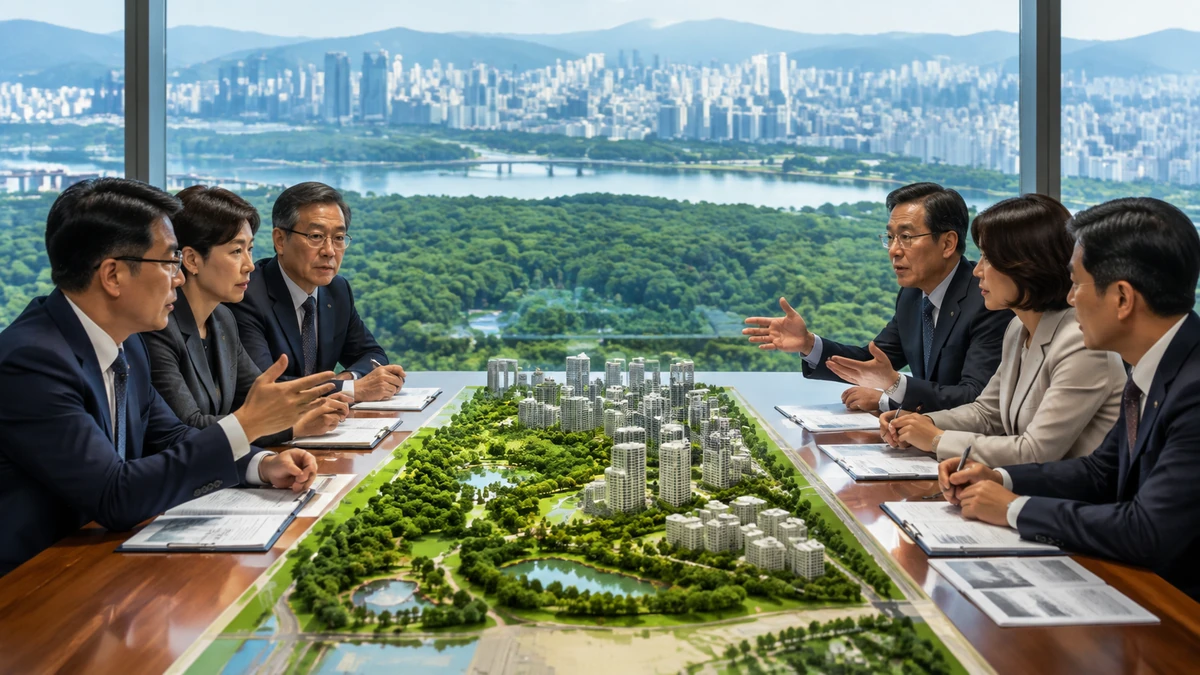
Image to help understand the article
South Korea’s Capital Debates the Future of One of Its Most Valuable Urban Spaces
Seoul is confronting a familiar challenge for major global cities: how to create more homes without sacrificing the public spaces that make urban life more livable. The debate centers on Yongsan Park, a large green area in the heart of the South Korean capital, where the national government is considering using part of the site for housing development.
The proposal has sparked disagreement between South Korea’s central government and the Seoul Metropolitan Government. The national government views the site as a potential solution to the city’s continuing housing supply pressures, while Seoul officials have emphasized the importance of preserving the park as a rare piece of open space in one of Asia’s most densely populated capitals.
For Americans watching South Korea’s rapid urban transformation, the dispute may resemble debates seen in cities such as New York, San Francisco and Los Angeles, where officials regularly weigh new housing construction against demands to protect parks, historic areas and public space.
Yongsan Park is not simply another development site. The land previously served as a military facility and occupies a central location in Seoul, making it both strategically valuable for real estate and symbolically important as a place where citizens hope to reclaim urban space.
A Former Military Site Becomes a Symbol of Seoul’s Urban Future
The discussion over Yongsan Park reflects decades of change in Seoul, a city that transformed from a war-damaged capital into a global business and cultural hub. The area’s history adds complexity to the current debate because the site represents both redevelopment opportunity and public memory.
Government officials have said that providing additional housing in central Seoul could help address demand in a city where land availability is limited. Seoul remains one of the world’s most densely populated metropolitan areas, and housing affordability has become a major political issue in South Korea.
To move forward with housing construction at Yongsan Park, changes to the special law governing the park’s creation would be required. The ruling bloc and government are reviewing possible legislative steps, although the details and scope of any changes remain part of an ongoing political discussion.
The issue is also connected to broader redevelopment plans in the Yongsan district. One major project is the Yongsan International Business District, planned on a former railway maintenance site. The project aims to create a mixed-use area combining offices, residential buildings, commercial facilities and cultural spaces.
Together, these projects could significantly reshape central Seoul. But they also raise questions about what kind of city Seoul wants to become: one focused primarily on increasing density, or one that balances growth with environmental quality and public recreation.
Why Green Space Has Become a Major Urban Planning Issue in Korea
South Korea’s economic success has created a new set of urban priorities. During earlier decades of rapid industrialization, development often focused on building infrastructure, apartments and commercial districts as quickly as possible. Today, as living standards rise, residents increasingly demand access to parks, nature and healthier urban environments.
Seoul Mayor Oh Se-hoon has argued that economic development and housing needs must be considered alongside the importance of green areas. His position reflects a broader argument that parks are not simply unused land but essential infrastructure that contributes to quality of life and a city’s global competitiveness.
This perspective is increasingly common in major cities worldwide. In the United States, debates over urban development frequently involve similar questions. New York’s Central Park, for example, is viewed not as vacant land but as a defining feature of the city’s identity and economic appeal. Los Angeles has also faced ongoing discussions about balancing housing shortages with environmental concerns and neighborhood character.
The Yongsan debate highlights a growing global challenge: major cities need more housing, but they also need places where residents can escape congestion and maintain a connection to nature.
What Seoul’s Decision Could Mean for the United States and Global Urban Development
For the United States, the Yongsan Park debate offers a case study in how another major economy is approaching one of the same problems facing American cities: the shortage of centrally located housing.
American policymakers and urban planners have increasingly focused on building more housing near employment centers and public transportation. Cities across the United States are examining ways to increase density while preserving community spaces. Seoul’s experience provides another example of the political and social challenges involved when valuable urban land becomes the center of competing priorities.
The discussion may also interest American companies and investors watching South Korea’s real estate and infrastructure sectors. Seoul has long been considered a key Asian city for technology, finance, entertainment and international business. Decisions about how the city manages its central districts can influence its attractiveness for global talent and investment.
For American visitors and Korean culture enthusiasts, Yongsan has additional significance. The district is home to cultural destinations, transportation links and international communities, and it has become part of the broader image of modern Seoul presented to global audiences through Korean entertainment, tourism and business connections.
However, there are important limits to comparisons between Seoul and American cities. South Korea’s land constraints, population density and centralized planning system differ significantly from the conditions in many U.S. metropolitan areas. The Yongsan debate is not a simple model for America to copy, but it provides insight into how another global city is approaching the same fundamental question: who benefits from urban land, and how should it be used?
A Test of Seoul’s Long-Term Vision Rather Than a Single Development Decision
The future of Yongsan Park will likely depend on more than political decisions or legal changes. Public opinion, environmental concerns and negotiations between national and local governments will all influence the final direction.
The disagreement between Seoul’s national government and city administration reflects a larger debate about the meaning of development in a modern economy. Housing supply remains a critical issue, but many urban experts argue that successful cities must also protect the spaces that improve everyday life.
As Seoul continues to compete with cities such as Tokyo, Singapore, New York and London, the quality of its urban environment may become just as important as the number of buildings it constructs. The Yongsan Park discussion therefore represents more than a dispute over one piece of land. It is a debate about what kind of global city Seoul hopes to create in the decades ahead.
For international observers, including those in the United States, the outcome will offer a closely watched example of how a major Asian capital balances housing demand, environmental protection and the changing expectations of urban residents.
Comments
Post a Comment