SK’s Japan comments highlight a bigger AI chip reality: In the memory race, power, water and geopolitics matter as much as technology
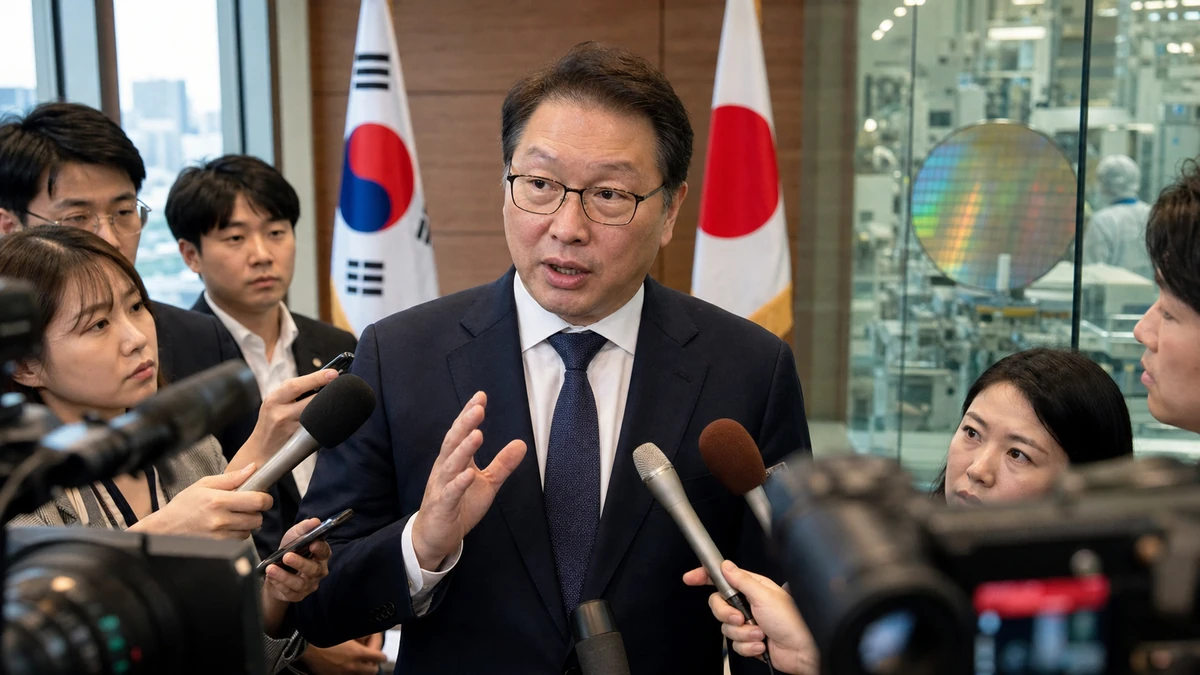
Image to help understand the article
A Korean executive’s remarks stirred questions far beyond Japan
Comments this week by SK Group Chairman Chey Tae-won about the possibility of producing memory semiconductors in Japan have drawn attention not because a factory is suddenly on the way, but because they offer a revealing snapshot of how the global artificial intelligence boom is reshaping the semiconductor map. For American readers, the key point is this: one of South Korea’s most important corporate leaders is signaling that, in the AI era, chip production decisions are increasingly driven by access to electricity, water, cost efficiency and resilient supply chains, not just by where a company has historically operated.
Chey, speaking during a visit to Sendai, Japan, for an annual meeting of Korean and Japanese chamber of commerce leaders, said Japan was among the options SK could consider as it looks for ways to respond to surging AI demand and lower production costs. Bloomberg reported that he was examining the feasibility of a joint chip plant in Japan. But SK Group quickly pushed back on that interpretation, saying it was not accurate to characterize the company as reviewing a joint factory project.
That distinction matters. As of now, there is no confirmed plan for a new SK memory plant in Japan, no announced partner and no disclosed site. The company’s position is that Japan is one of many ideas that could be considered, not a finalized investment destination and not a settled joint venture. In other words, the story here is not that SK Hynix, the group’s chip powerhouse, has chosen Japan. It is that a top Korean conglomerate is openly acknowledging how much the rules of the game are changing under pressure from AI.
That may sound like a subtle difference, but in the semiconductor industry, it is a major one. A CEO describing strategic options is not the same as a board-approved project. Yet those strategic hints often tell investors, governments and competitors what factors are moving to the center of decision-making. In this case, Chey’s remarks point to a future in which memory chip makers may judge locations less by simple market proximity and more by whether a place can support massive, energy-hungry, water-intensive facilities over the long term.
That shift is especially important because SK Hynix is not just any chip company. It is one of the world’s leading producers of memory chips, including high-bandwidth memory, or HBM, the specialized technology that has become indispensable for training and running advanced AI systems. When a company at the center of the AI hardware supply chain starts talking about power, water and international production options, the industry listens.
Why AI is changing where chips get made
The AI boom has created a new hierarchy inside the semiconductor business. For years, consumer electronics cycles and smartphone demand were central drivers of memory markets. Now the rise of generative AI, large language models and data center expansion has made advanced memory one of the most strategically valuable parts of the stack. Companies building AI systems need not only top-end graphics processing units, or GPUs, but also enormous amounts of fast memory to keep those systems running efficiently.
That demand spike has changed what matters when companies decide where to expand production. Building and operating semiconductor plants has always required a highly specialized industrial ecosystem, but AI-era capacity raises the stakes. Chip fabrication and related advanced manufacturing depend on large and stable supplies of electricity, abundant water, expensive equipment and a trusted network of materials and logistics providers. If any one of those inputs becomes unreliable or too costly, the economics of a facility can shift quickly.
Chey’s own description, according to Korean reports, centered on exactly those issues: rising AI demand, lower production costs, and locations with sufficient power and water. That is revealing because it reflects a broader transformation across the industry. Semiconductor competition is still about engineering excellence, but it is increasingly also about infrastructure. A region can have strong industrial talent and still lose out if it cannot guarantee the utility capacity needed for a modern chip complex.
American readers have already seen a version of this dynamic at home. The U.S. push to rebuild domestic semiconductor manufacturing under the CHIPS and Science Act has been about more than bringing back factories for symbolic reasons. It has forced Washington, state governments and private companies to confront practical questions about land, energy, water use, permitting, labor and supply-chain resilience. The glamour of AI often focuses on the software layer or on marquee chip designers like Nvidia, but the physical underpinnings of AI depend on a sprawling industrial base that is far more constrained than many consumers realize.
In that sense, Chey’s comments are less a one-off headline than an indicator of a global trend. As AI demand grows, memory companies are likely to compare countries and regions based on a much wider set of criteria. A location’s ability to provide low-cost, reliable power may become as important as tax incentives. Access to industrial water may matter as much as proximity to customers. And political alignment, especially among U.S. allies in Asia, may weigh heavily when companies assess long-term risk.
Why Japan keeps coming up, even without a firm project
Japan has reemerged in recent years as a serious player in semiconductor strategy, even if it no longer dominates chip manufacturing the way it did in the 1980s. It remains strong in critical materials, manufacturing equipment and industrial know-how. For Korean executives and policymakers, Japan can look attractive not because it replaces South Korea, but because it offers pieces of the ecosystem that remain highly valuable in a world where supply-chain security is under constant scrutiny.
Chey had already made positive remarks about Japan’s semiconductor environment in a June interview with the Nikkei newspaper, saying the country had the necessary ecosystem, including electricity and materials. At that time, too, speculation surfaced about potential investment, and SK Group similarly said it was not actually reviewing a factory construction plan. Taken together, the two episodes suggest consistency in one respect: SK sees Japan as industrially capable. But they also underline the same caution: recognizing Japan’s strengths is not the same thing as committing capital to a specific plant.
That repeated pattern of speculation followed by clarification tells us something useful about the moment. Semiconductor investment has become so strategically sensitive that even broad, exploratory remarks can trigger market and media reactions. A stray comment about production possibilities is immediately read through the lens of national industrial strategy, regional diplomacy and the AI arms race. That is particularly true in Northeast Asia, where technology, trade and security are deeply intertwined.
Japan also offers an interesting case because it has become a focal point for wider efforts by U.S. allies to reduce overconcentration and reinforce trusted supply chains. Tokyo has been more assertive in supporting semiconductor investment, and foreign companies increasingly view the country not only as a market, but as a platform for strategic manufacturing cooperation. For Korean firms, that creates both opportunity and sensitivity. South Korea’s chip sector is a national champion industry, and any suggestion that core production could move abroad naturally invites scrutiny at home.
So far, though, there is little basis to say South Korea’s semiconductor center of gravity is shifting to Japan. The far more grounded interpretation is that SK is keeping its options open in a world where the geography of advanced manufacturing is being reassessed. In that sense, Japan is not necessarily the destination. It is part of the conversation.
What this means for the United States
For the United States, the significance of this story lies in how tightly American AI ambitions are tied to the health of the Asian memory ecosystem. U.S. readers tend to be most familiar with American chip names such as Nvidia, AMD, Intel and Qualcomm. But advanced AI hardware depends heavily on non-U.S. partners, especially memory suppliers in South Korea and manufacturing partners across Asia. If those companies adjust their production footprints, costs or timelines, the effects can ripple through the American tech industry.
SK Hynix is one of the companies most crucial to the AI buildout now underway in the United States. Its high-bandwidth memory chips are a core component in AI accelerators used by American cloud companies and data center operators. The race to build bigger AI models and deploy AI services at scale is not just a software story unfolding in Silicon Valley. It is also a supply story, and much of that supply remains concentrated overseas.
If Korean companies explore production options in Japan, that could reinforce a broader U.S.-aligned industrial network among allies. Washington has spent years encouraging more resilient semiconductor supply chains that are less vulnerable to geopolitical shocks. Closer Korean-Japanese coordination in semiconductors would have once been harder to imagine given the historical and political tensions between the two countries. But recent improvements in Seoul-Tokyo relations, combined with shared concern about supply-chain security, have made such conversations more practical.
For American companies, that could be beneficial if it leads to more diversified and stable access to critical memory components. It could also intensify competition for where future investment goes. The United States is trying to attract more semiconductor manufacturing through subsidies and industrial policy, yet other advanced economies are doing the same. When executives like Chey talk openly about comparing countries based on power, water and cost, U.S. policymakers should hear a clear message: incentives alone are not enough. Infrastructure reliability and operating economics matter just as much.
There is also a lesson here for American audiences used to thinking of semiconductors primarily through the U.S.-China rivalry. That rivalry remains central, but it is not the whole story. The semiconductor map is also being redrawn by cooperation among U.S. allies, especially South Korea and Japan. If those ties deepen, the United States could benefit from a more integrated ecosystem among friendly countries. But American firms will still need to navigate a reality in which the most advanced supply chains are globally distributed, capital-intensive and vulnerable to bottlenecks that have nothing to do with software innovation.
The comparison to the U.S. auto industry is instructive. Americans understand that a car assembled in one state may rely on engines, electronics and materials sourced from multiple countries. The AI industry is moving toward a similar public recognition: a chatbot may seem weightless and digital, but behind it sits a brutally physical supply chain of chip fabs, power grids, water systems and transnational logistics. This story from Korea is a reminder that the future of AI in America will depend partly on strategic decisions made in places like Icheon, Hsinchu, Kumamoto and perhaps, one day, somewhere in Japan chosen for its electricity and water.
A sign of changing Korea-Japan relations, but not a finished deal
The venue of Chey’s remarks adds another layer to the story. He was in Japan not only as head of SK Group but also as chairman of the Korea Chamber of Commerce and Industry, attending an annual meeting with Japanese business leaders. During that trip, he spoke about the need for South Korea and Japan to form an economic bloc at a time when both countries face structural pressures, including aging populations and shrinking labor forces.
That language does not mean a chip project has been folded into a formal Korea-Japan industrial pact. It does, however, suggest that business leaders increasingly see cross-border cooperation as part of the answer to long-term competitiveness problems. For decades, Korea-Japan economic relations have swung between partnership and friction, often shaped by unresolved historical grievances stemming from Japan’s colonial rule of the Korean Peninsula. For American readers, the equivalent would be trying to imagine two essential U.S. trading partners with deep commercial interdependence but recurring political disputes that periodically spill over into supply chains.
That is why even tentative semiconductor comments carry political weight. In East Asia, industrial strategy cannot be cleanly separated from diplomacy. When a major Korean business leader praises Japan’s semiconductor ecosystem and speaks in favor of deeper bilateral economic cooperation, the message resonates beyond boardrooms. It suggests that practical pressures from AI, demographics and global competition may be nudging old rivals toward more pragmatic forms of alignment.
Still, it is important not to overstate the case. Nothing in the available facts shows that SK has chosen Japan, that a partner has been selected, or that a plant is imminent. The company’s explicit denial of a joint-factory review is not a minor footnote. It is a warning against getting ahead of the evidence. Semiconductor reporting often gets distorted by the enormous sums involved and by governments eager to portray tentative discussions as strategic wins. At this stage, the safest conclusion is that SK is signaling flexibility, not announcing a deal.
That caution matters because the line between “reviewing possibilities” and “pursuing a project” is especially consequential in the chip world. A company can spend months or years comparing sites, power availability, subsidy packages and geopolitical risks before deciding whether to move forward. The strategic signal can be real even when the project itself never materializes. For analysts and policymakers, then, the value of Chey’s remarks lies less in predicting a factory than in understanding how corporate thinking is evolving.
The bigger trend to watch in the AI supply chain
What changed here is not merely that Japan was mentioned. What changed is that the logic of semiconductor site selection is being discussed more openly through the lens of AI-era constraints. The conversation is no longer just about labor costs, tax treatment or customer access. It is about whether a region can sustain giant industrial loads at a time when AI demand is accelerating and competition for electricity, water and advanced manufacturing capacity is intensifying.
That has implications well beyond SK Group. Semiconductor companies across the world are likely to face the same questions. Can they scale production fast enough to meet AI demand? Can they do so without allowing energy costs to spiral? Can they build in places politically aligned with key customers and governments? And can they diversify enough to reduce the risk of disruption without creating unaffordable redundancy?
For South Korea, one of the messages is that AI is pushing memory producers into more global calculations about where to expand. For journalists and investors, another message is methodological: do not confuse exploration with commitment. The Korean reporting around Chey’s remarks makes clear that the company wants to preserve that distinction. It accepts that Japanese investment is one possible idea while rejecting a more concrete reading about a joint factory under review.
For the United States and other allies, the broader lesson is that the AI race will be won or lost not only on algorithmic breakthroughs, but also on industrial execution. The next bottleneck may come not from a lack of brilliant engineers, but from an inability to secure enough memory, enough utility capacity or enough trusted production bases. As a result, the countries that look most attractive to chip makers may be those able to combine technical ecosystems with dependable infrastructure and political predictability.
That is what makes this Korean story worth watching internationally. It is not, at least yet, a factory story. It is a strategy story. It tells us that one of the companies at the heart of the AI hardware boom is thinking in increasingly global, infrastructure-centered terms. Whether or not SK ever builds memory capacity in Japan, the reasoning behind the discussion is likely to shape semiconductor investment decisions for years to come.
In the months ahead, the most important things to watch are straightforward: whether SK discloses more detail after completing its review, whether Japan continues to strengthen its case as a semiconductor base, and whether U.S. and allied governments respond by competing even harder on the fundamentals of industrial readiness. In the AI era, the winners may be not only those with the best chip designs, but those with the best power grids, the deepest water reserves and the strongest partnerships among trusted nations.
Comments
Post a Comment