South Korea and Australia Launch Economic Security Dialogue to Strengthen Energy, Minerals and Technology Ties
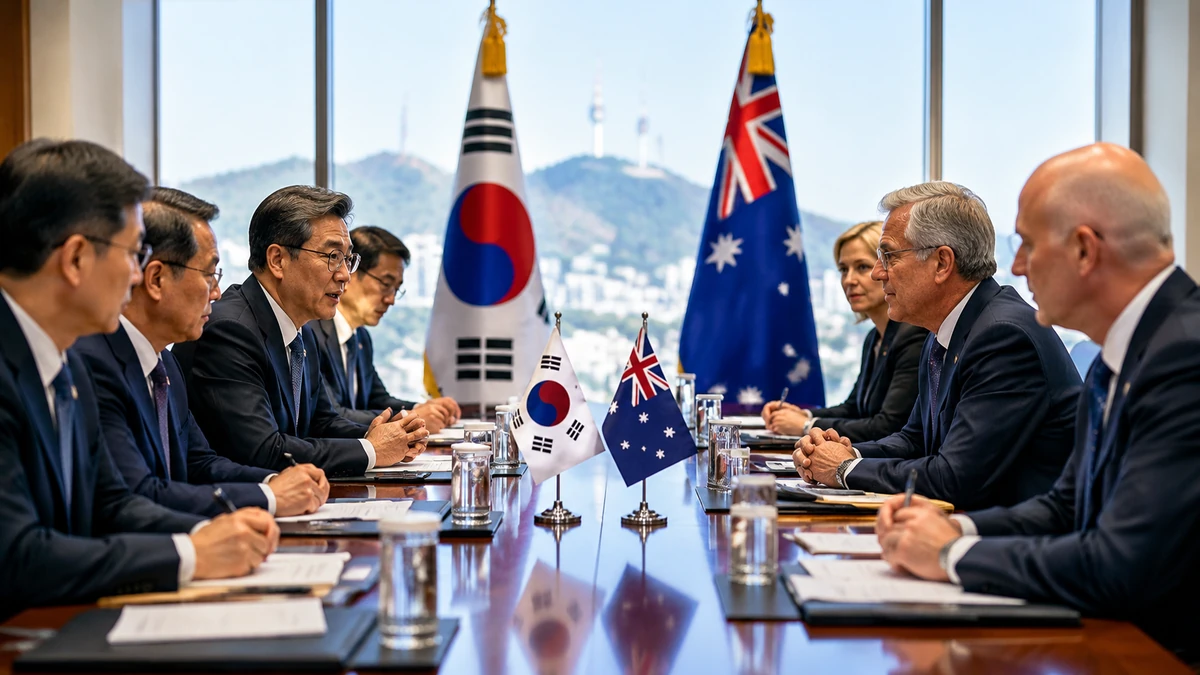
Image to help understand the article
Seoul and Canberra Open a New Chapter in Economic Security Cooperation
South Korea and Australia have launched a new bilateral economic security dialogue, marking a shift in their relationship from traditional trade cooperation toward a broader partnership focused on supply chains, strategic resources and emerging technologies. The first South Korea-Australia Economic Security Dialogue was held in Seoul on Aug. 18, 2026, with officials from both governments discussing how the two countries can respond to growing global economic uncertainty.
The meeting was attended by Park Jong-han, South Korea’s coordinator for economic diplomacy, and George Mina, Australia’s assistant secretary-level official for trade and investment affairs at the Department of Foreign Affairs and Trade. The talks focused on energy security, critical minerals and key emerging technologies, reflecting concerns shared by many industrialized economies about vulnerabilities in global supply networks.
For American audiences, the concept of “economic security” may be familiar from recent debates in Washington about semiconductor supply chains, rare earth materials and reducing dependence on strategically important goods from concentrated sources. South Korea and Australia are pursuing a similar approach: protecting economic stability by strengthening partnerships with trusted countries.
The dialogue does not represent a new trade agreement or the announcement of specific investment projects. Instead, it establishes a framework for continued discussions about shared economic challenges and potential areas of cooperation. The meeting reflects a growing international trend in which diplomacy increasingly includes technology, resources and industrial resilience alongside traditional foreign policy issues.
Critical Minerals and Energy Supply Chains at the Center of Cooperation
The most important issues discussed during the meeting were energy security and critical minerals. South Korea is one of the world’s leading manufacturing economies, with major industries in automobiles, batteries, electronics and advanced technology. These industries require stable access to energy and raw materials.
Australia, meanwhile, has significant advantages as a resource-producing nation. It has long been an important supplier of energy resources, including liquefied natural gas, and possesses reserves of minerals considered essential for modern industries. The South Korean government described Australia as its largest LNG supplier and emphasized the complementary nature of the two economies.
Critical minerals have become a major focus of international economic strategy because they are essential for products such as electric vehicle batteries, renewable energy systems, defense technologies and advanced electronics. Materials such as lithium, nickel and other strategic resources are increasingly viewed as important national assets rather than simply commercial commodities.
This issue has gained attention globally as governments seek to avoid excessive reliance on limited sources of supply. The COVID-19 pandemic, geopolitical tensions and disruptions in international trade have encouraged countries to rethink how they manage supply chains. Instead of relying only on the lowest-cost suppliers, many governments are now prioritizing reliability and diversification.
South Korea and Australia represent a natural partnership in this area. South Korea brings advanced manufacturing capabilities and technology expertise, while Australia offers resource security and experience in mining and energy production. Their cooperation could become an example of how resource-rich and manufacturing-focused economies can work together in a changing global environment.
Beyond Resources: Technology Becomes a New Pillar of Economic Diplomacy
The new dialogue also expanded beyond traditional energy and mineral discussions by including emerging technologies. This reflects a broader change in how countries define economic competition and security in the 21st century.
In the past, economic diplomacy often focused on tariffs, market access and trade agreements. Today, governments are increasingly concerned about semiconductor technology, artificial intelligence, digital infrastructure, cybersecurity and advanced manufacturing capabilities. These sectors influence not only commercial success but also national resilience.
South Korea is recognized globally for its strengths in electronics, semiconductors, batteries and digital industries. Companies based in South Korea play major roles in global technology markets, supplying products and components used by businesses and consumers around the world.
Australia has also expanded its focus on innovation, research cooperation and technology development. While the two economies have different strengths, officials see opportunities to connect their capabilities. The economic security dialogue provides a channel for discussing possible cooperation in areas where technology and strategic industries overlap.
For countries such as the United States, this type of partnership illustrates a wider transformation in global economic relationships. Alliances are no longer limited to military cooperation or traditional trade. Increasingly, countries are building networks around trusted supply chains, technological standards and industrial capacity.
What the South Korea-Australia Partnership Means for the United States
The launch of the South Korea-Australia Economic Security Dialogue carries significance for the United States because both countries are important American partners in the Indo-Pacific region. Washington has encouraged stronger cooperation among allies as governments seek more resilient supply chains and greater coordination on emerging technologies.
The United States has its own efforts to strengthen domestic production and reduce risks in areas such as semiconductors, batteries and critical minerals. Recent American industrial policies have focused on encouraging investment in strategic sectors and working with partners who share similar concerns about supply chain stability.
South Korea’s role in the American economy is already significant. Korean companies have invested in the United States in sectors including automobiles, batteries and advanced manufacturing. Australian resources are also important to global markets, including industries connected to energy and minerals that support technology production.
The Korea-Australia dialogue does not directly create a U.S. policy initiative, but it reflects a regional pattern that affects American companies and consumers. A stronger network among trusted partners could influence future access to materials needed for electric vehicles, renewable energy infrastructure, electronics and other industries.
For American businesses, the development is another example of how geopolitical considerations are becoming part of corporate planning. Companies increasingly evaluate not only cost and efficiency but also the reliability of suppliers and the political stability of production networks.
For American policymakers, deeper cooperation between South Korea and Australia may also reinforce broader Indo-Pacific strategies. Both countries are viewed as important partners in maintaining regional economic stability, although the specific priorities and policies of each government may differ.
A Sign of Changing Global Economic Rules
The creation of the economic security dialogue reflects a major change in the global economy. The traditional model of globalization emphasized efficiency, lower costs and expanding international trade. The current environment places greater emphasis on resilience, security and diversification.
Many countries are now asking different questions about their economies. Instead of only asking where products can be made most cheaply, governments are asking whether supply chains can survive political tensions, natural disasters or sudden disruptions.
This shift is particularly important in industries connected to energy and technology. Electric vehicles, artificial intelligence systems, renewable energy projects and advanced electronics all depend on complex international networks. A disruption in one part of the supply chain can affect businesses and consumers worldwide.
South Korea and Australia’s new dialogue shows how middle powers can respond to these challenges. Neither country is the largest economy in the world, but both have specialized strengths that make them strategically important. South Korea is a technology and manufacturing powerhouse, while Australia is a major resource supplier with strong links to global markets.
The partnership also highlights the importance of the Indo-Pacific region in the future of the global economy. As competition over technology and resources increases, cooperation among regional partners is likely to become a more central feature of international relations.
What Comes Next for Seoul and Canberra
The first economic security dialogue established a foundation for continued communication, but the future impact will depend on whether discussions lead to practical cooperation. Officials will need to determine how broad policy goals can translate into specific projects, investment opportunities and industrial partnerships.
Potential areas of future attention could include strengthening resource supply chains, supporting technology collaboration and improving coordination on economic risks. However, no new agreements or concrete projects were announced during the initial meeting.
The significance of the dialogue lies in its long-term approach. Economic security challenges rarely have immediate solutions. Building reliable supply chains, developing new technologies and creating international partnerships typically require years of planning and investment.
For South Korea and Australia, the dialogue represents recognition that their economic futures are connected. A resource supplier and a manufacturing economy can create mutual benefits when they coordinate strategies in a world where energy, technology and security are increasingly linked.
For global observers, including those in the United States, the meeting is another indication that international economic relationships are entering a new phase. The future of trade will likely be shaped not only by prices and markets but also by trust, resilience and cooperation among partners.
Comments
Post a Comment