South Korea and Kuwait widen talks from oil to AI, signaling a broader Middle East strategy with lessons for the U.S.
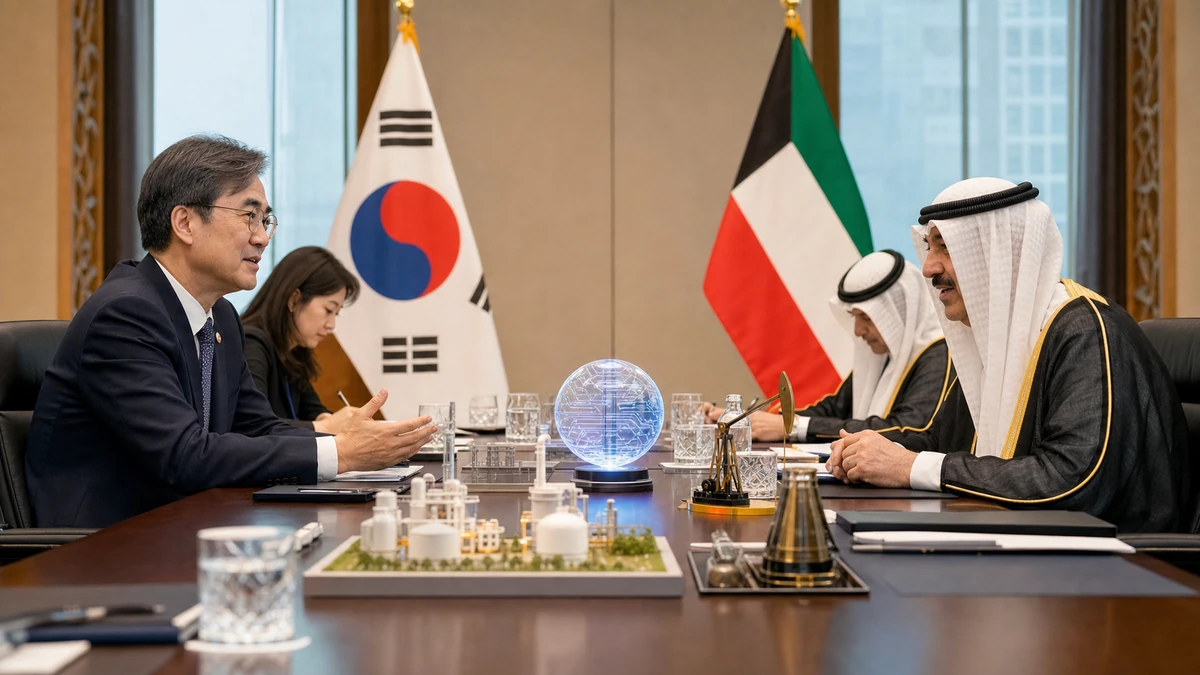
Image to help understand the article
A Seoul meeting that was about more than barrels of oil
When South Korean Foreign Minister Cho Hyun sat down in Seoul with Kuwaiti Foreign Minister Sheikh Jarrah Jaber Al-Ahmad Al-Sabah on Friday, the headline topic was easy to guess: energy. Kuwait is one of the Middle East’s major oil exporters, South Korea is one of Asia’s most energy-dependent industrial economies, and the region is navigating another period of geopolitical strain as the war involving Iran drags on. In that setting, any conversation between a producer and a major importer carries obvious weight.
But the significance of the meeting lies in what came after the familiar energy discussion. According to the South Korean government’s account, the two sides also discussed infrastructure cooperation, urban development and investment in artificial intelligence. No new blockbuster contract was announced. No specific dollar figure or timetable was made public. Even so, the agenda itself matters. It shows South Korea trying to move its relationship with Kuwait beyond the old model of seller and buyer — crude oil shipped one way, money sent the other — toward a more layered partnership that combines energy security, state-backed infrastructure cooperation and a foothold in emerging technology.
For American readers, the best comparison may be how Washington increasingly talks about economic security rather than just trade. In the U.S., energy, semiconductor supply chains, critical minerals, port infrastructure and AI are no longer treated as separate silos. They are all part of the same national conversation about resilience and strategic competition. South Korea appears to be making a similar calculation in the Gulf: if instability in the Middle East threatens energy supplies, then the answer is not merely to buy oil, but to deepen relationships across multiple sectors so that diplomatic ties are harder to disrupt and more valuable to both sides.
That is why this meeting deserves attention beyond Korea-watchers or oil traders. It offers a snapshot of how a U.S. ally in Asia is adjusting to a world where energy insecurity, regional conflict and the race for next-generation industries increasingly overlap. It also shows how Gulf states, long viewed in much of the West primarily through the lens of hydrocarbons, are being courted as broader economic partners in a period when AI, data infrastructure and state-directed investment are reshaping global commerce.
Why strategic oil stockpiles matter more than ordinary energy trade
One of the most consequential parts of the talks involved strategic petroleum reserves, or what South Korea described as expanding the scale of strategic oil stockpiling cooperation. That may sound technical, but it points to a deeper level of trust than a routine supply agreement. A strategic stockpile is not simply about buying crude when prices are favorable. It is about building a cushion for emergencies — wars, shipping disruptions, sanctions shocks or sudden supply shortages — so that a country can keep its economy running when markets seize up.
Americans are familiar with this concept through the U.S. Strategic Petroleum Reserve, a government-controlled emergency supply designed to blunt the effect of severe disruptions. South Korea, which lacks meaningful domestic oil production and relies heavily on imports, has long had strong incentives to think this way. Its vulnerability is structural. A manufacturing powerhouse that produces cars, ships, batteries, semiconductors and petrochemicals cannot afford a prolonged energy shock.
That is what gives the Kuwait talks particular urgency now. The South Korean side emphasized the need to continue strategic energy cooperation as uncertainty in the Middle East grows. In plain terms, Seoul is trying to make sure that even if regional tensions worsen, its channels with a trusted supplier remain intact and credible. It is also signaling that energy diplomacy today is not just about price or volume. It is about continuity under stress.
Kuwait has reasons to welcome that framing. For producers, dependable long-term demand from industrial economies remains valuable, especially at a time when global energy markets are being pulled in multiple directions by decarbonization goals, geopolitical rivalry and short-term supply volatility. A relationship that includes strategic stockpiling, not just spot purchases, can anchor demand and strengthen political ties.
Still, it is important not to overstate what happened. The two governments did not announce a specific expansion amount, storage arrangement or implementation schedule. What emerged from the meeting was a signal, not a finalized mechanism. But in diplomacy, signals matter. At a moment of heightened regional risk, South Korea chose to publicly underline strategic oil cooperation with Kuwait. That alone tells you what Seoul sees as the priority: reducing uncertainty not through dramatic gestures, but through quiet, practical state-to-state coordination.
Infrastructure is the second pillar of South Korea’s Gulf playbook
Energy was not the only major item on the table. Cho also asked for Kuwait’s continued interest and support so South Korean companies can keep participating in the country’s infrastructure and city development projects. That, too, fits a familiar but evolving Korean model.
South Korea is one of the world’s classic export-driven economies, but its global footprint has never been limited to consumer brands like Samsung, Hyundai or LG. Korean firms have long been major players in overseas construction, engineering, shipbuilding and industrial plant projects, including in the Middle East. For decades, Gulf markets have offered Korean companies opportunities in refineries, roads, housing, ports and large-scale public works. Those projects are not just corporate deals. They often sit at the intersection of diplomacy, development strategy and state support.
That helps explain why infrastructure came up in a foreign ministers’ meeting rather than being left entirely to business executives. Mega-projects in urban development and public infrastructure often depend on government-level communication, regulatory clarity and political confidence as much as they do on price bids or technical capacity. When a foreign minister directly raises the continued participation of national firms, it shows diplomacy functioning as commercial scaffolding — not choosing winners, but trying to keep the door open for them.
There is also a larger strategic logic here. If South Korea’s relationship with Kuwait rests only on imported oil, it remains vulnerable to swings in price, politics and global energy transitions. If it expands into infrastructure and urban development, the relationship gains a second pillar. Kuwait gets access to Korean engineering know-how and project execution experience. South Korea gains commercial opportunities and a reason for the relationship to persist even as energy markets change.
For Americans, a loose analogy might be how U.S. relationships in the Gulf increasingly involve defense, logistics, digital infrastructure and finance alongside energy. Modern partnerships are sticky when they are diversified. They become more resilient because each side has more to lose from disruption and more to gain from continuity.
Again, there were limits. No new project award was announced, and the public summary did not identify participating firms or contract values. That means this was not a ribbon-cutting moment. It was more like a strategic tune-up — an effort to ensure that political backing exists for future commercial follow-through. In a volatile region, that may be exactly the kind of patient groundwork governments believe they need.
Why AI showed up in a Gulf energy meeting
The most revealing part of the agenda may have been the least expected: investment in artificial intelligence. On the surface, AI can seem disconnected from a conversation centered on oil reserves and urban development. In reality, its inclusion says a great deal about how both South Korea and Gulf states are trying to define the next phase of their economic relationships.
For South Korea, AI is not a buzzword appended to every diplomatic communique for style points. It is tied to the country’s long-term growth strategy. Korea’s economy is deeply integrated into advanced manufacturing, electronics, telecom and digital services. As global competition intensifies in chips, cloud computing, automation and data-driven industry, Seoul has every incentive to make AI part of its foreign economic agenda.
For Kuwait and other Gulf states, AI investment discussions reflect a broader regional effort to think beyond oil. While hydrocarbons remain central to public finances and geopolitical leverage, many governments in the Gulf have spent years trying to diversify into logistics, finance, smart cities and digital industries. AI fits naturally into that ambition because it sits at the center of modern efforts to improve state services, optimize energy systems, build high-tech ecosystems and attract global capital.
That is why the combination discussed in Seoul makes sense: energy for stability, infrastructure for physical development, AI for future growth. They are not separate boxes so much as a sequence. Energy keeps economies running. Infrastructure shapes where people and industry live and work. AI is increasingly the layer that promises efficiency, automation and new forms of value on top of both.
At the same time, readers should be careful not to read too much into a single line item. The two governments did not disclose a specific AI fund, joint venture, research center or investment package. What this meeting shows is not that a major AI deal has already been born, but that the diplomatic vocabulary between South Korea and Kuwait is changing. A relationship once defined largely by commodity exchange is now being described in the language of next-generation investment.
That matters because it reflects a broader global pattern. Governments are increasingly treating AI not merely as a private-sector innovation race, but as a subject of statecraft. Just as countries once used diplomacy to open markets for heavy industry, aviation or telecom, they are now using it to explore where capital, talent and policy alignment can intersect in AI. South Korea’s outreach to Kuwait suggests that even traditional energy relationships are being reimagined through that lens.
What this means for the United States
For the United States, the Seoul meeting is worth watching for at least three reasons: energy market stability, commercial competition and the changing geometry of U.S.-allied diplomacy in the Middle East.
First, the energy piece is not somebody else’s story. The United States is far less import-dependent than South Korea thanks to its own oil and gas production, but global oil prices are still global. When instability in the Middle East threatens supply routes or rattles market psychology, American consumers can feel it at the gas pump regardless of how much crude is pumped in Texas or North Dakota. If South Korea is reinforcing ties with a key supplier like Kuwait to reduce disruption risk, that contributes — at least marginally — to broader market confidence that matters in the U.S. as well.
Second, American companies should pay attention to the infrastructure and AI dimensions. South Korean firms are already formidable competitors in global engineering, construction, electronics, batteries and digital hardware. In markets where Gulf governments are looking for partners who can combine state support, technology and delivery capacity, Korean companies often punch above their size. U.S. firms, depending on the sector, may find themselves competing with Korean players, partnering with them, or both.
That dynamic is familiar in other industries. In electric vehicles, semiconductors and shipbuilding, the U.S. and South Korea can be allies and rivals at the same time — security partners under one framework, commercial competitors under another. Something similar could emerge in Gulf infrastructure or AI-related investment. American technology companies, cloud providers and engineering firms may see opportunities in the same markets that Seoul is cultivating diplomatically.
Third, the meeting is a reminder that U.S. allies are building their own multi-sector strategies in the Middle East rather than waiting for Washington to define every lane. That is not a sign of drift from the United States. If anything, it reflects the reality of burden-sharing in a messy world. South Korea has direct energy vulnerabilities and clear corporate interests in the region, so it is acting accordingly. From a U.S. perspective, an ally that is more capable of managing its own economic exposure can be an asset.
There is also a subtler lesson here for American policymakers. In Washington, the Middle East is often debated through security crises, troop deployments and great-power competition. But many countries engage the region through a more practical mix of energy security, commercial access and technological investment. South Korea’s approach to Kuwait is a case study in that kind of pragmatic diplomacy. It is not headline-grabbing, but it may be increasingly relevant in a period when middle powers are trying to insulate themselves from geopolitical shocks without choosing dramatic sides.
For American audiences, especially those interested in Korea mostly through K-pop, Korean film or consumer tech, this is a reminder that South Korea’s global rise is not just cultural. It is diplomatic, industrial and strategic. The same country that exports BTS, Oscar-winning cinema and memory chips is also building a sophisticated foreign economic policy that stretches from Washington to the Gulf.
A sign of South Korea’s practical diplomacy in a riskier Middle East
The larger takeaway from the Seoul meeting is not that South Korea and Kuwait suddenly transformed their relationship overnight. It is that South Korea is steadily building a more practical, diversified framework for dealing with Middle Eastern partners at a time of mounting uncertainty.
The Iran war and the broader instability surrounding it heighten the stakes. When regional conflict drags on, the cost of treating diplomacy as episodic grows higher. Countries that depend on imported energy need durable communication channels, trusted partners and contingency plans. South Korea appears to be responding not with a single dramatic announcement, but with a strategy of layering: maintain strategic energy cooperation, reinforce access for national firms in infrastructure, and begin discussing future-oriented sectors like AI before they become urgent.
That is what makes this feel more like a trend than a one-day event. The meeting reflects a broader shift in how Seoul approaches the Middle East. It is no longer enough to preserve relations centered on resource trade alone. The new goal seems to be a more complex structure in which state diplomacy supports corporate participation, economic security and long-term investment themes simultaneously.
That approach is especially sensible for a country like South Korea. It is highly globalized, export-dependent, technologically advanced and acutely exposed to supply-chain disruption. In such an economy, foreign policy cannot be neatly separated into security on one side and economics on the other. Oil supply, urban contracts, AI investment and regional conflict all sit in the same policy ecosystem.
There is a restraint to this diplomacy that is also worth noting. Seoul did not oversell the outcome. Officials did not pretend that exploratory discussions were signed deals. In an era when governments often package routine meetings as breakthroughs, the more modest framing is useful. It leaves open the possibility of substantive follow-up while acknowledging that diplomacy often works through incremental trust-building rather than instant deliverables.
What to watch next is straightforward. If strategic oil stockpiling cooperation is truly expanding, future statements may provide more detail about scale or implementation. If infrastructure cooperation is moving beyond general support, project names, contractors or sector targets may surface. And if AI becomes more than a talking point, there should eventually be signs of institutional follow-up — investment frameworks, corporate meetings, pilot programs or research partnerships.
Until then, the importance of the Seoul talks lies in the map they sketch. South Korea wants its relationship with Kuwait to run on three tracks at once: secure energy today, business opportunities in the built environment tomorrow, and a foothold in the technologies shaping the next decade. For Kuwait, the appeal is equally clear: preserve its role as a reliable energy partner while widening the economic relationship with one of Asia’s most sophisticated industrial democracies.
For the U.S., that is a development worth understanding. It illustrates how allied countries are adapting to a world in which diplomacy is increasingly measured not only by defense commitments or summit communiques, but by how effectively governments connect energy resilience, corporate opportunity and technological change. In that sense, the South Korea-Kuwait meeting was not a narrow bilateral footnote. It was a small but telling example of how the global economy is being reorganized under pressure.
What to watch after the headlines fade
If this meeting produces a lasting legacy, it will probably not come from a single agreement but from whether the two governments can translate broad alignment into concrete follow-up. That is often how important diplomatic shifts work: first the vocabulary changes, then the bureaucracy mobilizes, and only later do specific deals emerge.
In the near term, the most likely test is whether Seoul can maintain stable energy coordination with Kuwait as Middle Eastern uncertainty continues. That may not be dramatic enough to dominate cable news, but for an import-dependent economy, quiet stability can be more valuable than flashy announcements. The second test is commercial. Korean companies will be looking for evidence that diplomatic support can translate into sustained participation in infrastructure and city development work. The third test is whether AI remains aspirational language or becomes a practical area of capital deployment and policy coordination.
That combination of patience and ambition increasingly defines middle-power diplomacy. South Korea is not trying to replace the United States in the Gulf, nor is it pretending energy can be separated from regional politics. Instead, it is doing something more realistic: strengthening ties with a key partner while broadening the relationship enough to make it more resilient.
In a global climate where supply chains are fragile, wars can redraw commercial assumptions overnight, and AI is becoming part of every government’s growth narrative, that may be the most sensible kind of foreign policy available. South Korea’s meeting with Kuwait shows what that looks like in practice: not just securing oil, but trying to build a relationship that can survive the next shock and still matter after it.
Comments
Post a Comment