Image to help understand the article
South Korea’s latest robotics move is about factories, not futuristic demos
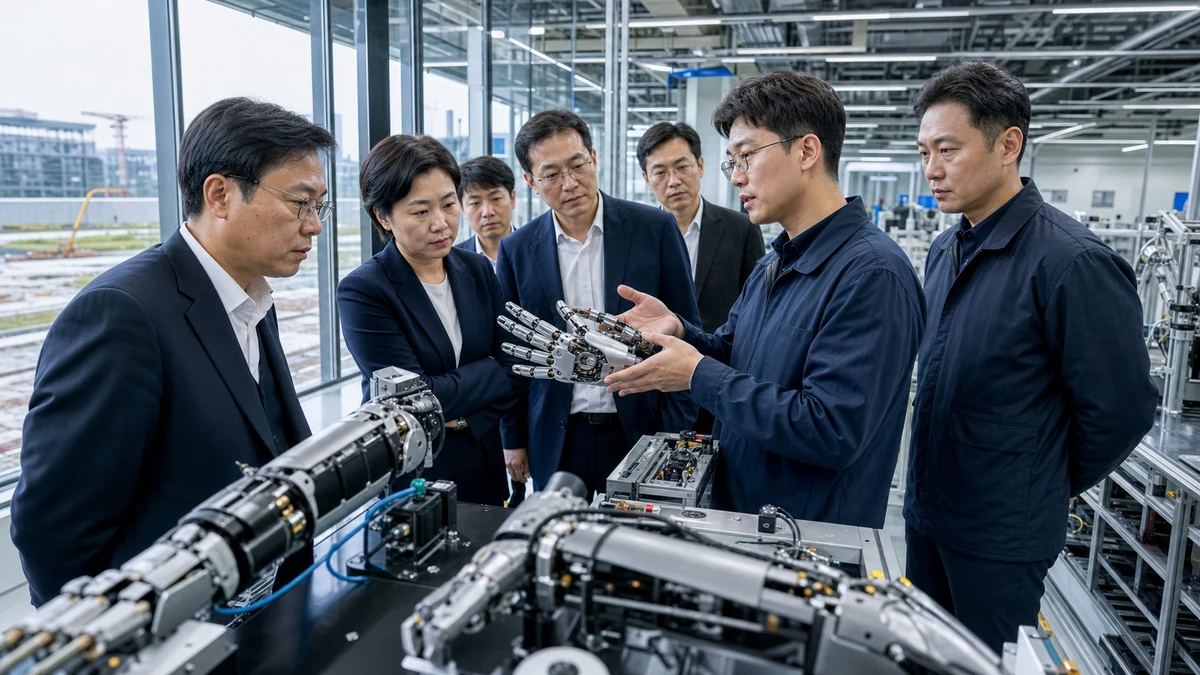
South Korea has approved the equivalent of about $255 million in support for a humanoid robot production project led by Wonik Robotics, a Korean robotics company, marking a notable shift in how the country is trying to compete in one of technology’s most closely watched races. The funding, approved by the committee overseeing the government-backed National Growth Fund, is intended for the construction of a robot-hand manufacturing plant and an artificial intelligence transition center in North Jeolla Province, according to the Korean news agency Yonhap.
That may sound technical, even obscure, compared with the flashier headlines that usually accompany humanoid robots. Public attention tends to focus on machines that walk, wave, or perform staged warehouse tasks in carefully controlled settings. But the Korean decision is significant precisely because it is less theatrical. It signals that South Korea is putting real money not just into proving that a humanoid can work, but into building the industrial base required to make such systems repeatedly, at scale, and with enough consistency to move beyond prototypes.
In practical terms, the distinction matters. A single impressive robot shown onstage or in a laboratory is one thing. A repeatable manufacturing system that can produce critical components, integrate AI functions and eventually support commercial deployment is something else entirely. The Korean government’s support appears aimed squarely at that second problem.
For readers in the United States, the development fits into a broader global pattern. Around the world, the race in advanced robotics is increasingly becoming less about who can post the most viral demo and more about who can connect software, precision parts, manufacturing discipline and capital. South Korea, long known for its strengths in semiconductors, electronics, batteries and industrial manufacturing, is now trying to apply that same model to humanoid robotics.
The news also offers a useful window into how Seoul sees the next phase of technological competition. Rather than treating robotics as a purely research-driven field, officials are backing physical infrastructure — the kind of long-term investment that is often less glamorous than venture capital hype but more important in determining which technologies survive the leap from experiment to industry.
Why robot hands — and an AI center — matter more than they may seem
The most revealing detail in the Korean plan may be the emphasis on robot hands. In the popular imagination, humanoid robots are often defined by walking, balance or humanlike appearance. But in industrial and service settings, the real value of a humanoid often depends on manipulation: picking up objects, sorting materials, handling tools and interacting safely with varied environments. In other words, a robot that can move but cannot reliably grasp and manipulate is far less useful than headlines might suggest.
That is why the planned robot-hand production plant deserves attention. Hands are not simply accessories in humanoid systems. They are among the most technically difficult and commercially consequential components, requiring precision mechanics, sensor integration, durable materials and fine motor control. A robot hand is where the promise of “humanlike” labor often either becomes practical or falls apart.
By pairing that factory with an AI transition center, the Korean project appears to acknowledge another reality of robotics: hardware and intelligence can no longer be treated as separate lanes. A robot is not just a body plus software added later. To function outside a controlled demo, the machine’s sensors, actuators, control stack and AI systems must be developed and refined together. The Korean summary does not provide detailed operational plans for the center, and it would be premature to infer too much about its exact role. But the structure of the investment suggests an effort to link manufacturing and intelligent control in a single industrial framework.
That is an important strategic point. Much of the global AI conversation, especially in the United States, has focused on digital products: chatbots, search, cloud tools and enterprise software. South Korea’s move highlights the harder, slower question now emerging behind the AI boom: who will turn algorithmic intelligence into reliable physical systems? Building that bridge is far more complicated than deploying an app. It involves supply chains, calibration, testing, component tolerances and the messy realities of machines operating in the real world.
In that sense, the Korean project is not just about robotics. It is about a larger industrial thesis — that the countries with the best chance of winning in embodied AI may be those that already know how to manufacture sophisticated products at scale.
From prototype competition to production competition
The clearest takeaway from the decision is that South Korea appears to believe humanoid robotics has entered a new stage. The Korean article frames the development as a move from “prototype competition” to “production system competition,” and that is a useful way for American readers to understand what is happening.
For the past several years, the humanoid field has been driven largely by demonstrations. Companies around the world have shown robots walking, navigating, carrying boxes or carrying out limited task sequences. Those demonstrations matter, especially because they help prove whether locomotion, control systems and AI integration are improving. But they do not answer the manufacturing question. Can the company build many units? Can it source the parts? Can it maintain quality? Can it lower costs enough for actual buyers to adopt the machines?
South Korea’s support for Wonik Robotics does not answer those questions yet. The available information does not include production targets, launch dates, expected customers or sales forecasts. It would be inaccurate to treat the announcement as proof that commercial success is imminent. But it does suggest that Korean policymakers now see manufacturing readiness as the central bottleneck worth funding.
That mirrors the path seen in other industries. In electric vehicles, for example, the early stage centered on proving the concept and winning attention. The next stage centered on factories, battery supply chains and quality control. In semiconductors, too, the decisive edge rarely comes from ideas alone; it comes from the costly, highly specialized infrastructure needed to make chips repeatedly and at exacting standards. Robotics may be heading in the same direction.
The Korean case is especially notable because of where the money is being directed. Rather than broadly supporting robotics research in the abstract, the funding is tied to facilities: a manufacturing plant and a center meant to support AI transition. That makes this less a science-policy story than an industrial-policy story. It reflects a government-backed attempt to build the missing middle between laboratory advances and commercial deployment.
For a country like South Korea, that approach has a certain logic. Korea’s economic strength has long rested on turning technical capability into production muscle. The nation’s best-known global companies did not become competitive merely because they had strong engineers. They became global players because they paired engineering with manufacturing, scale, export discipline and highly organized supply networks. The question now is whether that playbook can be adapted to humanoids.
What this means for the United States
For the United States, the Korean move matters for at least three reasons: competition, partnership and market signaling.
First, it sharpens the competitive picture. American companies have been among the most visible players in advanced robotics and AI, and the U.S. remains a center of software innovation, venture capital and high-end research. But the Korean decision is a reminder that the global humanoid race will not be won on software branding alone. It will also depend on who can build precision components, iterate manufacturing processes and create dependable production infrastructure. That is an area where East Asian manufacturing powers, including South Korea, have structural advantages.
Second, the move may create future openings for partnership with U.S. companies. American firms across logistics, industrial automation, semiconductors, automotive manufacturing and AI infrastructure all have reasons to watch how Korean robotics capacity develops. If Korean companies become stronger in components such as robotic hands or in hardware-AI integration, U.S. companies could wind up as collaborators, customers, rivals or all three at once. That pattern would not be unusual. The U.S.-Korea economic relationship already includes a blend of competition and cooperation in chips, batteries, consumer electronics and defense-related technologies.
Third, the decision sends a broader market signal to American investors and policymakers. It suggests that one U.S. ally is treating humanoids not merely as speculative moonshots but as an industrial category worthy of state-backed growth capital. In Washington, industrial policy has returned in a major way through efforts involving semiconductors, clean energy and strategic supply chains. Korea’s robotics investment is a reminder that allied countries are also choosing their next strategic sectors — and that robotics may increasingly join chips and batteries as an area where state support, private capital and national competitiveness overlap.
There is also a cultural dimension for American audiences. South Korea is often discussed in the U.S. through the lens of K-pop, film, streaming hits and beauty brands. Those sectors remain enormously important to Korea’s global image. But this story points to another side of the Korean Wave: a technology and manufacturing ecosystem that is trying to shape the next era of intelligent machines. For Americans who know Korea primarily through cultural exports, the robotics push is a reminder that the country’s global influence is also being built in factories, labs and industrial policy meetings.
As with any emerging field, caution is warranted. The existence of funding does not guarantee commercial success, and many robotics companies worldwide still face difficult questions about cost, safety, practical use cases and deployment timelines. But from an American perspective, the important point is not whether Korea has already solved those problems. It is that Korea is investing in the capacity to try.
A Korean model of tech finance is taking shape
The Wonik Robotics decision was not made in isolation. According to the Korean summary, the National Growth Fund committee approved seven financing cases in the same meeting, including direct investment in the robotics sector and an equity investment tied to a Korean content business. One of the other disclosed cases involved CJ 4DPLEX, the company known internationally for cinema technologies such as 4DX and ScreenX, and support related to global special-format theaters and infrastructure expansion.
At first glance, a humanoid robotics facility and an immersive cinema technology expansion may seem unrelated. But the pairing is revealing. In both cases, the Korean state-backed fund appears to be supporting not just ideas but the physical and commercial systems needed to scale those ideas. In robotics, that means manufacturing facilities and AI-linked infrastructure. In entertainment technology, it means theater formats and global deployment infrastructure.
That reflects a broader Korean approach to growth industries. Rather than assuming innovation ends with invention, policymakers are also focusing on what comes after: production, rollout, facilities, deployment channels and international reach. This is not unique to Korea, but the country has become especially adept at using coordinated industrial support to accelerate sectors where hardware, infrastructure and exports matter.
For American readers, this may sound closer to the logic behind large-scale public support for semiconductor fabs or electric vehicle supply chains than to the startup culture associated with Silicon Valley. Korea’s strategy here is less about celebrating disruption and more about backing the often expensive and unglamorous scaffolding of industrialization.
That could prove consequential in robotics, where the hardest step may be neither the first demo nor the boldest marketing claim, but the conversion of technical potential into a durable manufacturing ecosystem. The Korean summary explicitly emphasizes that government-backed growth financing is moving beyond the “research possibility” of humanoids and into direct support for mass-production foundations. That is a meaningful signal, even without detailed timelines or output numbers.
What to watch next in Korea’s humanoid push
The biggest question now is execution. Announcing support for facilities is easier than building an effective production system, and robotics remains a field where technical and commercial uncertainty is high. The next phase will depend on whether Wonik Robotics can translate this approved funding into an operational manufacturing base that meaningfully links component production and AI-enabled control.
Several markers will be worth watching. One is whether more specifics emerge about production capacity, target markets and deployment schedules. Another is whether Korean robotics companies begin forming clearer relationships with domestic manufacturing giants, suppliers or overseas buyers. A third is whether the AI transition center becomes a practical bridge between software capability and factory output, rather than a broad label attached to an ambitious plan.
It will also matter whether Korea’s robotics policy broadens beyond this case. If additional funding, supplier development, standards work or regional clustering follows, that would suggest Seoul is trying to build a more comprehensive humanoid ecosystem rather than supporting one isolated project. North Jeolla Province’s role is also worth noting. By placing the facilities there, Korea is not just funding technology but locating industrial infrastructure in a specific region, potentially tying robotics development to regional economic strategy.
For American companies and analysts, the larger lesson is straightforward. The next chapter in robotics will likely be defined less by spectacle than by systems: who can manufacture critical components, who can integrate AI into physical hardware, who can maintain quality at scale and who can secure enough patient capital to survive the long road from prototype to product.
South Korea’s latest move does not prove it will dominate humanoids. It does show that the country understands what the next bottleneck looks like. In a field full of dazzling videos and oversized claims, that may be the most serious signal of all.
And for the United States, that signal is worth hearing clearly. America’s lead in software, research and capital remains formidable. But allies and competitors alike are investing in the industrial base that could determine how embodied AI actually reaches the market. Korea’s bet on robot hands, AI-linked infrastructure and manufacturing readiness may not generate the same viral attention as a robot walking across a stage. In the long run, it could matter more.
Comments
Post a Comment